


Key Points and Summary – The Boeing EA-18G Growler is the undisputed king of electronic warfare, a machine designed to dominate the invisible battlefield of the electromagnetic spectrum.
-Born from a crisis to replace the aging EA-6B Prowler, the Growler combines the combat-proven, supersonic airframe of an F/A-18F Super Hornet with a sophisticated suite of jamming pods and sensors.
-Its mission is to blind and deafen enemy air defenses, creating safe corridors for strike aircraft. With a dominant combat record from Libya to Syria, where it even learned to jam IEDs, the Growler is the indispensable guardian of American airpower.
The EA-18G Growler Is the King of Electronic Warfare
In the complex theater of modern air combat, the most decisive battles are often fought in a domain you cannot see, hear, or touch. This is the war for the electromagnetic spectrum—an invisible battlefield of radar waves, communication signals, and data links where victory and defeat are determined in milliseconds.
For decades, the United States has dominated this invisible realm, and the undisputed king of that domain is a machine that looks like a fighter but fights with lightning: the Boeing EA-18G Growler.
The Growler is not a traditional instrument of war. It does not carry a massive payload of bombs, nor is it designed to be the fastest or most agile dogfighter. Its purpose is far more insidious and arguably more important.
The EA-18G Growler is a master of electronic attack, a digital ghost capable of blinding enemy radars, deafening their communications, and tearing apart the networked nervous system of a modern military. It is the electronic crowbar that pries open the world’s most formidable air defenses, allowing America’s strike aircraft to fly into the heart of enemy territory and return home safely.
To truly understand the Growler is to understand a fundamental truth of 21st-century warfare. The most sophisticated fighter jet or the stealthiest bomber is rendered useless if it can be seen, tracked, and targeted.
The EA-18G is the weapon that ensures that doesn’t happen. Its story is one of pragmatic evolution, battlefield dominance, and its continued, irreplaceable role as the guardian of America’s airpower.
EA-18G: Born from a Looming Crisis
The origin of the EA-18G Growler is a tale of necessity. By the late 1990s, the U.S. military’s electronic attack community was facing a full-blown crisis. Its workhorse platform, the venerable Grumman EA-6B Prowler, was a legend of the Cold War, but it was an aging one.
Based on the 1960s-era A-6 Intruder airframe, the Prowler was slow, subsonic, and increasingly difficult and expensive to maintain. It could no longer keep pace with the modern strike fighters it was tasked to protect, forcing entire carrier air wings to fly slower, more predictable routes that made them vulnerable.
The problem was compounded by a series of decisions that consolidated the Pentagon’s entire tactical electronic attack mission. The U.S. Air Force had retired its own fleet of EF-111A Raven jamming aircraft, leaving the Navy’s small community of Prowlers as the sole provider of this critical capability for all branches of the military. A replacement was desperately needed, but the post-Cold War budget environment was brutal.
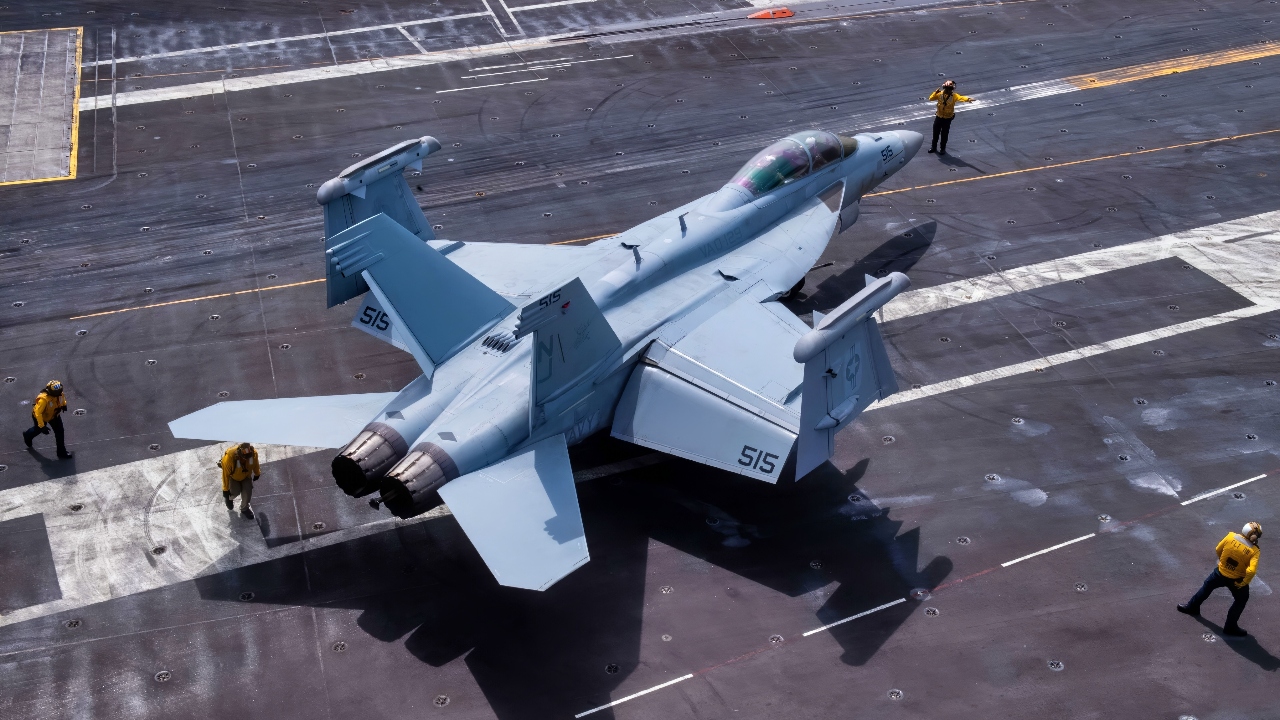
PACIFIC OCEAN (Aug. 11, 2025) – U.S. Navy Sailors direct an E/A-18G Growler, assigned to the “Vikings” of Electronic Attack Squadron (VAQ) 129, on the flight deck of the Nimitz-class aircraft carrier USS Theodore Roosevelt (CVN 71), Aug. 11, 2025. Theodore Roosevelt, flagship of Carrier Strike Group (CSG) 9, is underway conducting exercises to bolster strike group readiness and capability in the U.S. 3rd Fleet area of operations. (U.S. Navy photo by Mass Communication Specialist Seaman Apprentice Cesar Nungaray)
A brand-new, clean-sheet design was deemed too risky and astronomically expensive.
The solution came from a stroke of pragmatic genius. The Navy and its industry partners proposed not to invent a new aircraft, but to adapt the most successful and reliable airframe already on the carrier deck: the F/A-18F Super Hornet. This was a brilliant move.
By using the two-seat Super Hornet as the foundation, the Navy could leverage an existing, high-performance, supersonic airframe with a mature supply chain and a deep pool of trained pilots and maintainers.
It dramatically reduced development costs, simplified logistics, and ensured the new electronic attack jet could not only keep up with the strike packages it was protecting but could also defend itself—a luxury the Prowler never had. The result was the EA-18G Growler, a machine that married the combat-proven brawn of a Super Hornet with the sophisticated electronic brain of a dedicated jamming platform.
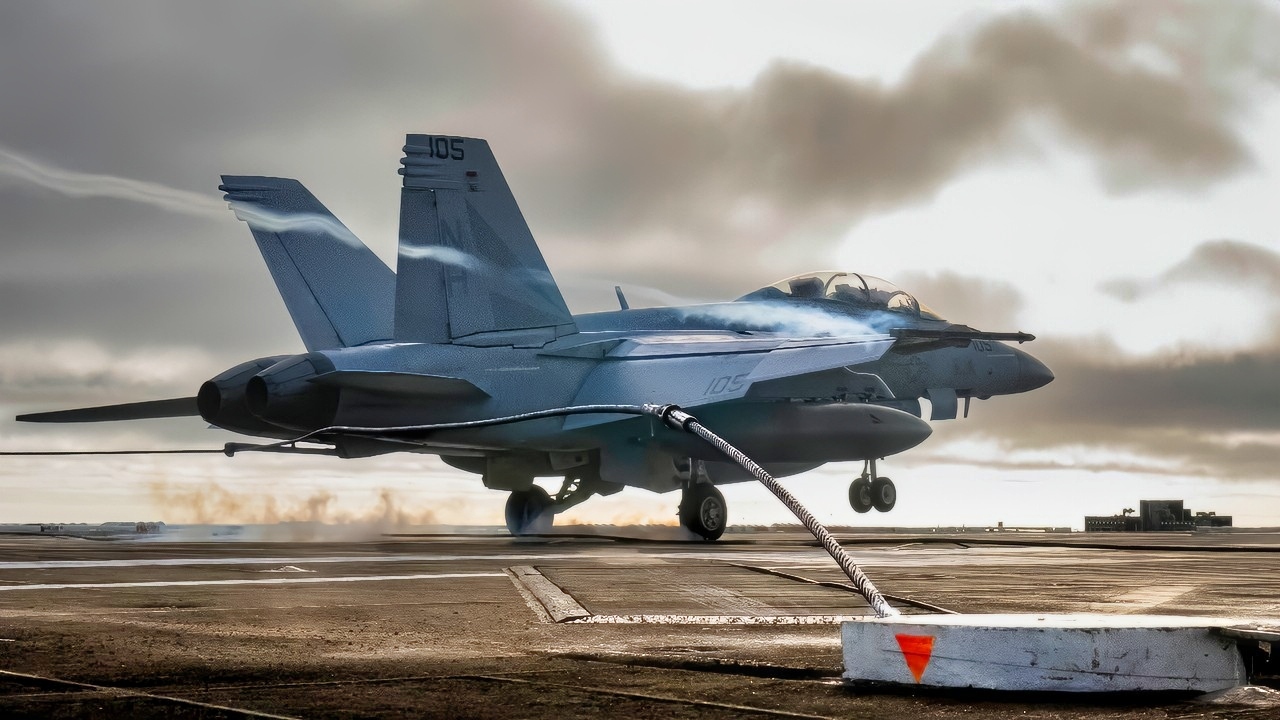
A U.S. Navy F/A-18F Super Hornet, assigned to the “Black Knights” of Strike Fighter Squadron (VFA) 154, lands on the flight deck of Nimitz-class aircraft carrier USS Theodore Roosevelt (CVN 71), July 24, 2025. Theodore Roosevelt, flagship of Carrier Strike Group (CSG) 9, is underway conducting exercises to bolster strike group readiness and capability in the U.S. 3rd Fleet area of operations. (U.S. Navy photo by Mass Communication Specialist 3rd Class Aaron Haro Gonzalez)
The Arsenal of the Electronic Ghost
What makes the EA-18 Growler a master of its craft is not the airframe, but the suite of highly advanced electronic systems it carries into battle. Its most visible and iconic weapons are the pods slung under its wings.
For years, this was the AN/ALQ-99 Tactical Jamming System, the powerful heart of the Prowler, adapted for a new host. These pods contain powerful transmitters designed to broadcast a torrent of disruptive electronic noise, capable of overwhelming and deceiving enemy radar systems, from ground-based missile batteries to airborne interceptors.
However, the true revolution in the Growler lies in how it integrates its own systems. Unlike the Prowler, which was a collection of federated systems, the Growler’s electronic warfare suite is woven into its very soul.
The ALQ-218 Tactical Jamming Receiver System acts as the aircraft’s incredibly sensitive ears, capable of detecting, identifying, and precisely locating a vast array of electronic emissions. This system allows the Growler to build a detailed, real-time map of the enemy’s electronic order of battle.
This information is then fused with the aircraft’s AN/APG-79 AESA radar. While the Super Hornet uses this radar to find and target enemy aircraft, the Growler’s AESA is a multi-tool. It can be used as an incredibly precise sensor to further refine the location of enemy emitters, but it can also be turned into a weapon itself, using its powerful, focused beams of energy to conduct highly targeted electronic attacks.
This entire suite is managed by the Electronic Attack Unit (EAU), which automates the process of threat detection and jamming, allowing the Electronic Warfare Officer in the back seat to manage the complex electromagnetic battle.
And unlike its predecessor, the Growler doesn’t need to be coddled. It is still a Hornet. It carries AIM-120 AMRAAM missiles for self-defense, freeing up other fighters from escort duty and making it a far more survivable and flexible asset.
Trial by Fire: A Dominant Combat Record
The Growler did not have to wait long to prove its worth. It was rushed into service and immediately thrown into the fire during the opening days of Operation Odyssey Dawn, the 2011 NATO intervention in Libya. This was the ultimate test. Muammar Gaddafi’s regime possessed a dense and relatively modern integrated air defense system, and the Growler was tasked with kicking down the door.
Flying the “first in, last out” missions, the Growlers led the way, suppressing Libyan air defense radars and creating safe corridors for the strike aircraft that followed. Their performance was flawless. Not a single coalition aircraft was lost to Libyan air defenses during the campaign, a success that was directly attributable to the electronic umbrella provided by the Growler fleet.
It was a stunning debut that cemented the aircraft’s reputation as an indispensable asset.
The Growler’s story continued in the skies over Iraq and Syria during Operation Inherent Resolve. Here, it demonstrated its incredible versatility. While it continued its primary mission of protecting coalition aircraft from Syrian air defenses, it also adapted to the unconventional nature of the fight against ISIS.
Growler crews developed tactics to jam the terrorists’ crude communication networks, disrupting their command and control. In one of the most innovative uses of electronic warfare, they even learned to use their jamming pods to remotely trigger the radio-controlled improvised explosive devices (IEDs) that were a constant threat to ground troops. The Growler had evolved from a high-end radar killer to a multi-role electronic warrior.
The Future: EA-18G as the Quarterback of the Networked War
The age of the Growler is far from over. In fact, its importance is only growing as the world returns to an era of great power competition. The aircraft is currently in the midst of a massive capability leap with the introduction of the Next Generation Jammer (NGJ) pods.
The NGJ is a generational advance over the 1970s-era ALQ-99, using its own AESA technology to broadcast more powerful, more precise, and more agile jamming signals. This new system is specifically designed to defeat the modern, frequency-agile radars being deployed by near-peer adversaries like China and Russia.
But the future of the Growler is not just about jamming. It is about information. The Growler is arguably the most capable signals intelligence (SIGINT) platform on the carrier deck. It soaks up an immense amount of data about the enemy’s electronic battlefield, processes it, and shares it across the entire naval network. It is the quarterback of the invisible war, providing real-time intelligence that makes every other platform—from F-35s to surface ships to submarines—more lethal and more survivable.
This role as a networked enabler is critical. Stealth aircraft like the F-35 are designed to be low-observable, to evade detection. The Growler complements this perfectly by actively shaping the electromagnetic environment.
It can create diversionary electronic signatures, suppress specific threat radars to create temporary corridors for stealth aircraft, and provide an overarching electronic shield for the entire force. Stealth and electronic attack are not competing philosophies; they are two sides of the same coin, and the Growler is the master of one of them.
Conclusion: The Indispensable Ghost
The EA-18G Growler has evolved from a clever, low-risk solution into the single most critical enabler of American airpower. It is a testament to the idea that an aircraft’s value is not just measured in speed or maneuverability, but in its ability to control the environment in which it fights. In the 21st century, that environment is the electromagnetic spectrum.
The Growler is the machine that allows the United States to project power into the most dangerous places on Earth. It is the ghost that blinds the enemy, the shield that protects the fleet, and the indispensable master of a war that is fought and won in the invisible waves of energy that saturate the modern battlefield.
As long as America’s adversaries rely on radars to see and radios to talk, the Growler will be there to ensure they can do neither.
About the Author: Harry J. Kazianis
Harry J. Kazianis (@Grecianformula) is Editor-In-Chief and President of National Security Journal. He was the former Senior Director of National Security Affairs at the Center for the National Interest (CFTNI), a foreign policy think tank founded by Richard Nixon based in Washington, DC. Harry has over a decade of experience in think tanks and national security publishing. His ideas have been published in the NY Times, The Washington Post, The Wall Street Journal, CNN, and many other outlets worldwide. He has held positions at CSIS, the Heritage Foundation, the University of Nottingham, and several other institutions related to national security research and studies. He is the former Executive Editor of the National Interest and the Diplomat. He holds a Master’s degree focusing on international affairs from Harvard University.
More Military
Russia’s Su-35 Fighter: An F-22 Killer?
The F/A-18 E/F Super Hornet Is a Powerhouse


