

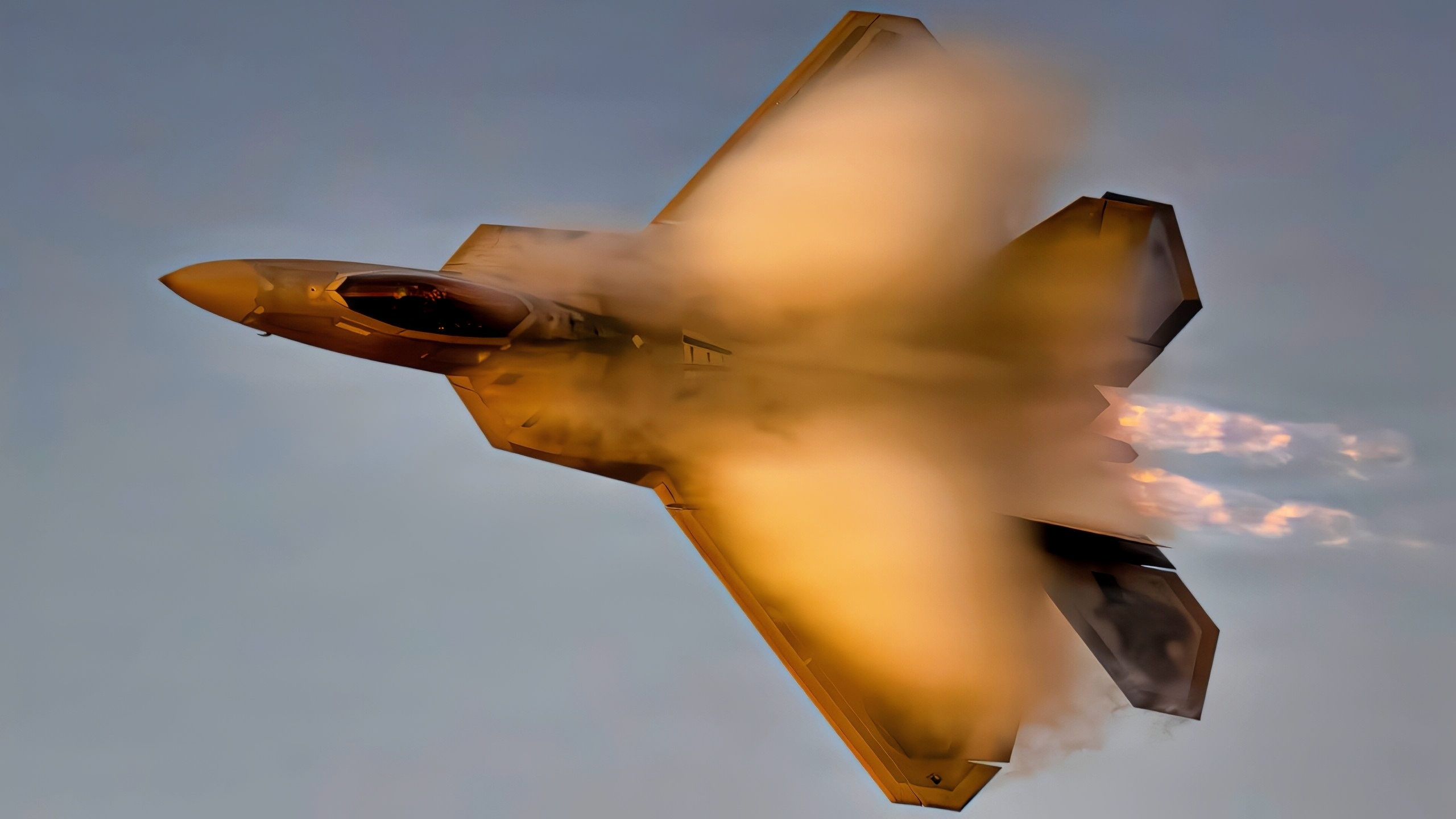
A Philippine FA-50 light fighter reportedly scored a simulated “Fox 2” kill against a U.S. Air Force F-22 Raptor during Exercise Cope Thunder in July 2023. The Philippine Air Force called the simulated win a “historic achievement.” Exercise Cope Thunder was originally launched in 1976 in the Philippines, moved to Alaska as Red Flag Alaska, and returned to the Philippines in 2023. The July 2023 exercise involved approximately 225 personnel and a mix of U.S. and Philippine aircraft.
The F-22 Raptor Was ‘Defeated’
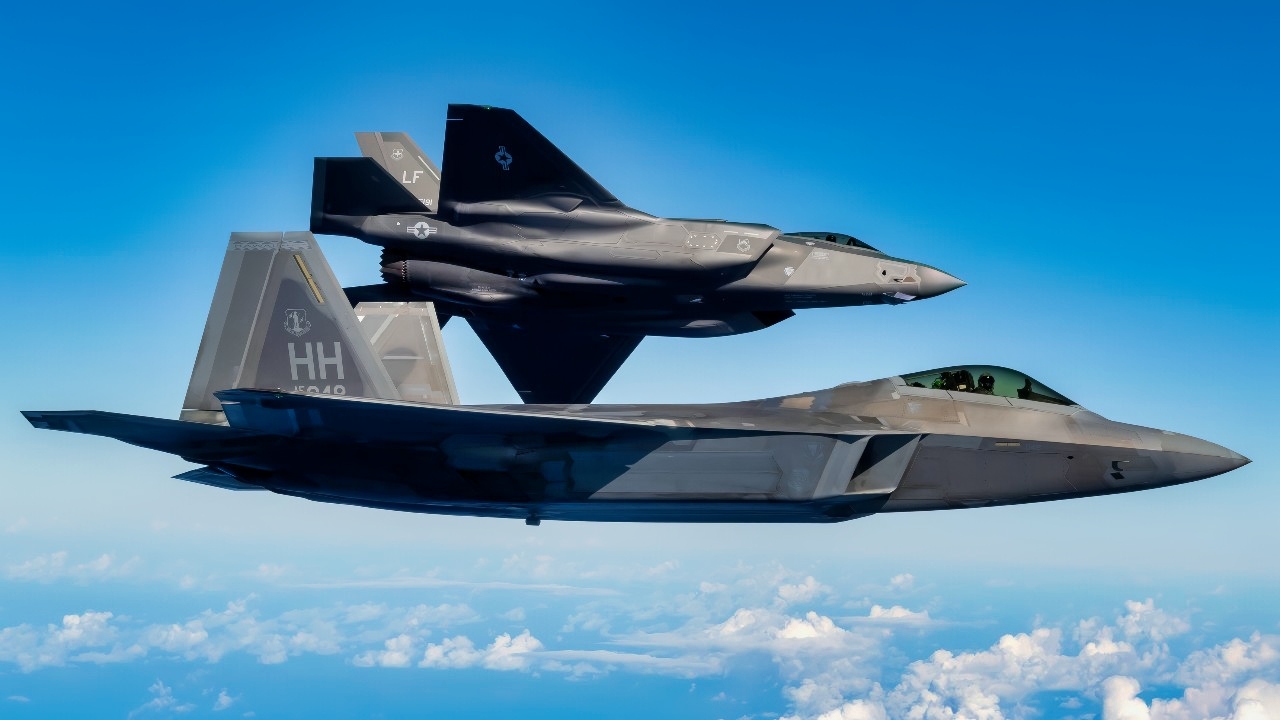
An F-35A Lightning II banks away from an F-22 Raptor Feb. 6, 2020, near the Hawaiian Islands. F-35 Airmen from Luke Air Force Base, Ariz., temporarily relocated to Joint Base Pearl Harbor-Hickam, Hawaii, to join other flying squadrons in exercise Pacific Raptor. Every training mission of the exercise was carried out by total-force teams from the Air Force’s Active, Reserve and Air National Guard components. (courtesy photo)

A U.S. Air Force F-22 Raptor assigned to Joint Base Langley-Eustis, Virginia, takes off during Checkered Flag 23-1 at Tyndall Air Force Base, Florida, Nov. 4, 2022. Checkered Flag is a large-force aerial exercise which fosters readiness and interoperability through the incorporation of 4th and 5th-generation aircraft during air-to-air combat training. The 23-1 iteration of the exercise was held Oct. 31 – Nov. 10, 2022. (U.S. Air Force photo by Tech. Sgt. Betty R. Chevalier)
A few years ago, a Philippine FA-50 light fighter reportedly scored a simulated “Fox 2” kill against a US F-22 Raptor during Exercise Cope Thunder.
The Philippine Air Force journal called the win a “historic achievement,” alluding to the simulated downing of the world’s greatest air superiority fighter.
The encounter raises an obvious question: how does a light fighter defeat the world’s premier air superiority platform?
Here’s what the encounter means—and does not mean.
Exercise Cope Thunder
Originally launched in 1976 in the Philippines, and later moved to Alaska (Red Flag Alaska), the exercise returned to the Philippines in 2023.
The purpose of the exercise was to enhance bilateral US-Philippines interoperability and fighter tactics integration while sending a regional deterrence signal.
The event in question, held in July 2023, involved approximately 225 personnel and a mix of U.S. and Philippine aircraft.
The engagement scenarios were likely tightly controlled in an environment where training objectives mattered more than scoreboards.
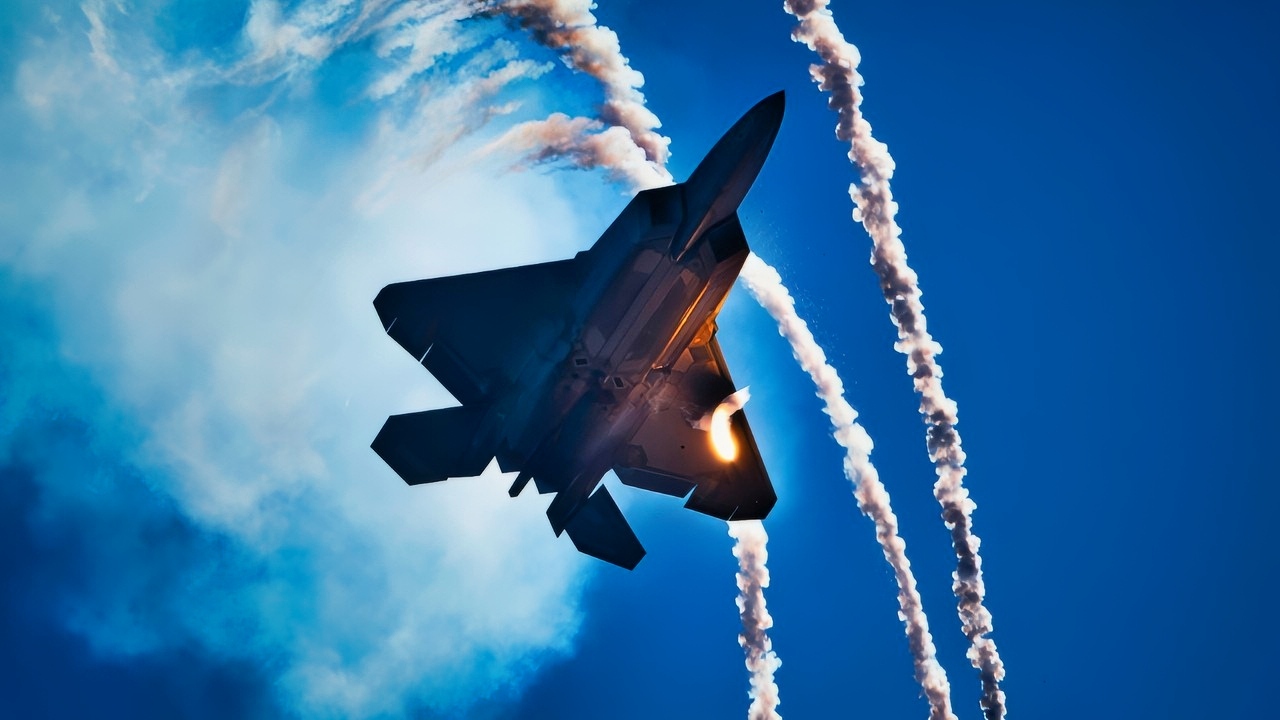
A U.S. Air Force F-22 Raptor, flown by Capt. Samuel “Razz” Larson, F-22 Raptor Demonstration Team pilot, deploys flares over the Gulf of Mexico during the 2024 Gulf Coast Salute Air Show at Panama City Beach, Florida, May 4. The F-22’s unique combination of stealth, speed, agility and situational awareness, combined with lethal long-range air-to-air and air-to-ground weaponry, makes it one of the most advanced fighters in the world. (U.S. Air Force photo by Staff Sgt. Stefan Alvarez)

An F-22 Raptor creates vapor trails during a high-speed maneuver during a training flight at Joint Base Langley-Eustis, Virginia, June 13, 2025. The aircraft’s design allows it to remain highly maneuverable while maintaining low observability. (U.S. Air Force photo by Senior Airman Adisen Smith)
The Aircraft in Question
The F-22 is the world’s best air superiority fighter. The first-ever operational fifth-generation fighter, the F-22 features stealth shaping and coatings, AN/APG-77 AESA radar, supercruise, and thrust vectoring. Designed for first look, first shot, first kill, the F-22 was built to avoid WVR merges whenever possible.
The FA-50PH, derived from the KAI T-50 Golden Eagle, is a supersonic light fighter/trainer.
Equipped with a small radar and lacking stealth shaping, the FA-50 has a limited payload and range compared with the F-22 and operates primarily as a lead-in fighter trainer, light-attack platform, and interceptor for smaller air forces.
On paper, the mismatch between the F-22 and FA-50 is extreme, with the former enjoying a heavy advantage.
Tactical Explanation
The “Fox 2” call indicates an infrared-guided short-range missile (AIM-9) was fired during a within-visual-range (WVR) engagement. In WVR, stealth advantage diminishes, IR signatures matter, and pilot skill and geometry dominate.
Possible factors include scenario constraints limiting F-22 BVR use, ROE specifications, simulated degraded radar conditions, and a training emphasis on defensive setups.
Exercises often intentionally disadvantage advanced aircraft, forcing them into merge scenarios to test pilots’ recovery skills.
The F-22’s core advantage lies in BVR, not knife-fight merges, so equalizing the encounter may have included a forced merge.
Historical Precedent
The F-22’s “loss” was not without precedent. In 2009, a Mirage 2000 scored a “kill” against an F-22. The Rafale has claimed kills against the F-22, including during a recent exercise encounter over Finland.
The German Eurofighter has defeated the F-22 in WVR during Red Flag 2012. And through the various encounters,s a thread has emerged: close-in engagements; constrained scenarios; training environments.
These circumstances degrade the stealth advantage, which is strongest at a distance and less decisive once within the visual envelope. The pattern is consistent and less surprising than it may appear.
Lessons Learned
The tactical takeaway is that modern air combat is BVR-dominant and network-centric. The F-22 ideally shoots before the merge and then disengages. If forced into WVR, thrust vectoring helps, but IR missiles remain lethal.
The FA-50 has advantages in specific contexts, including a smaller profile, high agility at certain speeds, and the potential for surprise. Pilot proficiency is likely a decisive factor post-merger as well.
Strategically, the encounter provided the Philippines with a symbolic morale boost and signaled the growing competence of the Philippine Air Force. This demonstrates increased training realism and interoperability with US forces.
Politically, the event reinforces the U.S.-Philippine alliance and signals regional capabilities amid tensions in the South China Sea. However, the encounter does not imply that the FA-50 is equivalent to the F-22 in real combat. Not even close.
The F-22 remains unmatched in penetration, air dominance, and first-shot advantage. The exercise results only reinforce that no platform is invulnerable and that close-in engagements remain dangerous, no matter what you happen to be flying. For the US, this emphasizes the need to maintain BVR superiority and avoid unnecessary merges.
Viral and Misleading
These viral “kill” moments are easily weaponized in the media and are often misleading if stripped of context. Fifth-generation fighters are designed for networked warfare, not dogfighting or airshows.
Modern air combat outcomes depend on sensors, data links, AWACS, jamming, etc. A single simulated WVR event does not redefine doctrine or reshuffle the aircraft hierarchy.
While the FA-50 “kill” is a training milestone for the Philippines, it does not constitute evidence of technological parity. It only reinforces the complexity of air combat and the importance of scenario context.
The F-22 remains the premier air superiority platform, though sometimes, under the worst-case geometry, that’s not enough.
About the Author: Harrison Kass
Harrison Kass is an attorney and journalist covering national security, technology, and politics. Previously, he was a political staffer and candidate, and a US Air Force pilot selectee. He holds a JD from the University of Oregon and a master’s in global journalism and international relations from NYU.


dog
May 16, 2026 at 6:45 pm
A “simulated defeat’. Who was flying the plane Mickey Mouse? This is a defeat by a programmer not a fighter jet. Hilarious. Who comes up with this BS?