

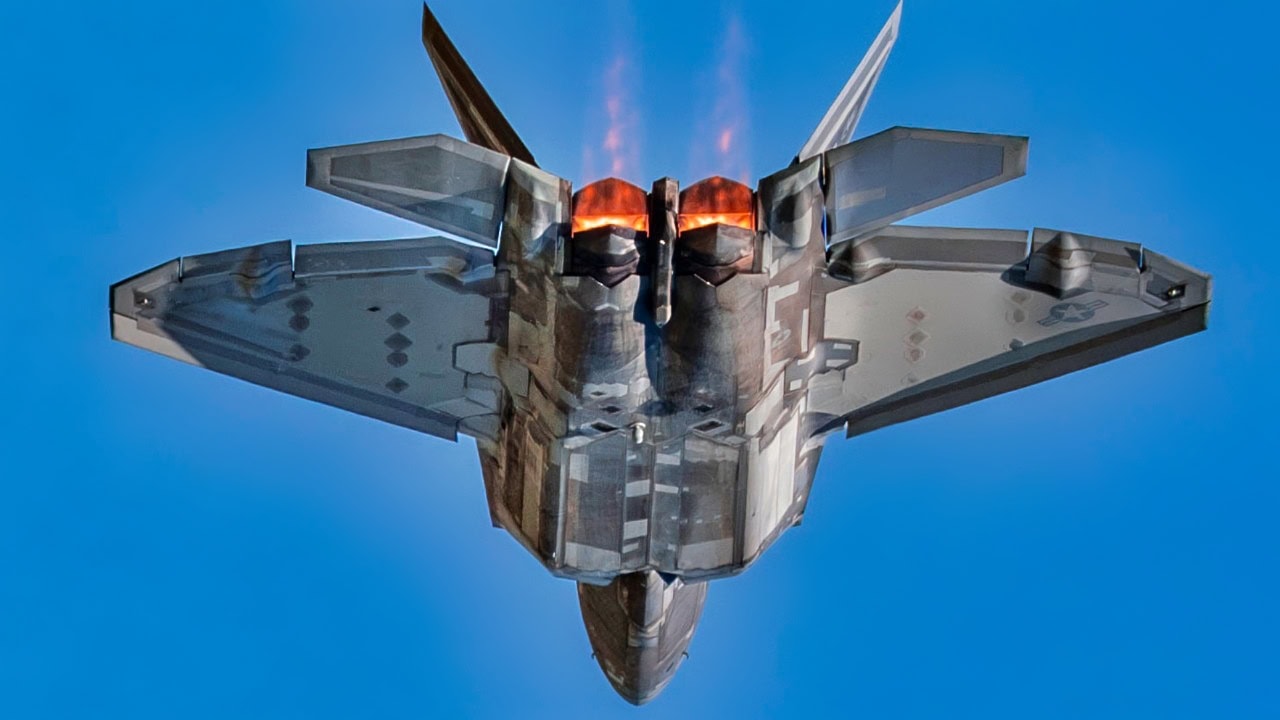
The F-22 Raptor fifth-generation warplane is the most potent in America’s arsenal today. Until the sixth-generation warplanes come online (if they ever do), the F-22 will remain the most powerful plane in the United States Air Force’s fleet. One of the main questions some people online have had over the years about the F-22 has been: if the F-22 is so powerful, why was a navalized version never made? In fact, the Navy did want an aircraft carrier-friendly F-22 Sea Raptor.
There’s just one problem with the Sea Raptor: it wasn’t workable.

Aircraft from the 1st Fighter Wing conducted an Elephant Walk at Langley Air Force Base, Jan. 31, 2025, showcasing the wing’s readiness and operational agility. This demonstration highlighted the wing’s capability to mobilize forces rapidly in high-stress scenarios. The wing’s fleet includes F-22 Raptors and T-38 Talons. As Air Combat Command’s lead wing, the 1 FW maintains unparalleled combat readiness to ensure national defense at a moment’s notice. (U.S. Air Force photo by SrA Ian Sullens)
Carrier aviation is about surviving in a brutal maritime environment where every landing stresses the aircraft to its breaking point. Every single landing. The F-22 dominates the skies from long, prepared runways and enjoys massive logistical support to keep the Raptor flying.
So, trying to fuse the carrier warplane, which struggles through a brutal, corrosive existence, with the exquisite nature of the F-22 was a non-starter.
As the Navy investigated the prospects of the F-22 Sea Raptor, they found that the project would be monstrously expensive–and would likely be an ineffective hybrid of the Air Force’s fifth-generation air superiority warplane and a carrier-based bird.
Aircraft Carrier Landings Are Controlled Violence
The bottom line is that the F-22 is based on Air Force assumptions, not Navy realities. Here’s how brutal an aircraft carrier landing is on a warplane. Naval aviators intentionally slam their aircraft onto the deck at a rapid descent rate. That’s because an aircraft carrier’s flight deck is shorter than landing strips on land.
Plus, a carrier is moving, pitching, rolling, and surrounded by the roiling seas.

F-22 Raptor at USAF Museum. Image Credit: National Security Journal.
So, a Navy bird must go from around 150 miles per hour to zero in only a few hundred feet. To achieve this dangerous goal of landing on a carrier flight deck, Navy planes require massively reinforced landing gear. Because the bird must hit the deck hard and slam to an immediate stop, engineers strengthen the fuselage sections of the planes so they don’t tear themselves apart.
Similarly, navalized planes must have specialized nose gear for catapult launches. Not only do Navy planes smash hard on the deck upon landing, but on takeoff, they must be shot forward at extraordinary speeds–basically, they have to move from zero to 150 miles per hour almost instantly to avoid crashing into the sea upon takeoff.
Why The Arresting Hook Changes Everything
Another structural difference between navalized planes and their Air Force counterparts is the integration of an arresting hook into the plane’s airframe. That’s a key addition that Navy planes require. Without the arresting-hook structures, the landing aircraft would likely slide off the deck upon hitting it.
A high-tension steel cable awaits every landing aircraft on an aircraft carrier. The arresting hook at the bottom of the aircraft catches the cable, which pulls the landing aircraft back with immense force, essentially bringing the plane from 150 mph to zero nearly instantly.
When the Navy wanted the F-22 for carrier flight operation, the Navy’s Advanced Tactical Fighter (NATF-22) studies estimated that a navalized F-22 would need to have its structure dramatically enhanced for 24-foot-per-second arrested-landing sink-rate loads. Thus, the F-22, designed specifically for Air Force operational models, was never intended to withstand that kind of stress.

F-22 Raptor National Security Journal Image
Some have pointed out that the F-22 does have an emergency tailhook. But that tailhook is for Air Force emergency landings. Such landings occur on runways, where energy dissipates over time. A carrier landing, as you’ve just read, is brutally abrupt. An F-22 requires around 1,000 feet to stop when using Air Force land-based arresting systems. On a carrier, though, an aircraft employing an arresting cable hook must stop in around 250-300 feet (or they end up in the drink).
Besides, the hook itself isn’t the issue. It’s the structural changes and reinforcements required to ensure an arresting hook on a navalized plane catches the trap. Such changes to the F-22 would have likely negated the plane’s impressive stealth features.
F-22 Raptor for Aircraft Carriers: The Wing Design Was Fundamentally Wrong
What’s more, NATF-22 determined that the Raptor is for stealth, supersonic cruise, high-altitude combat performance, and energy maneuverability.
But aircraft carrier planes required low-speed control, stable approaches, high lift at low speeds, and amenable handling at near-stall speeds. NATF-22 concluded that the F-22’s wing geometry was fundamentally unsuitable for carrier work without major redesign.
NATF-22 suggested any navalized F-22 would need variable-sweep wings, similar to what the iconic Grumman F-14 Tomcat possessed. That plane would have been quite a sight to behold, for sure. Yet, once you start changing the structure and add swing wings to a stealth warplane, complexity and cost explode while the utility of the craft (as primarily a stealth fighter) implodes.
Saltwater Would Have Been the F-22’s Worst Nightmare
Plus, any carrier-based plane must contend with the corrosion caused by permanent exposure to saltwater. Between the corrosive effects of the surrounding maritime environment, along with the chaotic and cramped environments on aircraft carriers, the F-22–even a navalized one with swing wings–would have likely been poorly suited.

U.S. Air Force Capt. Nick “Laz” Le Tourneau, F-22 Raptor Aerial Demonstration Team commander, performs an aerial maneuver during the Cocoa Beach air show in Florida, July 12, 2025. The F-22 Aerial Demonstration Team highlights cutting-edge airpower, precision, skill, all while reinforcing public confidence in the Air Force’s ability to protect and defend. (U.S. Air Force photo by Staff Sgt. Lauren Cobin)
Stealth aircraft require painstaking maintenance. Trying to maintain delicate stealth coatings aboard aircraft carriers in the 1990s would have been an onerous experience for the Navy, which just wanted a new carrier-friendly warplane.
In fact, one study on a navalized F-22 found that the plane would not fit in existing carrier infrastructure. So, the Navy would have needed to redesign the entire layout of its carriers to better support navalized F-22s. And there was a zero chance that the Navy–or Congress–would support such a drastic change to aircraft carriers to support a warplane.
The “Sea Raptor” Would Have Become a Totally Different Aircraft
The proposed F-22N Sea Raptor would have basically been an entirely new warplane. It would have required larger wings and variable-sweep geometry. This new plane would have needed a larger fuel capacity. Designers would have had to reimagine the cockpit for greater visibility while reinforcing the fuselage and strengthening the landing gear.
Then the designers would have had to introduce entirely new avionics, while making the F-22 more compatible with anti-ship weapons. There’d have been a need for expanded internal weapons bays and drastic modifications to the plane’s radar systems to align with Navy requirements.
At that point, you’re not dealing with a navalized variant of the F-22. You’re dealing with a whole new fifth-generation warplane that is costly, likely not as effective as it should be, and an onerous system to maintain.
Why the U.S. Navy Finally Walked Away
Here’s where it gets dicier. NATF-22 studies repeatedly showed that the F-22N Sea Raptor would have been around 10,000 pounds heavier than the Air Force variant.
More weight on a bird means lower performance, reduced speed, higher maintenance costs, less range, and greater strains on the carrier’s flight deck each time the plane takes off and lands. The Navy understandably shied away from the program.
What the F-22 represented was peak Cold War Air Force strategic concepts. The Raptor embodies the highest quality air superiority imaginable. But to enjoy that quality of air superiority, the bird needs long runways and carefully managed operations. Carrier operations, on the other hand, are about ruggedness, survivability, and adaptability in the most extreme conditions imaginable. These priorities conflict.
That’s why the Navy’s aircraft historically look and behave differently from those of the Air Force, even when they serve similar missions. The F-22 is for one mission set–the Air Force’s mission–to become an effective carrier aircraft.
At least it would have been without a major redesign of the aircraft, negating the concept that it was a navalized variant of the F-22.
Still, it would have been amazing to see what an F-22 with swing-wings, landing on the deck of a carrier, would have looked like.
About the Author: Brandon J. Weichert
Brandon J. Weichert is the Senior National Security Editor at 19FortyFive.com. Recently, Weichert became the editor of the “NatSec Guy” section at Emerald. TV. He was previously the senior national security editor at The National Interest. Weichert hosts The National Security Hour on iHeartRadio, where he discusses national security policy every Wednesday at 8 p.m. Eastern. He hosts a companion show on Rumble entitled “National Security Talk.” Weichert consults regularly with various government institutions and private organizations on geopolitical issues. His writings have appeared in numerous publications, among them Popular Mechanics, National Review, MSN, and The American Spectator. And his books include Winning Space: How America Remains a Superpower, Biohacked: China’s Race to Control Life, and The Shadow War: Iran’s Quest for Supremacy. Weichert’s newest book, A Disaster of Our Own Making: How the West Lost Ukraine, is available for purchase at any bookstore. Follow him via Twitter/X @WeTheBrandon.


