
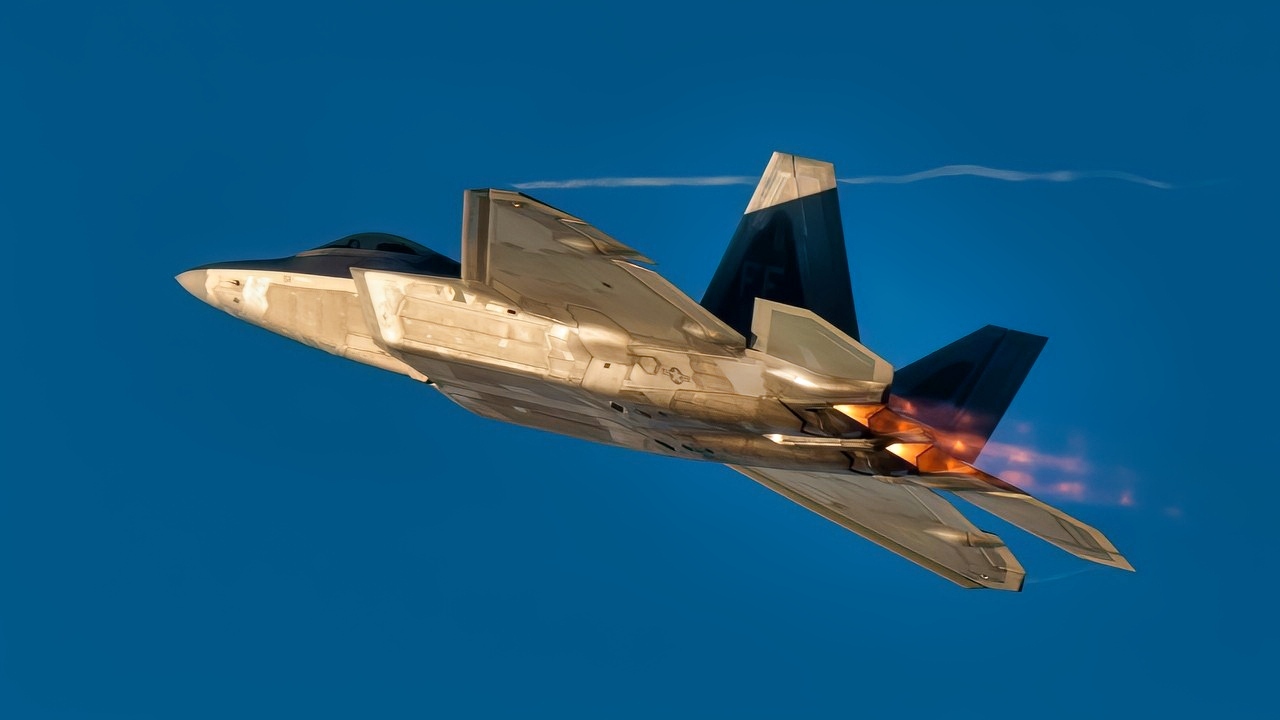
At the Air & Space Forces Association Warfare Symposium in February 2026, Lockheed Martin publicly displayed a production-representative scale model of what it informally calls “Raptor 2.0” — an upgraded F-22 configuration featuring low-observable external fuel tanks and underwing infrared search-and-track (IRST) pods designed to address one of the air superiority fighter’s most persistent constraints: range. The F-22’s combat radius on internal fuel is roughly 590 nautical miles, and existing 600-gallon external drop tanks degrade the aircraft’s radar signature and aerodynamics so severely that pilots must jettison them before entering contested airspace — even then, the underwing fuel lines and pylons leave residual stealth penalties. Lockheed’s new stealth-shaped tanks are designed to remain attached throughout a mission while preserving low observability, adding roughly 850 nautical miles of usable combat radius — a capability gap the Air Force has tacitly acknowledged is increasingly limiting, given that 12 F-22s deployed to U.S. Central Command in February 2026 to support Iran operations have required heavy escort from a tanker fleet now numbering 100+ aircraft regionally.
The F-22 Super Raptor 2.0 Is Coming Soon:
New imagery of the F-22 Raptor that hit the internet weeks back offers the clearest look yet at a problem the U.S. Air Force is looking to fix.

F-22 Fighter. Image Credit: National Security Journal.

F-22 Raptor Stealth Fighter. Image Credit: National Security Journal Original Photo.
At the February 2026 Air & Space Forces Association Warfare Symposium, Lockheed Martin displayed a production-representative scale model of what it informally calls a “Raptor 2.0,” featuring stealthy external fuel tanks and underwing infrared sensor pods. The additions go directly to one of the F-22’s most persistent operational constraints: range.
While the aircraft remains the most capable air superiority fighter in service, its ability to project power over long distances – especially in contested environments – has increasingly become a limiting factor.
That issue has been largely overshadowed by the ongoing Iran conflict, where F-22s have been actively deployed as part of U.S. air operations.
But the aircraft’s performance in that fight, combined with these newly revealed upgrades, suggests that modern air warfare is increasingly defined by distance, and even the F-22 was not built with that environment fully in mind.
What We Just Learned About the Next F-22
The new model displayed in February provides the most detailed look at the F-22’s new configuration yet.
The aircraft was seen equipped with low-observable external fuel tanks and underwing infrared search-and-track (IRST) pods, both designed to enhance capability without undermining its stealth.
The tanks are a significant departure from the F-22’s existing 600-gallon external drop tanks.
Traditional tanks increase range but come at a cost, significantly degrading the aircraft’s radar signature and aerodynamic performance, forcing pilots to jettison them before entering contested airspace if they intend to become stealthy.

U.S. Air Force Maj. Paul “Loco” Lopez, Air Combat Command F-22 Raptor Demonstation Team commander, flies the F-22 Raptor, demonstrating its combat capabilities at FIDAE (Feria Internacional del Aire y del Espacio) in Santiago, Chile, April 7, 2018. The Raptor is a multirole fighter capable of supporting both air-to-air and air-to-ground missions worldwide.
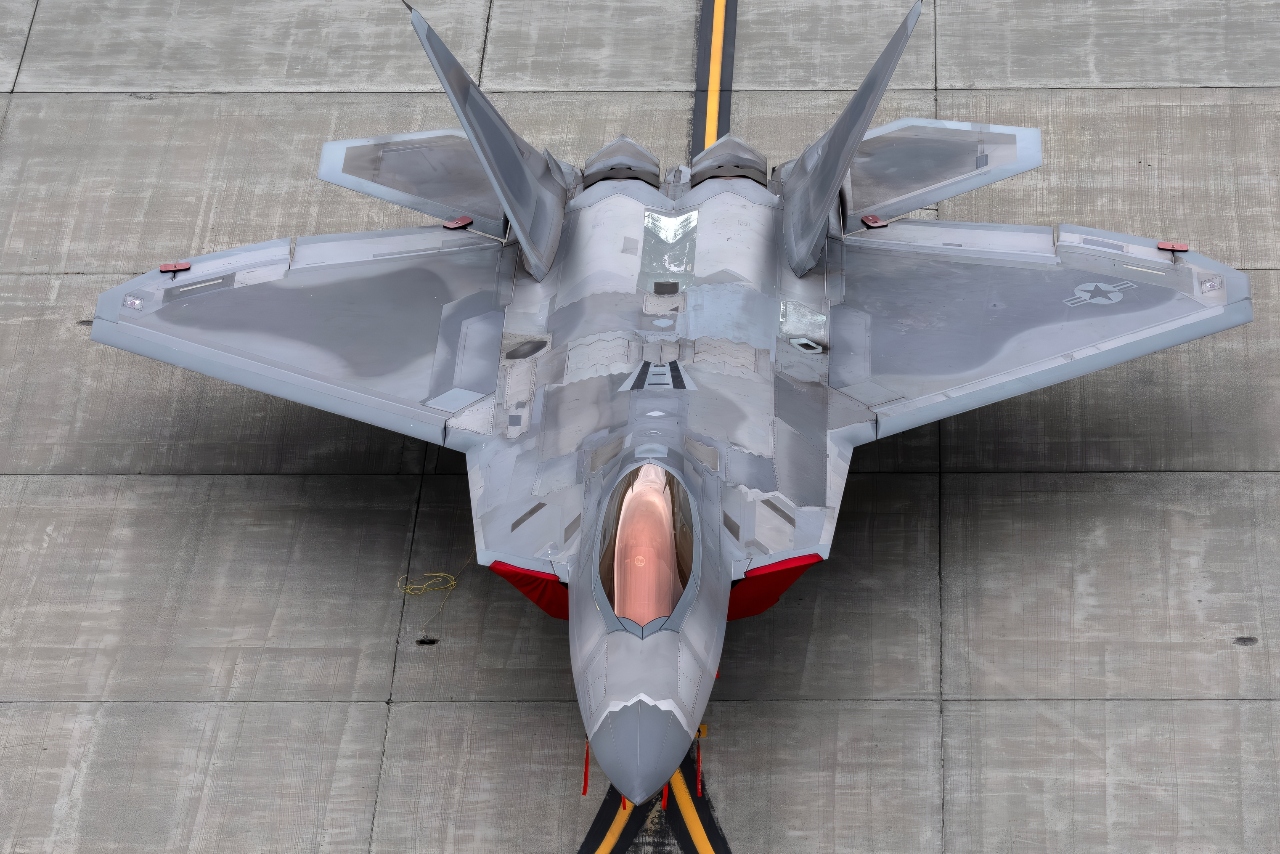
A U.S. Air Force F-22 Raptor is displayed on the flight line during a summit between U.S. President Donald J. Trump and Russian President Vladimir Putin at Joint Base Elmendorf-Richardson, Aug. 15, 2025. (Alaska National Guard photo by Seth LaCount)
And even then, jettisoning the tanks doesn’t give the aircraft its full stealthiness back, because the areas under the wing are still compromised by fuel lines and pylons designed to attach the tanks to the fighter jet.
The new design is intended to solve that problem. According to Lockheed Martin, the tanks are built to retain low observability and remain attached throughout a mission, rather than being discarded before combat. That fundamentally changes how the aircraft can be used. The tanks appear faceted and shaped to reduce radar cross-section, likely incorporating radar-absorbent materials and low-drag geometry to minimize both signature and performance impact. The addition of IRST pods is equally important. These systems allow the F-22 to detect and track targets passively – meaning, without emitting radar signals – to improve survivability against advanced adversaries.
The upgrades are intended to extend the F-22’s reach and persistence while preserving the stealth characteristics that make it such a valuable asset in combat.
The F-22’s Range Problem
The F-22’s range problem is real, but that doesn’t make it an incapable platform. The F-22 can fly long distances with external fuel tanks, extending its ferry range beyond 1,600 nautical miles. On internal fuel alone, however, the F-22’s combat radius is typically cited as around 590 nautical miles, depending on mission profile.
Put those numbers into the context of a hypothetical battle, however, and the problem becomes clear. In regions like the Indo-Pacific, distances between bases and potential targets can exceed 1,000 nautical miles round-trip.
Even in the Middle East, where basing is closer, sustained operations still require careful fuel management and support. To compensate, the F-22 relies heavily on aerial refueling.
Tankers such as the KC-135 and KC-46 extend their reach, but they introduce a vulnerability. These aircraft are non-stealthy, slow-moving, and highly visible targets in a contested environment.
That creates a dependency: the F-22 is one of the most survivable aircraft in the world, but its ability to operate at range is tied to assets that are not.
External tanks were meant to mitigate this, but traditional designs are not viable in high-threat environments.
As a result, the aircraft – much like the F-35 Lightning II – is forced to make a tradeoff between range and survivability. Like the F-22, there are indications that external fuel tank designs are being explored for the F-35 in preparation for potential conflict in the Indo-Pacific.
The F-22 Raptor Stealth Fighter In Current Conflict
The F-22’s role in the ongoing Iran conflict is a good example of how this range problem plays out – even if this is by no means comparable to the geography of the Indo-Pacific.
The aircraft was deployed to the region in February 2026, with at least 12 Raptors moving into the U.S. Central Command area of responsibility as tensions escalated. Those aircraft did not deploy immediately and crossed into the theater under tanker escort.
Once in theater, the F-22 was used for air superiority missions, escorting strike packages, and maintaining combat air patrols over operational areas. It has operated alongside other stealth platforms, including the F-35 and B-2, as part of the U.S. and Israeli air campaign.
U.S. Central Command has confirmed that aerial refueling tankers were part of the force package used in the operation, and open-source analysis suggests the scale is significant. More than 100 U.S. tanker aircraft have been deployed to support the operation, with some estimates putting the number even higher across the rest of the region.
The aircraft have been active participants throughout the campaign, too. In March, a KC-135 refueling aircraft crashed in Iraq while supporting operations related to the conflict, killing six U.S. service members.
The scale of tanker deployment reflects how much U.S. airpower is being sustained in Iran, with fighters, bombers, and support aircraft all operating across a distributed network of bases and aircraft carriers from Europe to the Gulf, with refueling aircraft bridging the gaps between them.
The F-22’s range here is not an immediate operational limitation, though; the distances involved in the Middle East are relatively manageable compared to the likes of the Indo-Pacific, and the density of available bases reduces the need for extreme reach. But the dependence is still there.
The F-22 cannot operate at range without tanker support, and the structure of the air campaign there proves it.
Why the Fuel Tanks Matter In Future Wars
Lockheed Martin has indicated that planned external tanks can add roughly 850 nautical miles of range, but the difference between older and newer variants lies in how that range can be used.
Traditional external tanks extend range only until they are jettisoned, and after that, the aircraft reverts to its internal fuel capacity. The new tanks completely change that dynamic.
By maintaining more low observability, the tanks allow the F-22 to carry additional fuel throughout the mission, effectively increasing its usable combat radius rather than just its transit range.
Even a modest increase in combat radius can have huge effects, too. A 20-30% extension would significantly extend the aircraft’s reach from forward bases and reduce dependence on tankers. That is particularly relevant in the Indo-Pacific, where distance is the defining feature of the aircraft’s operational deployment.
And as upgrades are being planned for the F-22, the Air Force is moving ahead with the F-47 NGAD fighter, which is being designed with range as a core requirement.
The stealth tank program is therefore best seen as a bridging solution, extending the F-22’s relevance while the Air Force develops platforms specifically designed for long-range operations.
About the Author: Jack Buckby
Jack Buckby is a British researcher and analyst specializing in defense and national security, based in New York. His work focuses on military capability, procurement, and strategic competition, producing and editing analysis for policy and defense audiences. He brings extensive editorial experience, with a career output spanning over 1,000 articles at 19FortyFive and National Secur


