

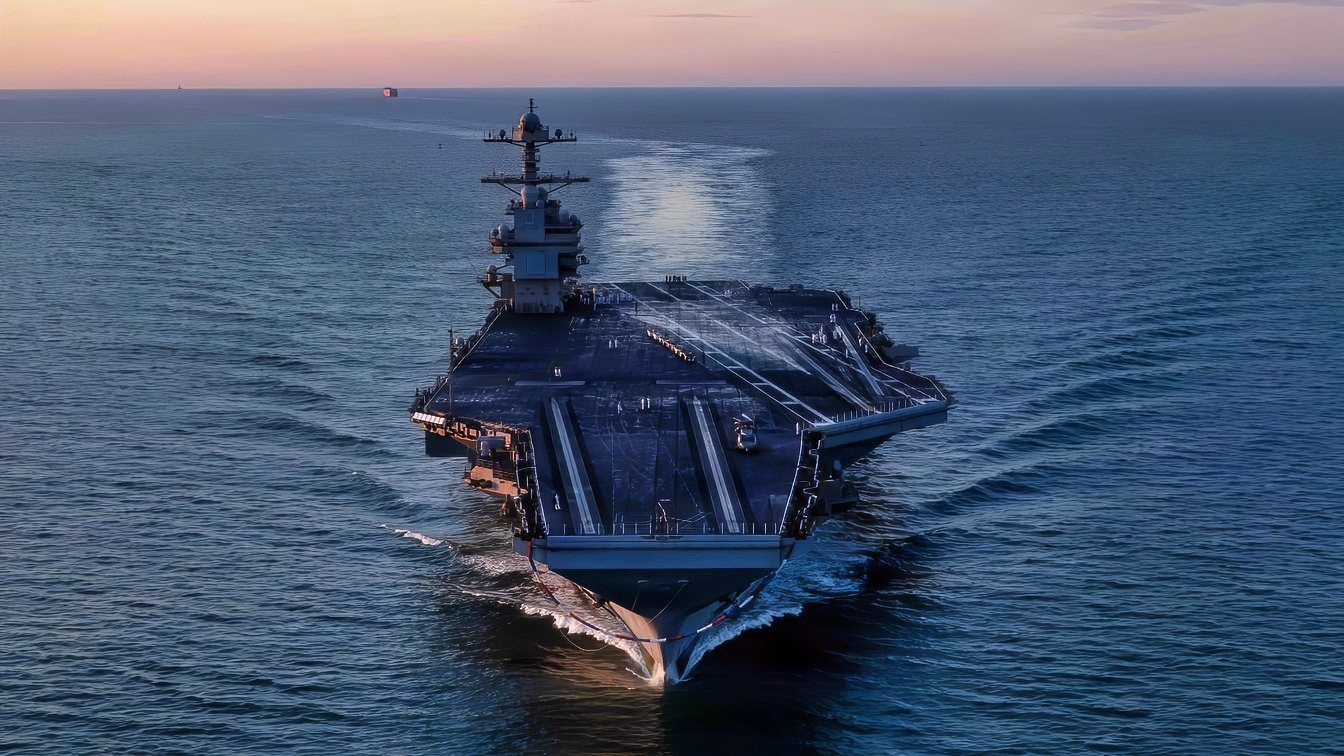
The USS Gerald R. Ford returned to Naval Station Norfolk on May 16, 2026, after a 326-day deployment — the longest American carrier deployment since the USS Coral Sea spent 329 days at sea in 1965. The Ford was scheduled for seven months but stretched to eleven across operations against Venezuela’s Nicolás Maduro and the opening of the air campaign against Iran. Chief of Naval Operations Admiral Daryl Caudle has openly opposed deployment extensions, telling the Surface Navy Association the practice disrupts funerals, marriages, and family planning. Post-deployment repairs to the Ford’s nuclear reactors, EMALS catapults, Advanced Arresting Gear, plumbing, and fire-damaged crew quarters could take two years or longer.
2 Years of Repairs: The USS Gerald R. Ford Aircraft Carrier Challenge

USS Ford Aircraft Carrier U.S. Navy Photo
The USS Gerald R. Ford (CVN-78) recently completed a historic 326-day (roughly 11-month) deployment, returning to Naval Station Norfolk on May 16, 2026. This deployment marks the longest for a U.S. aircraft carrier since the Vietnam War.
The Ford’s record deployment saw it support the ouster of Venezuelan strongman Nicolás Maduro and support the opening of the latest air campaign against Iran.
Later, a fire in the supercarrier’s laundry room caused extensive damage that left hundreds of sailors without places to sleep and forced lengthy repairs on the Greek island of Crete, before she returned home.
Long Deployment Takes A Toll On The Crew And Equipment
According to U.S. Naval Institute News, the only longer carrier deployments in the past 50 years were the 1973 deployment of USS Midway, at 332 days, and the 1965 deployment of USS Coral Sea, at 329 days.
While the crew of the USS Nimitz spent 341 days away from home during the pandemic in 2020-2021, a large segment of that time was spent ashore in isolation due to COVID-19.
However, the long deployment doesn’t just take a toll on sailors being away from home; it also takes a massive toll on the ship’s equipment and infrastructure, requiring months of maintenance.
The USS Ford will need extensive, expensive repairs that could take 2 years or longer, at least according to many experts, but no one knows for sure.
A Scheduled Seven-Month Deployment Stretches To Eleven

Aviation Boatswain’s Mate (Equipment) 3rd Class Mark Ruiz, assigned to Air Department aboard the world’s largest aircraft carrier, USS Gerald R. Ford (CVN 78), prepares a Carrier Air Wing 8 F/A-18E Super Hornet attached to Strike Fighter Squadron 37 for launch on the flight deck, Aug. 1, 2025. Gerald R. Ford, a first-in-class aircraft carrier and deployed flagship of Carrier Strike Group Twelve, is on a scheduled deployment in the U.S. 6th Fleet area of operations to support the warfighting effectiveness, lethality and readiness of U.S. Naval Forces Europe-Africa, and defend U.S., Allied and partner interests in the region. (U.S. Navy photo by Mass Communication Specialist 2nd Class Mariano Lopez)
The USS Ford was supposed to deploy for a seven-month deployment, but instead took part in two separate combat operations, taking nearly a year.
Those combat air operations took a serious toll on the aircraft, the ship’s equipment, and its crew.
As Harry Kazianis wrote, “Eleven months of continuous reactor operations. Eleven months of catapult cycles on the Electromagnetic Aircraft Launch System (EMALS). Eleven months of arrested recoveries on the Advanced Arresting Gear. Eleven months of saltwater corrosion accumulated around exposed fittings, in aviation spaces, on hangar deck plating, and in the ductwork.
“Eleven months of flight deck non-skid surfaces degrading under jet blast. Eleven months of hydraulic systems pushed past normal duty cycles. Eleven months of plumbing, refrigeration, ventilation, and laundry machinery — yes, the laundry machinery — running without the in-port maintenance windows those systems are designed around.”

The world’s largest aircraft carrier, USS Gerald R. Ford (CVN 78) (front) and the Arleigh Burke-class guided-missile destroyer USS Bainbridge (DDG 96) participate in an integrated phase training event, March 23, 2025. The Gerald R. Ford Carrier Strike Group is underway in the Atlantic Ocean completing integrated naval warfighting training. Composite Training Unit Exercise (COMPTUEX) is the Joint Force’s most complex integrated training event and prepares naval task forces for sustained high-end Joint and combined combat. Integrated naval training provides America’s civilian leaders and commanders highly-capable forces that deter adversaries, underpin American security and economic prosperity, and reassure Allies and partners.(U.S. Navy photo by Mass Communication Specialist 2nd Class Maxwell Orlosky)
The long deployment and extended combat operations have deferred crucial maintenance, leaving the ship facing costly, extensive post-deployment repairs.
Adm. Daryl Caudle, the Chief of Naval Operations (CNO), addressed this situation at the Surface Navy Association’s annual symposium.
“I think the Ford, from its capability perspective, would be an invaluable option for any military thing the president wants to do,” Caudle said. “But if it requires an extension, it’s going to get some pushback from the CNO. And I will see if there is something else I can do.”
“I am a big non-fan of extensions, and because they do have a significant impact,” Caudle said to TWZ. “Number one, I’m a sailors-first CNO. People want to have some type of certainty that they’re going to do a seven-month deployment.”
“When it goes past that, that disrupts lives,” Caudle added. “It disrupts things like funerals that were planned, marriages that were planned, okay, babies that were planned, you know, so the human element of extension, I’m not a big fan of obviously.”
Long Sea Deployments Hurt Readiness, Maintenance, And Morale
Prolonged sea deployments profoundly affect the U.S. Navy by straining sailors’ mental health, increasing the risk of shipboard accidents, disrupting maintenance schedules, and causing significant emotional distress for military families.
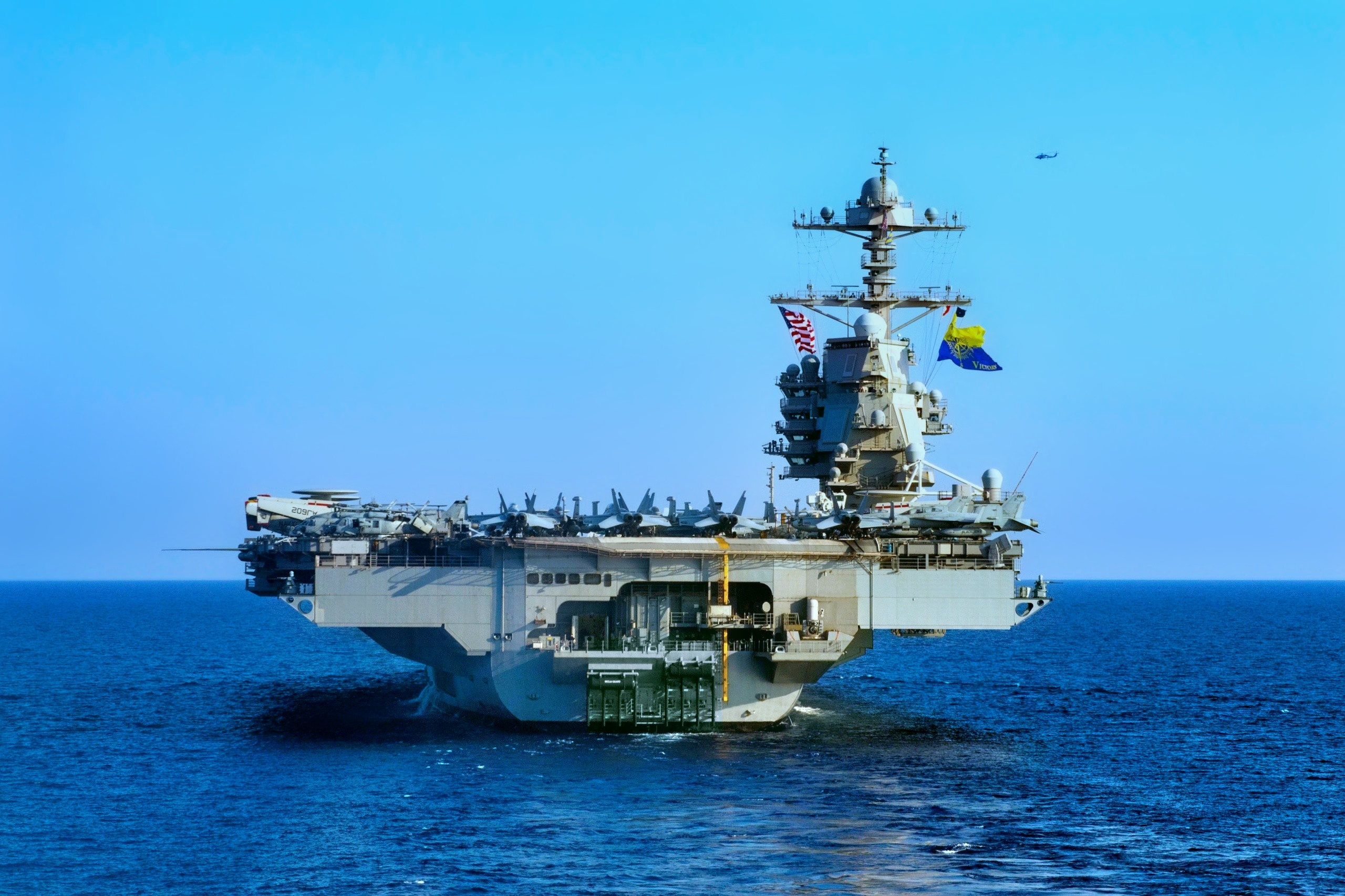
Ford-Class Aircraft Carrier. Image Credit: Creative Commons.
Extended periods underway significantly increase the risk of depression, anxiety, and PTSD among crew members. The monotonous shipboard environment, constant noise, demanding sleep schedules, and isolation from a normal support system add severe psychological strain.
Fatigue and burnout during deployments lasting well beyond the standard 6–9 month window increase the likelihood of operational accidents, particularly on high-tempo flight decks.
As Admiral Caudle stated, extended deployments create immense difficulties for military spouses and children, who shoulder increased responsibilities at home and endure prolonged absences of their loved ones during major life events.
Effects on Ships’ Maintenance And Future Readiness
Long, extended deployments often accelerate wear and tear on operating systems and equipment. Operating ships outside their planned cycles leads to accelerated deterioration and more frequent breakdowns.
Maintenance backlogs are frequently encountered. Extended deployments mean critical components that weren’t anticipated to require repair, increasing the maintenance workload and delaying return-to-service dates due to reduced downtime.
Extended deployments disrupt planned maintenance periods (such as post-deployment availabilities), affecting the readiness of the entire fleet rather than just the deployed ship. In the case of the USS Ford’s carrier strike group, all of the ships will suffer from the lack of maintenance downtime.
While US shipyards already operate under a very tight schedule, with maintenance operations operating far behind what is needed to maintain fleet numbers, the extended deployment of the Ford Carrier Strike Group will not just affect the Ford and her ships, but also other carriers already in the queue for future maintenance.
Strategic And Operational Concerns Are Tough To Reverse
One issue is that during extended deployments, the added wear and tear on systems and equipment can extend the maintenance period when the deployment finally ends.
Rand Corporation said, “Similar solutions with similar problems arise for nearly all elements of readiness, creating a spiral that becomes increasingly difficult to reverse. The impacts can rapidly cascade into persistent problems for force development, threatening the Navy’s ability to meet projected wartime surge needs.”
While necessary for global commitments, these disruptions challenge the Navy’s ability to maintain a sustainable forward presence and meet wartime surge needs.
While operational needs demand extended deployments, the Navy faces a difficult trade-off between immediate mission demands and long-term fleet health, crew sustainability, and maintenance capacity, with serious consequences for overall readiness.
Long sea deployments significantly compound maintenance challenges by accelerating equipment wear, depleting spare parts, and forcing crews to defer vital upkeep. This cumulative strain drastically increases post-deployment repair backlogs and maintenance costs.
Continuous operation of complex systems, such as flight deck arresting gear, catapults, and propulsion units, accelerates wear, requiring major overhauls upon return.
The Congressional Budget Office stated that “the Navy’s operational readiness depends on reliably estimating the time and resources needed to complete routine maintenance events. An overhaul of a ship that takes longer than expected can disrupt the training and deployment schedules for that ship and others.
“If maintenance events often take longer than planned, the Navy has fewer ships that it can deploy—and thus, in effect, a smaller fleet. For more than a decade, the Navy has experienced long delays and labor overruns in completing maintenance events for many of its ships.”
And the cost of the Ford’s maintenance and repairs is quite possibly going to be shockingly high after this long, extended deployment.
MORE – ‘She Can Shoot Down an F-22’: China’s J-20 Stealth Fighter Has Arrived
MORE – China’s J-35A Stealth Fighter Has a Message for the U.S. Air Force
About the Author: Steve Balestrieri
Steve Balestrieri is a National Security Columnist. He served as a US Army Special Forces NCO and Warrant Officer. In addition to writing on defense, he covers the NFL for PatsFans.com and is a member of the Pro Football Writers of America (PFWA). His work was regularly featured in many military publications.


KeepCoping
June 4, 2026 at 3:07 am
LOL Trying hard to sell us the narrative that it was all due to a long deployment while reality is that it got its butt kicked by Iran.