

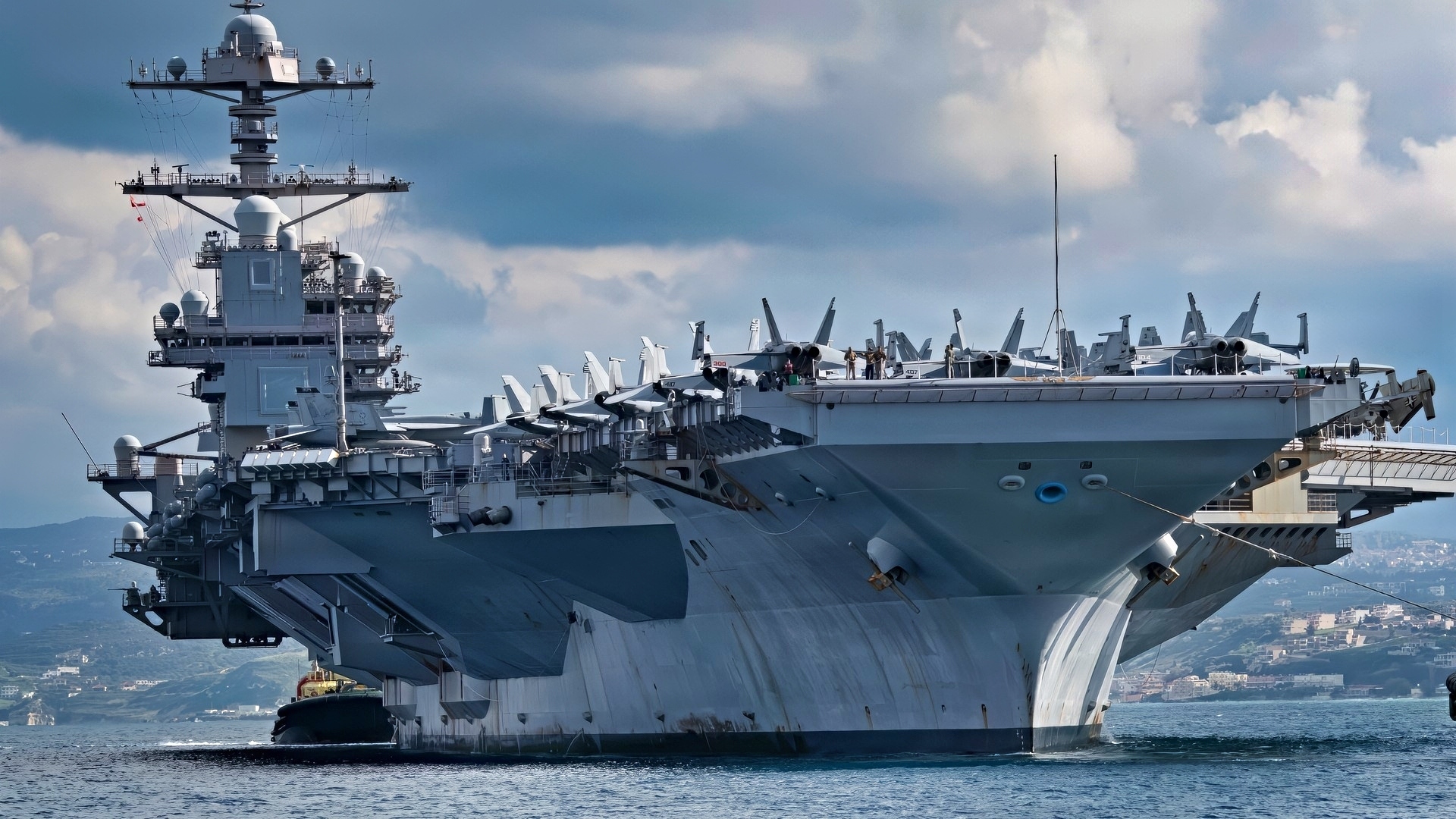
“This is one truly beaten-up supercarrier. My gut tells me that the USS Gerald R. Ford is in worse shape than we know in the press. I think she will be out of action for 2 years. She needs extensive repair work, and my sense is that the Navy will need time, energy, and resources to get this right. In any case, she isn’t going out to sea anytime soon.” That’s what a retired U.S. Navy officer told me yesterday when I asked what he thought the USS Gerald R. Ford’s repair timeline might look like as she heads home to Virginia after a nearly year-long deployment. Needless to say, she will need extensive repairs and upkeep, but how long that might take could surprise even the most seasoned naval experts.
When USS Gerald R. Ford Finally Comes Home, The Repair Bill Is Going To Be Brutal

The world’s largest aircraft carrier, USS Gerald R. Ford (CVN 78), sails in the Atlantic Ocean, July 4, 2025. Gerald R. Ford, a first-in-class aircraft carrier and deployed flagship of Carrier Strike Group Twelve, incorporates modern technology, innovative shipbuilding designs, and best practices from legacy aircraft
carriers to increase the U.S. Navy’s capacity to underpin American security and economic prosperity, deter adversaries, and project power on a global scale through sustained operations at sea. (U.S. Navy photo by Mass Communication Specialist 2nd Class Tajh Payne)
The USS Gerald R. Ford crossed the Strait of Gibraltar on May 6, 2026, eastbound to westbound, after 315 days of continuous deployment.
That makes her the longest-deployed U.S. carrier strike group since the Vietnam War. Two Cold War-era carriers — USS Coral Sea in 1964-65 and USS Midway in 1972-73 — held the previous post-WWII records at 329 and 332 days respectively.
The Ford is closing on both of them. By the time she pulls into Naval Station Norfolk by the end of May, she will have been at sea for somewhere close to 340 days.
That is the deployment record. The repair bill is what comes next. And it won’t be cheap.
The most expensive warship ever built — the lead ship of the most expensive American carrier class in history, at roughly $13 billion — is about to find out exactly how much eleven months of continuous combat operations across four theaters costs to put right.
Aircraft Carrier Test: A Deployment That Bears No Resemblance To The Plan
When the Ford left Norfolk on June 24, 2025, the planned deployment was a routine seven-month rotation focused on Europe and the Mediterranean. None of what actually happened was on the schedule.

The world’s largest aircraft carrier, USS Gerald R. Ford (CVN 78), conducts flight operations in the North Sea, Aug. 23, 2025. Gerald R. Ford, a first-in-class aircraft carrier and deployed flagship of Carrier Strike Group Twelve, is on a scheduled deployment in the U.S. 6th Fleet area of operations to support the warfighting effectiveness, lethality, and readiness of U.S. Naval Forces Europe-Africa, and defend U.S., Allied and partner interests in the region. (U.S. Navy photo by Mass Communication Specialist 2nd Class Maxwell Orlosky)
The carrier first detoured to U.S. Southern Command in October 2025 as part of the massive naval buildup that culminated in the surprise raid that captured former Venezuelan President Nicolás Maduro. The Ford participated in Operation Southern Spear off the Venezuelan coast, including the seizure of Iranian oil tankers attempting to deliver to the Maduro regime. After Maduro’s capture, she swung back across the Atlantic to the Mediterranean.
Then Operation Epic Fury happened. The U.S.-Israeli air campaign against Iranian nuclear and military infrastructure opened on February 28, 2026. President Trump shifted the Ford from the Mediterranean to CENTCOM to join USS Abraham Lincoln in the opening waves of strikes. Her air wing flew combat sorties throughout March and into April. By April 23, the arrival of USS George H.W. Bush brought the U.S. presence in the region to three simultaneous carrier strike groups — a rare operational concentration of more than 200 aircraft and approximately 15,000 sailors and marines. That density allowed CENTCOM to release the Ford for the long transit home.
She left the Red Sea in late April, transited the Suez, returned to the Mediterranean, and made the Gibraltar crossing this past Wednesday. As of yesterday, she was in the Atlantic, with more than 4,500 embarked sailors and personnel headed for Norfolk.
The 309-to-315-day deployment figures circulating in the press depend on which day the count starts. What is not in dispute: this is the longest deployment any American carrier has performed in 53 years.

The world’s largest aircraft carrier USS Gerald R. Ford (CVN 78) steams in the Adriatic Sea, June 23, 2023. Gerald R. Ford is the U.S. Navy’s newest and most advanced aircraft carrier, representing a generational leap in the U.S. Navy’s capacity to project power on a global scale. The Gerald R. Ford Carrier Strike Group is on a scheduled deployment in the U.S. Naval Forces Europe area of operations, employed by U.S. Sixth Fleet to defend U.S., allied, and partner interests. (U.S. Navy photo by Mass Communication Specialist 2nd Class Jackson Adkins)
The Laundry Fire That Nearly Sidelined Her Entirely
The most consequential incident of the deployment happened on March 12, 2026.
A fire broke out in the Ford’s main laundry compartment while the carrier was operating in the Red Sea. The blaze damaged multiple berthing compartments adjacent to the laundry, displaced approximately 600 sailors, and injured three service members — none with life-threatening injuries. More than 100 beds were destroyed.
The Ford broke off Red Sea operations and sailed for the U.S. Naval Support Activity at Souda Bay, Crete, where she remained from March 23 to March 26 for technical inspections and emergency repairs by structural engineers and naval architects from the Forward Deployed Regional Maintenance Center. From Souda Bay, she made a logistics and diplomatic stop in Split, Croatia, from March 28 to April 2 before returning to the Middle East.
Congressional sources in various press reports have indicated the laundry facilities themselves were repaired during the Souda Bay availability and the carrier resumed normal operations. What was not fixed — what cannot be fixed at a forward repair facility — is the underlying damage to the berthing compartments, the ventilation ducting that ran through the affected zone, the electrical wiring that took heat exposure, and any structural members that were compromised by the fire. Those repairs require shipyard time.
Senator Tim Kaine, who has been pressing the Navy on Ford’s condition since March, told local media this week he believes there will still be significant damage to the carrier from both the fire and from the length of the deployment itself. “There is a schedule for these things, and this ship is months past when it was supposed to come home,” Kaine said. “Will another ship have to wait while the Ford is fixed? These are problems created because of the extended deployment.”
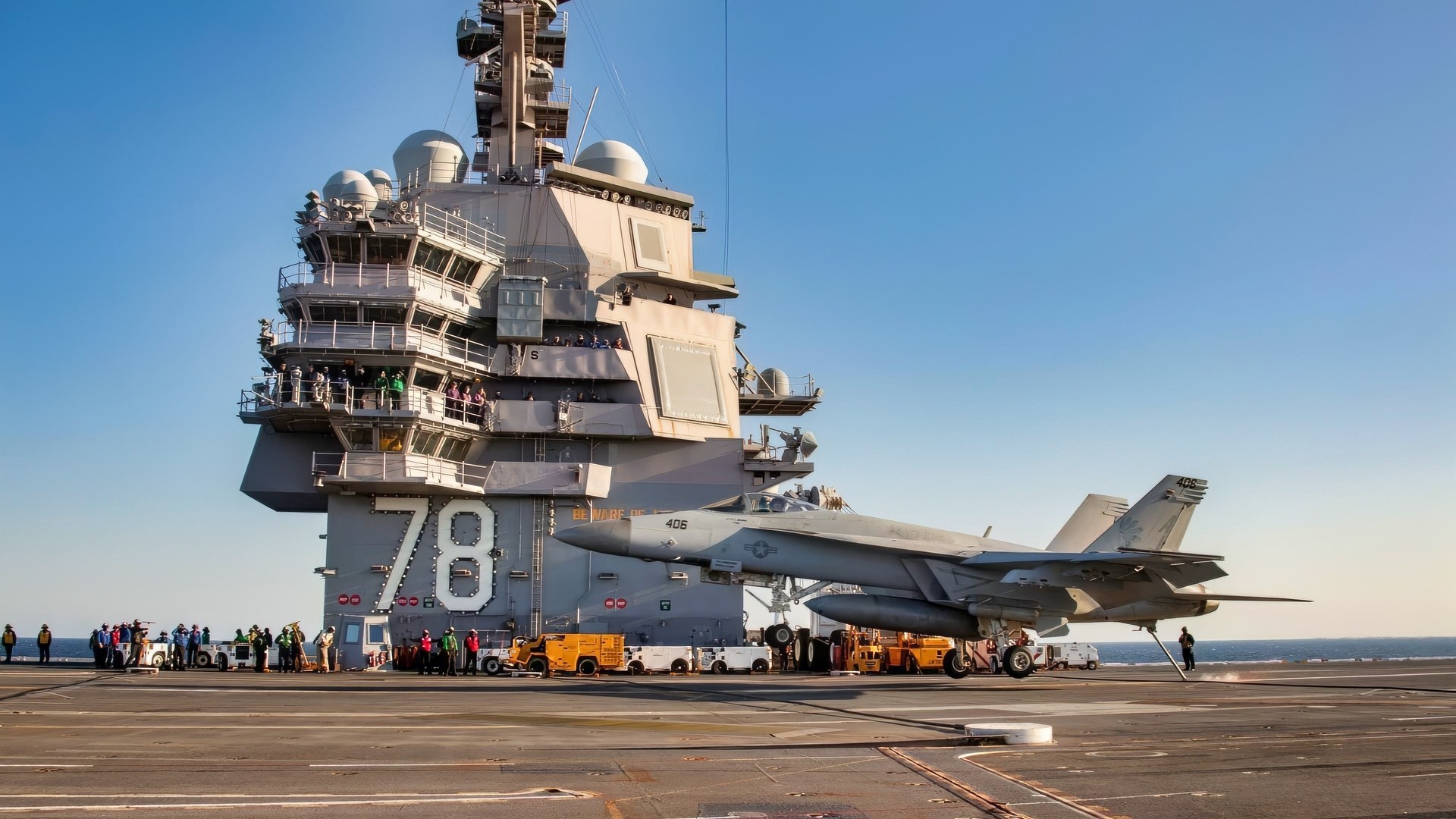
USS Gerald R. Ford Training. Image Credit: U.S. Navy.
That last point is the institutional problem. The Navy’s public shipyards are already scheduled tight. A long, complex Ford availability does not just delay Ford’s return to operational status — it pushes every other carrier that was queued behind her into a longer wait of its own.
What 315 Days At Sea Does To An Aircraft Carrier
A standard Norfolk carrier deployment runs about seven months. The Ford has been continuously operating at sea, with the exception of the Souda Bay and Split port calls and routine logistics stops, for nearly eleven months.
That tempo accumulates damage in ways that are not always visible from the flight deck.
Eleven months of continuous reactor operations. Eleven months of catapult cycles on the Electromagnetic Aircraft Launch System. Eleven months of arrested recoveries on the Advanced Arresting Gear. Eleven months of saltwater corrosion accumulating around exposed fittings, in aviation spaces, on hangar deck plating, in the ductwork. Eleven months of flight deck non-skid surfaces degrading under jet blast. Eleven months of hydraulic systems pushed past normal duty cycles. Eleven months of plumbing, refrigeration, ventilation, and laundry machinery — yes, the laundry machinery — running without the in-port maintenance windows those systems are designed around.
Vice Chief of Naval Operations Admiral Jim Kilby told the Senate Armed Services Committee in early March that the deployment extension would affect Ford’s return and the schedule for her maintenance availability. Kilby’s framing was diplomatic — “the good part about our public shipyards is they’re adjusting that schedule” — but the practical reality is that Ford requires substantially more shipyard time than a normal post-deployment carrier.
The Pentagon operational testing community had also flagged ongoing concerns about Ford-class subsystems before the deployment began. The Electromagnetic Aircraft Launch System, the Advanced Arresting Gear, the weapons elevators, and the radar performance had all generated scrutiny since the carrier was commissioned in 2017. None of those subsystems gets easier to maintain after eleven months of combat operations.

ATLANTIC OCEAN (Sept. 21, 2024) The world’s largest aircraft carrier, USS Gerald R. Ford (CVN 78), sails in formation with the Japan Maritime Self Defense Force (JMSDF) Kashima-class training ship, JS Kashima (TV-3508), middle, and Hatakaze-class guided missile destroyer JS Shimakaze (TV-3521) while conducting routine operations in the Atlantic Ocean, September 23, 2024. The U.S. Navy and JMSDF continue to train together to improve interoperability and strengthen joint capabilities. For more than 60 years, the U.S.-Japan Alliance has been the corner stone of stability and security and is crucial to the mutual capability of responding to contingencies at a moment’s notice. (U.S. Navy photo by Mass Communication Specialist 2nd Class Jacob Mattingly)
The Repair Availability That Awaits Her
The Navy has not yet publicly disclosed the planned scope or duration of Ford’s post-deployment maintenance period. What can be projected, based on standard practice and what is already known, breaks down across several work packages.
Repair of the laundry compartment and surrounding berthing spaces will dominate the early phase. Newport News Shipbuilding teams will need to assess the scope of fire damage, strip and replace damaged structural members, restore ventilation ducting, replace electrical wiring runs exposed to heat, and recertify the affected compartments for habitability and damage control standards.
Catapult and arresting gear overhauls will follow. Eleven months of continuous combat-rate launches and recoveries on EMALS and AAG will likely require a comprehensive teardown and component replacement.
Reactor maintenance windows that would normally have been worked into shorter deployment cycles have been deferred and will need to be addressed. Hull, paint, anti-fouling, and corrosion control will require dry dock time. Weapons elevators, plumbing, and habitability systems that have been running on workarounds throughout the deployment will need permanent fixes.

A U.S. Sailor prepares an F/A-18F Super Hornet aircraft for launch from the flight deck of the world’s largest aircraft carrier, Ford-class aircraft carrier USS Gerald R. Ford (CVN 78), while underway in the Caribbean Sea, Nov. 25, 2025. U.S. military forces are deployed to the Caribbean in support of the U.S. Southern Command mission, Department of War-directed operations, and the president’s priorities to disrupt illicit drug trafficking and protect the homeland. (U.S. Navy photo)
Realistic best case: Ford goes into a six-to-eight-month availability and is back at sea by early to mid-2027. Realistic worst case: post-deployment work expands as inspections uncover more, the scope of fire damage grows, and Ford does not return to operational status until late 2027 or even early 2028. Some, as noted above, think two years is more likely the real timeline before the Ford heads back out to sea.
Why The Timing Matters
The U.S. Navy does not have a Ford-class carrier to spare during the period when this one is in the yard.
USS John F. Kennedy is not commissioning until March 2027. USS Nimitz is in her final deployment, currently transiting around Cape Horn for her own decommissioning. The Pacific Fleet has its own rotation pressures. The Mediterranean and the Middle East still need carrier coverage as long as Operation Epic Fury continues.
The Ford’s family members have been waiting for nearly a year — the deployment has been hard on the sailors and harder on the Norfolk-area families who have watched the carrier’s return date slip from December to March to April to May. Acting Secretary of the Navy Hung Cao visited the carrier last week to thank the crew personally for completing what he called “a long, demanding deployment — from the High North to combat operations in South America and the Middle East.”
When Ford pulls into Norfolk by the end of May, the band will play, the families will be on the pier, and the sailors will go home to whatever furniture they remember from the previous June. Then the engineers will board the ship with clipboards.
Eleven months of war cannot be repaired in a week. The USS Gerald R. Ford has earned her break. The Navy will have to find a way to cover the gap.
About the Author: Harry J. Kazianis
Harry J. Kazianis (@Grecianformula) was the former Senior Director of National Security Affairs at the Center for the National Interest (CFTNI), a foreign policy think tank founded by Richard Nixon based in Washington, DC. Harry has over a decade of experience in think tanks and national security publishing. His ideas have been published in the NY Times, The Washington Post, The Wall Street Journal, CNN, and many other outlets worldwide. He has held positions at CSIS, the Heritage Foundation, the University of Nottingham, and several other institutions related to national security research and studies. He is the former Executive Editor of the National Interest and the Diplomat. He holds a Master’s degree focusing on international affairs from Harvard University.


Richard Barboza
May 10, 2026 at 7:19 pm
If the super carrier doesn’t have industrial-sized toilet bowls, I think now is a good time to get them.
Hans Wolfgang Schulze
May 10, 2026 at 7:35 pm
So besides laundry fire, what’s going to take 1 years?
Reading whole article, and 90% is about the record deployment time. What happens if the mar lasts 6 years? It sinks?
Brian
May 10, 2026 at 11:01 pm
Besides overhauling and upgrading systems. Plus repairs the laundry and berthing areas, which we do not know the extent of damage, may not require the repairs that are being described. I did a 9 month deployment, and the ship didn’t require such repairs.
Peter Fitzgerald
May 11, 2026 at 9:07 am
What happens if the USA is struck by a major attack? Surely this short deployment period & long maintenance downtime would not have worked during WW2. Australia needs to get out of AUKUS & get new diesel electric submarines from another supplier. Nuclear boats are useless, based on this article they need service twice a year.
Laura Ann Chacanaca
May 11, 2026 at 9:50 am
If she’s going to Newport News Shipyard, you can expect longer than 2 years to get her ready.
George Phillips
May 11, 2026 at 3:09 pm
Really, not redeployed till late 2027. What is the safety factor these systems are designed to? Salt water corrosion? Don’t you think we design for this? A laundry fire and extended service and you claim down for 2 years. Thank goodness it didn’t take a direct hit. We would have had to scrap it according to you. Heavy duty cycles are hard, salt water is bad, high tech components get stressed. This is our premiere carrier. It was designed and engineered to BE IN HARMS WAY. IT IS NOT A CRUISE SHIP. WE WILL FIX IT, QUEUE OTHER SHIPS AROUND IT IN A TIMELY MANNER, AND BE READY TO DEFEND AGAIN WHEN AND IF NEEDED.
Hazmat
May 16, 2026 at 5:10 pm
Missions of dubious wisdom and legality.