

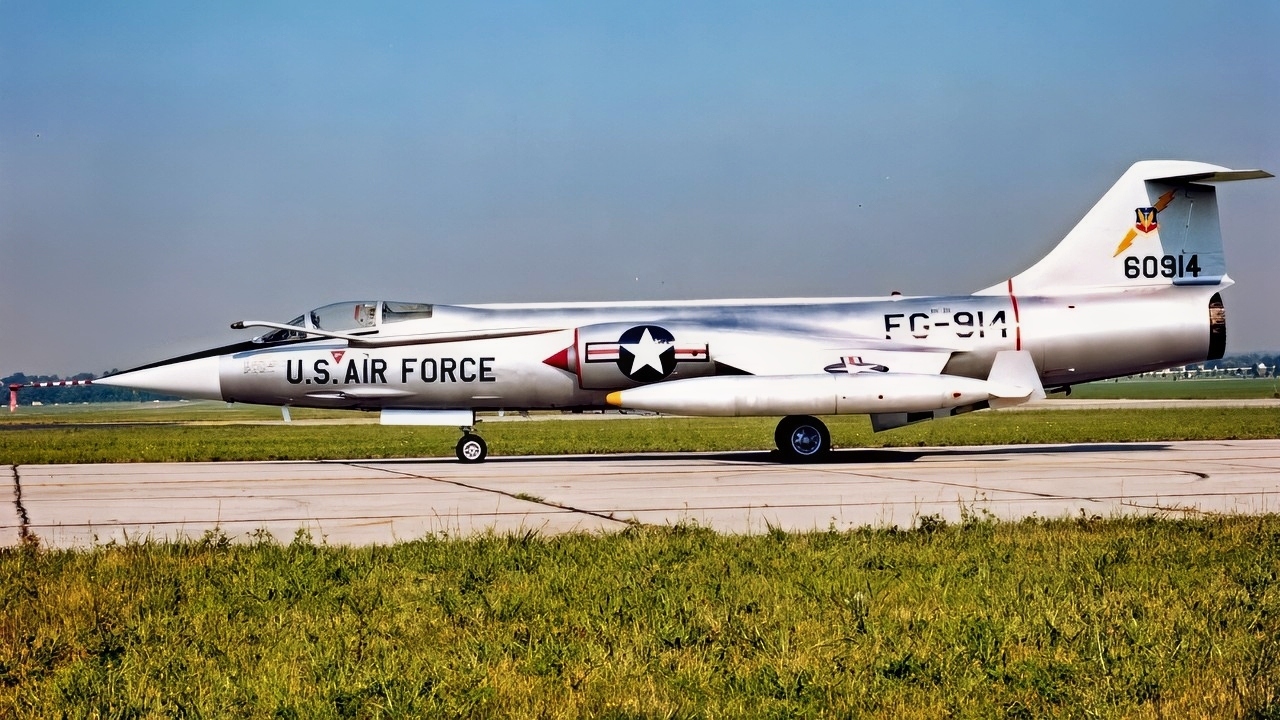
Lockheed’s F-104 Starfighter was one of the fastest fighters of the early Cold War, capable of Mach 2 on a single General Electric J79 turbojet, and was developed by Kelly Johnson’s Skunk Works after he toured air bases in Korea. The aircraft used a long, thin fuselage and very small straight wings to cut drag, but the same design produced brutal low-speed handling. West Germany became one of the largest operators of the Starfighter and lost a significant portion of its fleet to crashes, earning the jet the nickname Widow Maker. Italy flew the F-104 into the early 21st century.
The F-104 Starfighter Was a Speed Demon
The F-104 Starfighter was an American Cold War interceptor developed during the 1950s.
This aircraft featured a unique design with a long, thin fuselage and small, stubby wings.
The F-104 earned the nickname “zipper” for its high speeds (and some less flattering nicknames for its mechanical reliability issues) and could reach Mach 2, which was incredible for its time.
Despite its many flight records, the aircraft had a mixed reputation overall due to poor low-speed handling and was consequently phased out in favor of the F-4 Phantom II.
Design and Development
The origins of the F-104 date back to the early 1950s, when the United States Air Force sought a new interceptor to counter the growing threat of high-speed Soviet bombers.
Experiences from the Korean War had revealed that existing aircraft were often limited in speed and climb performance.
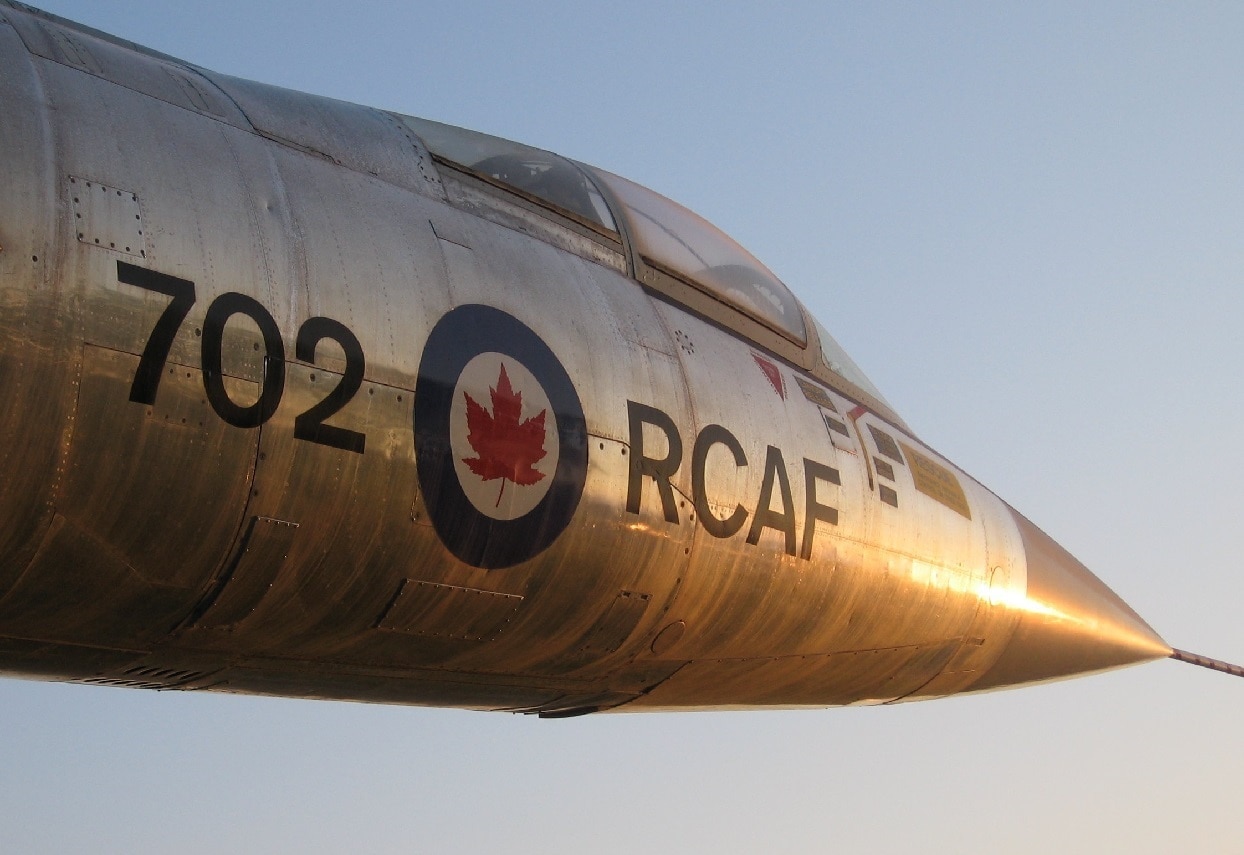
F-104. Image Credit: Creative Commons.
Clarence “Kelly” Johnson, the now-renowned engineer leading Lockheed’s Skunk Works, took these lessons seriously.
Johnson toured airbases around Korea and spoke directly with pilots who had fought Soviet aircraft during the war.
Many pilots expressed the need for a simpler, lightweight aircraft capable of flying at higher altitudes and speeds.
From these insights, Johnson and his team developed the XF-104 prototype, which first flew in 1954 and entered service a few years later as the F-104 Starfighter.
The aircraft was built around the powerful General Electric J79 turbojet engine, which provided extraordinary thrust for its time.
The fuselage was long and narrow, carefully shaped to minimize aerodynamic drag, particularly at supersonic speeds.
Unlike the broad, swept wings found on many contemporary jet fighters, the Starfighter used very small, straight wings that were exceptionally thin.
This design dramatically reduced drag, enabling the aircraft to exceed Mach 2 and making it one of the fastest fighters of its era.
However, this advantage came with a few trade-offs. The small wing area resulted in high wing loading, requiring the aircraft to reach higher speeds during takeoff and landing to generate sufficient lift.
As a result, piloting the Starfighter demanded high precision and skill, especially during low-speed operations.
Avionics and Weaponry
The aircraft’s tail configuration also contributed to its unique profile.
The horizontal stabilizer was mounted high on the vertical tail, forming a T-tail arrangement.
While this improved control at high speeds, it also introduced the risk of deep stall conditions if the aircraft entered certain flight attitudes.
Such conditions could make recovery extremely difficult, adding to the aircraft’s unforgiving reputation.
In keeping with its role as a point-defense interceptor, the early F-104 models were relatively simple in terms of avionics and armament.
Early variants of the aircraft were equipped with an RCA AN/ASG-14T1 radar, which provided a modest tracking range of 40 miles.
In the 60s, Italian Starfighters were equipped with the ALQ-70/72 ECM radar, which offered improved tracking and look-down/shoot-down capabilities.
In terms of armament, the aircraft became the first to carry the Vulcan M61 20mm cannon. Initially, this gun suffered from several reliability issues, but these were later resolved, and the M61 has since become a staple on American aircraft.
The aircraft could carry a limited number of AIM-9 Sidewinder missiles as well as the MB-1 nuclear missile for strategic missions.
The Starfighter in U.S. Service
The F-104’s service with the United States Air Force was relatively brief.
While it excelled in speed and high-altitude interception, it lacked the range, payload capacity, and versatility needed for broader combat roles.
As the nature of aerial warfare evolved, the Air Force turned to more flexible platforms such as the F-4 Phantom II. The Starfighter was gradually phased out of frontline service in the United States, although it continued to serve with Air National Guard units for some time.
The aircraft did see limited combat use during the Vietnam War. During the war, F-104s were primarily used for escort and ground-attack missions rather than for air superiority. They performed well in certain situations, particularly when speed was required, but their limited payload and range restricted their overall effectiveness. Consequently, their role in the conflict remained secondary to that of other aircraft.
The F-104 in International Service
While its tenure in the United States was relatively short, the F-104 had a much longer international career. It was widely exported to allied nations, particularly within NATO, and adapted to meet a variety of roles. Many countries operated upgraded versions with improved avionics, weapons systems, and mission capabilities.
West Germany became one of the largest operators of the Starfighter, using it extensively as a fighter-bomber and strike aircraft. In German service, however, the aircraft was plagued with reliability issues.
A significant portion of the fleet was lost over time, and many pilots were killed in crashes. The Germans nicknamed the Starfighter the “Widow Maker,” due to its propensity to crash and kill the pilot. Several factors contributed to this situation, including the aircraft’s poor performance at low levels, challenging weather conditions, and initial shortcomings in training and maintenance practices. As a result, the aircraft’s reputation was permanently tarnished
Italy, in contrast, operated the F-104 for decades and became one of its most enduring users. Italian Starfighters remained in service into the early twenty-first century, long after many other countries had retired the type.
Several other nations also incorporated the F-104 into their air forces, including Japan, Pakistan, Turkey, Spain, Norway, and Denmark.
Each adapted the aircraft to its own strategic needs. In some cases, the Starfighter proved highly effective, but in German/Canadian service, it was prone to mechanical failures.
About the Author: Isaac Seitz
Isaac Seitz, a Defense Columnist, graduated from Patrick Henry College’s Strategic Intelligence and National Security program. He has also studied Russian at Middlebury Language Schools and has worked as an intelligence Analyst in the private sector.


