

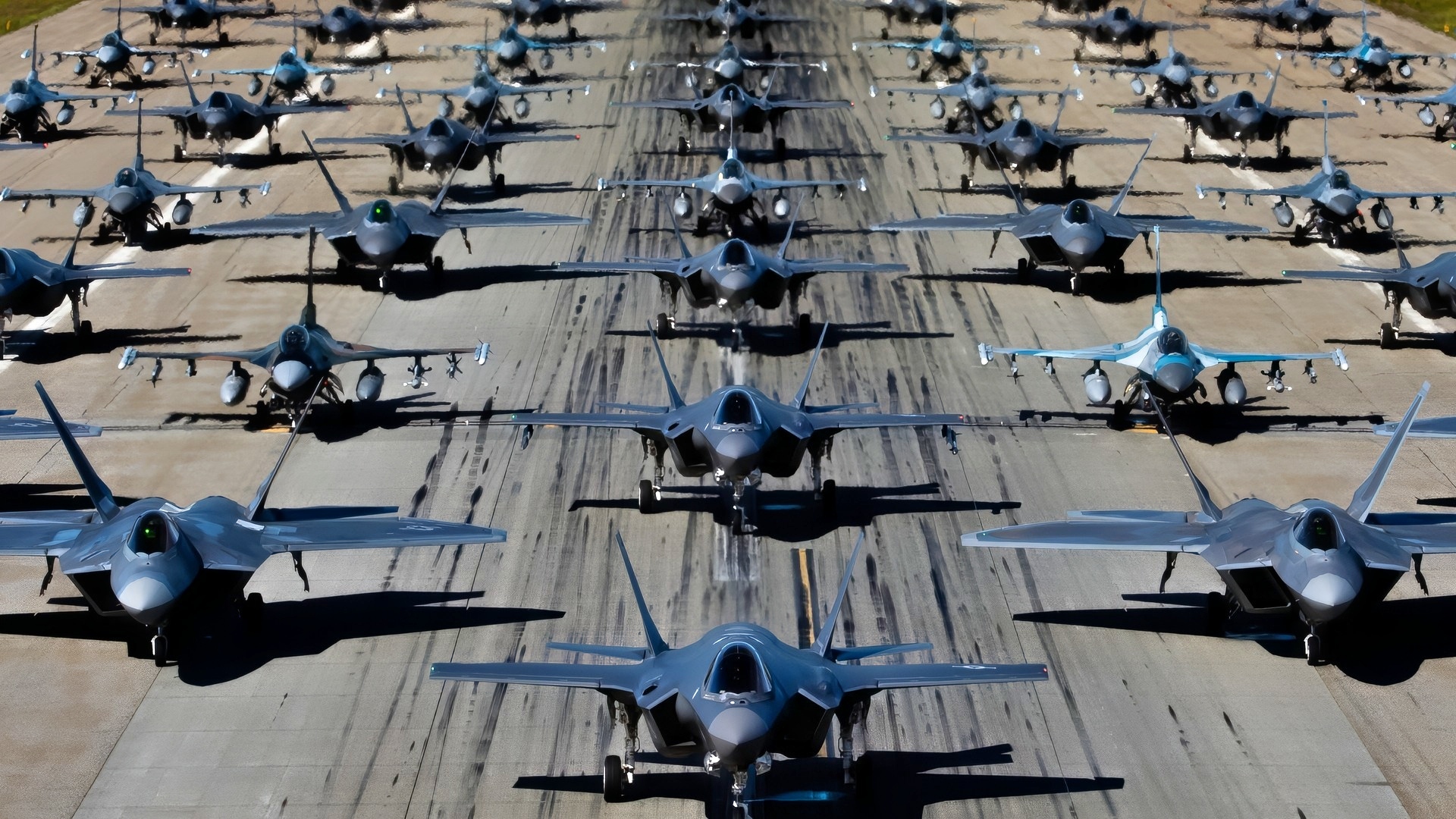
The U.S. Air Force has just concluded its Checkered Flag exercise at Tyndall Air Force Base, a high-end air-to-air training event designed to rehearse the kind of war the United States expects against a peer adversary like China or Russia. Run by Air Combat Command and the 325th Fighter Wing, Checkered Flag puts up to 100 aircraft in a single battle, with around 50 flying as adversaries. The exercise integrates fifth-generation F-22 Raptors and F-35s with older fourth-generation F-15E Strike Eagles and F-16 Fighting Falcons, networked through the carrier-capable E-2D Advanced Hawkeye for command and control.
The U.S. Air Force Has F-22, F-35, F-15 and F-16 Plans for China
As the United States slowly turns away from fighting the long, grinding counterinsurgency operations that defend the United Sates’ decades-long involvement in the Middle East, a key part of future combat operations will be wresting control of the skies from an adversary — a peer rival — and one with a robust air denial capability, as well as advanced fourth and fifth-generation aircraft, and in the future, potentially even sixth-generation aircraft as well.
To better face threats posed by the likes of the Chinese or Russian air forces, the United States Air Force is training for high-tempo aerial warfare through its recently concluded Checkered Flag exercise.
Checkered Flag delivers what participants consistently call “the best air-to-air training,” making it a premier destination for joint and coalition partners, according to Tyndall Air Force Base, which hosts the exercises. “Many units self-fund their participation to gain experience in this elite integration event. The exercise’s proximity to advanced ranges and its high-end training value directly builds a more capable, unified global response force.”
“The 325th FW continually evolves Checkered Flag to outpace adversaries. Tyndall actively upgrades its infrastructure to host higher classifications and incorporates key insights from operational testing to prepare forces for the threats of tomorrow.”
Checkered Flag
The United States Air Force’s Checkered Flag exercises are perhaps not as well-known as the Red Flag exercises, but they attempt to answer a fundamental task of modern aerial warfare: how to control and coordinate a multitude of formations of entirely disparate aircraft against a capable, peer adversary.
Run by Air Combat Command from Tyndall Air Force Base, the Checkered Flag has increasingly gained relevance as the United States turns away from the years of warfare against insurgent groups in the Middle East that lacked a robust air denial strategy toward high-end air combat against the likes of China or Russia.
The exercise’s new relevance is important because of the nature of fighting a peer rival from the air.
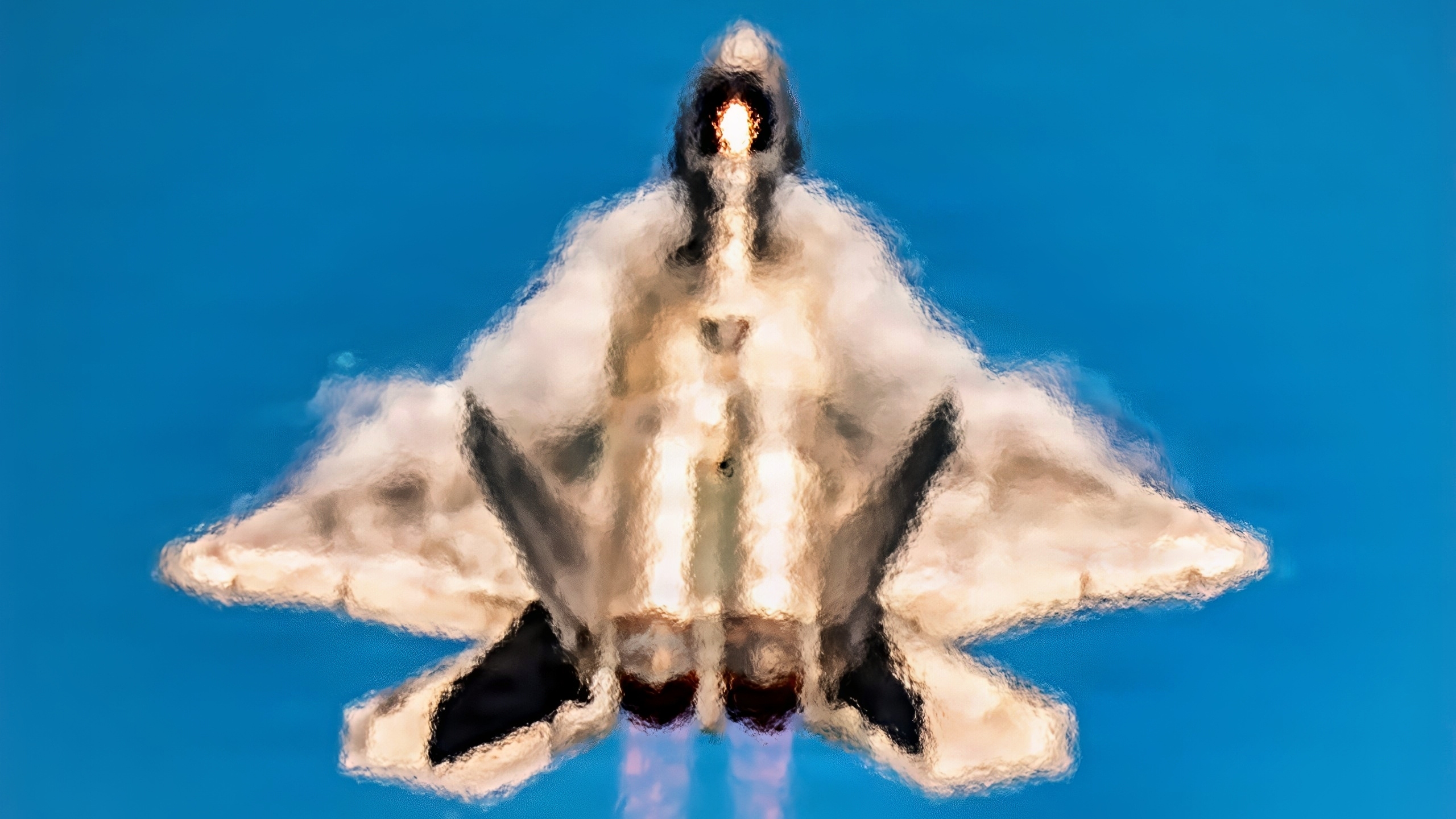
U.S. Air Force Capt. Nick “Laz” Le Tourneau, pilot and commander of the F-22 Raptor Aerial Demonstration Team, performs an aerial demonstration at Air Dot Show Tour Fort Lauderdale, Florida, May 9, 2026. Capt. Le Tourneau showcased the unmatched capabilities of the F-22 by performing a series of combat maneuvers. (U.S. Air Force photo by Staff Sgt. Mary Bowers)
Rather than just one type of fighter going up against another kind of fighter, it is a gross oversimplification.
Instead, modern air warfare depends heavily on networks of aircraft operating in parallel. Fifth-generation stealth fighters, older fourth-generation aircraft, airborne warning aircraft, tanker planes, electronic warfare assets, and command-and-control aircraft are all sharing information in near-real time.
And Checkered Flag is designed to put those capabilities through a stress test.
Checkered Flag’s usefulness lies in the size of the air battles it simulates, and Air Force information describes exercises that include 50 or more aircraft participating in one aerial fight, with several dozen flying as adversaries.
Some exercises have included more than 100 aircraft in total, a fighter that is significantly larger than most air combat simulations can handle.
Though the recent exercise overlaps somewhat with Red Flag’s mission. But Red Flag exercises typically simulate a broader range of air campaigns that involve strikes, the suppression of enemy air defenses, electronic warfare, and multi-domain operations.
In short, Checkered Flag is somewhat narrower and more specialized, with a greater emphasis on purely air-to-air integration and air dominance.
Fourth and Fifth Generation Teaming
But another important facet of the Checkered Flag exercises is the integration of older fourth-generation aircraft with newer fifth-generation stealth aircraft. Practically speaking, teaming Cold War-era F-15E Strike Eagles or F-16 Fighting Falcons with newer, more advanced F-22 Raptor aircraft and the F-35 stealth fighter could be effective.

A 96th Test Wing F-15E Strike Eagle flies during a test mission May 22, 2025 over Eglin Air Force Base, Florida. The 96 TW and the 53rd Wing teamed up to test AGR-20F Advanced Precision Kill Weapon System II laser-guided rockets on the F-15E in May in an effort to get the capability to the warfighter as quickly as possible. (U.S. Air Force photo by Staff Sgt. Thomas Barley)

A 96th Test Wing F-15E Strike Eagle flies during a test mission May 22, 2025 over Eglin Air Force Base, Florida. The 96 TW and the 53rd Wing teamed up to test AGR-20F Advanced Precision Kill Weapon System II laser-guided rockets on the F-15E in May in an effort to get the capability to the warfighter as quickly as possible. (U.S. Air Force photo by Staff Sgt. Thomas Barley)
The U.S. Air Force has spent years figuring out how those aircraft groups could work together in combat. Stealth fighters can penetrate defended adversary airspace and gather targeting information to relay to other platforms, but they are relatively few in number.
Older fighters, in contrast, can carry much more weaponry and are available in higher numbers, but do, of course, lack the stealthy features of their newer counterparts.
That cooperation and collaboration with many kinds of aircraft was on full display during the latest iteration of Checkered Flag, as evidenced by networking with the E-2D Advanced Hawkeye, a carrier-capable airborne early warning and command-and-control aircraft.
“The E-2D Hawkeye provides command and control — our primary role is to paint the combat zone picture,” said U.S. Navy Petty Officer 3rd Class Sydney Rodriguez, an Airborne Command and Control Squadron (VAW 113) avionics electrician technician. “We detect targets long before the fighter jets do. We identify the threats first and relay that tactical picture, ensuring the fighters successfully engage their required targets.”

A U.S. Air Force KC-135 Stratotanker offloads fuel to U.S. Air Force F-15 Strike Eagles over the U.S. Central Command area of responsibility, April 11, 2025. The F-15E is deployed to the CENTCOM AOR to reinforce regional stability and deter aggression from violent extremist organizations.. (U.S. Air Force photo by Senior Airman Keegan Putman)
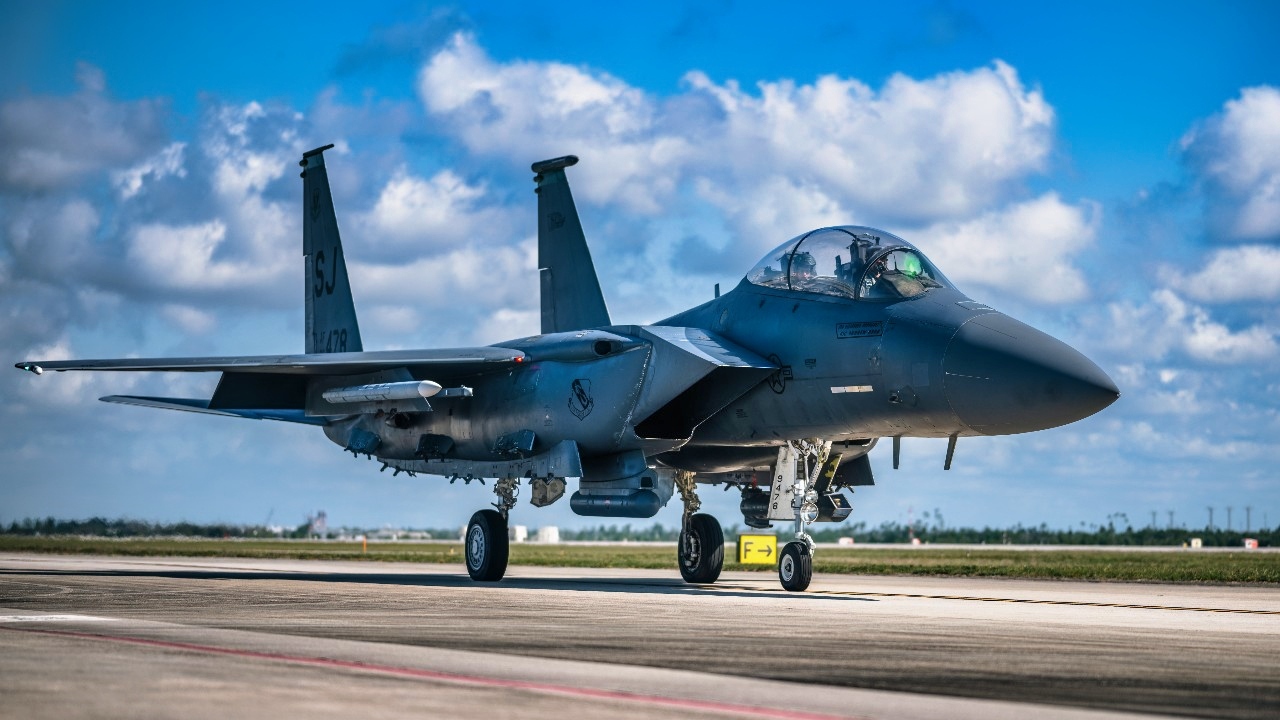
A U.S. Air Force F-15E Strike Eagle assigned to the 335th Fighter Squadron, Seymour Johnson Air Force Base, North Carolina, taxis during Checkered Flag 25-2 at Tyndall AFB, Florida, May 14, 2025. Checkered Flag, one of the Department of Defense’s largest air-to-air exercises, integrates fourth and fifth-generation aircraft to enhance mobility, deployment, and employment capabilities. (U.S. Air Force photo by Airman 1st Class Zeeshan Naeem).
A Sign of the Times
Though this was not the first time the U.S. Air Force has run Checkered Flag, its importance will grow in the coming years as the Air Force refines its thinking about air-to-air combat. It is no longer assumed that the United States will enter a war with completely uncontested air superiority.
Instead, missile threats, electronic attack, degraded communications, and opponents capable of coordinating large air operations of their own are to be assumed. Checkered Flag is one of the best chances for the Air Force to prepare for the worst.
About the Author: Caleb Larson
Caleb Larson is an American multiformat journalist based in Berlin, Germany. His work covers the intersection of conflict and society, focusing on American foreign policy and European security. He has reported from Germany, Russia, and the United States. Most recently, he covered the war in Ukraine, reporting extensively on the shifting battle lines in Donbas and writing about the war’s civilian and humanitarian toll. Previously, he worked as a Defense Reporter for POLITICO Europe. You can follow his latest work on X.


xi-xi-xi-xi
May 18, 2026 at 11:21 pm
Definitely, the US plans to fight china, in just exactly, nearly a hundred years ago today, how Japan planned cynically to fight china.
But, as seen or as revealed or exposed in the 2026 Iran war, the US can’t win using conventional forces, or conventional arms.
The only way for US to win, in the coming high-end war against china, is to employ the use of tactical nukes.
Liberal use of tactical nukes.