


The U.S. Navy’s Block V Virginia-class fast-attack submarine adds an 84-foot Virginia Payload Module that triples Tomahawk cruise missile capacity from 12 to 40 per boat. The increase matters because Operation Epic Fury against Iran depleted nearly one-third of America’s prewar Tomahawk inventory — over 1,000 of 3,100, according to CSIS. The U.S. Navy is also retiring four Ohio-class SSGNs between 2026 and 2028, removing 616 Tomahawk cells, and twelve Ticonderoga-class cruisers, removing another 2,080 vertical launch cells. Tomahawks cost between $1.5 million and $4 million each and take 47 months to deliver. Dr. Brent Eastwood calls this the Kinetic Missile Fight.
The Tomahawk Missile Crisis?

Norfolk, VA. (May 7, 2008)-The Virginia-class submarine USS North Carolina (SSN 777) pulls into Naval Station Norfolk’s Pier 3 following a brief underway period. North Carolina was commissioned in Wilmington, N.C. on May 3, 2008. (U.S. Navy Photo By Mass Communications Specialist 3rd Class Kelvin Edwards) (RELEASED)
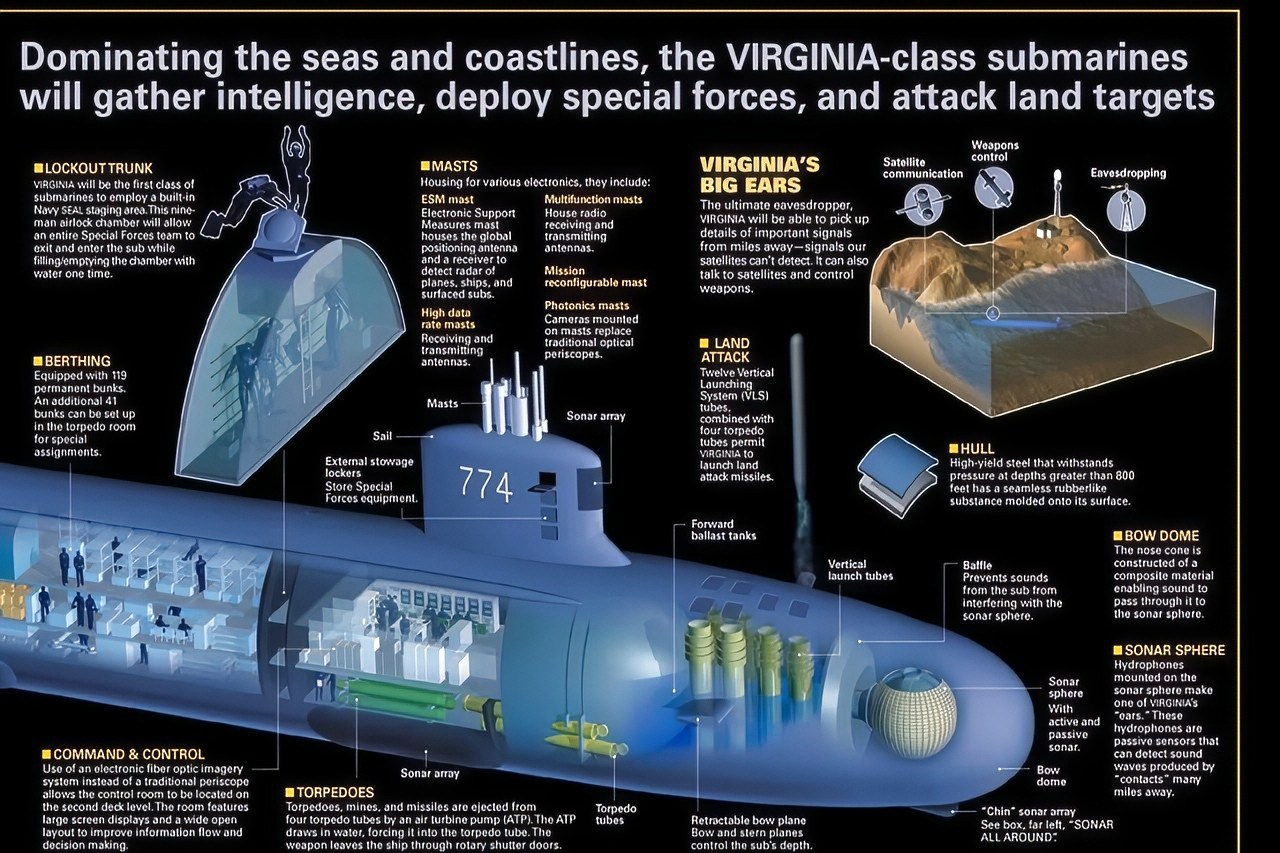
The U.S. Navy’s Block V Virginia-class fast-attack submarines have made a breakthrough in weapons payload. The nuclear-powered boats feature the Virginia Payload Module (VPM). There is now an 84-foot missile tube section added to the center of the submarine that will increase the missile firing capability for Tomahawk cruise missiles from 12 missiles up to 40, tripling the boat’s firepower.
The Block V has four large-diameter payload tubes. “Each VPM payload tube is capable of carrying seven Tomahawk cruise missiles, adding 28 missiles per VPM,” according to a U.S. Navy profile.
Block V Virginia-class Subs Are Adept at Deploying SEALs Too
The Block V VPMs will be installed on 10 new submarines procured from 2019 through 2025. VPM “reconstitutes the ability to host dry deck shelters.” This is important for deploying larger numbers of Navy SEALs. The Virginia-class Block V will be adept at special operations, including deploying SEALs to conduct intelligence, surveillance, and reconnaissance missions onshore. The SEALs could also deploy to blow up ships in harbors or to help prep the landing zone in an amphibious attack.
Tomahawk Supply Has Been Depleted
But it is the increase in Tomahawk missile magazines that is so important today. The “Kinetic Missile Fight” against Iran during Operation Epic Fury has greatly depleted the Tomahawk supply. Having submarines that have triple the capacity of cruise missiles will be extremely important should a two-front war spark against Iran, Russia, or China at the same time.

(Sept.9, 2011) The Virginia-class submarine Pre-Commissioning Unit (PCU) California (SSN 781) gets underway from Naval Station Norfolk to conduct weapons systems acceptance trials. California is the eighth Virginia-class submarine and is scheduled to be commissioned Oct. 29. (U.S. Navy photo by Mass Communication Specialist 2nd Class William Jamieson/Released)
Losing Attack Submarine and Cruisers to Retirement
The Navy is also decommissioning its four Ohio-class guided-missile submarines (SSGNs) between 2026 and 2028. They carry 154 Tomahawks each. This will remove 616 cruise missile launch cells from the fleet. Twelve Ticonderoga-class cruisers will also retire soon. This reduces the number of Tomahawk magazine capabilities. The Ticonderoga retirement would take out 2,080 Vertical Launch System cells from the mix.
Can the U.S. Navy Compete In Multiple War Theaters?
The Block V VPMs on the Virginia-class will help, but this is still a problem for the Navy. Delivery of Tomahawks to a war zone is important for U.S. military strategy in multiple theaters. Tomahawks are presidential-level assets. A commander-in-chief can order a Tomahawk strike at any time, and this can sometimes reduce the need for boots on the ground.
Cruise missile attacks are also Day One tactics and were used during the war with Iran. If President Donald Trump wants to attack Iran, if peace negotiations fail, the Department of Defense is likely to call on the launch of cruise missiles to punish Tehran for not making a deal to keep the country from producing a nuclear device. Trump delayed his plan of attack, scheduled for May 19, to allow time for peace talks to resume.
Virginia-Class Submarine Cut Out. Image Credit: Creative Commons.
What Is the Kinetic Missile Fight?
What I call the Kinetic Missile Fight is the next dominant phase of modern warfare. This is large-scale combat driven by long-range missiles, drones, cruise missiles, and interceptors rather than by classic dogfighting between fighter jets or by the mass use of tanks and armored personnel carriers on land. Magazine depth becomes strategically decisive. The United States waged the Kinetic Missile Fight quite effectively against Iran.
However, China would be better at the Kinetic Missile Fight. So, the United States must improve its game. Victory depends on missile inventories and industrial production. The Block V VPM will help bring more cruise missiles to bear, but will they be enough in the next war?
Tomahawks Are Difficult and Expensive to Build
Tomahawks cost between $1.5 million and $4 million per missile, depending on the variant and level of modernization. They take around 18 to 26 months to build, and the “delivery timeline is 47 months,” according to the think tank CSIS.
“Analysis performed by CSIS in April found that the Iran war had depleted nearly one-third of the United States’ prewar Tomahawk inventory — over 1,000 out of 3,100,” National Defense magazine noted.
Block V VPM Comes at a Good Time
The Block V VPM is a valuable addition to the Tomahawk supply, but it could be too little too late. It is a good thing that the ceasefire with Iran is still holding and that the two countries have discussed a comprehensive peace offering.
The Navy needs more Tomahawks, but the retiring subs and ships will make it difficult to compete in the Kinetic Missile Fight. China is certainly doing the arithmetic and closely examining the supply of Tomahawk missiles.
The latest VPM is noted by Beijing, but Xi Jinping’s intelligence chieftains are surely telling the Chinese leader that the United States has a limited number of Tomahawks and that they are costly and time-consuming to replace.
Don’t Forget About North Korea
Russia is also surely conducting its own intelligence analysis and reporting to its military high command on the problem of U.S. Tomahawk magazine depth. North Korea is watching too.
Indeed, the global reach of the Virginia-class with the Block V VPM comes at a good time as the Navy looks at East Asia and wonders if it could compete in a Kinetic Missile Fight against either China or North Korea. President Donald Trump has even acknowledged that it would be difficult to resupply the military if the Americans were forced to intervene in a Chinese attack on Taiwan or during a blockade or quarantine of the island.
So the Block V VPM comes at the right time. U.S. missile supplies must be improved, but losing the Ohio-class SSGNs and the Ticonderoga-class warships will reduce the number of Tomahawks available for deployment.
Let’s hope the Navy has other plans to increase the magazine depth, or it may find itself lagging in preparation for the Kinetic Missile Fight.
About the Author: Brent M. Eastwood, PhD
Author of now over 3,500 articles on defense issues, Brent M. Eastwood, PhD, is the author of Don’t Turn Your Back On the World: A Conservative Foreign Policy and Humans, Machines, and Data: Future Trends in Warfare, plus two other books. Brent was the founder and CEO of a tech firm that predicted world events using artificial intelligence. He served as a legislative fellow for US Senator Tim Scott and advised the senator on defense and foreign policy issues. He has taught at American University, George Washington University, and George Mason University. Brent is a former US Army Infantry officer. He can be followed on X @BMEastwood.


