


Summary and Key Points: Prime Minister Sanae Takaichi’s landslide victory in the February 2026 elections has granted her a powerful two-thirds majority, cementing a hardline Japanese stance against Chinese expansionism.
-This electoral mandate vindicates Takaichi’s “survival-threatening” rhetoric regarding Taiwan, signaling a historic departure from Tokyo’s traditional strategic ambiguity.
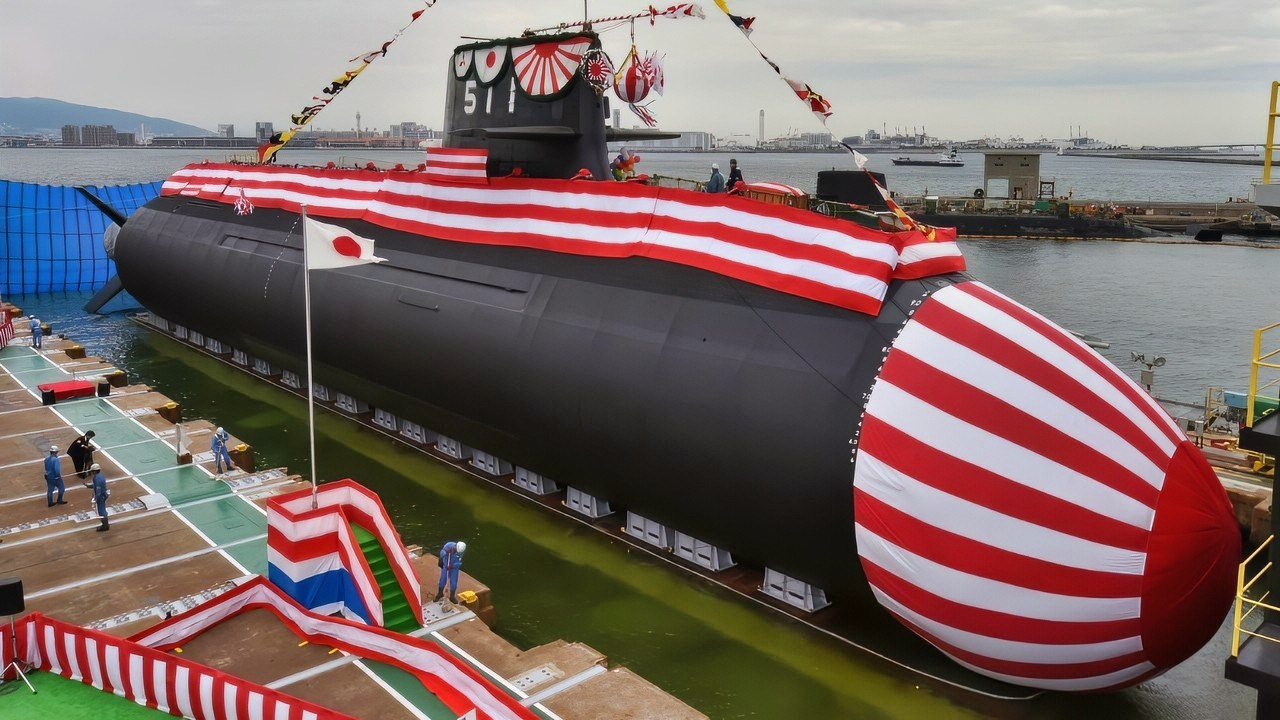
Japan AIP Soryu-Class Submarine. Image Credit: Creative Commons.
-As Beijing continues to “tighten the screws” around the Senkaku Islands, a newly emboldened Japan faces a critical choice: serve as Washington’s deputy or emerge as an independent regional hegemon.
-With Taiwan’s internal politics volatile and U.S. commitment questioned, Takaichi’s victory marks a new, more assertive era for Japanese military and diplomatic policy.
Japan’s 2026 Landslide: Why Sanae Takaichi’s Victory Is Xi Jinping’s Newest Headache
Japan’s new prime minister, Sanae Takaichi, seemed determined from the outset to pursue a hardline policy toward the People’s Republic of China (PRC) regarding Taiwan and a range of other security issues. She also emphasized that she intended to firmly resist Beijing’s economic, diplomatic, and military pressure tactics. Regarding Taiwan, Takaichi made it clear that her country was committed to preserving at least the status quo regarding the island’s de facto independence.
During a parliamentary debate, she even dared to cross a longstanding policy line that Beijing had drawn. Asked repeatedly about a hypothetical Taiwan “security contingency,” Takaichi abandoned Tokyo’s usual diplomatic evasions and declared that a military crisis over the island would constitute a “survival-threatening situation” for Japan, thereby potentially triggering collective self-defense and direct Japanese military involvement.
Japan’s Strengthened Position
Beijing’s furious, uncompromising response was not long in coming.
Warwick Powell, a scholar at Queensland University of Technology in Australia, noted that Chinese coast guard ships soon “conducted prolonged patrols in the waters around the Diaoyu/Senkaku Islands,” which Tokyo and Beijing both claim. Powell contends that the patrols were “a reminder that Beijing can tighten the screws in the East China Sea whenever it wishes.” One ugly recent confrontational incident occurred between Japanese and PRC vessels in early December 2025.
However, Takaichi’s political position is now much stronger after Japan’s February 8, 2026, parliamentary election. Her Liberal Democratic Party and its coalition partner, the Japan Innovation Party, were on track to win at least 310 seats in the 465-seat lower house in Japan’s parliament, according to initial results and major news media projections. That outcome would provide Takaichi’s government with a two-thirds majority in the lower house, giving it overwhelming control of that chamber and the ability to push through its domestic and foreign policy agenda virtually unimpeded.

Capt. Ryosuke Sugimoto, a Japanese Air Self-Defense Force F-35 Lightning II pilot, sits in an ejection seat wearing his new pilot gear after completing the 1,000th fitting in the pilot fit facility at Eglin Air Force Base, Florida, May 22, 2024. This milestone fitting underscores the strong international partnership and commitment to pilot readiness and safety. (U.S. Air Force photo by 1st Lt. Jymil Licorish)
The LDP alone was projected to win a majority of seats, a huge improvement in the party’s fortunes after more than a decade of relying on fragile, often fractious coalitions.
As the Wall Street Journal noted: “The landslide win was a vindication for the 64-year-old conservative, who called the risky snap vote only three months after taking office. The scale of Takaichi’s win suggests voters approve of her handling of China, which has heaped pressure on Japan over remarks she made about Taiwan.”
It will be both interesting and extremely significant to see how Beijing responds to the Japanese prime minister’s strengthened electoral mandate.
Chinese leaders might decide to seek a limited rapprochement with Tokyo to minimize the risk of an even greater surge of anti-Chinese Japanese nationalism.
Conversely, President Xi Jinping’s government could choose to escalate tensions with Japan as a demonstration of China’s overall rising power and influence.
Territorial Disputes
Intensifying the bilateral territorial dispute over the Diaoyu/Senkaku Islands could be an especially tempting option for Beijing if PRC leaders embrace the latter course. Those uninhabited tidbits of land are strategically located, and credible indications suggest that the surrounding waters may contain sizable deposits of valuable minerals.
Yet, absent a PRC attempt to forcibly seize the islands from Japan’s longstanding administrative control, both Tokyo and Washington would be unlikely to mount a major military response to Beijing’s naval maneuvers or depredations. Hence, the risk level to China for jingoistic posturing is modest.

J-20 Fighter In All Yellow. Image Credit: Creative Commons.
Beijing also could decide to test the extent of Takaichi’s rhetorical commitment to Taiwan’s security and de facto independence. She may discover that under its current political leadership, Taipei could prove to be a volatile client. Taiwan’s president, Lai Ching-te (William Lai), has adopted a provocative, highly assertive policy toward Beijing since taking office in May 2024.
The PRC has responded with menacing military maneuvers. Lai’s strategy seems aimed at securing, eventually, formal international recognition of Taiwan’s current de facto independence. He also appears to want a firm commitment from the United States and its allies to defend Taiwan from PRC coercion.
Lai’s agenda may go well beyond where even Takaichi and other Japanese hawks are comfortable going. Japan’s leaders also must consider Taiwan’s internal political divisions and volatility.
Lai and his Democratic Progressive Party (DPP) supporters continue to wage a bitter internal political war with the more moderate Kuomintang Party (KMT), which favors a decidedly softer, less confrontational policy toward Beijing. It is an increasingly tense political environment with Lai holding the presidency, but a KMT-led coalition controlling the legislative branch. In July, 2025, voters rejected an effort by Lai to purge targeted opposition legislators through an unprecedented recall vote.
Tokyo’s Policy
Takaichi and her ministers must ensure that Tokyo’s policy is not undermined by a sudden change in Taiwan’s political leadership or by Taipei adopting an appeasement policy toward Beijing.
Beyond the political issue regarding Taipei, Japanese policymakers must decide both how much they are willing to have their country spend on additional military might to help defend Taiwan and the level of risk they are willing to have their country incur for that mission.
Indeed, there is the even larger question of whether Japan has the political will to challenge a gradual PRC bid for regional hegemony across East Asia. Most previous Japanese governments have been content to let their country embrace US hegemony and serve as Washington’s obedient deputy.

J-20 Fighter in the Sun. Image Credit: PLAAF.
However, Donald Trump’s volatile rhetoric and inconsistent conduct raise legitimate doubts about whether the United States is willing or able to continue its traditional role as the region’s de facto hegemon. A substantial change in Washington’s stance would have profound implications for Japan’s policy.
Prime Minister Takaichi and the governing party now have an impressive electoral mandate.
Regarding foreign policy, the mandate confirms the Japanese public’s desire for a more assertive stance toward the PRC. But how the newly victorious government implements that mandate will be crucial going forward.
About the Author: Ted Galen Carpenter
Ted Galen Carpenter is a senior fellow at the Randolph Bourne Institute and a contributing editor at The National Security Journal and The American Conservative. He is the author of 13 books and more than 1,500 articles on national security, international affairs, and civil liberties. His latest book is Unreliable Watchdog: The News Media and US Foreign Policy (2022).


