


Israel’s F-16I Sufa — Storm in Hebrew — is a heavily modified two-seat F-16D Block 50/52 built by Lockheed Martin and customized by Israeli defense industries for the Israeli Air Force. The Sufa can reach Iran or Libya without refueling thanks to Israeli-designed conformal fuel tanks that extend its range by 50% and let it carry 50% more weapons. Israel operates more than 360 F-16s — second only to the U.S. Air Force globally. Half of the aircraft’s avionics are Israeli, including the Elisra SPS 3000 self-protection jammer and Elbit’s DASH IV helmet. Weapons include the AIM-120 AMRAAM and Rafael Python 5.
The F-16I Sufa Fighter Is a Monster

F-16I Sufa. Image Credit: Creative Commons.

F-16I Fighter from Israel. Image Credit: Creative Commons.

Israel F-16I Fighters IDF. Image Credit: IDF.
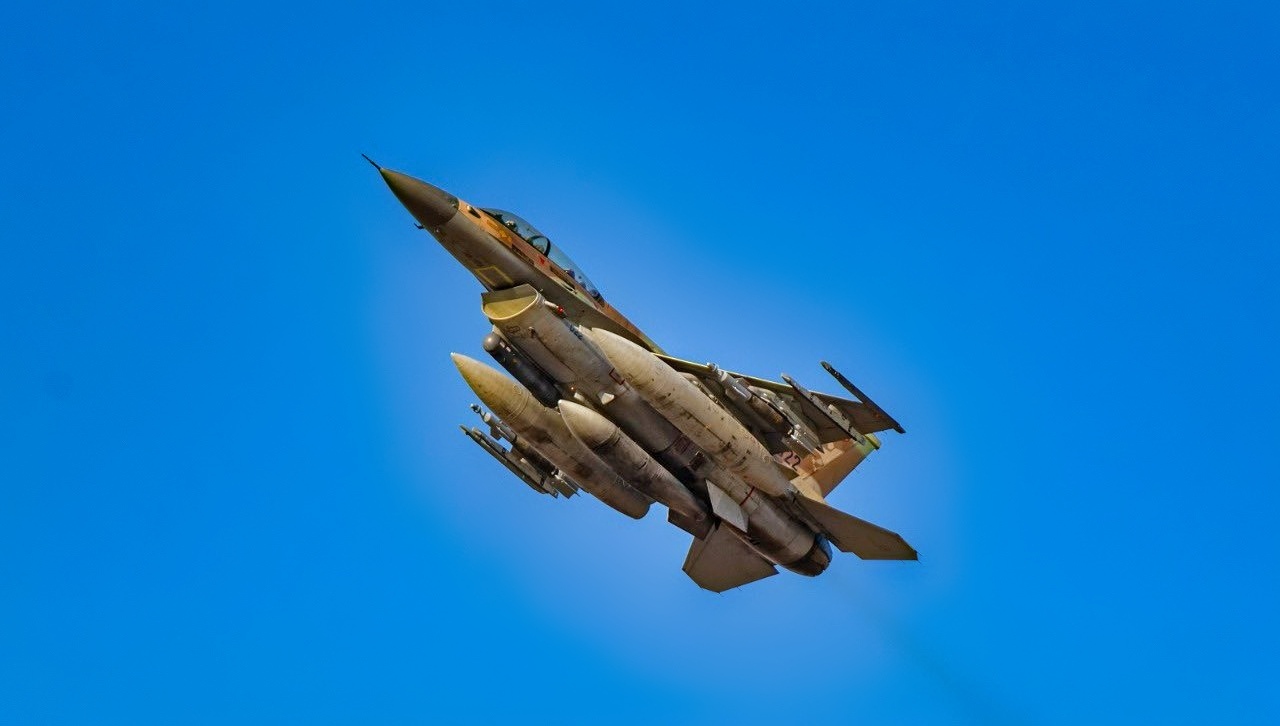
F-16I from Israeli Air Force. Image Credit: Creative Commons.
The Israeli Air Force F-16I Sufa is a heavily customized, two-seat variant of the F-16D Block 52 fighter, tailored specifically for the Israel Air Force. Built by Lockheed Martin, it serves as the backbone of Israel’s long-range strike and air superiority capabilities.
The F-16I Sufa (Storm) is a modified variant of the F-16D Block 50 and 52 air superiority fighter and ground-attack aircraft. Its avionics and weapons systems capabilities have been modified to meet the requirements of the Israeli Air Force.
Like the Israeli version of the Lightning II, the F-35I, Israel has taken an already outstanding aircraft, tailored it to its own needs, and made it even better.
Enhancements Make A Great Aircraft Better
The Sufa (Storm) is manufactured by Lockheed Martin and equipped with a Pratt & Whitney F100-PW-200/220/229 or General Electric F110-GE-100/129 engine that produces 27,000 pounds of thrust.
Its top speed is 1,500 mph (Mach 2 at altitude). The Sufa also has advanced systems developed in Israel according to the IAF’s specifications by the country’s defense industries.
Deliveries for the Sufa began in 2004. It features advanced avionics, Israeli-designed conformal fuel tanks for extended range, and enhanced air-to-ground weapons capacity.
Meet The Israeli F-16I Sufa
Outside the United States, the Israeli Air Force has the largest number of F-16s worldwide, with more than 360 aircraft. The two-seat variant of the F-16—the F-16I Sufa—was specifically designed to meet the IAF’s requirements and is nicknamed Sufa, or “storm” in Hebrew.
The F-16I can reach Iran or Libya without refueling. The Storm, with its conformal fuel tanks running along the fuselage instead of on the wing pods, can carry 50 percent more weaponry while extending the range by 50 percent. The F-16I carries US and Israeli weapons.
It will be the first Israeli aircraft to carry the US-made AIM-120 AMRAAM air-to-air missile, which has a range of 57-65 nautical miles (NM). The AIM-120D has a greater range, allowing it to hit and destroy targets 86-97 NM away.
The F-16I is also equipped with the Synthetic Aperture Radar system and Litening navigation pod, which give it all-weather, day-and-night attack capabilities. It also has internally mounted FLIR (forward-looking infrared) viewers and state-of-the-art systems hardware from the Israeli manufacturer Lahav, allowing simultaneous multi-target engagement and increased survivability.
Conformal Fuel Tanks Extend Their Range
One of the more significant differences between the Sufa and the American version is the addition of conformal fuel tanks mounted along the upper fuselage.
These external fuel tanks significantly extend the operational range without occupying underwing hardpoints, and they can also reduce radar signature by creating a smoother, more rounded, and more horizontal fuselage.
The F-16I’s Elbit Dash IV display Helmet (DASH) enables pilots to aim their weapons simply by looking at the target. According to Elbit’s website, DASH measures the pilot’s line of sight (LOS) relative to the aircraft and transfers its information to other aircraft systems.
Thus, aircraft, sensors, avionics, and weapons are enslaved to the target. DASH is adaptable to any fighter or attack aircraft and will accommodate advanced missiles and smart weapon lock-on envelopes.
The Storm’s electronic warfare suite and avionics package are the most significant upgrades. Israeli industries replaced half of the F-16s’ avionics with their own, much as the F-35I Adir does. The Storm’s electronic warfare suite incorporates radar warning systems and jamming capabilities, including the Elisra SPS 3000 self-protection jammer.
Besides the AIM-120 AMRAAM, the F-16I can carry the Israeli Rafael Python 4 and Python 5 imaging infrared-guided high-agility air-to-air missile. The Python 4 is widely considered the most advanced heat-seeking missile in the world.
The F-16I Operates As A Two-Pilot Aircraft
The Sufa features a pilot and a Weapons Systems Officer (WSO), significantly reducing workload during high-threat, long-range strike missions.
Many US F-16s operate with a single pilot; however, the Israelis have found that the two-pilot system has enhanced its performance on deep-strike and precision strike operations.
The F-16I’s Outstanding Combat Record
The Israeli Air Force (IAF) has taken the tremendous F-16 aircraft and made it even better.
“Going over to fly a Sufa jet, after flying the existing F-16, is like starting to drive an American luxury car after you’re used to an old, dilapidated Subaru,” said Major H. (Israeli pilots do not publicize their full names in the media for their protection).
The pilot added, “The Sufa is able to fly low and in all weather conditions, almost without manual intervention. It was able to avoid being detected by enemy radar and return home safely from its missions.”
During Operation Guardian Walls in Gaza in 2021, Israeli aircraft, mainly the Sufa, blasted Hamas tunnel complexes, weapons depots, and high-value targets. It involved other IAF aircraft, including the F-35I and F-15I.
The F-16I Sufa was heavily involved in the recent Israeli counterstrikes against Hamas in Gaza and the West Bank, in Syria against Iranian proxies, and against Hezbollah in Lebanon.
After they took out all of Iran’s air defenses in October of last year, the Israeli Air Force proved that they will not suffer attacks from Iran’s missiles, their proxies, or their threats any longer.
And while traditional F-16s were made for dogfighting, the F-16I was designed as a deep-strike platform, making it one of the most formidable, customized iterations of the F-16 Fighting Falcon ever produced.
As we’ve seen in Iran, the Israelis open an air campaign by flying F-35I Adir stealth fighters first, knocking out air defenses and hitting targets. Once lanes open, F-16I Sufa’s pour through and conduct precision strikes with its massive bomb load. It is the perfect “Israeli Storm.”
And it seems like the Israelis will continue to operate the aircraft for many years to come.
MORE – China Has Thousands of Missiles to Point at Navy Aircraft Carriers
MORE – Canada’s F-35 Purchase Could Get Squashed
About the Author: Steve Balestrieri
Steve Balestrieri is a National Security Columnist. He served as a US Army Special Forces NCO and Warrant Officer. In addition to writing on defense, he covers the NFL for PatsFans.com and is a member of the Pro Football Writers of America (PFWA). His work was regularly featured in many military publications.


