

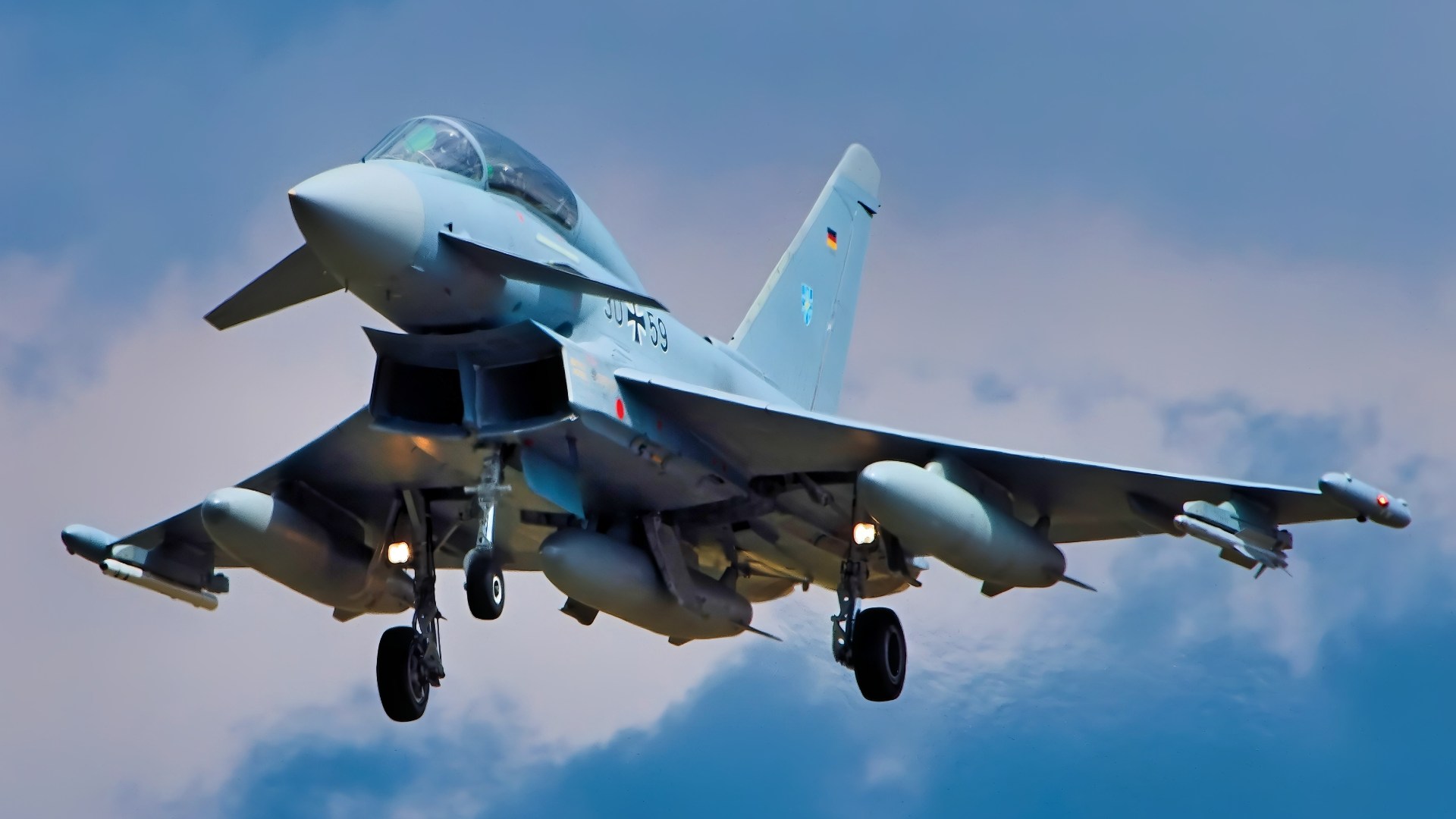
The Eurofighter Typhoon’s CAPTOR-E AESA radar is mounted on a pivoting mechanism that gives the aircraft a wider field of view than any rival fighter. The Tranche 4 aircraft recently unveiled by Germany received the ECRS Mk 1 AESA radar, developed jointly by Italy, the UK and Germany. The Tranche 5 — still under development — will reach operational status in the 2030s. Phase 1 Enhancements turned the Typhoon from an air superiority fighter into a multirole aircraft capable of air-to-air and air-to-ground missions in the same sortie. Phase 2 added the Meteor beyond-visual-range air-to-air missile and the Brimstone precision air-to-ground missile.
The Eurofighter Typhoon Is One Tough 4th Generation Fighter

A UK Typhoon flies above the Baltics on 25 May 2022.
UK and Czech fighter jets have been taking part in air defence training over the Baltic region. UK Eurofighter Typhoons, F-35s and Czech Gripens were involved in an exercise as part of Neptune Shield 22 (NESH22), a multinational maritime vigilance activity. NESH22 has seen a range of multi-domain activities between air, land and maritime assets across Europe and in the Baltic and Mediterranean Seas. It runs from 17 to 31 May 2022.
The Eurofighter Typhoon was developed through a joint effort by the UK, Germany, and Italy to create a solely European aircraft for the program’s participants and any other allied countries that may be interested.
Despite the program’s many delays, the Typhoon has now become a staple aircraft for many air forces worldwide. Over time, the Eurofighter has evolved from an air-superiority fighter to a versatile and highly capable multi-role aircraft. Recent batches include upgraded avionics, enhancing the Typhoon’s capabilities in networked environments.
Design and Capabilities
The Typhoon features a twin-engine configuration with a canard-delta wing layout that provides exceptional agility and aerodynamic efficiency.
The aircraft uses a digital fly-by-wire control system that allows for relaxed static stability, giving pilots a highly responsive platform capable of rapid maneuvers.
Its high thrust-to-weight ratio and supercruise capabilities give it a strong advantage in air combat scenarios.
Early versions of the Typhoon were primarily built for air-superiority missions and were equipped with advanced radar systems, infrared search-and-track sensors, and a suite of defensive countermeasures known as the Defensive Aids Sub-System. These features provided pilots with strong situational awareness and survivability in contested environments.
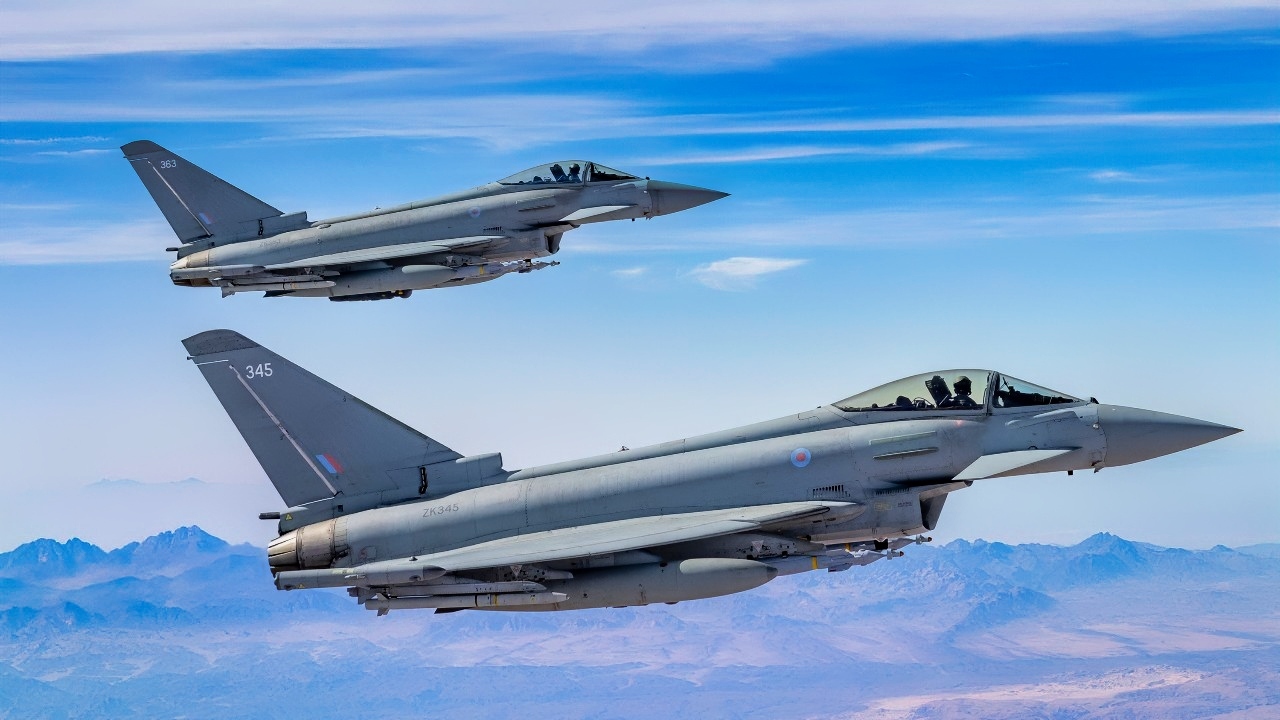
Image of two RAF Typhoon FGR Mk 4 aircraft, seen here during a routine mission over the Middle East as part of Operation Shader.
Op SHADER air to air refuelling sortie took place on Wednesday 13th November, maintaining Typhoon presence across the Middle East running routine missions.
Typhoon, Voyager and Atlas A400 aircraft operate from RAF AKrotiri as part of Op SHADER, part of the International coalition effort fighting terrorist organisations in the Middle East region.
The RAF has been engaged in this mission since 2014 combating Daesh in Iraq and Eastern Syria as well as Houthi Rebels more recently in Yemen who threaten global shipping. Image Credit: Creative Commons.
The Eurofighter’s Evolution Over Time
The development of the Typhoon was structured in production tranches, each bringing progressive improvements in capability and flexibility.
Tranche 1 aircraft were primarily configured for air-to-air combat and had limited ground-attack capabilities.
While still highly effective in their intended role, these early jets lacked the versatility that later versions would achieve. Tranche 2 introduced significant upgrades, including improved avionics, better computing power, and expanded compatibility with air-to-ground weapons. This shift allowed the Typhoon to begin functioning as a multirole aircraft rather than a dedicated interceptor.
Tranche 3 took this progression even further by incorporating structural and electronic provisions for future enhancements, including increased power generation and the option for conformal fuel tanks, which extend range without reducing weapon capacity.
The most recent tranches further enhance the aircraft’s capabilities.
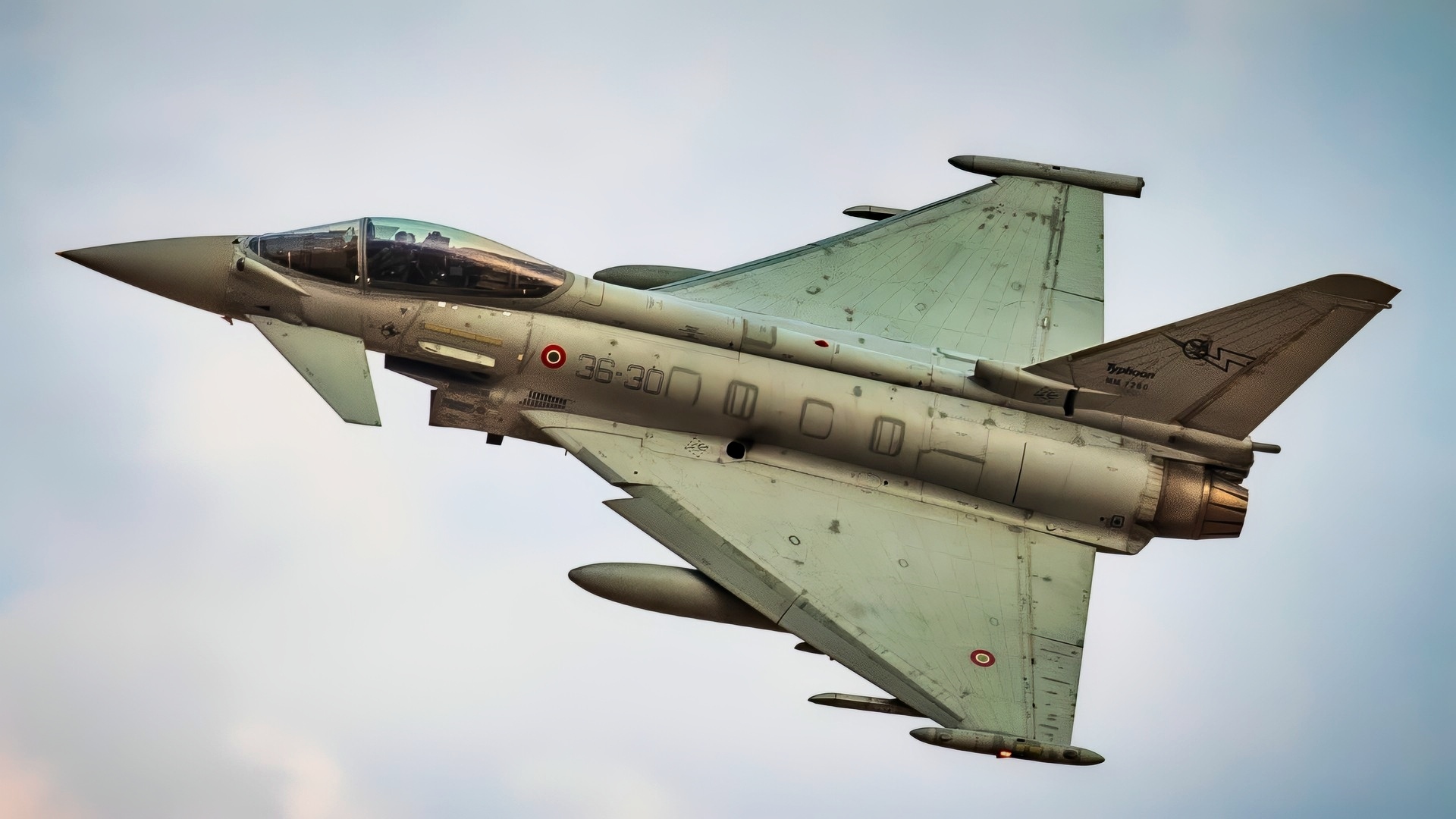
An Italian Air Force Eurofighter Typhoon maneuvers during a joint close air support exercise with U.S. Marines attached to the Special Purpose Marine Air-Ground Task Force – Crisis Response – Central Command (SPMAGTF-CR-CC) 19.2, and service members with the Italian Air Force in Kuwait, Oct. 14, 2019. The SPMAGTF-CR-CC works with partner nations on maintaining regional security. (U.S. Marine Corps photo by Sgt. Kyle C. Talbot)
The Eurofighter tranche 4, recently unveiled by Germany, received the ECRS Mk 1 AESA radar, developed by a joint partnership among Italy, the UK, and Germany. Interestingly, the Luftwaffe’s newest Typhoons seem to lack the PIRATE (Passive InfraRed Airborne Track Equipment) system, although the decision is likely based on Germany’s particular operational needs.
The Eurofighter tranche 5 is the newest variant of the aircraft and is still undergoing development. This tranche is expected to reach operational status in the 2030s and will have a completely new set of avionics, enabling it to participate in multiple missions as needed.
Phase Enhancement Upgrades
In parallel with these production tranches, the Typhoon has undergone a series of structured upgrade programs known as Phase Enhancements. Phase 1 Enhancements, completed in the mid-2010s, marked a turning point in the aircraft’s operational flexibility.
These upgrades enabled the Typhoon to conduct air-to-air and air-to-ground missions during the same sortie, an important capability in modern combat environments.
The integration of weapons such as the Paveway IV precision-guided bomb expanded its ability to engage ground targets with accuracy, while improvements in onboard software enhanced sensor integration and mission effectiveness.
Phase 2 Enhancements brought further expansion of the Typhoon’s strike and air combat capabilities. One of the most important additions during this stage was the integration of the Meteor BVR air-to-air missile, which significantly increased the aircraft’s engagement range and lethality against enemy aircraft.
The Brimstone missile was also added, giving the Typhoon a highly effective tool for precisely targeting moving ground targets.
These upgrades strengthened its role in both air-dominance and close-support missions, allowing it to adapt more effectively to modern battlefield requirements. More recent phases have enabled the aircraft to carry more advanced armaments, such as the Storm Shadow/SCALP cruise missile.
Avionic Improvements
One of the most significant technological upgrades to the Typhoon has been the introduction of the CAPTOR-E AESA radar. Earlier versions of the aircraft used mechanically scanned radar systems, but the AESA upgrade provides a major leap in performance.
It enables faster target acquisition, simultaneous tracking of multiple threats, and greater resistance to electronic jamming. The CAPTOR-E radar is mounted on a pivoting mechanism that increases its field of view, giving the Typhoon an advantage in detecting and engaging targets across a wider area. This improvement enhances both air-to-air combat effectiveness and ground mapping for strike missions.
Avionics and software have also seen continuous improvement throughout the aircraft’s service life.
The Typhoon’s systems are designed to fuse data from multiple sensors, presenting pilots with a clear and comprehensive picture of the battlespace. Updates to the human-machine interface, including helmet-mounted displays, have made it easier for pilots to manage complex missions. Enhanced data link capabilities allow the Typhoon to operate effectively in network-centric environments, sharing information with other aircraft, ground forces, and command systems in real time.
Offensive and Defensive Enhancements
Weapons integration has played a central role in the Typhoon’s upgrades. In addition to traditional air-to-air missiles such as the AIM-120 AMRAAM and ASRAAM, the aircraft now carries advanced systems like the Meteor missile for long-range engagements.
Its air-to-ground arsenal includes precision-guided bombs, Brimstone missiles, and Storm Shadow cruise missiles, enabling it to conduct both tactical strikes and deep penetration missions. Ongoing development programs aim to integrate additional advanced weapons, ensuring the Typhoon remains competitive against newer aircraft.
The aircraft’s defensive systems have also been steadily improved.
The Defensive Aids Sub-System includes radar warning receivers, missile approach warning sensors, electronic countermeasures, and towed decoys.
Continuous updates to these systems have improved the Typhoon’s ability to survive in increasingly complex threat environments, including those involving advanced surface-to-air missile systems and electronic warfare capabilities.
About the Author: Isaac Seitz
Isaac Seitz, a Defense Columnist, graduated from Patrick Henry College’s Strategic Intelligence and National Security program. He has also studied Russian at Middlebury Language Schools and has worked as an intelligence Analyst in the private sector.


