

Summary and Key Points: This summer, the U.S. Navy will conduct an unprecedented test, exporting electricity from the USS Gerald R. Ford’s two A1B nuclear reactors to Naval Station Norfolk — the world’s largest naval base — to prove the carrier can keep the facility running if cyberattacks, missile strikes, or drone strikes take down the civilian power grid.
-Acting Navy Secretary Hung Cao confirmed the plan at a May 14 House Armed Services Committee hearing, telling lawmakers “This summer, Norfolk Naval Base is going to be powered from an aircraft carrier.”
The U.S. Navy Has a Big Aircraft Carrier Idea
The U.S. Navy is preparing to test whether the USS Gerald R. Ford can act as a floating nuclear power plant for shore facilities, using the carrier’s two A1B nuclear reactors to export electricity to Naval Station Norfolk in Virginia later this summer. The decision was confirmed by Acting Navy Secretary Hung Cao during a May 14 House Armed Services Committee hearing.

The world’s largest aircraft carrier, USS Gerald R. Ford (CVN 78), conducts flight operations in the North Sea, Aug. 23, 2025. Gerald R. Ford, a first-in-class aircraft carrier and deployed flagship of Carrier Strike Group Twelve, is on a scheduled deployment in the U.S. 6th Fleet area of operations to support the warfighting effectiveness, lethality, and readiness of U.S. Naval Forces Europe-Africa, and defend U.S., Allied and partner interests in the region. (U.S. Navy photo by Mass Communication Specialist 2nd Class Maxwell Orlosky)
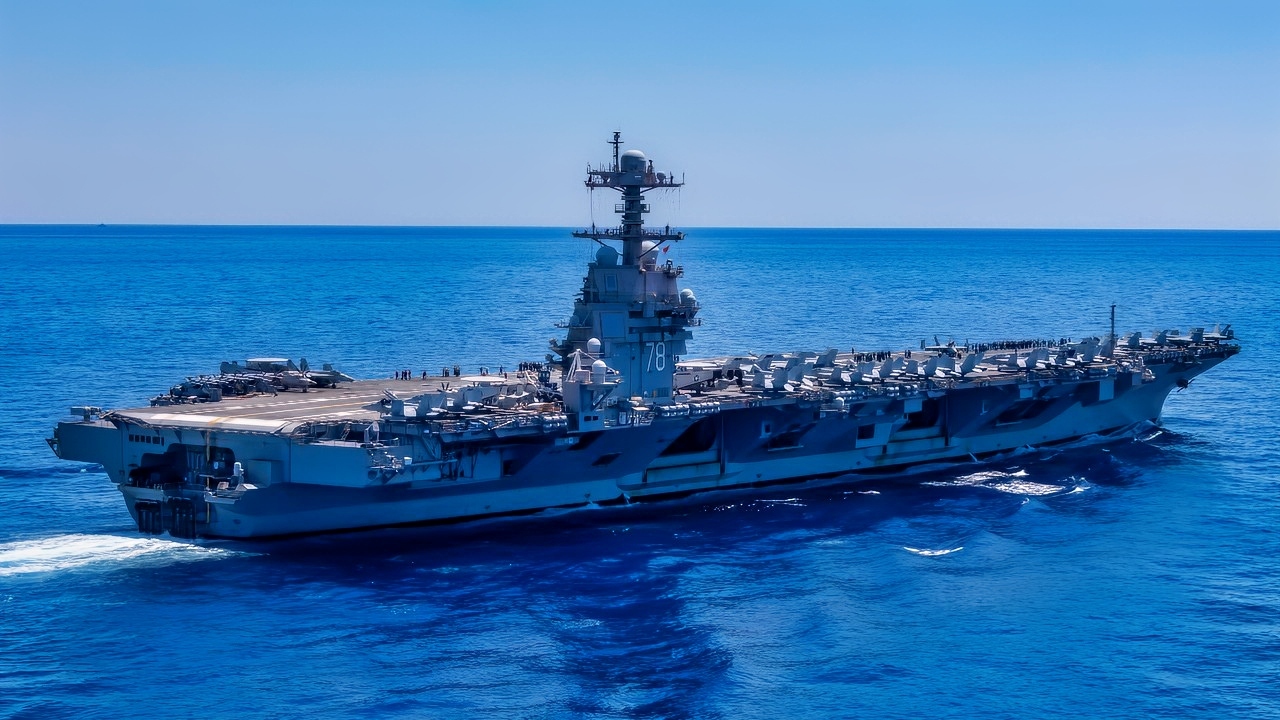
The world’s largest aircraft carrier, USS Gerald R. Ford (CVN 78) transits the Mediterranean Sea, August 1, 2025. Gerald R. Ford, a first-in-class nuclear aircraft carrier and deployed flagship of Carrier Strike Group Twelve, is on a scheduled deployment in the U.S. 6th Fleet area of operations to support the warfighting effectiveness, lethality, and readiness of U.S. Naval Forces Europe-Africa, and defend U.S., Allied, and partner interests in the region. (U.S. Navy photo by Mass Communication Specialist Seaman Brianna Barnett)

(July 28, 2017) An F/A-18F Super Hornet assigned to Air Test and Evaluation Squadron (VX) 23 approaches the aircraft carrier USS Gerald R. Ford (CVN 78) for an arrested landing. The aircraft carrier is underway conducting test and evaluation operations.(U.S. Navy photo by Erik Hildebrandt/Released) 170728-N-UZ648-161
“This summer, Norfolk Naval Base [sic] is going to be powered from an aircraft carrier,” Cao said. “We’re going to export the energy from the aircraft carrier to the base.”
The test is designed to prove that the Navy can keep critical bases operating if the civilian grid is disrupted by cyberattacks, a missile, or drone strikes.
What, Exactly, the Navy Is Testing
Speaking to The War Zone, a Navy spokesman confirmed that the Department of the Navy is “executing a multi-pronged strategy to ensure the delivery of firm, baseload power to our installations for energy resilience and mission assurance.”
“One line of effort in the strategy is to deliver power from a Ford-class nuclear-powered aircraft carrier to a compatible shore installation, to demonstrate the capability to meet emergent, mission-critical needs. An initial test of this capability is being planned for later this year at Naval Station Norfolk,” the spokesperson also said.
The USS Gerald R. Ford is currently the only commissioned Ford-class carrier and is homeported at Norfolk, making it the obvious ship for the test. The carrier recently returned to Virginia after a 326-day deployment, the longest U.S. aircraft carrier deployment since the Vietnam War.
Why Ford Is Different
Ford-class carriers can already be described as floating cities. The ships can carry roughly 4,500 sailors and air wing personnel, and their reactors must support propulsion, sensors, aircraft launch systems, weapons elevators, communications equipment, and shipboard services.
The exact output of the A1B reactors is classified, but they are generally understood to provide around a quarter more reactor energy than the A4W reactors used on Nimitz-class carriers. That extra energy was built into the Ford design, in part, because future carriers are expected to require far more electrical power for new equipment, including next-generation weapons, electronic warfare systems, sensors, and more.
That requirement for expanded energy generation for future directed-energy weapons is what makes this test particularly important.
The Navy is not simply asking whether a carrier can produce enough electricity for itself, but also if it can generate excess power to serve as a backup source for critical infrastructure on land. That is an enormous amount of power.
Why Bases Need Backup Power
As the Pentagon focuses on expanding American military capability, it is also working to protect it by addressing vulnerabilities in U.S. bases and infrastructure. For decades, major domestic installations have been treated as relatively safe areas – but that assumption is no longer completely accurate.
Everything from long-range missiles and cyberattacks to sabotage, drones, and direct attacks on civilian infrastructure now poses a risk to U.S. installations as those techniques have all become central features of modern warfare.
The war in Ukraine is a good example of this, and it shows how quickly power grids can become military targets – and be forced offline.
Cheap unmanned systems can slip through defenses and wreak havoc when directed at civilian energy infrastructure, and for the U.S. military, there is a clear lesson: bases can no longer assume that the civilian grid will always be available.
That matters particularly at Norfolk, the world’s largest naval base and a critical hub for Atlantic Fleet operations. If the base lost power during a crisis, the disruption would not just affect offices and housing – it could affect everything from ship maintenance and communications to logistics, fuel systems, and command-and-control functions.
Disaster Relief
Domestic emergency planning is also a factor here. Cao said that carrier-generated energy could support desalination and freshwater production, arguing that the ship could even export potable water during crises such as California droughts.
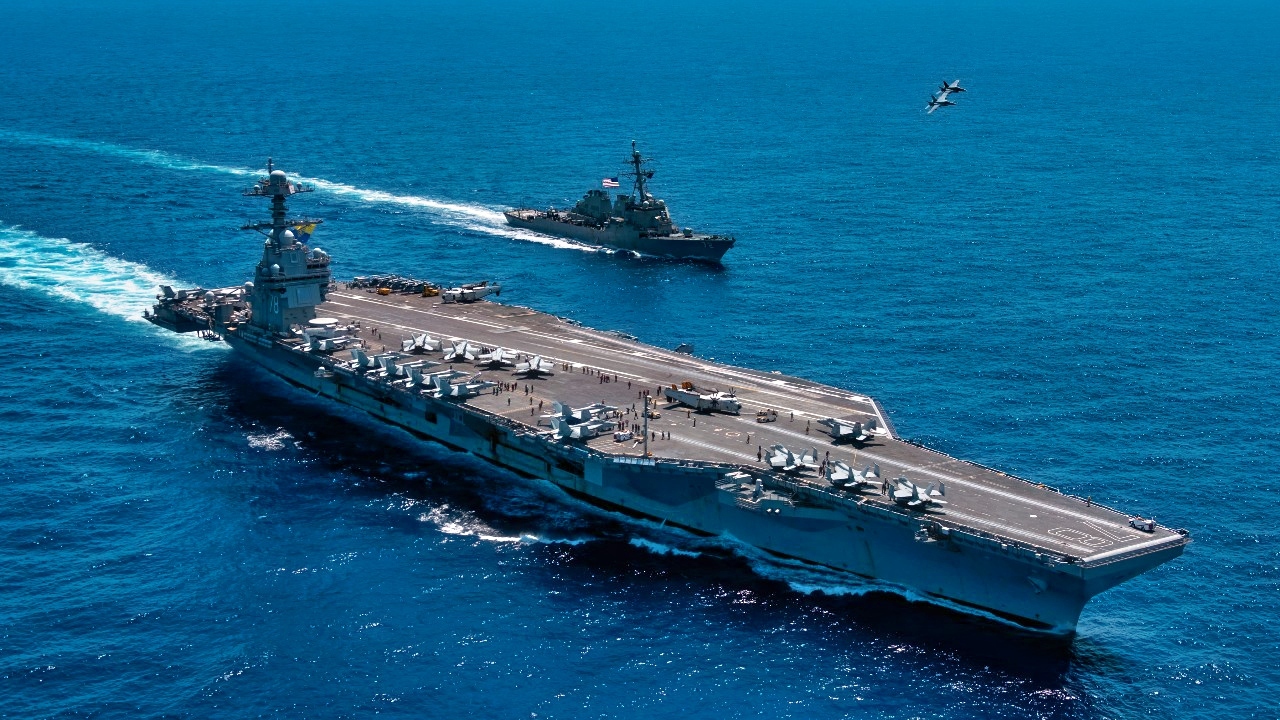
An F/A-18F Super Hornet, attached to the “Blacklions” of Strike Fighter Squadron (VFA) 213 and a F/A-18E Super Hornet, attached to the “Golden Warriors” of Strike Fighter Squadron (VFA) 87 fly over the world’s largest aircraft carrier, USS Gerald R. Ford (CVN 78), the Arleigh Burke-class guided-missile destroyer USS Mahan (DDG 72), April 11, 2025. The Gerald R. Ford Carrier Strike Group is underway in the Atlantic Ocean completing integrated naval warfighting training. Composite Training Unit Exercise (COMPTUEX) is the Joint Force’s most complex integrated training event and prepares naval task forces for sustained high-end Joint and combined combat. Integrated naval training provides America’s civilian leaders and commanders highly-capable forces that deter adversaries, underpin American security and economic prosperity, and reassure Allies and partners. (U.S. Navy photo by Mass Communication Specialist 2nd Class Maxwell Orlosky

The world’s largest aircraft carrier USS Gerald R. Ford (CVN) 78 and the USNS Laramie (T-AO-203) conduct a refueling-at-sea in the Eastern Mediterranean Sea, Oct. 11, 2023. USS Gerald R. Ford is the Navy’s newest and most advanced aircraft carrier, representing a generational leap in the U.S. Navy’s capacity to project power on a global scale. The Gerald R. Ford Carrier Strike Group is currently operating in the Eastern Mediterranean Sea, at direction of the Secretary of Defense. The U.S. maintains forward deployed ready and postured forces to deter aggression and support security and stability around the world.(U.S. Navy photo by Mass Communication Specialist 2nd Class Jackson Adkins)

The Ford-class aircraft carrier USS Gerald R. Ford (CVN 78) and the Italian aircraft carrier ITS Cavour (CVH 550) transit the Atlantic Ocean March 20, 2021, marking the first time a Ford-class and Italian carrier have operated together underway. As part of the Italian Navy’s Ready for Operations (RFO) campaign for its flagship, Cavour is conducting sea trials in coordination with the F-35 Lightning II Joint Program Office’s Patuxent River Integrated Test Force to obtain official certification to safely operate the F-35B. Gerald R. Ford is conducting integrated carrier strike group operations during independent steaming event 17 as part of her post-delivery test and trials phase of operations.

ATLANTIC OCEAN (Oct. 29, 2019) USS Gerald R. Ford (CVN 78) conducts high-speed turns in the Atlantic Ocean. Ford is at sea conducting sea trials following the in port portion of its 15 month post-shakedown availability. (U.S. Navy photo by Mass Communication Specialist 3rd Class Connor Loessin)
It may sound extreme or unusual, but carriers have long been used in disaster responses. They can bring helicopters, medical facilities, communications equipment, logistics, and large crews to areas that really need the support. And, restoring power is often one of the most important tasks after natural disasters like hurricanes or earthquakes, before electricity supports hospitals, fuel distribution, communications, and more. Without it, rebuilding or saving lives becomes extremely difficult.
And, Norfolk itself is exposed to hurricanes and flooding.
A carrier that can help power its own base after a disaster would give the Navy another layer of resilience at one of its most important facilities.
America’s Grid Problem
The news comes amid growing concern over the fragility of America’s aging power grid. In April 2025, Spain and Portugal suffered a massive blackout that disrupted transportation, communications, airports, and hospitals across the Iberian Peninsula, proving just how vulnerable modern societies become when electricity suddenly disappears.
For the Pentagon, there is a clear and important lesson: if civilian grids fail during a war or after a cyberattack, the world’s most advanced military will become significantly less effective.
About the Author: Jack Buckby
Jack Buckby is a British researcher and analyst specializing in defense and national security, based in New York. His work focuses on military capability, procurement, and strategic competition, producing and editing analysis for policy and defense audiences. He brings extensive editorial experience, with a career output spanning over 1,000 articles at 19FortyFive and National Security Journal, and has previously authored books and papers on extremism and deradicalization.


Wayne
May 27, 2026 at 4:48 pm
It probably can power the base, but while doing so kind of makes it useless as an aircraft carrier.