

Chief of Naval Operations Admiral Daryl Caudle told Congress this month that the Trump-class nuclear-powered guided-missile battleship will use the A1B nuclear reactor — the same one that powers the Ford-class aircraft carrier. The lead ship will be named the USS Defiant. The Navy considered conventional propulsion to speed delivery but ultimately returned to nuclear, with Caudle saying nuclear is the exact right answer. Existing Ford-class reactor plant components — steam generators, pressurizers, reactor coolant pumps — will carry across. President Donald Trump first announced the program on December 22, 2025 as part of the Golden Fleet initiative. The Navy now plans 15 ships by 2056 at more than $17 billion each.
Trump-Class Battleship Getting Ford-Class Aircraft Carrier Nuclear Reactor
The U.S. Navy has confirmed that its future Trump-class guided-missile battleship will use the same A1B nuclear reactor technology currently powering the USS Gerald R. Ford aircraft carrier.
Chief of Naval Operations Adm. Daryl Caudle announced the decision during congressional testimony in Washington this month, ending months of uncertainty over whether the Navy would pursue conventional propulsion to accelerate production timelines.
What Caudle Said
“I’m thrilled we finally landed on the fact that it’s going to be nuclear,” Caudle said during his testimony. “We batted it around — to deliver it sooner, to make it conventional — and we came back around full circle to make it nuclear. That’s the exact right answer.”
The decision is hugely significant because the reactor system effectively defines what the Trump-class is intended to become.
The ship is no longer being discussed as a larger destroyer or missile cruiser, but is becoming a true next-generation capital ship designed around massive electrical generation, thereby making it suitable to accommodate weapons systems that are not even fully developed yet.
It will have long-range endurance and provide room to expand, upgrade, and grow over the years.
The Navy’s FY2027 30-year shipbuilding plan describes the battleship as a nuclear-powered platform intended to provide “longer endurance, higher speed, and accommodating advanced weapon systems required for modern warfare.”
The Trump-Class
The Trump-class was first announced by President Donald Trump on December 22, 2025, as part of the administration’s wider “Golden Fleet” naval expansion initiative.
Trump said the Navy would initially build two ships, including the lead vessel, USS Defiant, before eventually expanding the class to 20-25 ships.
Since then, the Navy’s official planning documents have evolved toward a more formal acquisition structure calling for 15 battleships by 2056, with the first ship projected to cost more than $17 billion.
The reactor decision is especially important because the Trump-class is expected to carry systems that demand enormous electrical output.
Unlike older warships designed primarily around missile cells and propulsion, the new battleship is intended to support high-energy laser weapons, advanced SPY-6 radar systems, large electronic warfare suites, hypersonic missile launchers, and potentially electromagnetic railguns.
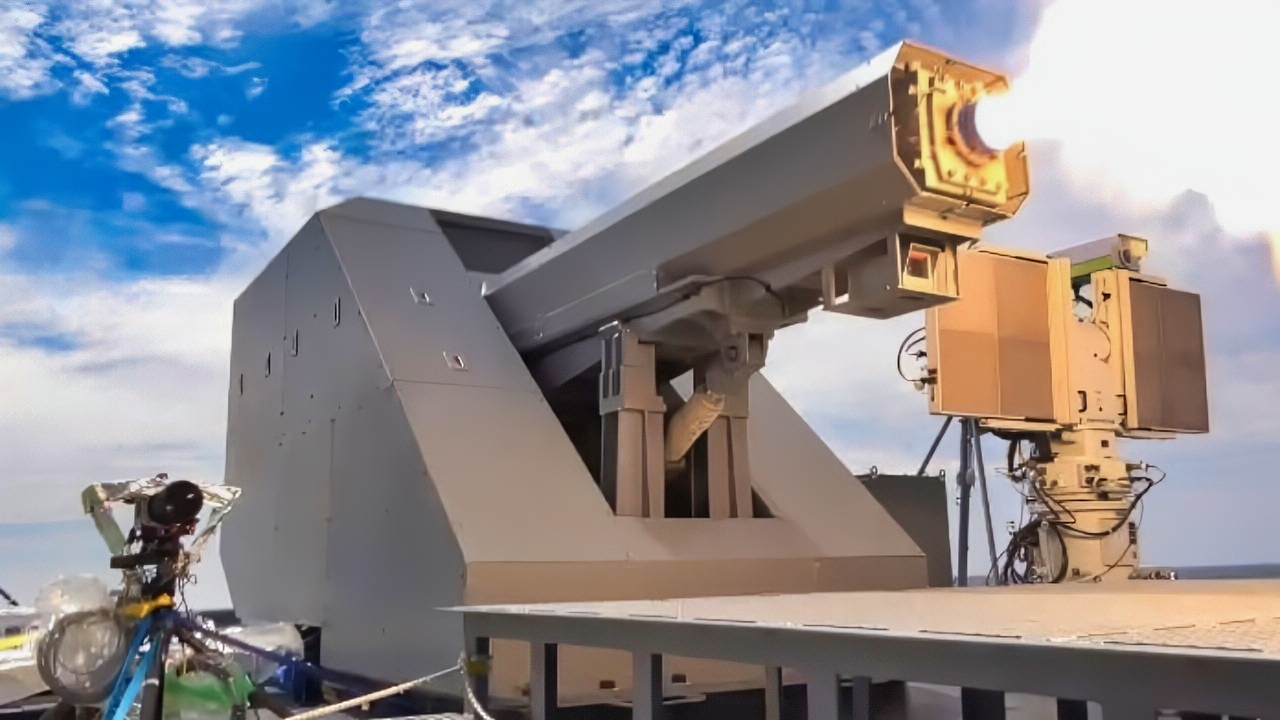
Japan Railgun X Screenshot. Image Credit: X.

U.S. Navy Railgun Test. Image Credit: Creative Commons.

DAHLGREN, Va. (Jan. 31, 2008) Photograph taken from a high-speed video camera during a record-setting firing of an electromagnetic railgun (EMRG) at Naval Surface Warfare Center, Dahlgren, Va., on January 31, 2008, firing at 10.64MJ (megajoules) with a muzzle velocity of 2520 meters per second. The Office of Naval Research’s EMRG program is part of the Department of the Navy’s Science and Technology investments, focused on developing new technologies to support Navy and Marine Corps war fighting needs. This photograph is a frame taken from a high-speed video camera. U.S. Navy Photograph (Released)
Caudle has repeatedly argued that future naval warfare will require dramatically more onboard power generation than existing destroyers can provide.
A1B Reactor
The A1B reactor was originally developed for the Ford-class aircraft carrier program because the older A4W reactors used aboard Nimitz-class carriers no longer provided enough electrical margin for future systems.
The newer reactor is smaller, more efficient, and capable of generating substantially more electrical power. According to Caudle, the Navy plans to reuse as much existing Ford-class reactor technology as possible – a decision that will reduce developmental risk and hopefully speed up development.
“We’re going to use an existing design. We’re going to use the Ford reactor, the A1B reactor, and the components that support that from the vessel, the steam generator, pressurizer, loop components, reactor coolant pump components. So all of that technology that’s going into the design of the battleship, the nuclear battleship, from the reactor plant perspective, is all pull-through technology from the Ford class,” Caudle said.
A Successor to DDG(X)?
The Navy appears to view the Trump-class as the successor to the troubled DDG(X) destroyer concept.
DDG(X) was originally envisioned as the service’s next-generation large surface combatant, replacing aging Arleigh Burke-class destroyers while providing additional space, cooling, and power for future systems.

DDG(X) U.S. Navy. Image Credit: Creative Commons.
But the Navy’s latest shipbuilding documents now openly acknowledge the program’s limitations. The FY2027 plan states that “even the planned DDG(X) program made undesirable capability and weapon system compromises.”
That language strongly suggests the Navy concluded that simply enlarging the destroyer concept would not provide sufficient growth margin for the systems it now wants to field.
The Trump-class instead appears designed around the idea of a heavily armed command-and-control warship capable of operating as the centerpiece of future surface action groups in the Pacific.
Nuclear propulsion is central to that concept because it removes the operational constraints associated with conventional fuel logistics while enabling the ship to sustain power-intensive combat systems for extended periods.
“The fact it’s nuclear is going to give it the sustainment it needs,” Caudle explained, adding, “In particular, in the Pacific — an ocean is three times the size of the Atlantic — I need those types of legs and endurance to serve as a capital ship that comes with that firepower to be able to deliver that combat payload.”
All New Technologies
The Navy has also suggested that the battleship could integrate SPY-6 radar technology, the Baseline 10 Aegis combat system, directed-energy weapons, and expanded missile capacity. The ship may also eventually carry nuclear-capable sea-launched cruise missiles, hypersonic Conventional Prompt Strike weapons, and large vertical launch missile arrays.

Trump-Class Battleship. Image Credit: White House.
The program remains politically controversial, not just because of its ambition, but also because it carries the name of President Donald Trump.
While some argue it is too ambitious and expensive, it’s worth noting that the name alone could be enough to force the most partisan lawmakers in the country to oppose it – and a future Democratic administration may feel the pressure to make changes based almost entirely on the fact it was championed by the most controversial Republican leader in modern history.
MORE – China Has Thousands of Missiles to Point at Navy Aircraft Carriers
MORE – Canada’s F-35 Purchase Could Get Squashed
About the Author: Jack Buckby
Jack Buckby is a British researcher and analyst specializing in defense and national security, based in New York. His work focuses on military capability, procurement, and strategic competition, producing and editing analysis for policy and defense audiences. He brings extensive editorial experience, with a career output spanning over 1,000 articles at 19FortyFive and National Security Journal, and has previously authored books and papers on extremism and deradicalization.


