

The Justice Department charged former Cuban President Raúl Castro and other Cuban officials with murder for their roles in the February 24, 1996, shoot-down of two unarmed Brothers to the Rescue aircraft over international waters, and U.S. Southern Command has confirmed the USS Nimitz (CVN-68) and her Carrier Strike Group are now operating in the Caribbean.
The USS Nimitz Has One Last Mission: Make Cuba Think Twice
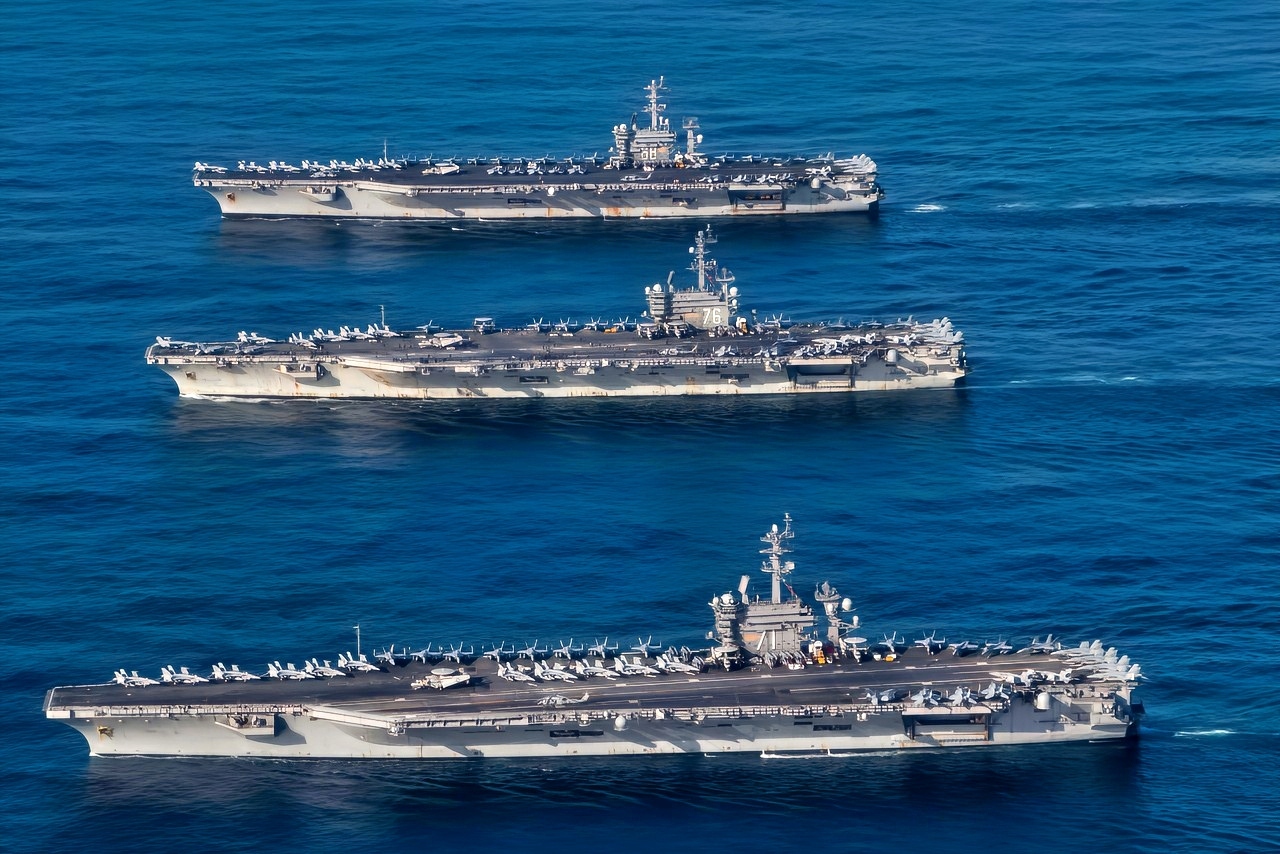
The U.S. Navy aircraft carriers USS Nimitz (CVN-68), USS Theodore Roosevelt (CVN-71) and USS Ronald Reagan (CVN-76) underway in the Western Pacific on 12 November 2017. The strike groups were underway and conducting operations in international waters as part of a three-carrier strike force exercise. This was the first time since August 2007 that three U.S. Navy carriers operated together. In 2007, USS Kitty Hawk (CV-63), USS Nimitz (CVN-68) and USS John C. Stennis (CVN-74) participated in exercise “Valiant Shield”.
Nimitz-class carriers and their carrier strike groups are still the centerpiece of the U.S. Navy. They project immense power worldwide.
The Navy’s supercarriers have been among the most successful warships in history. They have an outstanding combat record.
As great as the carriers have been, all nuclear-powered vessels eventually must be retired. The Navy announced several years ago that it would replace the iconic Nimitz-class with the new Ford-class carriers.
The Navy, which was set to retire the USS Nimitz (CVN-68) in 2026, has extended her service until 2027 to accommodate the delays associated with the Ford-class carrier, USS John F. Kennedy (CVN-79).
The US Southern Command (SOUTHCOM) confirmed that the Nimitz, with her carrier strike group, is already operating in the Caribbean likely due to tensions with the Cuban government.
Especially in the wake of the United States Department of Justice announcing it had charged former Cuban President Raúl Castro and other Cuban officials with murder for their roles in the Feb. 24, 1996, shoot‑down of two unarmed U.S. civilian aircraft operated by Brothers to the Rescue over international waters.
The Nimitz Strike Group Still Packs A Punch
“Welcome to the Caribbean, Nimitz Carrier Strike Group!” SOUTHCOM posted on its X account, formerly Twitter. “The aircraft carrier USS Nimitz (CVN 68), the embarked Carrier Air Wing 17 (CVW-17), USS Gridley (DDG 101), and USNS Patuxent (T-AO 201) are the epitome of readiness and presence, unmatched reach and lethality, and strategic advantage.
USS Nimitz has proven its combat prowess across the globe, ensuring stability and defending democracy from the Taiwan Strait to the Arabian Gulf.”
The Oldest Carrier In The United States Navy
While considered on a goodwill and retirement tour, the USS Nimitz, which is scheduled to be decommissioned in March 2027, 52 years after she first entered service on May 3, 1975, is still an active supercarrier.
With the volatile situation in Cuba, where blackouts and fuel shortages are causing major issues for the Communist government, the Nimitz has been conducting several joint exercises with Latin American allies, as well as counterdrug interdiction missions.
“The Southern Seas 2026 deployment provides a unique opportunity to enhance interoperability and increase proficiency with our partner-nation forces across the maritime domain,” said Rear Adm. Carlos Sardiello, commander of U.S. Naval Forces Southern Command/U.S. 4th Fleet.
“Deployments like this demonstrate our unwavering commitment to ensuring a secure and stable Western Hemisphere.
The Nimitz is the longest-serving carrier in the Navy’s history. But the record for the longest-serving ship still belongs to the USS Constitution, “Old Ironsides.”
Current Demand For Carrier Strike Groups Is High
The current world situation is volatile, and the demand for US carrier strike groups in the Indo-Pacific, the Middle East, and Europe is very high. US doctrine states that the US maintains 11 aircraft carriers to meet the nation’s needs.
Even with the Nimitz operational, those capabilities have been stretched thin due to the Navy’s OPTEMPO. Now, with the next-generation USS John F. Kennedy (CVN-79) and follow-on Ford-class vessels delayed or still in trials, the retirement of the USS Nimitz from the fleet risks making America’s carrier force weaker than is advisable, considering the situation.
And the issues with the shipbuilding industry are not getting any better anytime soon.
Keeping the USS Nimitz (CVN-68) Active Due To High Demand
The high demand for carrier strike groups in the Indo-Pacific, the Middle East, the Arctic, and elsewhere (including the Caribbean) has already stretched the Navy thin. Carrier Strike Groups are vital for U.S. power projection in the Indo-Pacific, Middle East, and Europe, and removing one carrier weakens the force.
The transition gap leaves the Navy shorthanded. New Ford-class carriers (such as USS John F. Kennedy) are facing delays, potentially creating a gap in available carriers if the Nimitz leaves service too soon. There is a valid argument that keeping the Nimitz active, at least until the USS Kennedy is operational.
The Nimitz’s proven capability is, without question, a plus, despite her age. The Nimitz is a reliable, proven nuclear-powered platform that provides significant operational flexibility.
“Cuba Is Next”…
President Donald Trump has escalated his “maximum pressure” campaign against Cuba, issuing repeated threats of military intervention while tightening economic sanctions.
Citing national security concerns, his administration is targeting the island’s energy supply and demanding political concessions.
President Trump has explicitly warned that “Cuba is next” and hinted at potential military action to topple the revolutionary government in Havana, stating the U.S. might have “the honor of taking Cuba”.
The Pentagon has always had strike plans for Cuba, if any hostilities were to occur. Those plans have undoubtedly been updated in light of the changing situation with the Cuban Communist government.
However, senior military and political officials in the US government insist that none of those plans are imminent.
The U.S. has proposed a conditional aid package that includes humanitarian support, two years of free Starlink internet access for all Cubans, and agricultural aid, though Havana has rejected all of those advances.
About the Author: Steve Balestrieri
Steve Balestrieri is a National Security Columnist. He served as a US Army Special Forces NCO and Warrant Officer. In addition to writing on defense, he covers the NFL for PatsFans.com and is a member of the Pro Football Writers of America (PFWA). His work was regularly featured in many military publications.


