

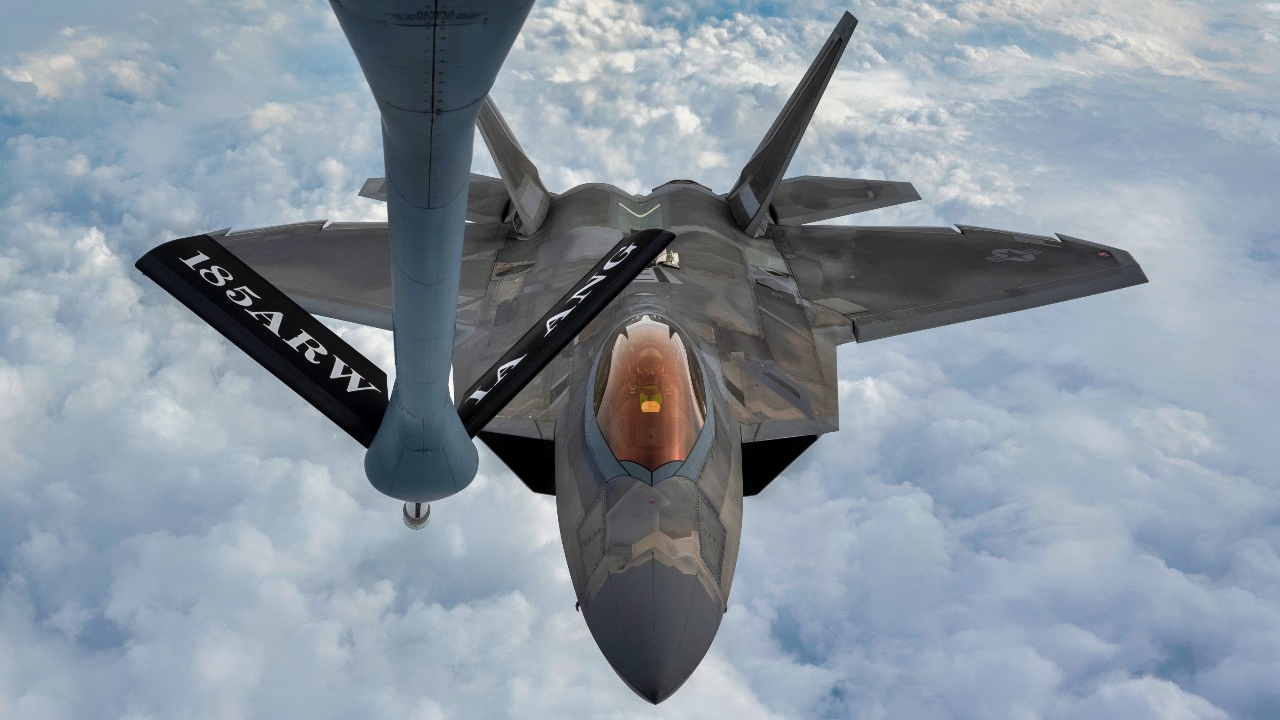
Summary and Key Points: Despite America’s intense bombing in Operation Epic Fury, Iran is rapidly rebuilding its missile and drone arsenal — roughly half its launchers survived, many hidden in underground “missile cities” carved deep into granite mountains.
-Defense columnist Brent Eastwood argues the conflict revealed a new era of warfare he calls the “Kinetic Missile Fight,” where massed barrages decide outcomes and victory depends on stockpile depth.
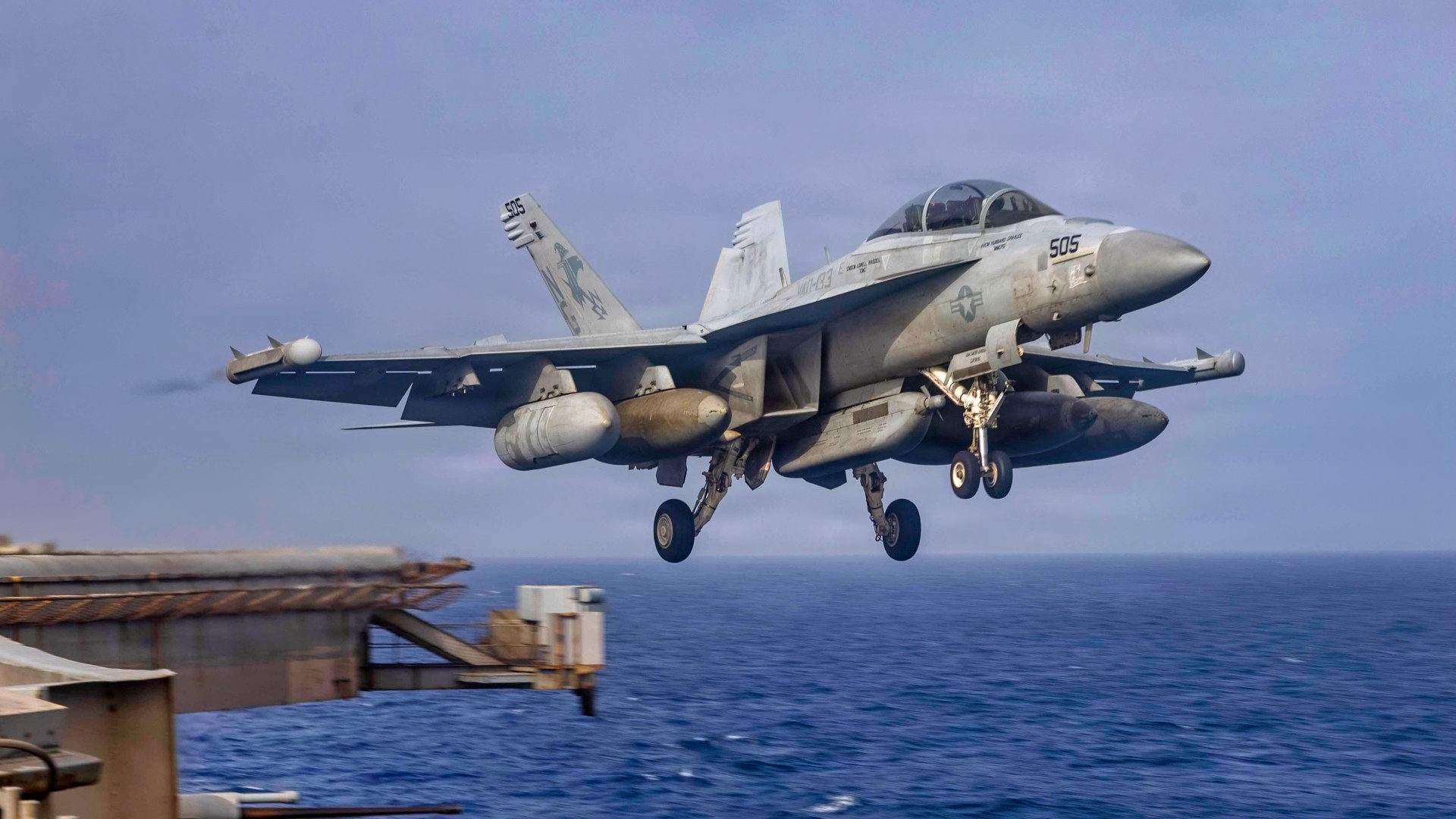
An EA-18G Growler, attached to Electronic Attack Squadron (VAQ) 133, takes off from the flight deck of Nimitz-class aircraft carrier USS Abraham Lincoln (CVN 72), May 21, 2026. Abraham Lincoln is deployed to the U.S. 5th Fleet area of operations to support maritime security and stability in the Middle East. (U.S. Navy photo)
-The biggest lesson may be for China, which is studying how fast missile inventories run dry.
America Hit Iran With Everything It Had — and Iran Is Already Back on Its Feet
It would seem that after the shock and awe bombing campaign during Operation Epic Fury against Iran, the Middle Eastern country would be on its last legs. The United States military worked around the clock to deliver devastating blows to enemy ballistic missile launchers, drone suppliers, and command and control installations. This was meant to decisively reduce Iran’s ability to wage war.
However, Tehran may be down, but it is not out of the game. The Iranians are rapidly replacing the weaponry that they lost. They may still have thousands of missiles and drones in their stockpiles. The Iranian supply of munitions must be reduced further before Tehran can be completely taken out of the fight. Iran can still wage an extended war of attrition against the United States should the ceasefire break.
Iran Is On the Comeback Trail
President Donald Trump and Secretary of Defense Pete Hegseth have always claimed that the Iranian military complex was completely devastated. But Iran has proven resilient and has been able to replace many ballistic missiles and unmanned kamikaze loitering munitions that can still attack the United States and its allies in the Middle East.
CNN quoted sources familiar with U.S. intelligence that “roughly half of Iran’s missile launchers are still intact, and thousands of one-way attack drones, such as the Shahed, remain in Iran’s arsenal. Israeli military officials put the total number of Iranian launchers remaining operational at a lower number, roughly 20 to 25 percent, but U.S. and Israeli intelligence bodies apparently differ in the criteria they use for assessing the extent of the destruction,” the Soufan Center reported.
Iran Still Has Missile and Drone Capacity
Iran could still fire dozens of ballistic missiles a day and 50 to 100 one-way attack drones at targets around the Middle East every 24 hours. The Iranians have also improved their air defenses during the ceasefire. Many surface-to-air missile sites remain intact since they are often dug into caves or deployed deep underground.

An F/A-18 Super Hornet from Naval Air Station Oceana, Virginia, performs an aerial demonstration over Rickenbacker International Airport, Ohio, June 16, 2024, as part of the Columbus Air Show. This year’s event featured more than 20 military and civilian planes, including a KC-135 Stratotanker from the 121st Air Refueling Wing, which served as the base of operations for military aircraft participating in the show. (U.S. Air National Guard photo by Senior Airman Ivy Thomas)
“Some of the U.S. strikes military leaders perceived as successful were only partially effective. U.S. strikes on Iran’s deeply buried missile and drone storage sites, including its ‘missile cities,’ generally target entrances and ventilation shafts, and do not necessarily destroy the missiles or drones directly. One such missile city, outside the central Iranian city of Yazd, extends more than 1,500 feet into a mountain consisting of a type of granite that can withstand crushing pressures,” according to the Soufan Center.
Perhaps Iran’s Mosaic Defense Strategy Succeeded
Iran still boasts its “Mosaic Defense Strategy.” This is a decentralized, autonomous grouping of air defense sites across the country that can operate independently, without explicit commands from higher echelons.
One of the Early Instances of the Kinetic Missile Fight
This Iranian asymmetric strategy has been a key feature of what I call the “Kinetic Missile Fight.” This type of warfare is dominated by large-scale standoff missile exchanges involving cruise missiles, ballistic missiles, hypersonic weapons, drones, and other types of precision-guided munitions.
This replaces aerial combat between individual airplanes and large-scale ground maneuvers by armored forces.
In the Kinetic Missile Fight, there are massive barrages of long-range missiles targeting ships, air bases, command centers, and air defenses. The idea is to overwhelm an adversary with sheer volume.

A B-2 Spirit assigned to the 419th Flight Test Squadron, conducts flight tests above Rogers Dry Lake on Edwards Air Force Base, California, August 3, 2023. (Air Force photo by Giancarlo Casem)
The Overall Winner Is Not Clear
Which side won the Kinetic Missile Fight? It appears that the United States did a good job eliminating much of Iran’s missile and drone-producing infrastructure. This likely surprised the Iranians at first. The sheer volume of weaponry the Americans deployed was immense. Iran, however, learned that the Mosaic Defense Strategy, which features many dug-in and reinforced systems, could survive and fight a longer engagement. Iran is also stepping up efforts to resume the fight if needed.
“The rebuilding of military capabilities, including replacing missile sites, launchers, and production capacity for key weapons systems destroyed during the current conflict, means that Iran remains a significant threat to regional allies should President Donald Trump restart the bombing campaign,” CNN wrote.
Running Low on Weaponry
The United States has also mostly depleted its stock of land-attack cruise missiles, such as the Tomahawk, and has been forced to rely on numerous defensive interceptors, including Patriot PAC-3 and THAAD. These air defenders are expensive and time-consuming to replace.

A Terminal High Altitude Area Defense (THAAD) interceptor is launched from the Pacific Spaceport Complex Alaska in Kodiak, Alaska, during Flight Experiment THAAD (FET)-01 on July 30, 2017 (EDT). During the test, the THAAD weapon system successfully intercepted an air-launched, medium-range ballistic missile (MRBM) target.
This is a key facet of the Kinetic Missile Fight. Missile inventories are difficult to fortify. It may take years for the United States to have the same number of cruise missiles and interceptors it had before Operation Epic Fury.
What Has China Learned?
One lesson from the Kinetic Missile Fight that China may learn is that numbers matter. Whichever side can supply the most projectiles and drones to the battlefield can outlast the other side, which is straining to keep up. Beijing can do the math on U.S. missile stocks. Any conflict in East Asia would make the resupply of missiles more difficult due to the sheer distance from the United States. Stocks could run dry quickly.
New Ways to Store Aircraft Are Needed
China has also learned during the Kinetic Missile Fight that airplanes that are not stored underground or in reinforced hangars can be destroyed on the tarmac at air bases. The United States lost 42 aircraft to the Iranians during Operation Epic Fury.
The Kinetic Missile Fight is here to stay. American battle planners will have to take into account “magazine depth” and missile stocks before they can wage modern warfare against other adversaries in the future.
The Department of Defense must devise a strategy to maintain missile stocks high enough to fight a two-front war if needed, which will put pressure on the defense industrial base to keep up if new conflicts arise.
About the Author: Brent M. Eastwood, PhD
Author of now over 3,500 articles on defense issues, Brent M. Eastwood, PhD, is the author of Don’t Turn Your Back On the World: A Conservative Foreign Policy and Humans, Machines, and Data: Future Trends in Warfare, plus two other books. Brent was the founder and CEO of a tech firm that predicted world events using artificial intelligence. He served as a legislative fellow for US Senator Tim Scott and advised the senator on defense and foreign policy issues. He has taught at American University, George Washington University, and George Mason University. Brent is a former US Army Infantry officer. He can be followed on X @BMEastwood.


