

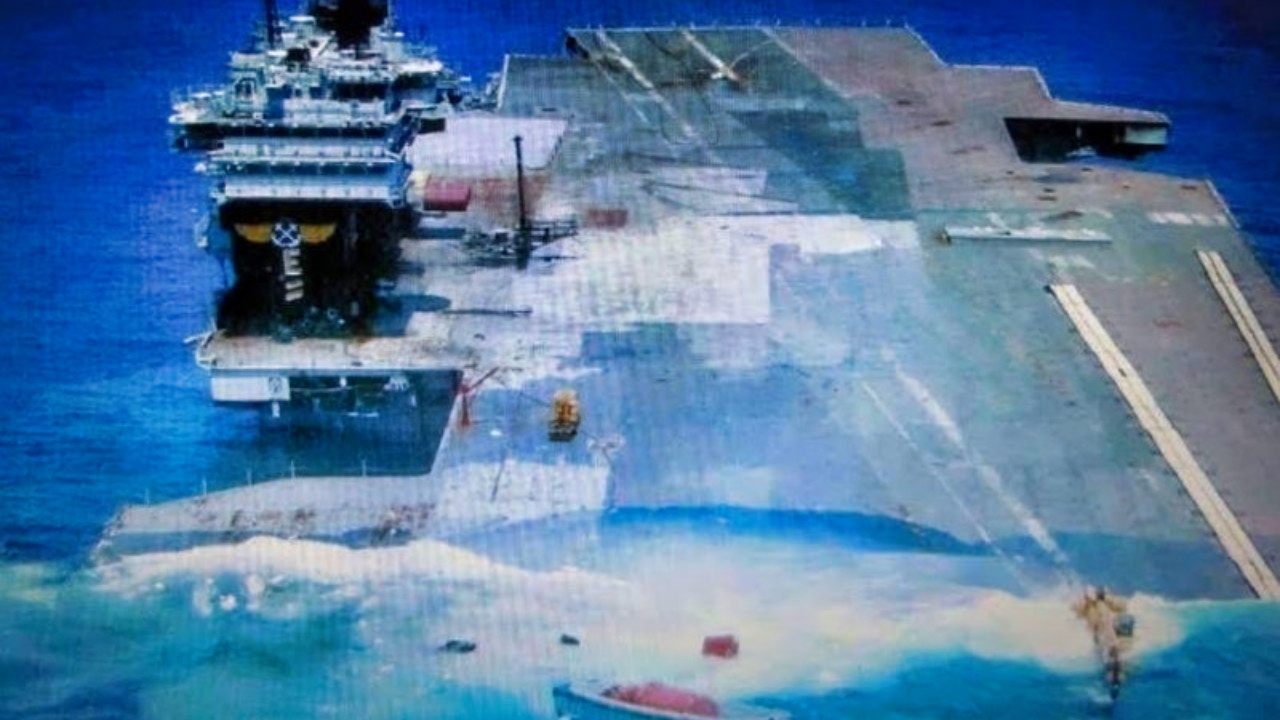
Summary and Key Points: The USS America (CV-66), a Kitty Hawk-class aircraft carrier, served the Navy for 30 years — through Vietnam, the 1986 Libya strikes, and Desert Storm — without ever losing an aircraft to enemy fire.
-Her final mission was unusual: in 2005, the Navy used the decommissioned carrier as a live-fire “SinkEx” target to build tougher future ships.
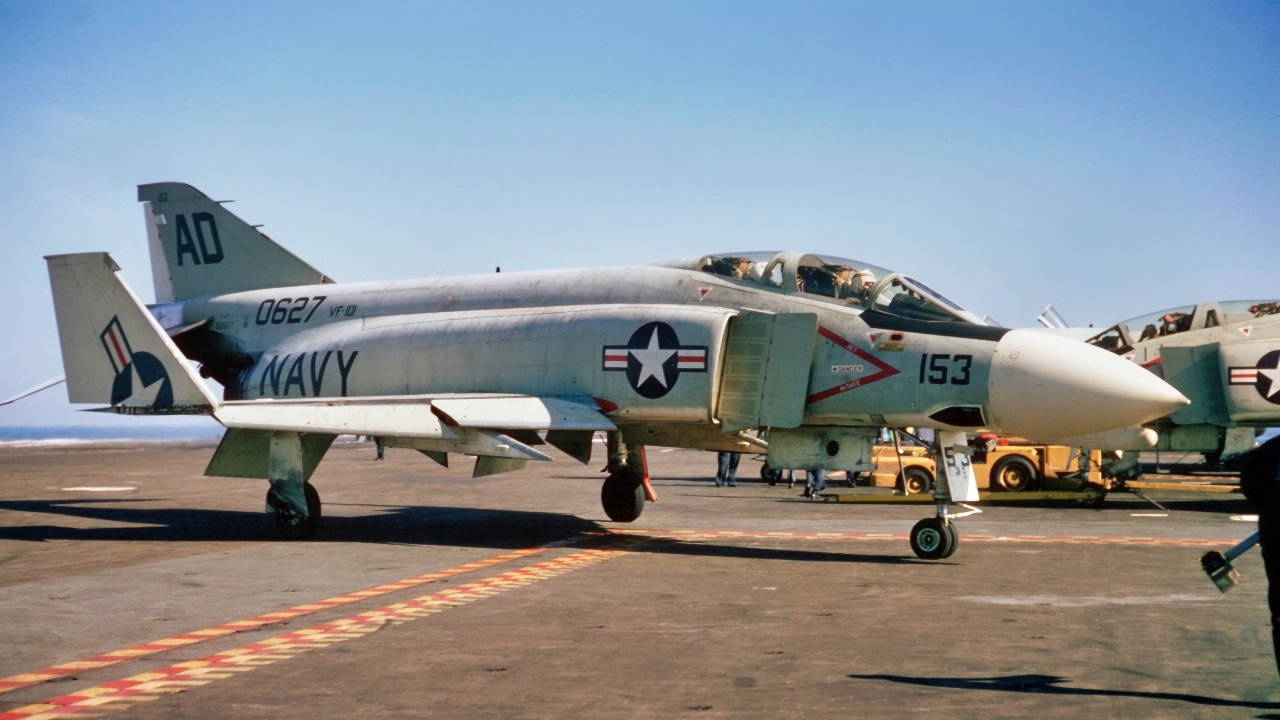
A Fighter Squadron 101 (VF-101) F-4J Phantom II aircraft taxis on the flight deck of the attack aircraft carrier USS AMERICA (CVA 66).
-Battered by submarines, torpedoes, bombs, and missiles, the America stayed afloat for weeks — proving just how hard it is to sink a U.S. carrier.
USS America: Sunk By the Navy
The USS America, CV-66, was one of three Kitty Hawk-class aircraft carriers constructed during the 1960s. After commissioning in 1965, the carrier had a long 30-year career with service in Vietnam and the Persian Gulf during Operation Desert Storm.
After decommissioning, the America languished in the Philadelphia shipyard for another ten years. In 2005, the carrier was towed from Philadelphia to a location off the coast of the Carolinas, about halfway to Bermuda. There, the ship was sunk over the objections of the sailors who had served on it, who wanted it turned into a museum.
It was the first time an aircraft had been sunk since World War II. The USS America was the largest ship ever to sink. Why did the Navy decide to sink the USS America?
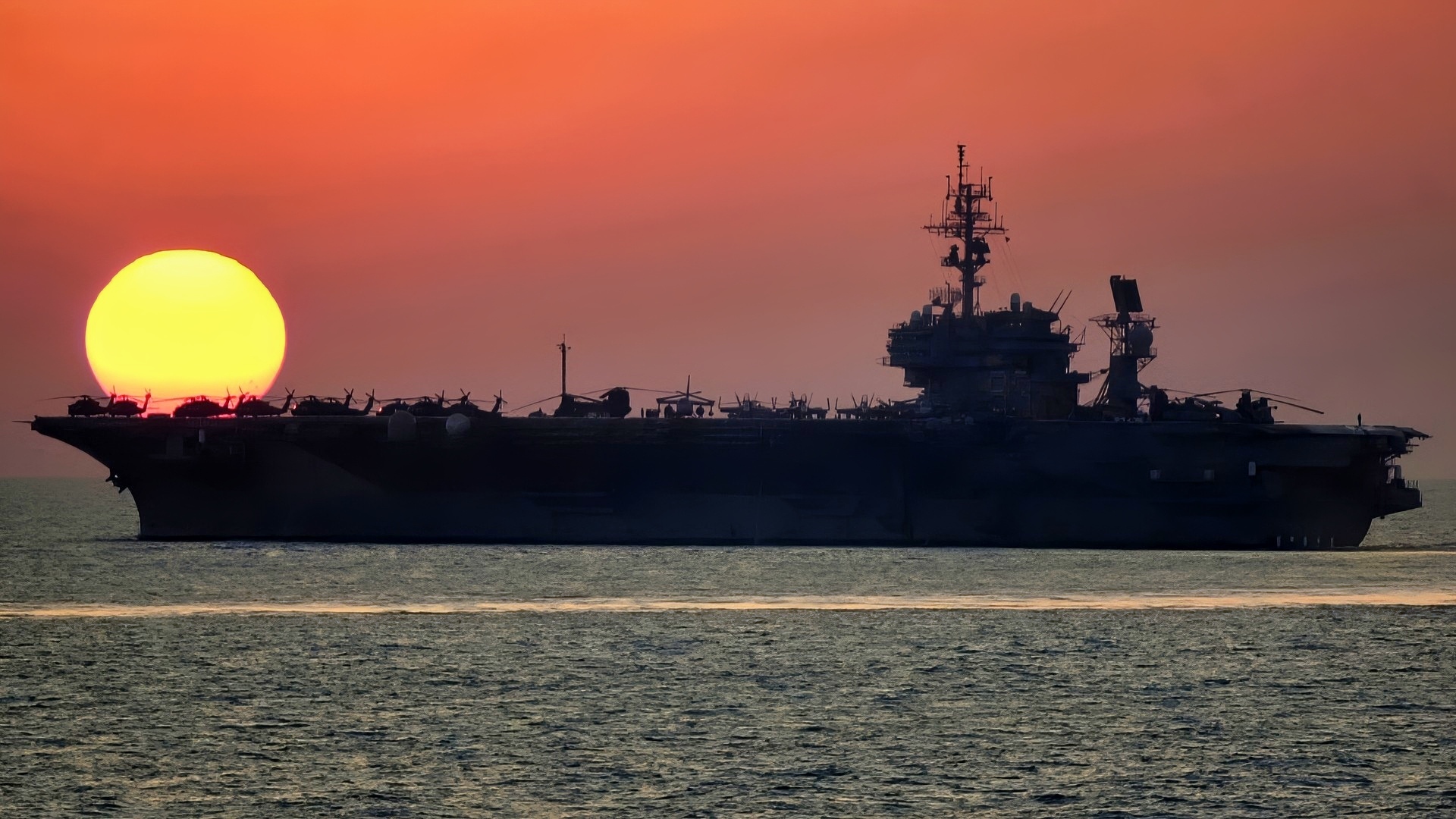
USS Kitty Hawk of Kitty-Hawk-Class. Image Credit: Creative Commons.
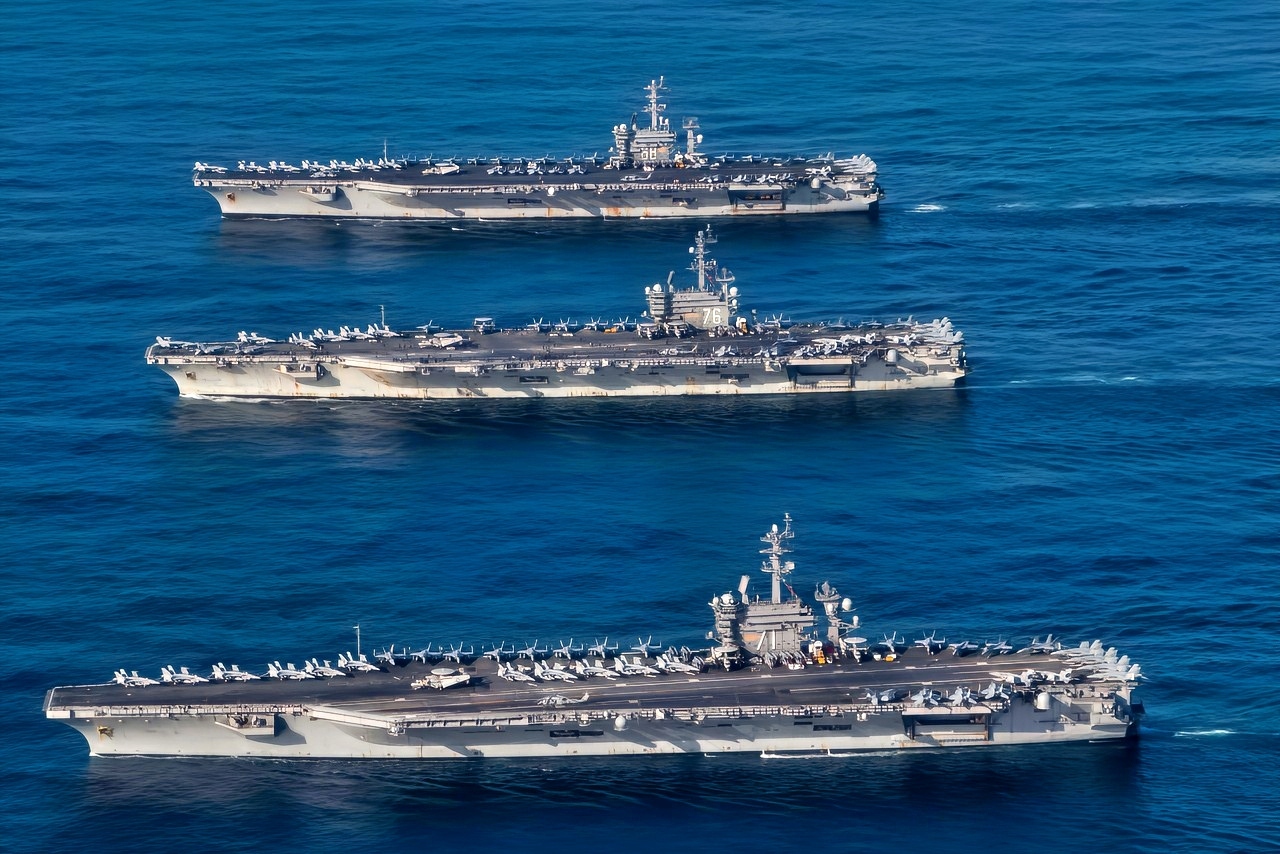
The U.S. Navy aircraft carriers USS Nimitz (CVN-68), USS Theodore Roosevelt (CVN-71) and USS Ronald Reagan (CVN-76) underway in the Western Pacific on 12 November 2017. The strike groups were underway and conducting operations in international waters as part of a three-carrier strike force exercise. This was the first time since August 2007 that three U.S. Navy carriers operated together. In 2007, USS Kitty Hawk (CV-63), USS Nimitz (CVN-68) and USS John C. Stennis (CVN-74) participated in exercise “Valiant Shield”.
Brief History of the USS America (CV-66):
The USS America was initially ordered as an Enterprise-class nuclear carrier. However, the rising costs of the Enterprise during construction caused the Navy to cancel the nuclear CVAN-66 and reorder her as a conventionally powered Kitty Hawk-class carrier (CV-66).
After commissioning in January 1965, the ship conducted short-shakedown cruises until September 1965, when she first deployed to the Mediterranean. CV-66 would spend the majority of her service in the Atlantic, where she was off the coast of Israel during the 1967 war.
The carrier made three different tours to Vietnam in 1968, 1970, and 1972, where she served with distinction. During the 1980s, in Libya, after being fired upon by Libyan forces in 1986, the USS American sank a missile-equipped patrol boat. This was the first use of the Harpoon anti-ship missile in combat.
A second patrol boat was severely damaged but sought refuge alongside a neutral merchant ship. Libyan anti-aircraft radars that had been targeting US aircraft that had been operating off the carrier were destroyed.
After Libya responded with terrorist attacks in Berlin, USS America took part in a joint Navy-Air Force strike against Libyan targets.
During the Gulf War (Operation Desert Storm), CV-66 conducted more than 3,000 sorties against Iraqi Republican Guard positions, anti-aircraft sites, anti-ship missile sites, oil production facilities, and command and control headquarters.
Amazingly, during more than 10,000 sorties in Vietnam and 3,000 more in the Gulf War, the USS America never lost an aircraft due to enemy action.
In 1994, in one of her final deployments, the USS America sailed to the coast of Haiti with a contingent of US Army helicopters on board, a first for the carrier. Due to the troubles in Haiti, the president authorized the military to evacuate American civilians by using Army Special Forces via helicopters and US Marines on the ground if the situation called for it. But no direct action was needed.

USS Ronald Reagan (CVN 76), USS Kitty Hawk (CV 63), and USS Abraham Lincoln (CVN 72) cruise side-by-side in the Philippine Sea June 18, 2006, during exercise Valiant Shield 2006. The joint exercise consists of 28 naval vessels, more than 300 aircraft, and approximately 20,000 service members from the Navy, Army, Air Force, Marine Corps and Coast Guard. (U.S. Navy photo by Chief Photographer’s Mate Spike Call) (Released)
The carrier was decommissioned on August 9, 1996. She was initially slated to undergo a Service Life Extension Program (SLEP) in 1996 for subsequent retirement in 2010; however, due to service budget cuts by President Clinton, she retired instead.
A Final Mission for the USS America
The aircraft carrier was slated for scrap after its time in the Philadelphia shipyard, but it was not to be.
The Navy decided to sink her during a simulated live-fire exercise dubbed “SinkEx. ” This exercise was intended to test the carrier’s capacity to withstand battle damage and improve the durability of future ship designs. The Navy has sunk several retired ships in this manner.
The Navy’s then-Vice Chief of Naval Operations, Admiral John Natham, said, “America will make one final and vital contribution to our national defense, this time as a live-fire test and evaluation platform.
“America’s legacy will serve as a footprint in the design of future carriers — ships that will protect the sons, daughters, grandchildren, and great-grandchildren of American veterans.
“We will conduct various comprehensive tests above and below the waterline, collecting data for use by naval architects and engineers in creating the nation’s future carrier fleet.
We must make those ships as highly survivable as possible. When that mission is complete, America will slip quietly beneath the sea. I know America has a very special place in your hearts, not only for the name but also for your service aboard her.
“I ask that you understand why we selected this ship for this one last crucial mission and make note of the critical nature of her final service.”
The tests first simulated attacks by submarines and torpedoes under the waterline. Aircraft then launched bombs and missiles at the flight deck to no avail. The America was built rugged and still stood weeks after the Sinkex began. The Navy then decided to place explosive charges at different sections of the ship, and it finally sank on May 9, 2005.
Lessons Learned From the Sinking of CV-66
The Sinkex for the USS America showed just how difficult it is to sink an aircraft carrier. With modernized firefighting equipment, a modern aircraft carrier can take a lot of punishment. However, it must be noted that the USS America didn’t have any fuel, bombs, or ammunition on board, which can set a carrier ablaze after a hit from a bomb or a missile.
During the Battle of Midway, the Japanese carrier Kaga was eviscerated by bombs, setting off a series of explosions of bombs and fuel that utterly destroyed the top half of the carrier.
The USS America finally came to rest upright on the ocean’s floor about 16,000 feet beneath the surface.
About the Author:
Steve Balestrieri is a National Security Columnist. He served as a US Army Special Forces NCO and Warrant Officer. In addition to writing on defense, he covers the NFL for PatsFans.com and is a member of the Pro Football Writers of America (PFWA). His work was regularly featured in other military publications.


