

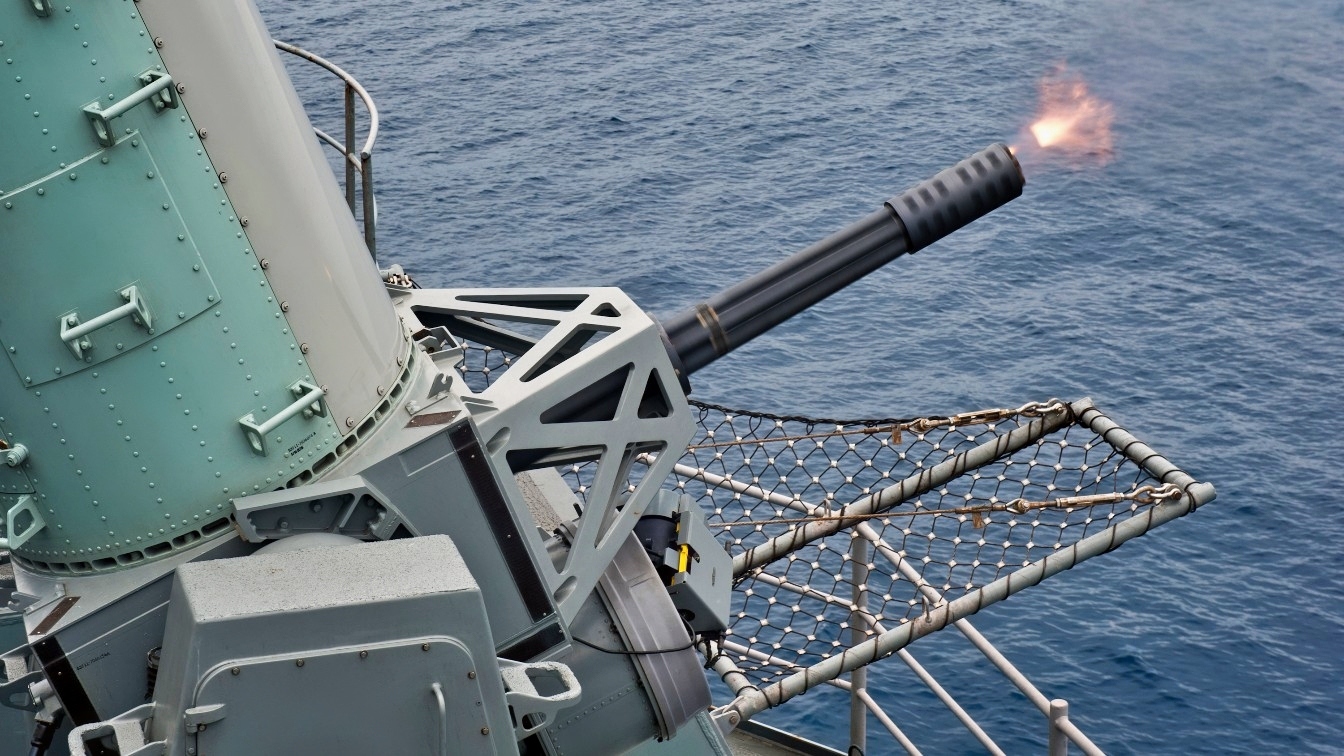
Summary and Key Points: It looks almost comical — a squat white dome sailors nicknamed “R2-D2.” But the Phalanx is one of the deadliest defensive weapons afloat: a radar-guided Gatling gun that fires 4,500 rounds a minute and decides on its own when to shoot, no human required. It’s a warship’s last line of defense — and in the Red Sea, it shredded a Houthi missile that had slipped past a destroyer’s Aegis shield to within a mile. But the autonomy that makes it lethal has a dark side: once, a Phalanx locked onto the wrong target and opened fire on a friendly American jet. What happened next is a sobering reminder of what fully automated weapons can get wrong.
The Phalanx Is Critical for the U.S. Navy
The Phalanx Close-In Weapon System (CIWS) is a highly effective, automated last-ditch defense used mainly on US Navy warships.

USS John Finn (DDG 113) arrives Nov. 15 at the Port of Hueneme for routine Combat System Assessment Team (CSAT) repairs and training. The ship is one of four in the fleet with an Optical Dazzling Interdictor, Navy — also known as ODIN. The ODIN laser weapon system stuns enemy drones threatening surface ships. The destroyer also has two helicopter hangars, big enough to hold an MH-60R Seahawk Romeo multi-mission helicopter and the MH-60S Knighthawk Sierra helicopter. (U.S. Navy Photo by Dana Rene White/Released)
However, because of its effectiveness, the US Army has adapted it for use in C-RAM (Counter-Rocket, Artillery, and Mortar), where it successfully shoots down incoming rockets, artillery shells, and mortars.
It fires up to 4,500 rounds of 20 mm armor-piercing projectiles per minute. While incredibly capable, it does, however, have limitations against supersonic and salvo-fired missiles.
Background on the Phalanx CIWS
The Phalanx CIWS was designed and manufactured by the General Dynamics Corporation, Pomona Division, later a part of Raytheon.
The Phalanx is a radar-guided 20 mm Vulcan cannon mounted on a swiveling base; the weapon system is in use by the United States Navy and the naval forces of 15 other countries.
The U.S. Navy deploys it on every class of surface combat ship, except the Zumwalt-class destroyer and San Antonio-class amphibious transport dock.

Zumwalt-Class U.S. Navy Image.
Development of the Phalanx began in the 1970s, with the weapon approved for production in 1978. The first ship equipped with the Phalanx was the aircraft carrier USS Coral Sea (CV-43) in 1980.
An entirely self-contained unit, the mounting houses the gun, an automated fire-control system, and all other major components, enabling it to automatically search for, detect, track, engage, and kill enemy targets using its computer-controlled radar system.
The CIWS Is Nicknamed For a Star Wars Character
Because of its outward shape, the Phalanx CIWS weapon is nicknamed “R2-D2” after the droid from the Star Wars films.
The CIWS is designed to be the last line of defense against anti-ship missiles. As a result, its effective range is very short compared with that of modern ASMs, ranging from 1 to 5 nautical miles (2 to 9 km).
The Block 1A and newer (pneumatic-driven) CIWS mounts fire at a rate of 4,500 rounds per minute with a 1,550-round magazine. The velocity of the rounds fired is about 3,600 feet per second.
The ammunition consists of armor-piercing tungsten penetrator rounds or depleted uranium with disposable plastic sabots.
Phalanx CIWS Capabilities
The Phalanx uses integrated search-and-tracking radars that operate independently of a ship’s primary combat systems. It completes the entire process of identifying, tracking, evaluating, and firing on a target without human input.
The 20 mm Gatling gun spits out tungsten or depleted uranium rounds at 4,500 rounds per minute. These travel at over 3,600 feet per second, shredding a missile’s airframe and destabilizing its aerodynamics.
The maximum effective range is about 1,625 yards (1,486 meters, or just under a mile), with a maximum projectile range of 5,500 meters (3.41 miles).
The primary naval role is Anti-Ship Missile Defense (ASMD), destroying incoming anti-ship cruise missiles and low-altitude aircraft that have bypassed long-range defenses.
Upgraded variants (such as the Block 1B) feature Forward Looking Infrared (FLIR) sensors, allowing the system to target hovering helicopters, drones, and small, fast-moving surface boats.
The Phalanx CIWS Proved Its Worth In Yemen
The Phalanx Close-In Weapon System (CIWS) served as a vital last-ditch defense for U.S. warships combating Houthi anti-ship missiles and drones in the Red Sea and Gulf of Aden.
The USS Gravely (DDG-107) initiated the Phalanx system when a Houthi anti-ship cruise missile penetrated the outer and middle layers of the warship’s Aegis defense system.
The missile came within 1 nautical mile of the destroyer before the crew successfully engaged it with the Phalanx CIWS, destroying it and protecting the vessel.
Japanese Phalanx Shot Down A Friendly US Navy A-6 Intruder
On June 4, 1996, the Asagira-class destroyer Yugiri of the Japanese Maritime Self-Defense Force (JMSDF) accidentally shot down a U.S. Navy A-6 Intruder jet that was towing a radar reflective target during joint gunnery exercises.

A-6 Intruder National Security Journal Photo. Image By Jack Buckby Taken on September 18, 2025.

A-6 Intruder National Security Journal Photo. Taken on September 18, 2025.
Both the pilot and bombardier-navigator survived and were able to eject successfully. The Yugiri’s radar locked onto the aircraft instead of the towed target array. The Phalanx had also locked onto decoy chaff clouds deployed by friendly ships instead of targets.
A post-accident review board concluded that Yugiri’s Phalanx was in manual control, and the ship’s gunnery officer gave the order to fire before the A-6 was out of the CIWS engagement envelope.
The Navy Is Upgrading Its Defenses
Due to the mounting threat of supersonic and salvo-fired missiles, the Navy’s warships are increasingly relying on or supplementing Phalanx with guided missile interceptors, such as the SeaRAM or RIM-116 Rolling Airframe Missile (RAM), which are able to engage threats at much further distances.
The Navy awarded Raytheon a $205 million contract to improve the Phalanx CIWS.
“Phalanx is our Navy’s last line of defense, expertly designed to protect our sailors from the threats they face every day. Securing this contract underscores the trust the US Navy places in an absolutely critical system,” Barbara Borgonovi, president of Naval Power at Raytheon, said in a company press release.
About the Author: Steve Balestrieri
Steve Balestrieri is a National Security Columnist. He served as a US Army Special Forces NCO and Warrant Officer. In addition to writing on defense, he covers the NFL for PatsFans.com and is a member of the Pro Football Writers of America (PFWA). His work was regularly featured in many military publications.


