

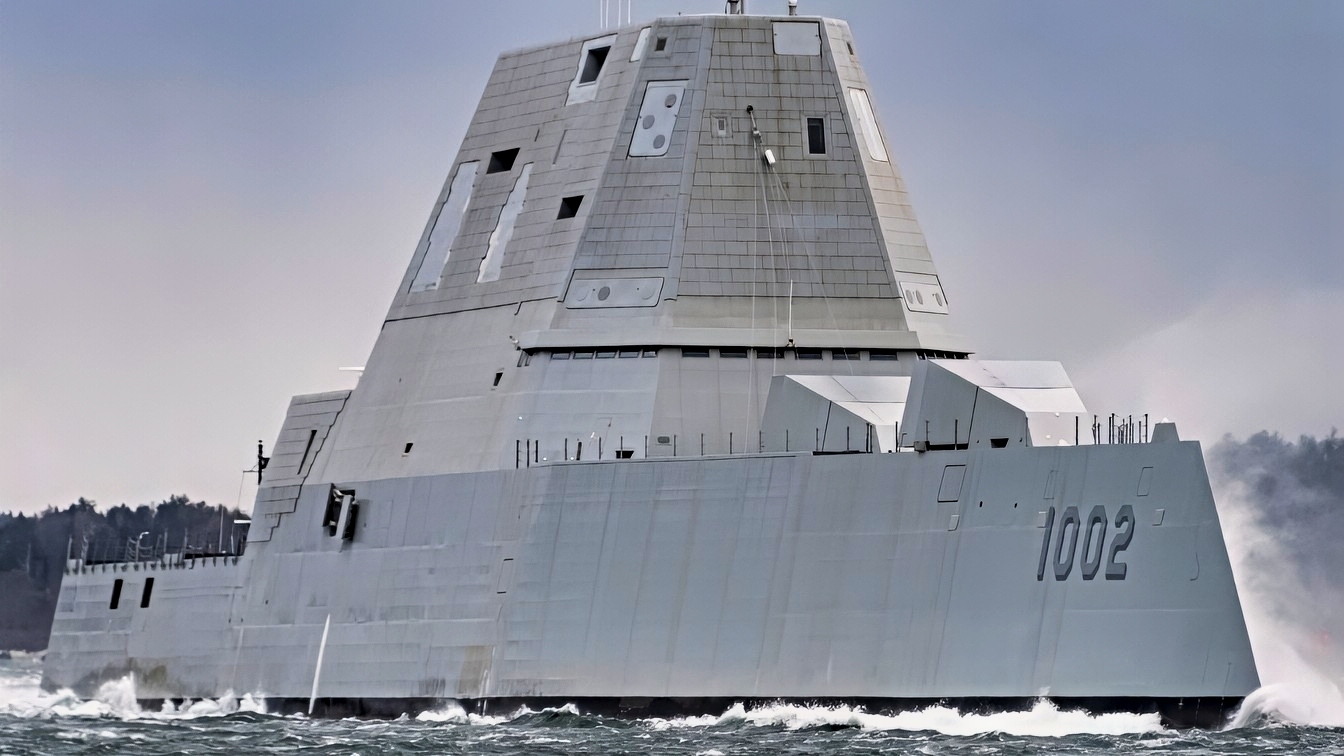
The U.S. Navy originally planned 32 Zumwalt-class stealth destroyers. Only 3 were built — USS Zumwalt, USS Michael Monsoor, and USS Lyndon B. Johnson. Total program cost was approximately $22.5 to $23 billion. Each ship was designed around the Advanced Gun System (AGS). Each Zumwalt carries 2 AGS guns. The AGS was designed to fire the Long Range Land Attack Projectile (LRLAP) — a rocket-assisted GPS-guided shell with 80-100 nautical mile range. Each LRLAP shell cost $800,000 to $1 million.
The Great Zumwalt-Class Cost Crisis

(July 28, 2022) U.S. Navy Zumwalt-class guided-missile destroyer USS Michael Monsoor (DDG 1001) sails in formation during Rim of the Pacific (RIMPAC) 2022, July 28. Twenty-six nations, 38 ships, three submarines, more than 30 unmanned systems, approximately 170 aircraft and 25,000 personnel are participating in RIMPAC from June 29 to Aug. 4 in and around the Hawaiian Islands and Southern California. The world’s largest international maritime exercise, RIMPAC provides a unique training opportunity while fostering and sustaining cooperative relationships among participants critical to ensuring the safety of sea lanes and security on the world’s oceans. RIMPAC 2022 is the 28th exercise in the series that began in 1971. (U.S. Navy photo by Mass Communication Specialist 3rd Class Aleksandr Freutel)

Zumwalt-class Guided Missile Destroyer USS Michael Monsoor (DDG 1001) transits the Pacific Ocean, June 25, 2022. Twenty-six nations, 38 ships, four submarines, more than 170 aircraft and 25,000 personnel are participating in RIMPAC from June 29 to Aug 4 in and around Hawaiian Islands and Southern California. The world’s largest international maritime exercise, RIMPAC provides a unique training opportunity while fostering and sustaining cooperative relationships among participants critical to ensuring the safety of sea lanes and security on the world’s oceans. RIMPAC 2022 is the 28th exercise in the series that began in 1971.
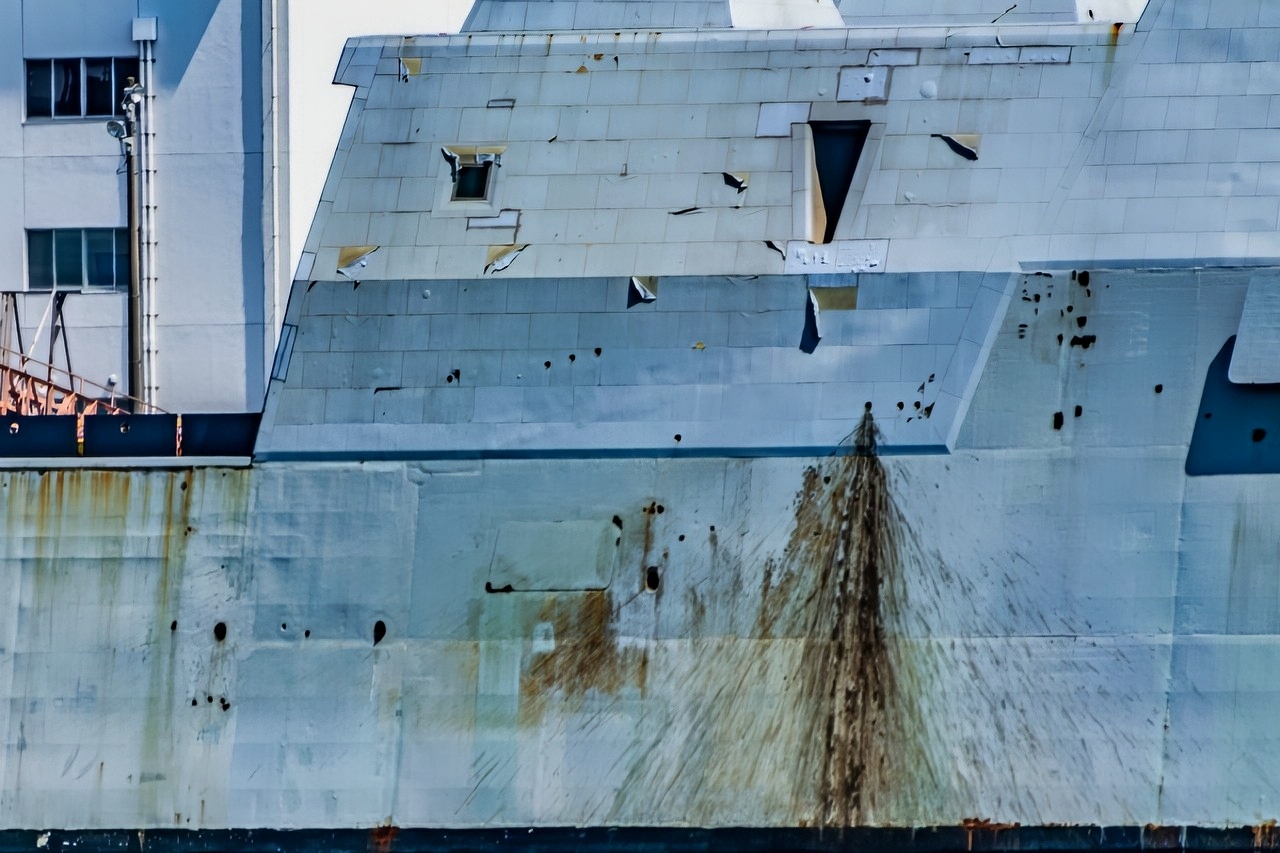
Zumwalt-Class In Bad Shape X Screenshot.
The stealthy Zumwalt-class destroyers were supposed to be modern marvels. They were planned to be stalwarts when it came to prepping beaches for U.S. Marine Corps amphibious landings. The U.S. Navy thought they could sneak near the shoreline and bombard targets to establish landing zones and bring the noise to help marauding leathernecks who needed close support from naval gunfire.
But the guns on the Zumwalt-class ships that were supposed to wreak so much havoc were an abysmal failure. One would think that the 155mm Advanced Gun System would have been sufficient on only three Zumwalt-class ships that were ever built. Thirty-two destroyers were planned, and the only fully-manufactured ships cost around $22.5 to $23 billion for three vessels (USS Zumwalt, USS Michael Monsoor, and USS Lyndon B. Johnson).
The Sticker Shock was Considerable
The Navy thought that the Advanced Gun System (AGS) would be cheaper to fire than launching the more expensive Tomahawk Cruise Missiles. But ironically, the AGS’s ammunition costs reached astounding levels. Each round would cost $800,000 to $1 million per unit.
This just didn’t make sense. How was the Navy going to afford this? Congress was alerted, and legislators did not like what they learned during hearings. The Department of the Navy was flummoxed. AGS would be rendered combat-ineffective, and the Zumwalts would be unarmed and unable to deploy effectively.
Would All Zumwalt Destroyers Be Cancelled?
By 2016, the Navy had to act. The maritime branch canceled the ammunition purchasing and production line for the mega-expensive shells.
Now what? The Zumwalt’s were going to be seen as a Class-A boondoggle with the kind of serious expenditures that made some naval acquisition honchos feel like a dagger had been thrust into their hearts.
Working in Concert With the Marines
The Zumwalt-class dates back to the 1990s, when the program was known as the DD-21 and later as DD(X). The Marines wanted to get back to basics after serving as desert fighters during Operation Desert Storm. Around 93,000 Marines served in the First Gulf War. They used combined arms techniques with tanks, artillery, and combat aircraft to great effect.
While that “left hook” was executed, other Marines faked an amphibious invasion in the Ash Shu’aybah area in Kuwait on the right side of the area of operations. For shore support, the Navy contributed naval gunfire from the battleships USS Missouri and USS Wisconsin.

USS Iowa Battleship Guns. Image Credit: National Security Journal.
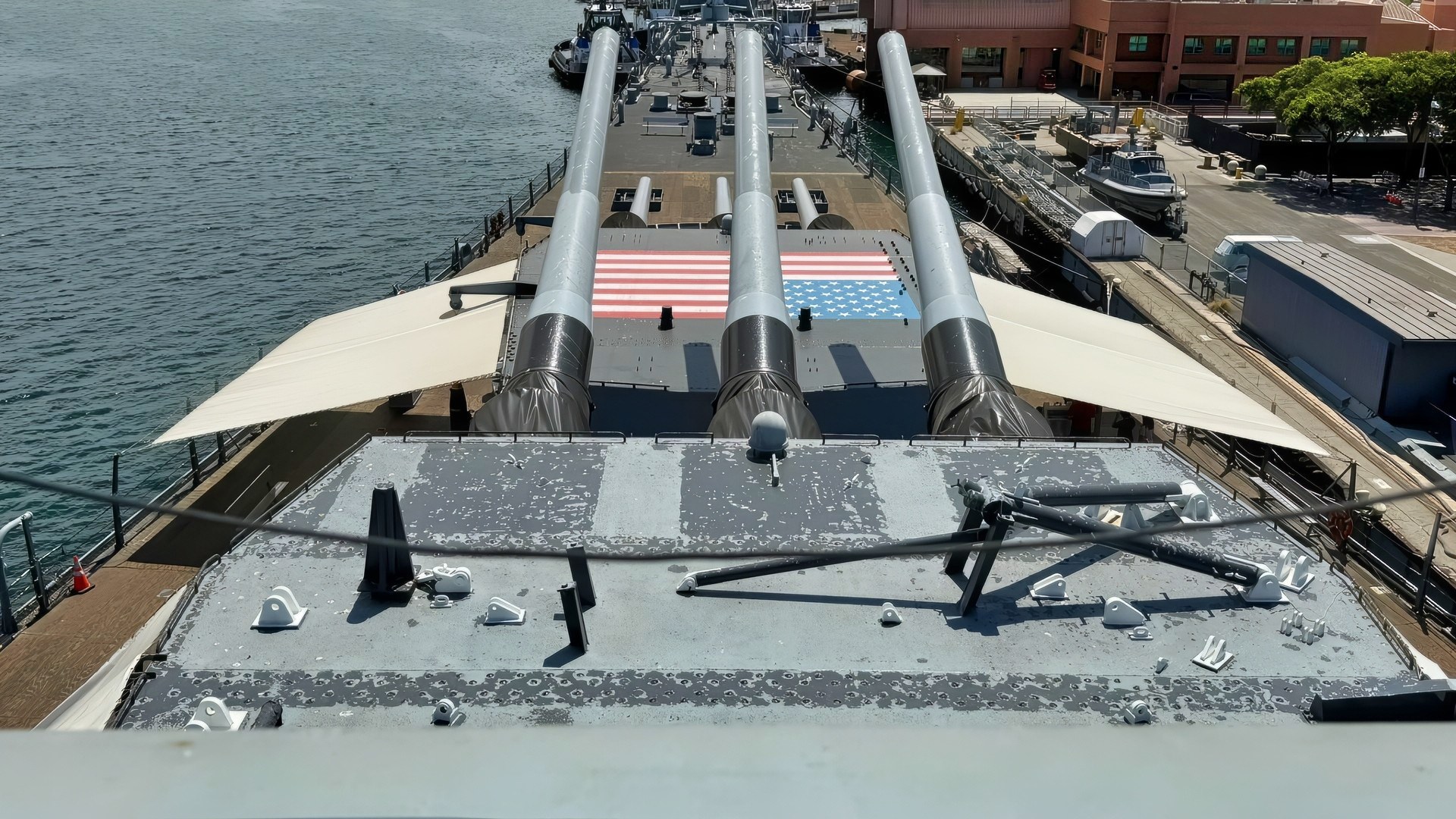
USS Iowa main guns. National Security Journal Photo.
Amphibious Operations Could Become Devastating to the Enemy
What would the next war entail after the outstanding success against Saddam Hussein’s forces? The Marines had to be ready for a potential amphibious invasion, but they needed naval gunfire support. The old battleships could not be expected to serve into the 2000s, so a new ship was needed to help the Marines succeed in an amphibious attack.
We Are Talking About Some Long-range Firepower
The designers and engineers devised the Zumwalts with the AGS, which was designed for maximum firepower. Two of the advanced guns would go on each destroyer. Soon, they devised the Long Range Land Attack Projectile (LRLAP), a rocket-assisted, GPS-guided shell that could strike targets up to 80-100 nautical miles away.
That was an incredible range. Perhaps the Zumwalts would not have to sneak as close to shore as originally thought. They could remain outside of enemy defenses and bombard beachheads at will without being in harm’s way from ground batteries in the amphibious attack zone.
Doom on You from the Advanced Gun
The Zumwalt-class destroyers were designed with effective electrical power systems to support the AGS. Sailors could quickly and efficiently load the LRLAP. These guns and their powerful shells were going to belch fire that would make the enemy run for cover.
But Costs for the Shells Spiked
There was a problem. The Zumwalt-class ships became more expensive, and the number of vessels to be acquired was whittled down considerably from the original 32 intended to join the Navy. The LRLAP shells would have been manufactured in great numbers for 32 Zumwalts. This would give production economies of scale and efficiencies. The more the Navy ordered, the cheaper they would be to produce over time. However, with only three ships to supply, costs for the LRLAPs ballooned. This made the price tag nearly a million dollars per projectile.
The Arithmetic Did Not Look Good
That was still cheaper than a Tomahawk, which can run between $3 and $4 million per missile, but the LRLAP did not make sense cost-wise. Naval bombardment assumes a large number of shells to be expended. Hundreds would be needed in just one shore attack. The Navy did the arithmetic and knew it had a major problem with the LRLAP. Two thousand rounds would cost around $2 billion. This was seen as a ridiculous sum, and the Navy, prodded by the bean counters in Congress and the Department of Defense, canceled the LRLAP.
What About Using a Conventional Howitzer Shell?
Meanwhile, the AGS could not fire any round but the LRLAP. Ugh, this made people’s blood pressure boil. What was the future of the Zumwalt-class with no armaments? One idea for the AGS was to use the 155mm Excalibur GPS-guided projectile borrowed from conventional artillery units in the U.S Army. Excalibur did not have nearly the range of an LRLAP, which undermined the Zumwalt-class’s advantages.
What about making something brand new? This was tried, but no good ideas bubbled up from the ammunition industry. Perhaps some type of hypervelocity projectiles could be fashioned, but this was discarded as an unworkable concept.
Zumwalts Saved by Hypersonic Missiles
The Zumwalt’s lagged for years until new technologies became available.
Now they will be outfitted with the Conventional Prompt Strike hypersonic missile, and work is already underway to make that happen. The Zumwalts will be saved from cancellation.
But this provides a more significant teaching point for defense acquisition.
Be careful of over-promising and under-delivering on a new gun and uniquely constructed ammunition for a ship that was not purchased in high numbers.
The Navy wasted much time and money trying to see if the AGS and its modernized shell could help Marines on shore. The lessons learned here are a cautionary tale on the need to keep prices down and lead times short. This acquisition failure could have rendered the Zumwalt’s useless for all time, and it is a good thing that they will now be saved by the ability to fire hypersonic missiles.
About the Author: Brent M. Eastwood, PhD
Author of now over 3,500 articles on defense issues, Brent M. Eastwood, PhD, is the author of Don’t Turn Your Back On the World: A Conservative Foreign Policy and Humans, Machines, and Data: Future Trends in Warfare, plus two other books. Brent was the founder and CEO of a tech firm that predicted world events using artificial intelligence. He served as a legislative fellow for US Senator Tim Scott and advised the senator on defense and foreign policy issues. He has taught at American University, George Washington University, and George Mason University. Brent is a former US Army Infantry officer. He can be followed on X @BMEastwood.


