

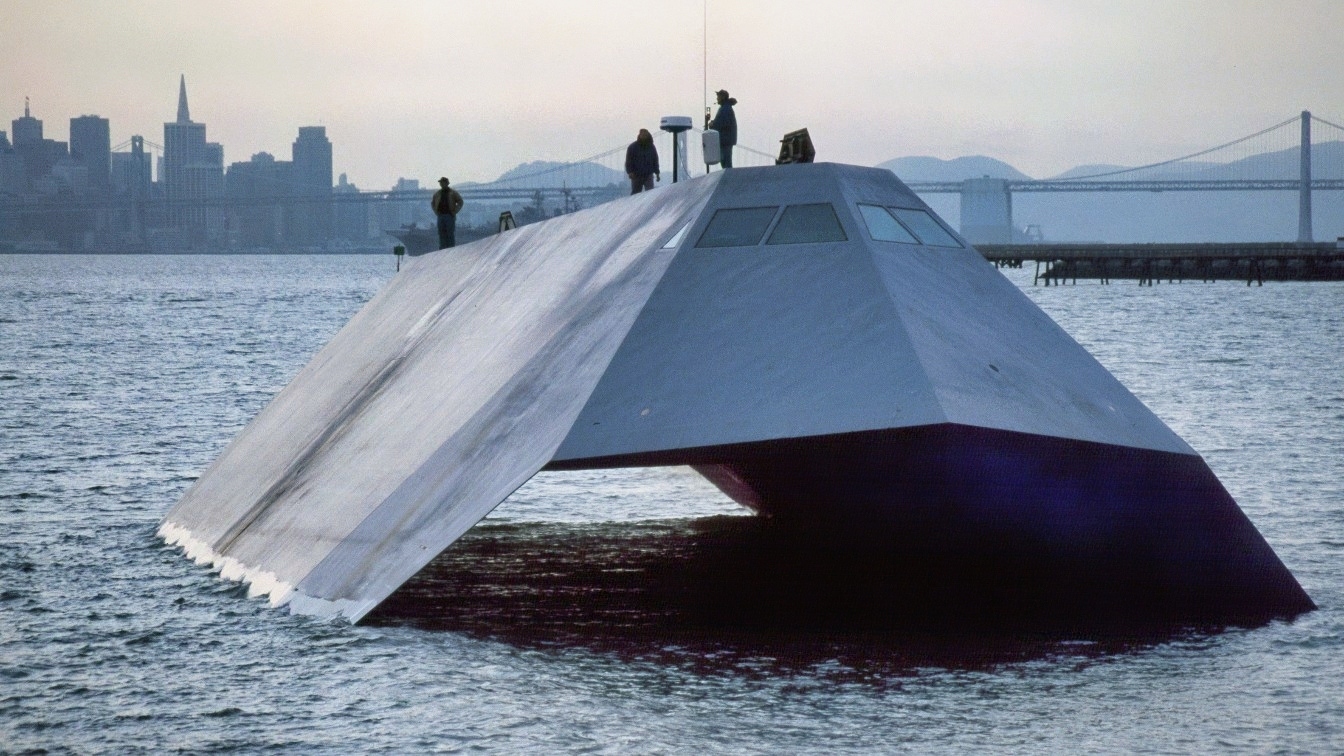
Developed in the early 1980s by the Defense Advanced Research Projects Agency (DARPA) and Lockheed Martin, the Sea Shadow was less of a working warship prototype and more of a concept vehicle-turned-floating testbed. Engineers wanted to see whether the same radar-defeating principles employed by Lockheed designers for the US Air Force’s F-117 Nighthawk long-range stealth bomber could work when applied to warship designs.
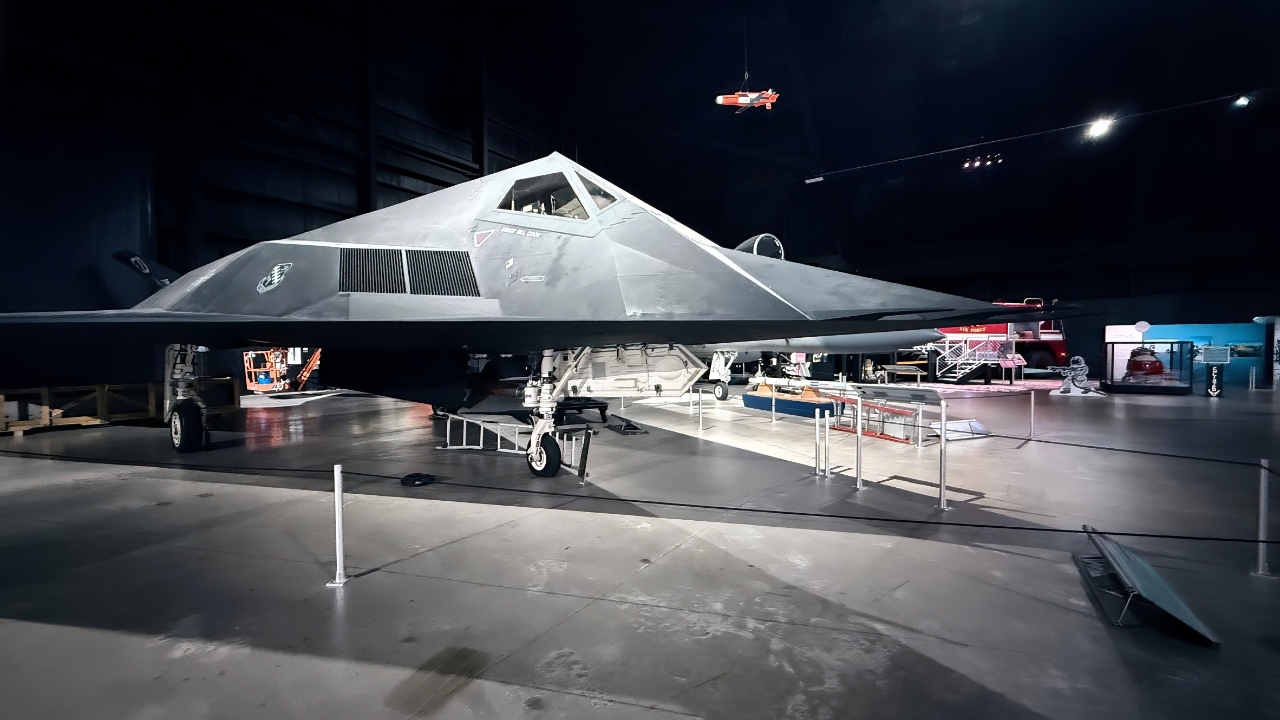
F-117 Still Looks Amazing National Security Journal Photo. All Rights Reserved.
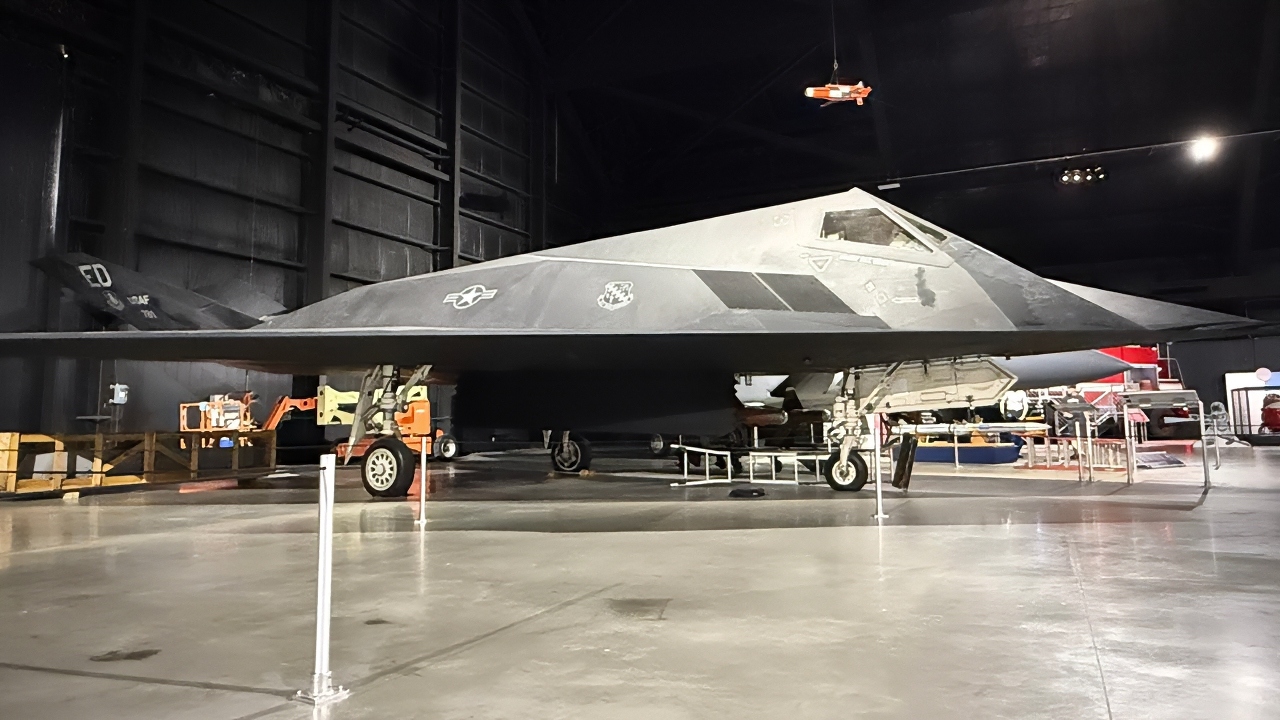
F-117 Nighthawk in the Air Force Museum. Image Credit: National Security Journal.

F-117 Stealth Fighter National Security Journal Photo. Image taken at the U.S. Air Force Museum.
For those 1990s James Bond fans, you’ll remember that the gonzo villain in 1998’s Tomorrow Never Dies, Eliot Carver, cruises the South China Sea (SCS) in a replica of the Sea Shadow.
Sea Shadow possessed faceted, angular surfaces just like the F-117 Nighthawk. It was designed with radar-deflecting geometry, too. American designers gave the ship extremely low acoustic signatures. Lockheed then built the Sea Shadow with a Small Waterplane Area Twin Hull (SWATH) design that provided unusual stability in rough seas.
As a preview of what future naval warships of the twenty-first century would be like, Lockheed equipped the Sea Shadow with extensive automation, ensuring that the ship would require only a tiny crew compared to conventional warships.
To maintain its high level of secrecy, American engineers built the ship inside the Hughes Mining Barge (HMB-1). They operated primarily at night for years before the public learned about them in 1993.
Why Was It Important?
Sea Shadow was a proof-of-concept vessel. The Navy wanted to better understand whether the same concepts that undergird the highly successful Air Force stealth plane program would apply to future warship designs. Indeed, many of the lessons learned eventually found their way into later warships, particularly the Zumwalt-class destroyer.
The angled surfaces, reduced radar returns, enclosed equipment, and automation concepts all influenced later American naval designs.
So, the Sea Shadow testbed was to naval strength what the early Have Blue demonstrator was to the F-117 and later Air Force stealth plane designs. Of course, that comparison is superficial only. Whereas the Have Blue led to one of the most successful, memorable series of warplanes and bombers based on the Have Blue’s design, the Sea Shadow inspired the likes of the failed Zumwalt-class destroyer. Nevertheless, that is the role that the Sea Shadow played for the Navy.

Zumwalt-Class U.S. Navy. Image Credit: Creative Commons.
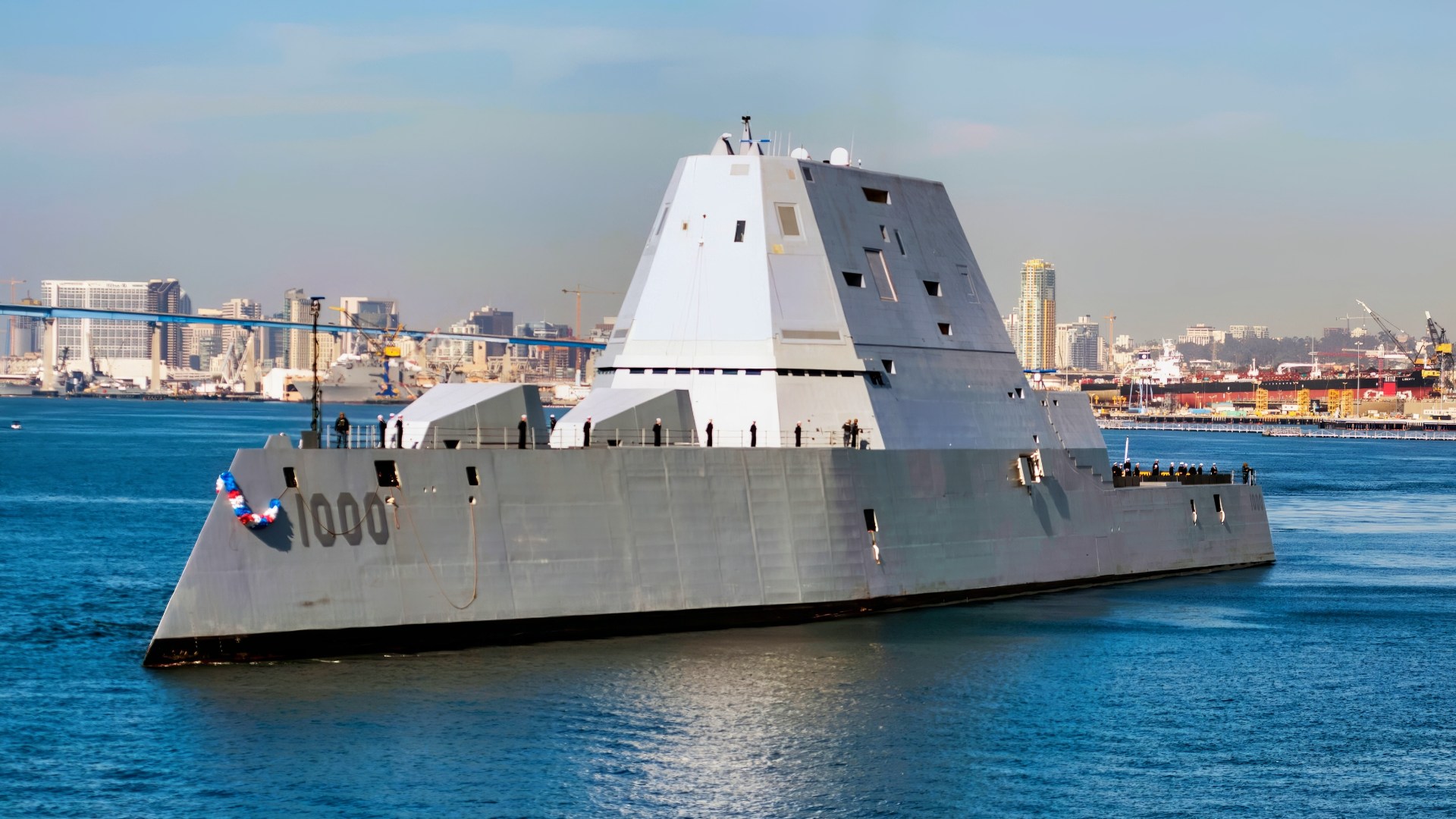
(Dec. 8, 2016) The guided-missile destroyer USS Zumwalt (DDG 1000) arrives at its new homeport in San Diego. Zumwalt, the Navy’s most technologically advanced surface ship, will now begin installation of combat systems, testing and evaluation and operation integration with the fleet. (U.S. Navy photo by Petty Officer 3rd Class Emiline L. M. Senn/Released)
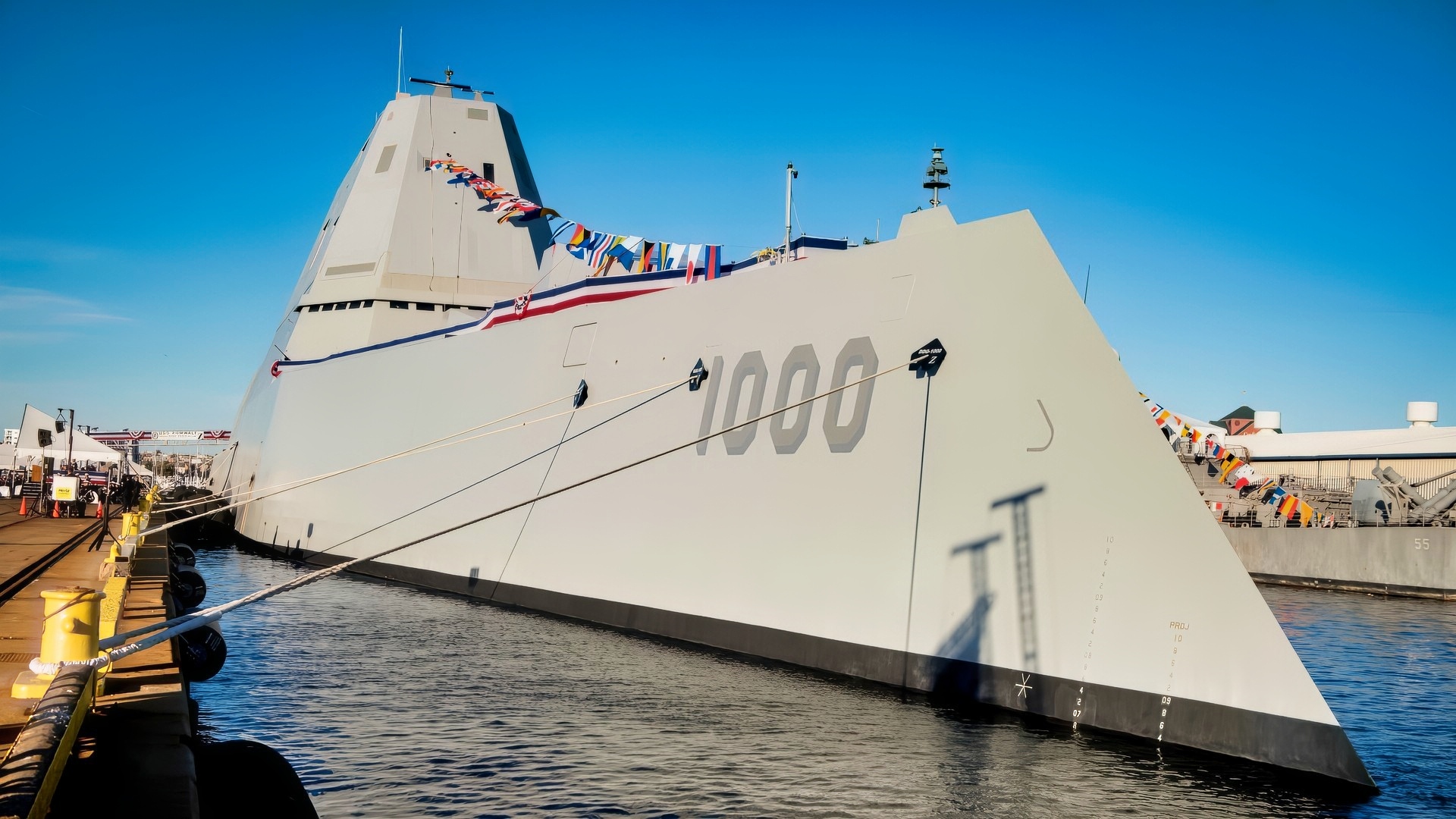
The Navy’s newest and most technologically advanced warship, USS Zumwalt (DDG 1000), is moored to the pier during a commissioning ceremony at North Locust Point in Baltimore. (U.S. Navy photo by Petty Officer 1st Class Nathan Laird/Released)
Could the Sea Shadow Be Something More Today?
A recent essay in the online trade publication Aviation Geek Club speculates that the Navy could develop 18 Sea Shadows, and that this fleet of 18 stealth warships could protect the entire US Navy carrier fleet (which is increasingly vulnerable to attack from anti-access/area-denial, A2/AD, systems).
The argument presented in the piece goes something like this: at least 18 Sea Shadows could extend sensor coverage, conduct missile reconnaissance, provide missile defense, act as a forward picket, and reduce the radar footprint of a carrier battle group.
Enemy reconnaissance systems depend heavily on locating carrier groups via radar, satellites, submarines, and maritime patrol aircraft. If US carriers had stealthy escorts, though, enemy tracking and targeting of massive carriers would become more difficult, making it harder to find them.
Then again, strategic rivals, like China, have other means of tracking and targeting American aircraft carriers at sea. Satellite constellations can identify the massive carriers from space. Meanwhile, US rivals constantly look for specific electronic emissions that are almost exclusively associated with US aircraft carriers.
There are infrared signatures that are unique to carriers, too. The primary purpose of carriers is to launch and recover warplanes and rotor-wing aircraft. Those aircraft operations make it easier for US rivals to identify carriers at sea.
Plus, there are vast undersea surveillance networks that can now readily locate US carriers.
The Aviation Geek Club piece is trying to be creative by bringing back an older, albeit iconic, warship to potentially counter the rising threat posed by enemy A2/AD networks to expensive, nearly irreplaceable US aircraft carriers. It’s an interesting suggestion. But it is not realistic. There were real reasons behind the Navy’s decision to discontinue its Sea Shadow project.
Why Didn’t the Navy Build More Sea Shadows?
For starters, the cost of an individual Sea Shadow, both to build and maintain, made the program more trouble than it was worth. Stealth coatings, unusual hull designs, and advanced automation all added complexity, compounding the costs and the time it took to build the Sea Shadow. If the Sea Shadow went to battle against a peer competitor and was damaged, repairing it–or replacing it–would have been a far costlier endeavor than it was worth.
Besides, the Navy preferred evolutionary improvements rather than building entire fleets around a radically new concept. The fact that the Cold War had ended by the time it was revealed to the world. Congress had drastically cut military funding around this time in favor of the “Peace Dividend,” a reduced military designed merely to police the global commons in the post-Cold War US hegemonic world order.
Expensive platforms like the Sea Shadow weren’t as necessary as they once were.
Warships are distinct from warplanes. On a ship, antennas and weapons exist on the outside, helicopters must operate from the deck, and radar systems are always transmitting. What the Navy discovered throughout the Sea Shadow project was that reducing signatures was useful, but there was no way to shroud a warship behind complete stealth.
This reality brings us back to the Aviation Geek essay referenced above. The writer had an innovative idea.
But it is totally impractical.
Not only would the US Navy need to build a fleet of stealth warships, but it would have to maintain these warships. America’s ongoing naval shipyard crisis forces the Pentagon to be much more selective about starting new projects.
Restoring the Sea Shadow and restarting its production line would be a waste of time and resources.
The Real Legacy
Where things get interesting, though, is in the questions the Sea Shadow program raised about naval power projection and the technology that undergirds it. Today, China is building an increasingly sophisticated maritime reconnaissance-strike complex capable of tracking carriers across the Pacific.
So, the question of how best to protect US warships at sea under intense surveillance conditions is suddenly relevant again. Back in the 1980s and 1990s, the Navy briefly explored a future built around low-signature ships, automation, and deception embodied by the Sea Shadow concept ship.
That future was never fully pursued.
But the Navy should look back at that program and similar ones for inspiration on how best to defend its existing legacy platforms against enemy A2/AD networks.
About the Author: Brandon J. Weichert
Brandon J. Weichert is the Senior National Security Editor at 19FortyFive.com. He also manages The Weichert Brief on Substack. Weichert hosts “National Security Talk” on Rumble, too. He is the author of four bestselling national security books, the most recent of which is A Disaster of Our Own Making: How the West Lost Ukraine (Encounter Books). Follow him via Twitter/X @WeTheBrandon.


