

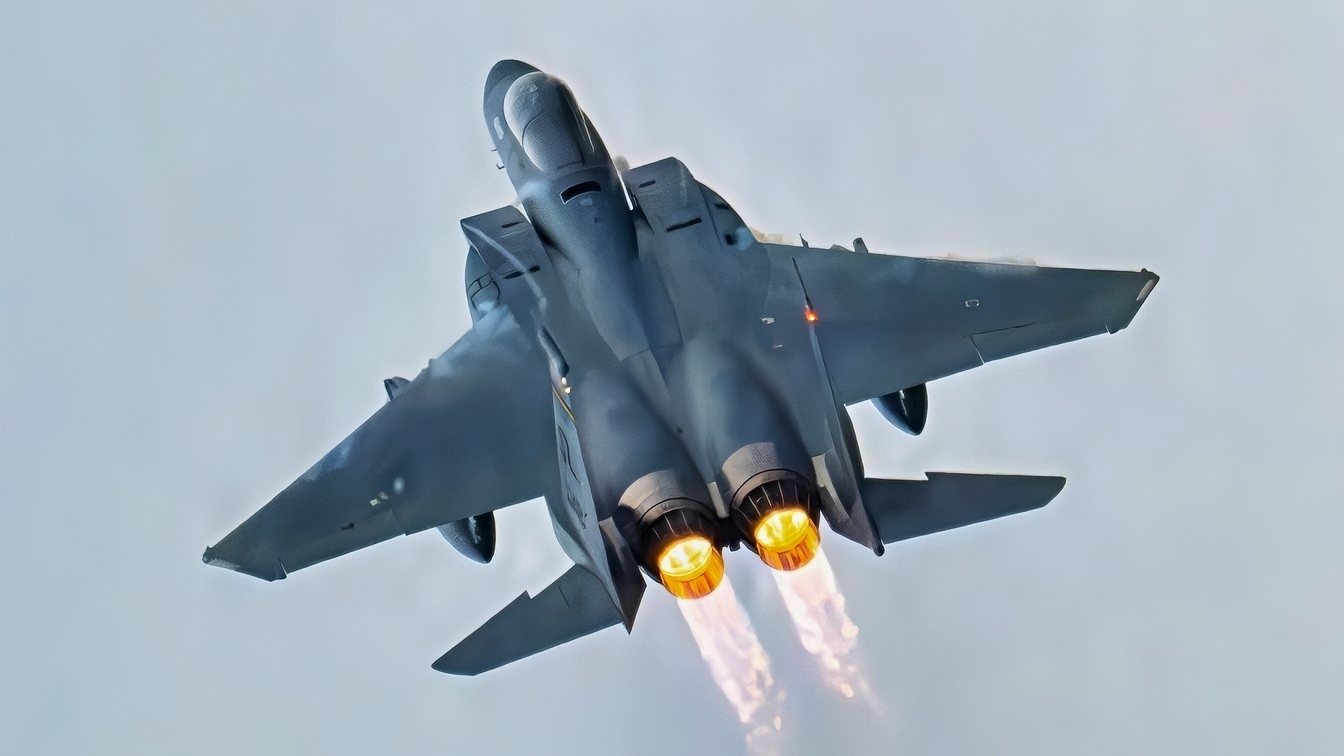
Summary and Key Points: For the first time in history, all 22 National Guard generals who command America’s Air National Guard fighter squadrons have signed a single letter to Congress — and the warning inside it is blunt. The U.S. Air Force, they say, has never been older, smaller, or less ready in its entire existence. The alarm comes at a striking moment: the same Air Force just proved its worth over Iran during Operation Epic Fury, even as the generals warn that pilots are being sent into combat in jets built before they were born.
The U.S. Air Force Is In Trouble

An F-22 Raptor performs an aerial demonstration at Naval Air Station Oceana, Virginia, Sept. 19, 2025. Rapid changes in angle of attack create visible vapor around the aircraft, providing a clear view of its aerodynamic performance. This demonstration highlights the F-22’s advanced maneuvering capabilities, showcasing its speed, agility, and thrust-vectoring performance. (U.S. Air Force photo by Staff Sgt. Lauren Cobin)

The F-22 Raptor performs a demonstration at the Mather Airshow in Sacramento, California, Sept. 23, 2018. The P-38 is a World War I-era fighter aircraft that was developed for the Army Air Corps. (U.S. Air Force photo by Senior Airman Lauren Parsons/Released)
Twenty-two U.S. National Guard adjutants general from every state operating Air National Guard fighter squadrons have sent a formal letter to Congressional Appropriations and Defense committee leadership urging procurement of 72 to 100 new fighter aircraft per year — dramatically above current planned rates — warning that the U.S. Air Force is now the “oldest, smallest, and least ready” force in the service’s 78-year history.
A group of National Guard adjutants general from nearly two dozen states has written a letter to Congress, seeking an increase in the number of fighter jets ordered per year.
The letter is dated April 1, although media coverage, including by Fox News, did not begin to appear until a few weeks later.
Peace Through Strength?
The National Guard letter is addressed to the chairs and ranking members of the Appropriations and Defense committees and subcommittees in both Houses of Congress.

A U.S. Air Force B-52H Stratofortress aircraft flies in a seven-ship formation during the Hyundai Air and Sea Show at Miami Beach, Florida, May 24, 2025. The flyover represented the Air Force’s total force, integrating active duty, guard, and reserve pilots flying the B-1B Lancer, B-2 Spirit, F-22 Raptor, A-10 Thunderbolt II, B-52H Stratofortress, F-16C Fighting Falcon, and F-15C Eagle aircraft. (U.S. Air Force photo by Staff Sgt. Bailee A. Darbasie)

U.S. Air Force Major Lindsay “MAD” Johnson, A-10C Thunderbolt II Demonstration Team commander and pilot, flies during the National Cherry Festival Air Show in Traverse City, Mich., June 29, 2024. It took a team of highly skilled individuals to keep the A-10 flying and make Johson’s demonstrations possible. (U.S. Air Force photo by Senior Airman Devlin Bishop)

A-10 Warthog. Image Credit: Creative Commons.
“We write to express our unified and urgent concern regarding the United States Air Force’s current and future ability to meet the requirements of the 2026 National Defense Strategy (NDS), the letter begins. The authors go on to describe the current iteration of the Air Force as “the OLDEST, the SMALLEST and the LEAST READY in its 78-year history.”
“We must build a fighting force that WILL WIN,” the letter authors say.
That 2026 National Defense Strategy, released in January, laid out Defense Secretary Pete Hegseth’s vision for national defense. It was subtitled “Restoring Peace Through Strength For a New Golden Age of America.”
That strategy, per the National Guard letter, “requires a total Air Force indistinguishable between components in lethality and survivability.” Once again citing the National Defense Strategy, the Guard leaders call to “Supercharge the Defense Industrial Base” by procuring 72 new fighters per year, possibly as many as 100, across the F-35A Lightning II, F-22 Raptor, F-15EX Eagle II, and F-47 categories.
The call is for Congress to appropriate 48 F-35s and 24 F-15EXs annually, with a stretch goal of 72 F-35As and 36 F-15EXs each year.
“Current world events have once again demonstrated the irreplaceable and outsized proposition that the USAF brings to the Joint Force, as evidenced by Operation Epic Fury,” the letter said.
Why the Ask?
In an interview with Air and Space Forces magazine, Brig. Gen. Shannon Smith, head of the Idaho Air National Guard, said that the 22 adjudcants general who signed the letter are from the states that have guard fighter units. Smith added that this is the first time all 22 have gotten together to write such a letter.
The signatories of the letter represent Alabama, Arizona, California, Colorado, Florida, Hawaii, Idaho, Indiana, Louisiana, Massachusetts, Missouri, New Jersey, Ohio, Oklahoma, Oregon, South Carolina, South Dakota, Texas, Vermont, and Wisconsin.
“What we’re trying to do with this is send a strong message from the two-star generals that command the National Guards in these states,” Smith told the publication.
The letter was to be followed by further communications with Congress.
“We all see the headlines of the amazing things our service men and women do,” Smith told Air and Space Forces. “We are burning these jets and the Airmen over time to support the joint force to accomplish the president’s goals with Epic Fury in this conflict with Iran.”

Airman Brandon Kempf, 757th Aircraft Maintenance Squadron assistant dedicated A-10 Thunderbolt II crew chief, watches as an aircraft taxis into position after landing May 9, 2013 at Nellis Air Force Base, Nev. Upon landing, the A-10 Thunderbolt receives numerous post-flight checks and maintenance including strut servicing and ammunition downloads. (U.S. Air Force photo by Airman 1st Class Joshua Kleinholz)

A U.S. Air Force F-35 Lightning II performs during the Fairchild Skyfest 2024 airshow at Fairchild Air Force Base, Washington, June 23, 2024. Team Fairchild hosted the Skyfest 2024 airshow June 22 and 23 to thank the local community for their support and partnerships. During the event, attendees observed performances by the A-10 Thunderbolt II Demonstration team, Wings of Blue parachute team, UH-1N Huey and various other aerial acts, as well as static displays. Events like SkyFest allow communities within the Inland Northwest to witness U.S. military air capabilities and the Air Force’s premier air refueling wing in action. (U.S. Air Force photo by Airman 1st Class Matthew Arachikavitz)
The publication noted that the last time the Air Force procured as many as 72 jets in one year was 1998, before the post-9/11 wars.
Per Fox News, the Air Force “asked Congress to procure 48 F-35s in 2024 and 42 in 2025. For F-15EXs, they asked for 24 in 2024 and 18 in 2025.”
“If we keep dabbling under 72, that isn’t winning, that is raising the water line,” Smith told Air and Space Forces. “If we don’t procure at a higher rate, all of these fighter squadrons will remain with ’70s-era fighters. Most of the money will go to keep them flying. In a few years, they’ll be struggling to be flyable, let alone be relevant.”
What Will Congress Do?
Weeks back, the White House asked Congress for a record amount of defense spending, of $1.5 trillion- a price tag that’s not expected to include the Iran war, which will be the subject of a supplemental budget ask.
As noted by The War Zone in a story about the National Guard letter, “the Fiscal Year 2027 budget request also includes funding for the purchase of 10 F-35Bs and 37 F-35Cs for the Marine Corps and the Navy, which is already a notable uptick in planned acquisitions.”
“At the same time, the F-35 program has faced worrisome delays in work on a new radar, as well as a host of other critical upgrades.”
According to an NPR report last week, Congress has some questions about how that record request for defense money will be spent.
Rep. Betsy McCollum (D-MN), the ranking Democrat on the House Defense Appropriations Committee and one of the recipients of the National Guard letter, told NPR last week that the defense appropriations request was “shocking.”
“That’s the only way we can do our job properly to do the oversight that we are tasked with. To be clear, the size of the request for defense spending is shocking,” the Congresswoman said.
It also should be noted that if, as expected, Republicans lose control of one or both houses of Congress this November, defense appropriations will almost certainly become a heavier lift for the Trump Administration. The NPR story also noted that votes on defense appropriations will likely come later in the year, closer to the elections, forcing elected officials into a tough vote.

A U.S. Marine Corps F-35B Lightning II aircraft with Marine Fighter Attack Squadron (VMFA) 242 conducts a low pass next to the Japanese Ship Izumo off the coast of Japan, Oct. 3, 2021. U.S. Marines and Sailors embarked aboard the Japanese Ship Izumo in support of the first ever F-35B Lightning II operations aboard a Japanese vessel. The U.S. and Japan continue to work closely together to broaden their operational capabilities, support the Treaty of mutual Cooperation and Security, and maintain a free and open Indo-Pacific. (U.S. Marine Corps photo by Lance Cpl. Tyler Harmon)

U.S. Air Force Capt. Kristin “Beo” Wolfe, F-35A Lightning II Demonstration Team commander and pilot, takes off from Selfridge Air National Guard base for the 2020 London SkyDrive Air Show in Canada Sep. 12, 2020, Harrison Township, Mich. The F-35 Demo Team flew alongside the F-16 Viper, the F-22 Raptor, the A-10 Thunderbolt II, and the Air Force Thunderbirds aerial demonstration teams in London, Ontario, Canada. (U.S. Air Force photo by Capt. Kip Sumner)
Meanwhile, as The War Zone noted, even if Congress were to go along with what the National Guard chiefs recommended, following the orders would be “far from easy.”
“Meeting the aim of 72 to 100 new fighters each year would demand a significant uptake in production capacity, which is already stretched. With that in mind, the Air National Guard projects it could still take 10 to 15 years to re-equip units now flying older fighters,” TWZ reported of the ask. “One option to re-equip Guard and Reserve units would be to cascade fighters down from the Active component, but Air National Guard chiefs warn against this, too, since it only pushes recapitalization with new fighters further down the line.”
About the Author: Stephen Silver
Stephen Silver is an award-winning journalist, essayist, and film critic, and contributor to the Philadelphia Inquirer, the Jewish Telegraphic Agency, Broad Street Review, and Splice Today. The co-founder of the Philadelphia Film Critics Circle, Stephen lives in suburban Philadelphia with his wife and two sons. For over a decade, Stephen has authored thousands of articles that focus on politics, national security, technology, and the economy. Follow him on X (formerly Twitter) at @StephenSilver, and subscribe to his Substack newsletter.


kathy A Evans
June 7, 2026 at 7:30 pm
As an 70s veteran and the reading i keep up with i will say Ÿes the AIR FORCE is old. The NAVY takes the power in today’s world. The navy ships hold all the power. Along with the navy planes. It also makes more sense to down more Air Force planes. Then they are able to pursue one or two branches if not all four of them. JUST as the ground troups have gone down ìn numbers. We happen to War in a very different way today.
cbvand
June 8, 2026 at 9:00 am
Seems the Air force top brass are a bunch of squirrels, always looking for a new, bright, shiny object, that simply has to cost far more than an arm and a leg.
Bruiser in Houston
June 8, 2026 at 2:12 pm
Why do we still use the F-15, F-16, the A-10, and the B-52?
Because they work.
Why do the Russkies still use the Mig-29 and derivatives of the Su-27?
Because they work.
Why do airlines still fly airframes that were designed 50 years ago?
Because they work.
Htos1av
June 9, 2026 at 9:22 am
When I applied to the USAF in ’79, I was unceremoniously told “no way’, after scoring perfect on all ASVAB’s, etc. And had already ‘fabbed a radio station at school. While getting my first saftey certs from GE, under the guidance OF a GE engineer who was the county electrical inspector as well.
“Get lost”.
And was laughed OUT of the room when I presented my credentials for the aviation TCAS solution of 1981.
Sooooooo…..it was optical switch nodes and the Motorola cable modem in 1993, with Comcast.
My “problem”: A white boy, with red haire and blue eyes. That’s IT!
Let THAT sink in…….