


A British aircraft carrier is sitting in a Norwegian fjord because its propeller shaft failed. Again. HMS Prince of Wales, the 65,000-tonne flagship of the Royal Navy, was left marooned off the coast of Norway and forced to limp into Stavanger for repairs after a technical fault surfaced during a NATO exercise in the High North. The suspected culprit is the propeller shaft, the same component that has crippled this ship and her sister before. She had been steaming toward celebrations marking 250 years since the American Declaration of Independence. Instead, Britain’s premier warship is broken down in a Scandinavian port, and a senior naval source has called it devastating for a crew whose morale was already at rock bottom.
This is not bad luck. It is a pattern, and the pattern is now impossible to wave away.
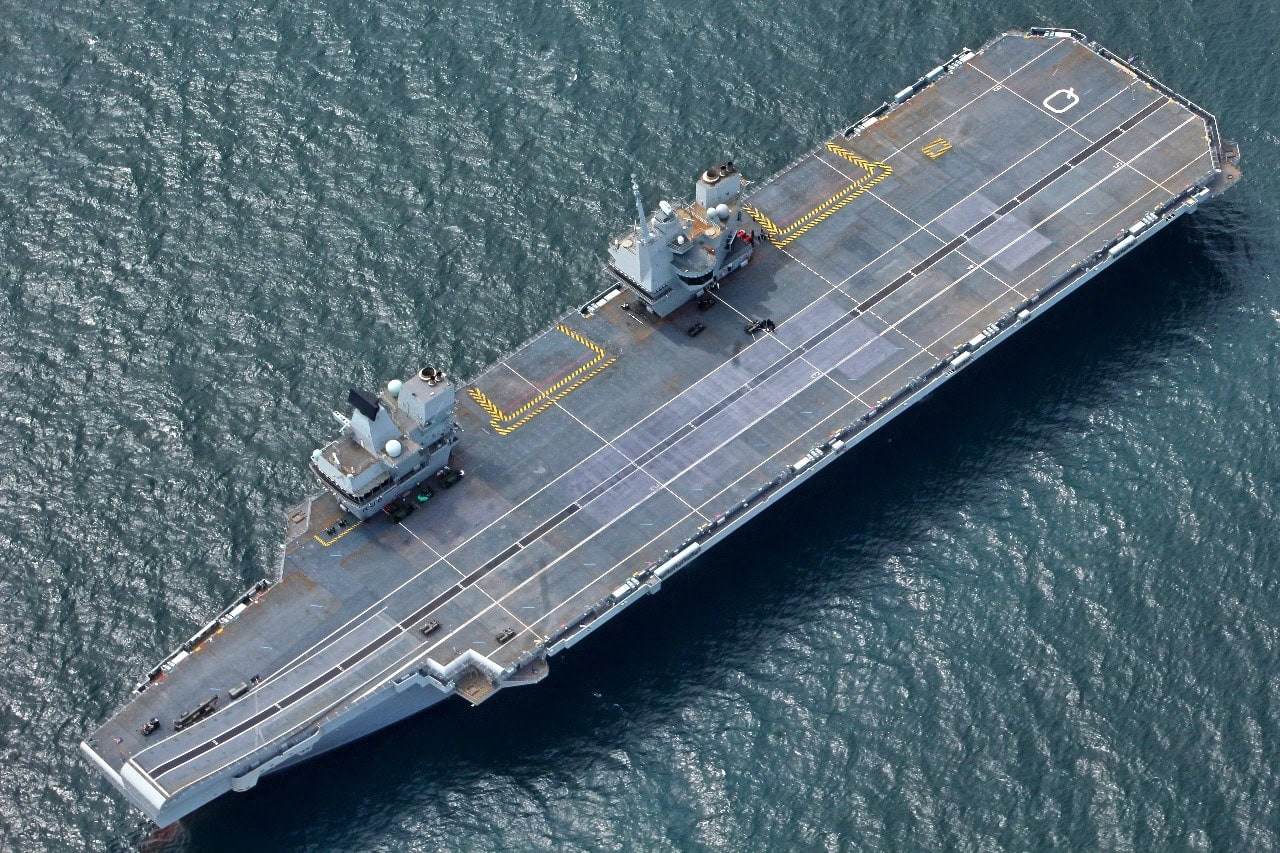
Queen Elizabeth-Class. Image Credit: Creative Commons.

HMS Prince of Wales and HMS Queen Elizabeth pictured at sea for the first time. Image Credit: Royal Navy.
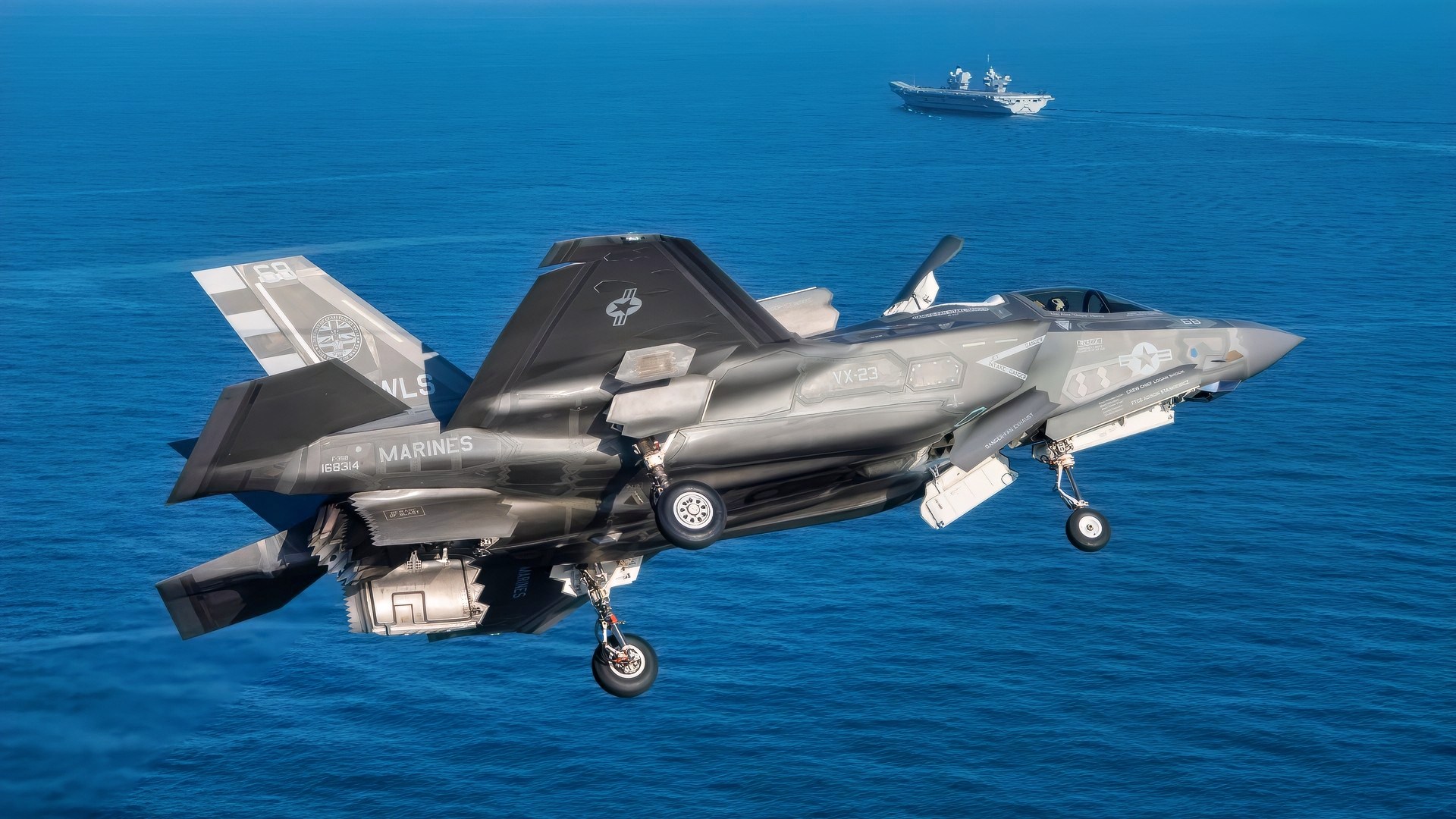
F-35 test pilot Marine Maj. Paul Gucwa from Air Test and Evaluation Squadron Two Three (VX-23), Naval Air Warfare Center Aircraft Division (NAWCAD), flies an F-35B Lightning II fighter aircraft to the U.K. HMS Prince of Wales aircraft carrier in the Western Atlantic Oct. 11, 2023. Gucwa will embark with a detachment from the Patuxent River F-35 Integrated Test Force (ITF) to conduct developmental test phase 3 (DT-3) sea trials with the specially instrumented, short takeoff vertical landing variant of the stealth jet aboard Britain’s largest warship.
The U.K. Queen Elizabeth-class (QEC) aircraft carrier HMS Prince of Wales (R09)’s participation in WESTLANT 23 encompasses a range of U.K. and U.S. naval aircraft trials in the Western Atlantic throughout the autumn of 2023.The HMS Prince of Wales continues to push the boundaries of naval aviation capabilities and operations from QEC aircraft carriers, including increasing the range and lethality of F-35 operations. The U.K. is the only Tier I partner in the F-35 Joint Strike Fighter (JSF) Program. U.K. and U.S. interactions during this deployment are characterized by cooperation and reinforce international relationships, as well as enhance interoperability between the U.S. Navy and Royal Navy.
The F-35 Joint Program Office is the U.S. Department of Defense’s focal point for the 5th-generation strike aircraft for the Navy, Air Force, Marines, and our allies. The F-35 is the premier multi-mission, 5th-generation weapon system. Its ability to collect, analyze and share data is a force multiplier that enhances all assets in the battle space: with stealth technology, advanced sensors, weapons capacity, and range. The F-35 has been operational since July 2015 and is the most lethal, survivable, and interoperable fighter aircraft ever built.
(US Navy photo by Dane Wiedmann)

Queen Elizabeth-Class Aircraft Carrier. Image Credit: Creative Commons.
A Propeller Shaft Curse That Keeps Returning
The Prince of Wales has a history with this exact failure.
In August 2022, barely out of Portsmouth and bound for exercises with American and Canadian forces, she broke down off the Isle of Wight with a propeller shaft problem and had to be towed back into harbor.
Divers and engineers found the 33-tonne starboard propeller, roughly the weight of thirty small cars, had malfunctioned when the coupling holding it in place broke. She then spent close to a year in dry dock at Rosyth before returning to service in 2023. The two ships were commissioned with great fanfare in 2017 and 2019 as the largest warships ever built for the Royal Navy.
Her sister’s ship offers no reassurance. HMS Queen Elizabeth was pulled from a major NATO exercise in 2024 after routine checks revealed a propeller shaft coupling issue, and she sailed to Rosyth for repairs while the Prince of Wales took her place.
That substitution itself told a story: the Royal Navy and its industrial partners had to work around the clock to ready the Prince of Wales in just seven days against a normal preparation time of thirty, simply to keep one carrier in the fight.
As recently as the start of 2026, both ships were sidelined at the same time, leaving Britain with no available aircraft carrier at all.
The “Not A Class Issue” Defense Is Wearing Thin
After the 2022 breakdown, officials worked hard to contain the damage to the ship’s reputation.
Amid an Anglo-French row over the embarrassment of a flagship failing so soon after leaving port, an official declined to say whether a build defect or damage at sea was to blame, but insisted the Royal Navy was confident it was not a class issue with the carriers.
The contractor, Babcock, said it remained focused on completing the repair and that an investigation into the starboard shaft failure had been commissioned.
That reassurance has not aged well. When one ship breaks a propeller shaft, you can call it an isolated defect. When both ships in a two-ship class suffer propeller shaft failures, when one of them does so twice, and when those failures keep knocking the carriers out of marquee NATO exercises, the claim that this is not a class-wide problem starts to look less like an engineering assessment and more like a public-relations holding line.
The shaft, the coupling, and the seals are precisely the parts that keep failing, and they are common to both hulls.
What £6 Billion And A Ski-Jump Actually Bought
The carriers were not cheap. The program to build the two ships cost the United Kingdom more than £6 billion, and they were sold as the centerpiece of a renewed era of British global power projection. On their best days, they deliver real capability. The Prince of Wales completed an ambitious global deployment in 2025 and embarked on two dozen F-35B stealth fighters at once, the most ever flown from a British warship.
But the design carries built-in limits that the breakdowns only compound. The carriers were built around the short-takeoff-and-vertical-landing F-35B and use a ski-jump ramp rather than the catapults and arrestor wires of an American supercarrier.
That choice locks them out of operating heavier fixed-wing aircraft such as the E-2 Hawkeye airborne early-warning plane, forcing them to rely on shorter-ranged helicopter radar instead, and it caps the practical air wing well below the fifty or more jets a US carrier routinely puts to sea. A British carrier is a genuinely capable ship with a smaller punch than its size suggests, and that is before anything breaks.
The Escort Fleet That Cannot Screen Them
A carrier never fights alone, and here the Royal Navy’s deeper weakness shows. A carrier strike group needs destroyers for air defense, frigates for anti-submarine work, support ships, and ideally an attack submarine, a protective screen without which a multi-billion-pound carrier is a liability rather than an asset. Britain is struggling to generate that screen even in peacetime. In a January 2026 parliamentary answer, the Ministry of Defense acknowledged that only three of the six Type 45 destroyers, the navy’s dedicated air-defense ships, were operational. Half the fleet that is supposed to shield the carriers from air and missile attack was unavailable.
Layer the aircraft on top, and the picture worsens. In July 2025, the National Audit Office warned that the Ministry of Defense faced serious gaps across the F-35 program, including shortages of spare parts, engineers, support infrastructure, and trained personnel.
So the carriers can be broken, the destroyers that protect them can be in dock, and the jets that arm them can be grounded for lack of spares, all at once. Each problem is bad on its own; together, they describe a force that can flex impressively for a single set-piece deployment but struggles to sustain credible carrier power as a standing capability.
What Happens Now to the Queen Elizabeth-Class Carriers?
Britain spent more than £6 billion on two carriers conceived for global power projection at a moment when its most pressing maritime burdens, anti-submarine warfare and sea control in the North Atlantic and the waters around Europe, are jobs that escorts and submarines do better than big-deck carriers. The irony is that the Prince of Wales broke down on precisely such a mission, a carrier strike group deployment across the North Atlantic and Arctic billed as a show of force to deter Russia and protect undersea infrastructure, with the Ministry of Defense declining to specify the fault while saying it expected her to sail again within days. President Trump has openly mocked the Royal Navy as old and broken down, and a flagship stranded in a Norwegian fjord on the way to an American anniversary is exactly the image that mockery feeds on.
None of this means the carriers are worthless. A ship that can carry two dozen fifth-generation fighters and anchor a coalition task group has obvious value, and the alliance signaling of a British carrier sailing alongside American and allied forces is real. But value is not the same as readiness, and a capability available only between breakdowns is one a serious navy cannot plan around.
About the Author: Harry J. Kazianis
Harry J. Kazianis (@Grecianformula) was the former Senior Director of National Security Affairs at the Center for the National Interest (CFTNI), a foreign policy think tank founded by Richard Nixon based in Washington, DC. Harry has over a decade of experience in think tanks and national security publishing. His ideas have been published in the NY Times, The Washington Post, The Wall Street Journal, CNN, and many other outlets worldwide. He has held positions at CSIS, the Heritage Foundation, the University of Nottingham, and several other institutions related to national security research and studies. He is the former Executive Editor of the National Interest and the Diplomat. He holds a Master’s degree focusing on international affairs from Harvard University.


