

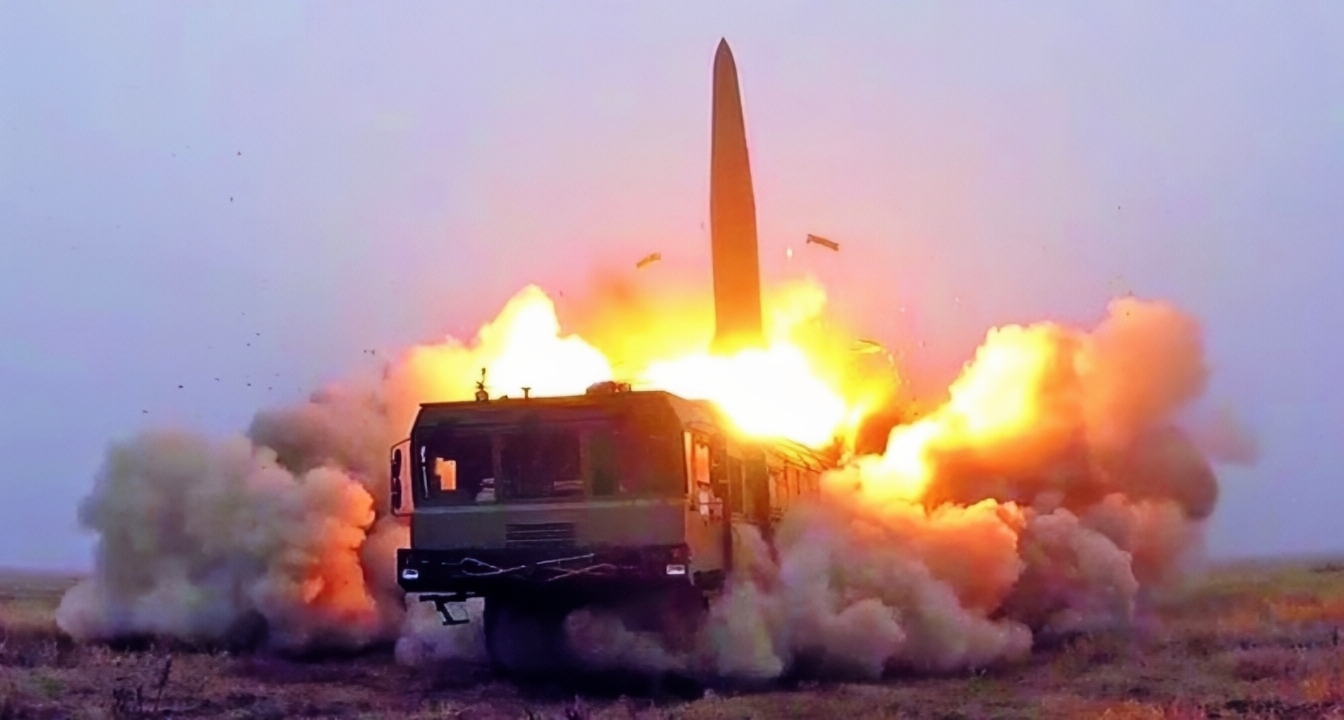
On the night of 8-9 August, Ukrainian drones destroyed an Almaz-Antey S-400 missile launch assembly.
That unit had been used to cover the airspace over one of Russian President Vladimir Putin’s palatial residences from long-range missile and drone strikes.

German soldiers assigned to Surface Air and Missile Defense Wing 1 fire the Patriot weapons system at the NATO Missile Firing Installation (NAMFI) during Artemis Strike Nov. 7 in Chania, Greece. Artemis Strike is a German-led multinational air defense exercise. German soldiers Over 200 U.S. soldiers and approximately 650 German airmen will be participating in the realistic training within a combined construct, exercise the rigors associated with force projection and educate operators on their air missile defense systems. (Photo By Officer Candidate Sebastian Apel, Air Defence Missile Group 24)

Exercise Artemis Strike is a German-led tactical live fire exercise with live Patriot and Stinger missiles at the NATO Missile Firing Installation in Chania, Greece from Oct. 31-Nov. 09. Over 200 U.S. soldiers and approximately 650 German airmen will be participating in the realistic training within a combined construct, exercise the rigors associated with force projection and educate operators on their air missile defense systems. The 10th Army Air Missile Defense Command will deploy, operate and fire live missiles within a tactical scenario, under Supreme Headquarters Allied Powers Europe operational readiness evaluation criteria.
This particular S-400 “Triumph” battery was positioned approximately 12 miles from the Russian president’s Italianate palace complex, built near Gelendzhik in southern Russia. The S-400 is designed to take down aircraft, drones, and cruise missiles.
According to Ukraine’s Unmanned Systems Forces, this system launched six missiles against Ukraine the previous day, employing the S-400 in a surface-to-surface attack configuration rather than its standard air-defense role. Russia produces these surface-attack variants by converting decommissioned air defense missiles.
Ukraine’s Defence Intelligence Service (HUR) has reported that Russian industry manufactured of these 200 RM-48Us, as they are designated, in 2025 and intends to produce more than 480 in 2026.
Major Robert “Magyar” Brovdi, the Commander of the Unmanned Systems Forces, stated that on 8 August between 0925 and 1251 hours, the S-400 system positioned near Gelendzhik carried out six missile launches against Ukraine.
However, after it was struck by a Ukrainian drone strike, the battery’s position was left “ablaze and sputtering for three hours”, Brovdi reported.
Layered Air Defense
The air defense architecture protecting Putin’s favorite holiday residence consists of more than just this one S-400 unit.
It is part of a layered configuration and is used alongside electronic warfare (EW) systems and mobile fire groups, which are supposed to coordinate their movements to defend the palace.
According to HUR intelligence reports, they are all component units of different range- and altitude-capable missile launchers and EW emplacements.
Together they form a circle that creates a 27-square-mile “buffer zone”. Russian security officials also enforce a permanent no-fly zone above the complex.
Major Brovdi told media outlets that the S-400’s firing unit had been recently repurposed to fire missiles at Ukrainian cities, which includes the six missiles that were fired on 8 August.
Various missile system analysts who spoke to the London Daily Telegraph explained that Russia’s military was at present converting any and all assets possible to fire on Ukrainian cities.
Putin and his military leadership have decided to make maximum use of these systems for surface-to-surface missile attacks due to Ukraine’s severe shortage of US Patriot system missiles.
Unfortunately for Ukraine, only the most capable of the effectors that are part of the Patriot’s “missile mix” are capable of defending civilian population centers against ballistic missile barrages.
“While less accurate and lethal, they [the S-400 missiles] still represent a threat to civilian infrastructure, particularly when launched at densely populated areas,” wrote Fabian Hoffmann, a missile expert at the University of Oslo, in an e-mailed comment to the Telegraph.
The Billion GBP Residence
This estate in the Gelendzhik region, which has been known as “Putin’s Palace”, may have cost the former KGB Lt. Col. who is now Russia’s president as much as £1 billion.
This figure, amounting to US$ 1.3 billion, was calculated in an earlier 2021 investigation by the Anti-Corruption Foundation, led by the late opposition leader Alexei Navalny.
Navalny was later convicted in a set of legal proceedings widely seen as a show trial organized by Putin’s security services.
He was sentenced to imprisonment in an Arctic Circle gulag and died in prison in 2024 under circumstances that suspiciously suggest he was murdered by the prison authorities.
Obviously, some of Putin’s palaces are more important to him than others.
This particular residence has been reported as the home of Alina Kabaeva, his rarely seen or publicly mentioned long-term partner, and their two sons.
It is protected by at least 27 specially constructed towers, each with Pantsir-S1 short-range air defense (SHORAD) systems mounted on top. Each unit carries a price tag of £16 million (US$ 20.7 million).
Journalists who have reported on the residence have stated that the complex features a casino, vineyard, spa, ice rink, theatre, pole-dancing room, hookah lounge, an “aquatic disco”, and a miniature railway room – among other luxuries.
Putin is believed to visit this Black Sea resort palace only on rare occasions. The Russian leader is known for having a pathological fear of being caught in a Ukrainian long-range drone strike.
About the Author: Reuben F. Johnson
Reuben F. Johnson has thirty-six years of experience analyzing and reporting on foreign weapons systems, defense technologies, and international arms export policy. Johnson is the Director of Research at the Casimir Pulaski Foundation. He is also a survivor of the Russian invasion of Ukraine in February 2022. He worked for years in the American defense industry as a foreign technology analyst and later as a consultant for the U.S. Department of Defense, the Departments of the Navy and Air Force, and the governments of the United Kingdom and Australia. In 2022-2023, he won two awards in a row for his defense reporting. He holds a bachelor’s degree from DePauw University and a master’s degree from Miami University in Ohio, specializing in Soviet and Russian studies. He lives in Warsaw.


