

Now that the world has awoken to the complete breakdown of the ceasefire between the United States, the Islamic Republic of Iran, and Israel, US President Donald Trump is pleading with two medium-sized Mideast powers to return to the deal. The question remains: how can the Americans sustain even a semblance of a ceasefire between these two warring parties?
Whereas before Trump’s disastrous second term in office (made disastrous only because of his pathetic handling of the Iran War), the US was clearly the senior partner in the US-Israeli relationship.
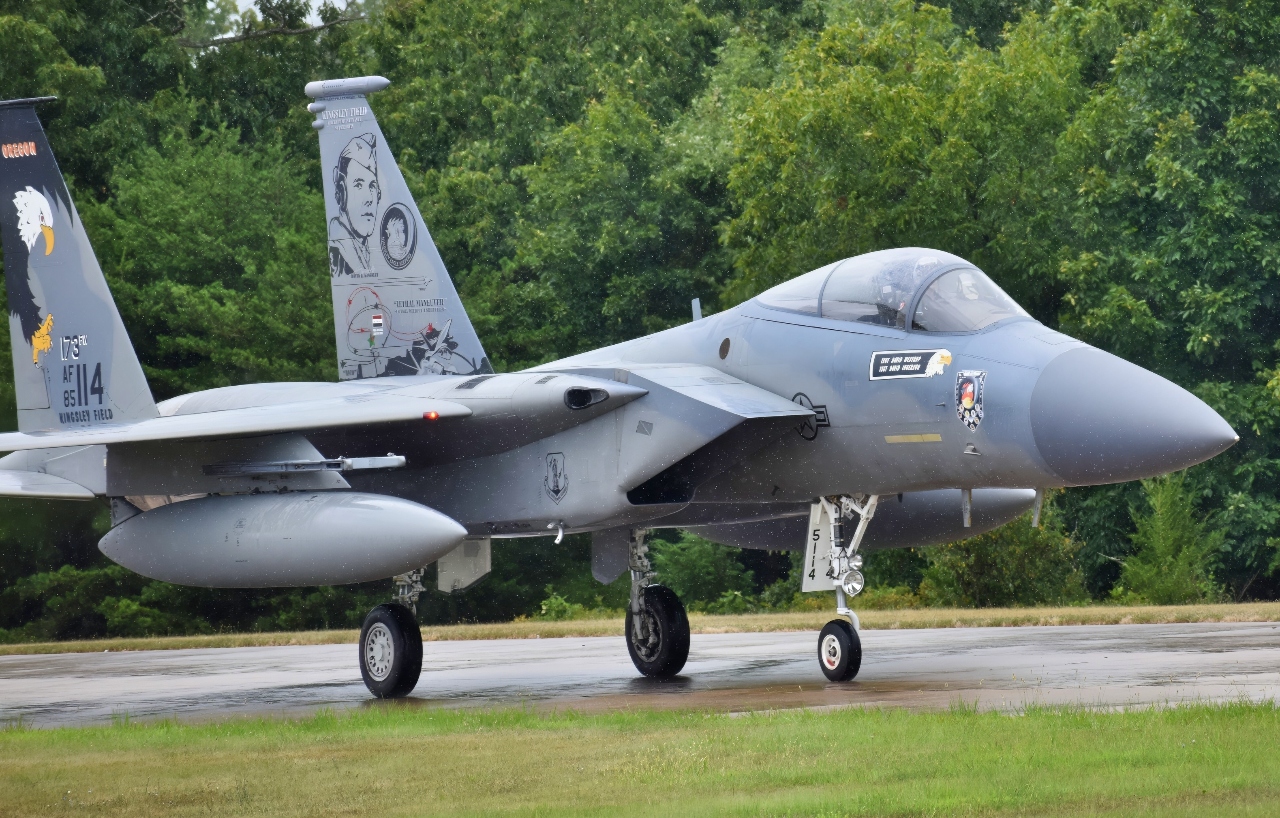
F-15C Fighter on the Tarmac. Image Credit: National Security Journal. Taken on August 13, 2025.
Now that the Iran War has kicked off again, the US is increasingly the junior partner to an Israel that is deeply committed to continuing the Iran War, even though Tehran is clearly winning at the strategic level.
Netanyahu’s Message to Trump
In any case, Netanyahu clearly told the US President “no” when Trump asked him to avoid escalating last night. Maybe not in words, persay, but in deeds.
In the late hours of the night, over the skies of Iran, missiles ostensibly fired from Israeli warplanes worked their way through well-defended Iranian airspace and destroyed or damaged multiple targets, including a petrochemical production facility–one of the targets that Tehran told the Americans and Israelis never to target if they ever wanted a ceasefire again. Iran targeted that facility, fully aware that this was an Iranian red line.
The Russians would describe the Israeli actions late last night over Iran as provokatsiya.
Did Israel Really Act Alone?
A question we should ask: What role did the Americans have in that attack, though?
While it’s true that the Israeli Air Force (IAF) has a few midair refueling tankers, the IAF disproportionately depends on the vast midair refueling capacity of its planes to reach the strike range against Iran. Indeed, per open-source flight tracking apps, USAF mid-air refueling tankers were deployed in unusually large numbers over the skies of the Middle East as the IAF struck Iran.
Even if the US Air Force did not provide mid-air refueling for whatever IAF warplanes Prime Minister Netanyahu deployed to strike Iran last night, the IAF still depends on the expansive US military intelligence, surveillance, and reconnaissance (ISR) capabilities.
Plus, the Israelis likely employed whatever precision-guided standoff munitions they have remaining in their depleting stockpile by firing them from safer areas outside Iran, in places like Iraq, rather than risk their warplanes by flying over heavily defended Iranian airspace last night.
All this would have required at least US military acquiescence, if not outright assistance. Clearly, right now, all we can ask is questions.
Israel and America: Who Is Really Running the Alliance?
Many are wondering whether the Trump administration is preparing to resume hostilities. This question is the wrong one to ask, though. After all, the last 24 hours have proven what many critics of the Trump administration have been arguing: that Trump is not his own man.
Netanyahu looks like the real power in the US-Israeli alliance.
For now, this seems true. Between Netanyahu’s shocking comments to the Knesset and his actions to “defy” the US president’s “pleas” for an off-ramp, Trump is not running anything. He’s more of a mid-level manager working for Netanyahu rather than the president of the purportedly sole remaining superpower. At least, those are the optics.
The Next Rung On the Escalation Ladder
But any escalation that the purportedly recalcitrant Trump takes will be different from what came before. Yes, he’d likely engage in airstrikes as happened before. But those airstrikes would necessarily be limited, thanks to the dangerous depletion of key precision-guided standoff munitions.
After those were sufficiently drained (and, yes, I do think if Trump escalates, he’d irresponsibly drain whatever remains of those basically irreplaceable stockpiles), Trump would likely switch to munitions that were in far greater supply.
Meaning that US pilots would be at greater risk.
Although Trump has warned Iran that if US personnel die, there’s no hope for a deal. So, it’s likely that if any US pilot died as a result of Trump’s escalatory decision, Trump would then move for a more decisive military response. At that point, we’d revert to earlier strategies to forcibly reopen the critical Strait of Hormuz and to seek regime change in Iran.
The Ground War Scenario
That’s where reasonable concerns that the Trump White House might try a ground invasion at some place along Iran’s well-defended coastline come to the fore. The point is less what, precisely, Trump will do, but he will be dragged up the escalation ladder by his “partner” in Israel.
And as that occurs, given the real limitations on US strategic stockpiles of critical precision-guided standoff munitions and air defense interceptors, the only significant way up the escalation ladder will be involving larger numbers of US military elements in either a ground invasion or some bizarre uranium hunt in the center of Iran. In either event, many Americans will die, and the US military will be further humiliated by the war.
About the Author: Brandon J. Weichert
Brandon J. Weichert is a Senior National Security Editor. He also manages The Weichert Brief on Substack. Weichert hosts “National Security Talk” on Rumble, too. He is the author of four bestselling national security books, the most recent of which is A Disaster of Our Own Making: How the West Lost Ukraine (Encounter Books). Follow him via Twitter/X @WeTheBrandon.


