
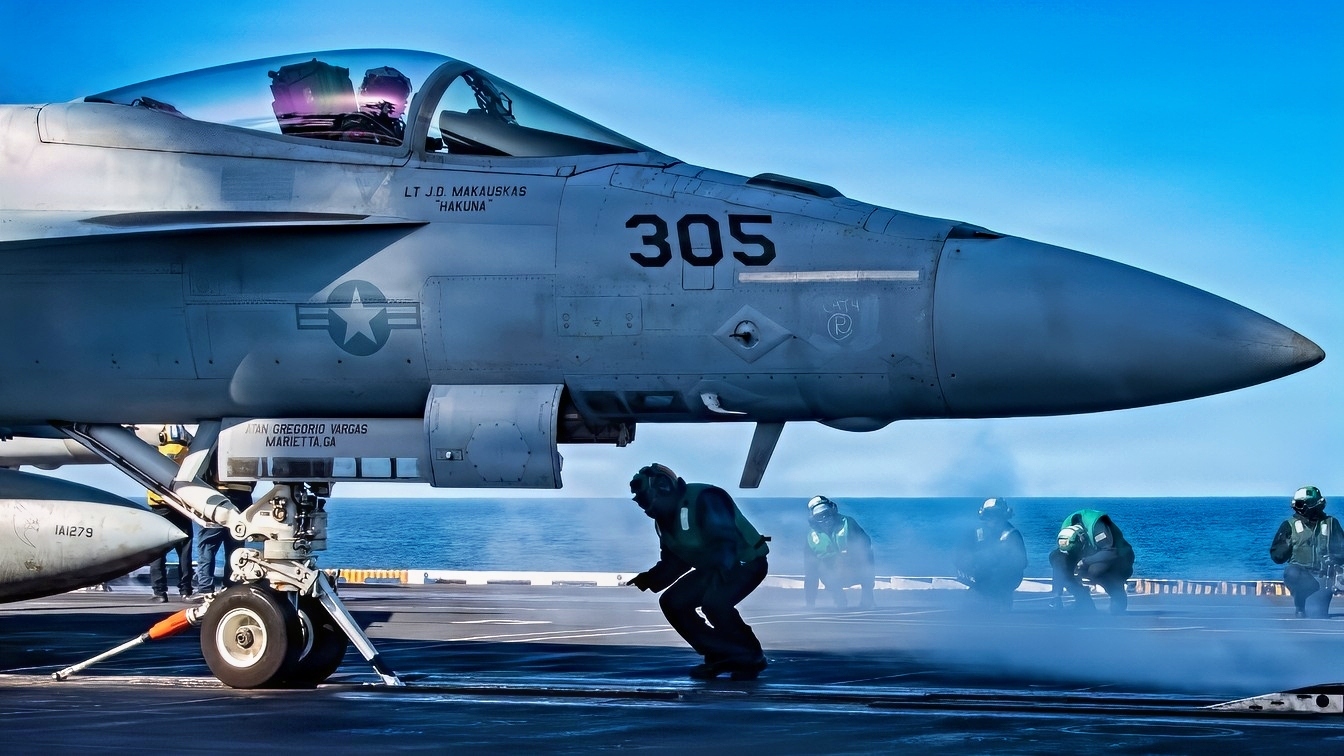
The full text of the memorandum of understanding (MOU) agreed by the United States and Iran was officially confirmed by Washington on Wednesday, June 17. It has also now been signed by President Trump.
The 14-point agreement officially declares the war between the two countries to be over and calls for Iran to open the Strait of Hormuz in exchange for the United States lifting its blockade.

An F/A-18 Super Hornet from Naval Air Station Oceana, Virginia, performs an aerial demonstration over Rickenbacker International Airport, Ohio, June 16, 2024, as part of the Columbus Air Show. This year’s event featured more than 20 military and civilian planes, including a KC-135 Stratotanker from the 121st Air Refueling Wing, which served as the base of operations for military aircraft participating in the show. (U.S. Air National Guard photo by Senior Airman Ivy Thomas)
As previously stated by the White House, the agreement also initiates 60 days of additional negotiations, during which time the thorny issue of Iran’s nuclear program and uranium enrichment will be hashed out in the hope of a lasting peace deal being signed by the end of the summer.
The deal has proven controversial among both Democrats and Republicans over the size of the economic incentives offered to Iran in exchange for compliance and cooperation, including the unfreezing of frozen assets and a privately funded $300 billion reconstruction fund.
It’s important to note that a final deal is not yet done and could still collapse at any moment – but, as President Trump noted during a speech in France on Wednesday, the deal has effectively averted a global oil crisis by opening up the Strait of Hormuz right before global oil reserves hit catastrophic lows.
While the Strait of Hormuz is open again for now, and commercial shipping companies and insurers so far seem convinced they can resume somewhat normal operations, the question of governance was raised in the MOU.
In fact, the text seems to suggest that while Tehran and Washington expect Hormuz traffic to be fully restored once a deal is reached, it could well occur under a new governance structure.

At sea (Mar. 1, 2007) – Capt. Craig “Animal” Williams (front) in a F/A 18C Hornet (front) and Capt. Richard “Rhett” Butler (back) in an F/A 18C Hornet look up for a photo as they fly over USS Ronald Reagan (CVN 76). Capt. Williams, a 22-year Naval Aviator who graduated from the United States Naval Academy, was relieved as Commander, Carrier Air Wing Fourteen (CVW-14) by 21-year Naval Aviator, Capt. Butler, a graduate of the University of Kentucky during an aerial change of command ceremony. The Ronald Reagan Carrier Strike Group is currently underway in the Pacific Ocean on a surge deployment in support of U.S. military operations in the Western Pacific. Official U.S. Navy photo by Lt. Cmdr. Tam Pham
(RELEASED)
What the MOU Says
Point 5 of the MOU states that, upon signing, Iran will arrange for the safe passage of ships through the Strait of Hormuz for the next 60 days.
Upon signing this MOU, the Islamic Republic of Iran will make arrangements, using its best efforts, for the safe passage of commercial vessels without charge for 60 days only from the Persian Gulf to the Sea of Oman, and vice versa.
“The traffic of commercial vessels will immediately start, and considering the need for removing the technical and military obstacles and de-mining by the Islamic Republic of Iran, will be instated within 30 days,” the agreement reads.
It goes on to suggest that Iran will begin negotiations with Oman to define the future administration of the Strait of Hormuz.
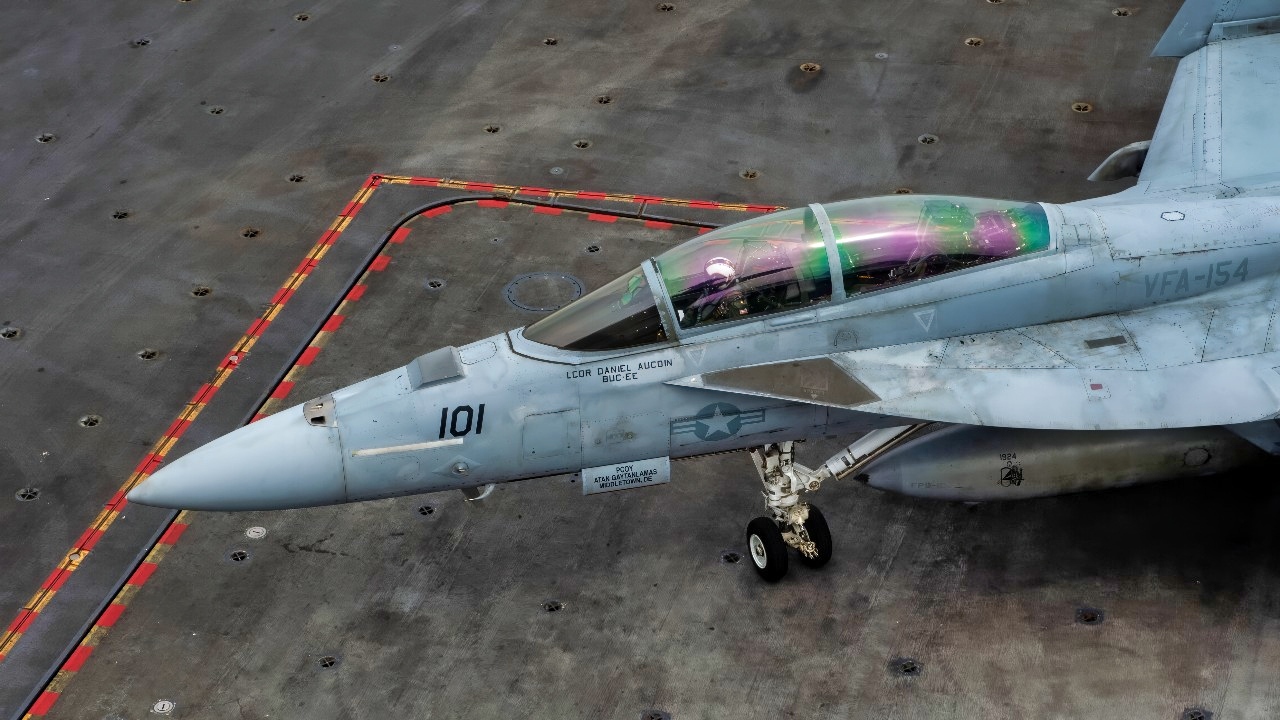
(July 24, 2025) – A U.S. Navy F/A-18F Super Hornet, assigned to the “Black Knights” of Strike Fighter Squadron (VFA) 154, transits the flight deck of Nimitz-class aircraft carrier USS Theodore Roosevelt (CVN 71), July 24, 2025. Theodore Roosevelt, flagship of Carrier Strike Group (CSG) 9, is underway conducting exercises to bolster strike group readiness and capability in the U.S. 3rd Fleet area of operations. (U.S. Navy photo by Mass Communication Specialist Seaman Maddix Almeyda)
“The Islamic Republic of Iran will conduct dialogue with the Sultanate of Oman to define the future administration and maritime services in the Strait of Hormuz, in discussion with other Persian Gulf littoral states, in line with the applicable international law and the sovereign rights of coastal states of the Strait of Hormuz,” it continues.
The statement, therefore, suggests that the governance of the strait will differ from the arrangement that existed before the war began.
Hormuz Governance, Then and Now
Before the war began earlier this year, the Strait of Hormuz was not jointly governed by Iran and Oman under any special agreement, but rather by a combination of international maritime law and the fact that the strait lies within the territorial waters of both Iran and Oman.
Neither country owns the entire strait.
Ships followed what’s known as a Traffic Separation Scheme (TSS), similar to lanes on a highway, whereby inbound ships used one lane and outbound ships used the other. Commercial vessels did not ask Iran or Oman for permission every time they passed through the waters.
That all changed when Iran sought to close the Strait of Hormuz, taking full control of the waterways through a combination of threats and naval mines.

(Jan 31, 2009) An F/A-18 Super Hornet assigned to the “Tomcatters” of Strike Fighter Squadron (VFA) 31 launches from the flight deck of USS Theodore Roosevelt (CVN 71). The Nimitz-class aircraft carrier and embarked Carrier Air Wing (CVW) 8 are operating in the 5th Fleet area of responsibility and are focused on reassuring regional partners of the United States’ commitment to security, which promotes stability and global prosperity (U.S. Navy photo by Mass Communication Specialist 3rd Class Jonathan Snyder/Released)
What Comes Next?
Assuming Washington doesn’t simply return to bombing Iran, the next 60 days will determine the future governance of the Strait of Hormuz.
The text of the MOU indicates that Oman and Iran will begin discussions about how the strait will be governed, and Tehran has already publicly stated its plans to charge “maritime service fees.”
Few details have yet been made available about the plans, but it seems safe to say that charging for navigation, safety, or other “related services,” as a recent statement indicated, amounts to a toll in all but name.
The choice of language is probably deliberate, given that President Donald Trump has repeatedly assured in recent days that the Strait of Hormuz will be open and permanently “toll-free.”
Even if Oman prefers to maintain the status quo, Iran has already demonstrated that it can force negotiations by simply exerting pressure and issuing threats.
Just as Tehran used threats and naval mines to bring Washington to the negotiating table – as Trump effectively admitted on Wednesday when he said the MOU was designed to avoid an oil crisis – it may now be able to leverage its position to secure changes that make the Strait of Hormuz a profitable asset in the event of a peace deal being agreed.
About the Author: Jack Buckby
Jack Buckby is a British researcher and analyst specializing in defense and national security, based in New York. His work focuses on military capability, procurement, and strategic competition, producing and editing analysis for policy and defense audiences. He brings extensive editorial experience, with a career output spanning over 1,000 articles at 19FortyFive and National Security Journal, and has previously authored books and papers on extremism and deradicalization.


