

In footage shared on social media, President Donald Trump offered a candid assessment of the state of global oil and offered a possible explanation for his willingness to accept a deal with Iran that even his own administration officials reportedly opposed. During a speech at the G7 meeting in France, the president warned that the world would run out of oil reserves within weeks and admitted that the situation forced his hand.
What Trump Said
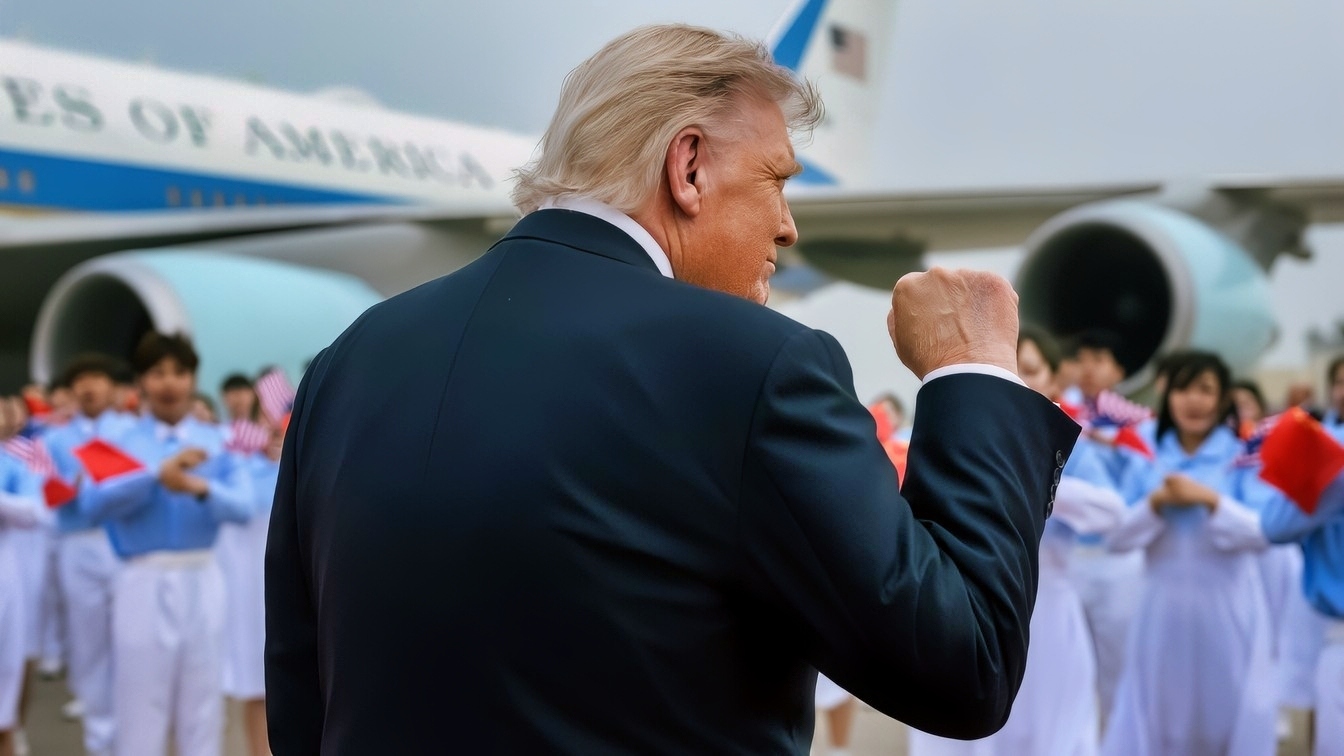
President Donald J. Trump greets Ambassadors David Perdue and Xie Feng, Executive Vice Minister of Foreign Affairs Ma Zhaoxu and Minister of Foreign Affairs Wang Yi at Beijing Capital International Airport, China on Friday, May 15, 2025, before boarding Air Force One en route Washington, D.C. (Official White House Photo by Daniel Torok)
During a speech in Evian, the president said, “also we run out of reserves in about four weeks, you know there are reserves all over the world and we would really run out, and there would be a time when you wouldn’t be able to get it, and you wanna see bedlam.”
The comments reflect predictions made by analysts in the last several weeks that the world was headed toward a full oil supply crisis, rather than a temporary oil price shock.
Robin Brooks and Ben Harris argued in a Brookings Institution analysis that the global oil market was approaching a critical inflection point in mid-July. The warning was made in May, before the announcement of the Memorandum of Understanding (MOU), with the authors stating that emergency stockpile releases and other temporary supply buffers that had so far eased disruptions would be largely exhausted by July 9. Once those buffers disappear, the full extent of the shortage would have become visible to the markets.
The Energy Information Administration (EIA) also projected that global inventories would continue to fall dramatically through June and July. In a June 9 update, the EIA said that oil inventories in OECD countries are at their lowest level since 2003.

Trump Speaking Outside White House. Image Credit: The White House.
Trump was aware of the impending crisis as much as anyone – perhaps even more so. And that almost certainly informed his decision-making when negotiating the MOU with Iran.
Trump Goes Further
During the same speech, the president went even further, explaining that continued strikes against Iran could have collapsed the global economy.
“If we didn’t do this deal, we could have dropped more bombs for another three weeks, two weeks, four weeks, two years… You would never have the Hormuz Strait open… Your market would have, instead of going up, would go down at levels that nobody ever saw before, maybe except for 1929,” the president said, adding, “I did not want to see economic catastrophe.”
The comments seem to suggest that the president believed additional strikes on Iran would not immediately cause the collapse of the regime – and that, even if it did, it would have been impossible to prevent efforts to mine the Strait of Hormuz or cause further disruption.
Disruption, after all, is not dependent on the long-term survival of the regime in Tehran – all it takes is rogue actors, a small boat or two, to lay mines in the Strait and wreak havoc. Even the threat of mining the strait risks sending insurance rates skyrocketing and once again disrupting the flow of oil through the strait.
Did Iran’s Delay Tactics Work?
Iran’s conduct throughout the negotiations has been entirely predictable, though it’s hard to know whether negotiators in Tehran were deliberately delaying or simply struggling to function after months of war and internal upheaval.
By sowing confusion throughout the negotiations, Tehran has effectively delayed negotiations until the very last minute. For example, throughout the spring, Iranian officials routinely sent mixed signals about sanctions relief and uranium enrichment and the future of talks with Washington. Diplomats would indicate that progress was being made on the one hand, only for military officials or political figures to publicly contradict them days later. Negotiations appeared to move forward before stalling again, leaving Trump to decide whether to take military action or wait until negotiations could resume.
Then there’s the MOU itself. After the White House announced that an agreement had been reached, Iranian officials immediately started offering conflicting accounts. While Iran’s Supreme National Security Council appeared to confirm the deal initially, Foreign Ministry spokesman Esmail Baghaei publicly denied that an agreement had been made and insisted that a formal signing ceremony wasn’t yet confirmed. Once again, Iran issued conflicting and confusing statements, leaving the world wondering who was telling the truth.
Perhaps this was all incompetence. After all, much of the regime’s senior leadership was killed during the conflict, leaving officials scrambling to rebuild the government. But it also doesn’t matter. The fact is, Iran was capable of dragging out negotiations long enough that the United States, even with its military might, could no longer risk a collapse at the last minute.
In that sense, the MOU could be described as a surrender – but that assessment could also be described as lazy. After all, the agreement only remains in place for the next sixty days. That gives the global economy a chance to settle at least somewhat (normal oil production won’t return for several more months at least), and after that, the United States’ next move is anybody’s guess.
About the Author: Jack Buckby
Jack Buckby is a British researcher and analyst specializing in defense and national security, based in New York. His work focuses on military capability, procurement, and strategic competition, producing and editing analysis for policy and defense audiences. He brings extensive editorial experience, with a career output spanning over 1,000 articles at 19FortyFive and National Security Journal, and has previously authored books and papers on extremism and deradicalization.


