

In the latest test of the Washington-Tehran memorandum of understanding (MOU), U.S. Central Command (CENTCOM) announced a series of strikes against Iran on June 26. The announcement followed news that an Iranian drone had struck a ship transiting the Strait of Hormuz close to the Omani side of the waterway.
What CENTCOM Confirmed

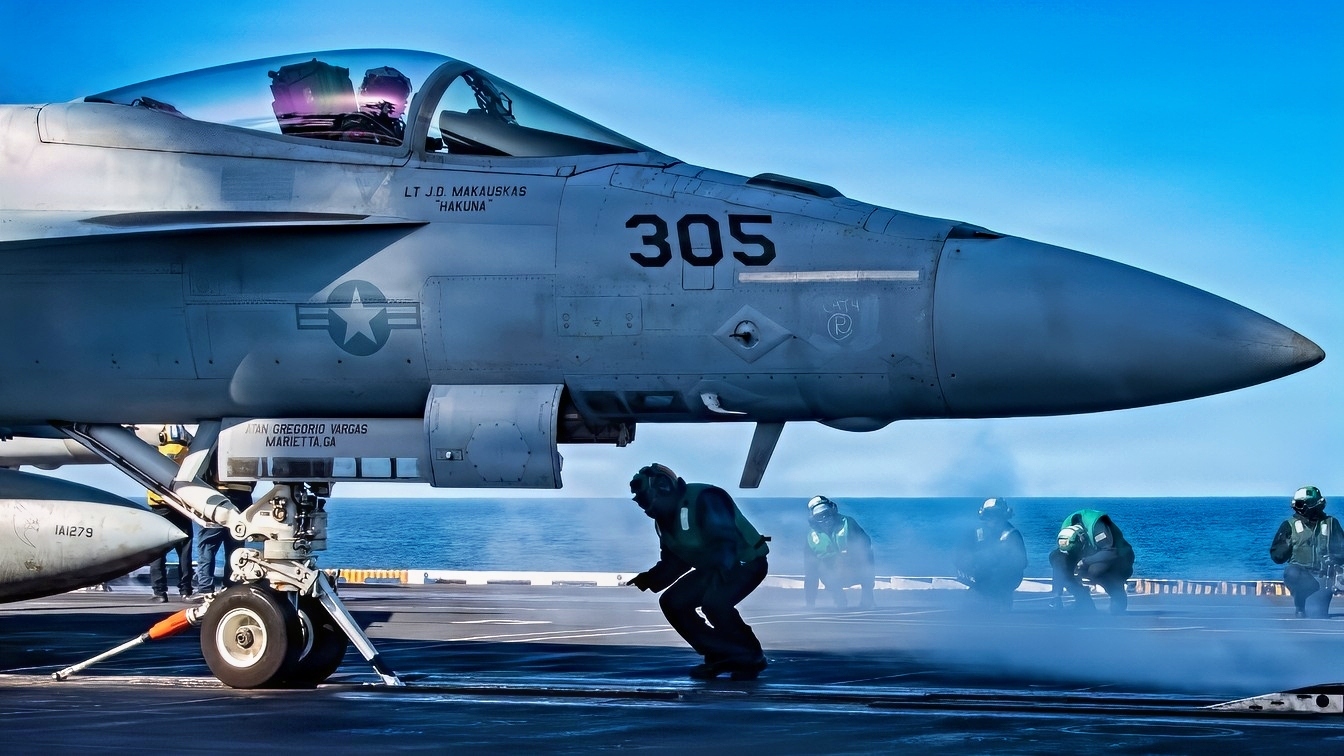
U.S. Navy Aviation Boatswain’s Mate Aircraft Handling 2nd Class Kyle Darmanin, from Mooresville, North Carolina, assigned to air department’s flight deck crash and salvage division, signals an F/A-18E Super Hornet, attached to Strike Fighter Squadron (VFA) 27, on the flight deck of Nimitz-class aircraft carrier USS George Washington (CVN 73) while underway in the Timor Sea in support of Talisman Sabre 2025, July 14, 2025. Talisman Sabre is the largest bilateral military exercise between Australia and the United States advancing a free and open Indo-Pacific by strengthening relationships and interoperability among key allies and partners, while enhancing our collective capabilities to respond to a wide array of potential security concerns. (U.S. Navy photo by Mass Communication Specialist 2nd Class Tyler Crowley)
In a statement, CENTCOM confirmed that U.S. aircraft had struck missile and drone storage facilities in Iran, as well as coastal radar sites. The statement confirmed that the strikes, which technically violate the terms of the MOU signed earlier this month, were conducted in response to the Iranian drone strike on M/V Ever Lovely on June 25. The Singapore-flagged cargo ship was damaged but remained seaworthy, and no injuries were recorded. The ship was attempting to exit the Strait of Hormuz along the Omani coast.
CENTCOM described Iranian actions as “unwarranted aggression” against commercial shipping by Iranian forces, and described the attack as a violation of the cease-fire. The statement also criticized Iran’s “dangerous behavior” that “undermined freedom of navigation as commerce increasingly flows through the vital international trade corridor.”
“CENTCOM forces continue to provide safe passage coordination and support to commercial vessels transiting the strait. The U.S. military remains present and vigilant to ensure all aspects of the agreement with Iran are adhered to, obeyed, and in full force and effect,” the statement continues.
Iran Responds Again
In a statement issued on Saturday, the Iranian Ministry of Foreign Affairs said that Iran had responded to the U.S. strikes with its own attacks on “targets linked to the American aggressor forces.” The statement also criticized other Gulf states that have allowed their territory to be used by U.S. forces to “carry out hostile actions against the Islamic Republic of Iran.”
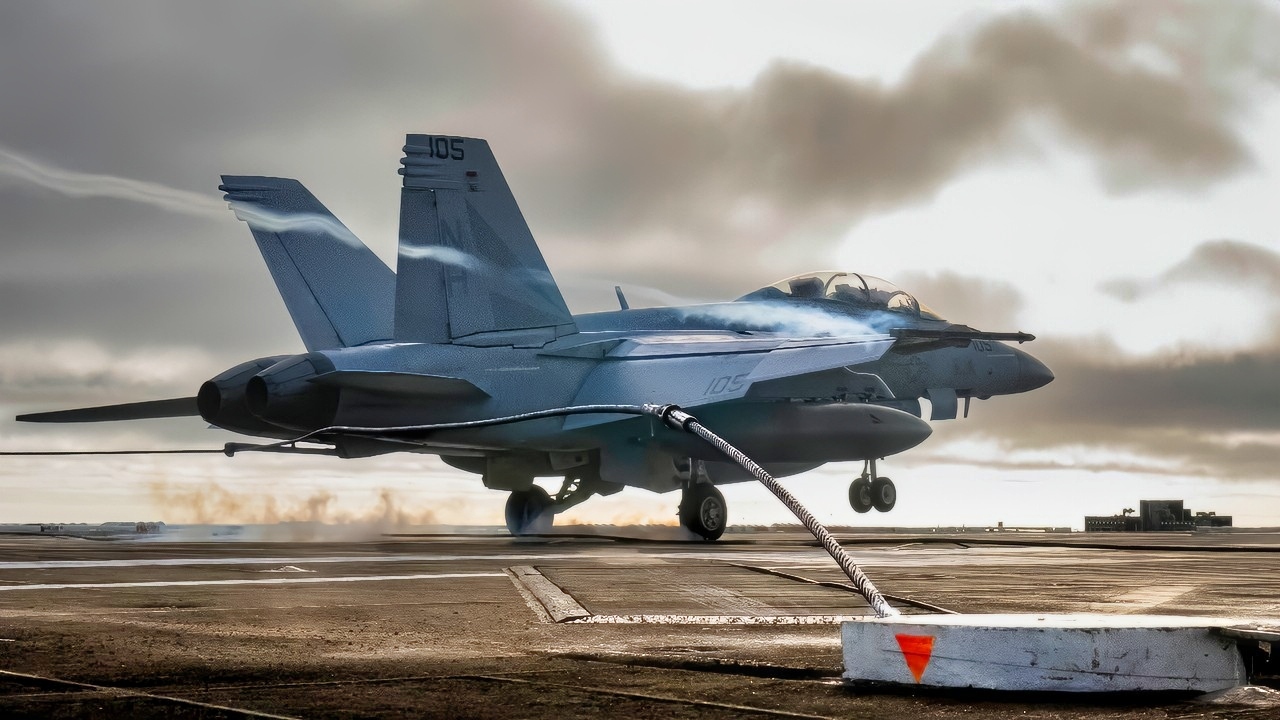
A U.S. Navy F/A-18F Super Hornet, assigned to the “Black Knights” of Strike Fighter Squadron (VFA) 154, lands on the flight deck of Nimitz-class aircraft carrier USS Theodore Roosevelt (CVN 71), July 24, 2025. Theodore Roosevelt, flagship of Carrier Strike Group (CSG) 9, is underway conducting exercises to bolster strike group readiness and capability in the U.S. 3rd Fleet area of operations. (U.S. Navy photo by Mass Communication Specialist 3rd Class Aaron Haro Gonzalez)
While the location of the Iranian strikes was not confirmed in a statement, Bahrain issued a public statement condemning an Iranian drone attack on its soil. The attack was described as a “blatant threat to the security of its citizens and residents.”
A strike on Bahrain would not be surprising. The U.S. Navy’s Fifth Fleet is headquartered at Naval Support Activity Bahrain in Manama, one of the most strategically important U.S. installations in the Middle East. The base is the headquarters of U.S. Naval Forces Central Command and supports American and allied naval operations throughout the Persian Gulf and beyond. It also plays a crucial role in protecting commercial shipping through the Strait of Hormuz and in conducting maritime security operations.
The attack also comes only days after a Wall Street Journal investigation revealed that Iran’s missile and drone campaign earlier this year caused more damage than previously acknowledged.
According to the report, repeated Iranian strikes forced the U.S. to disperse soldiers and assets, with drones damaging the Fifth Fleet headquarters building and more than a dozen other structures.
The strikes also reportedly damaged satellite communications systems, forcing the Pentagon to reassess the vulnerability of its existing Gulf basing strategy.
Peace Talks At Risk
Peace negotiations are now at risk, with Iran claiming on Saturday that the United States had violated the terms of the MOU. A statement from the Iranians claimed that the “brutal attacks” by the United States are a “blatant violation” of the terms of the deal.
The Islamic Revolutionary Guard Corps said that the American strikes had struck assets in the Gulf region and that the Iranian response “will be broader” if they are repeated.
The comments suggest there are no plans for further escalation in the region, though it’s difficult to determine how the strikes will affect negotiations. While Iranian strikes and threats to walk away from negotiations may serve as an opportunity to gain leverage over Washington, with the White House keen to make a deal as soon as possible, continued strikes by the Americans also serve as a reminder to Tehran that continued military conflict would be devastating to the regime.
Shippers Fear What’s Coming Next
The uncertainty about whether passage through the Strait of Hormuz is safe is creating problems for commercial shipping companies. Speaking to CNN, Dmitris Maniatis, the CEO of maritime risk consultancy firm Marisks, said that the situation is “very confusing for safely navigating those waters.”
“Global shipping wants to avoid dealing with the Iranians because there is a fear that they may run a risk of US sanctions in the future,” Maniatis also said, adding that people are “cautious” of the current U.S. administration because of the lack of certainty about what the deal may look like, and even the nature of the current agreement between Washington and Tehran.
Maniatis cited the claims by Washington that any toll fee paid to the Iranian regime by shipping companies could result in U.S. sanctions, leaving commercial shipping companies unable to pass without enormous economic risk, not to mention facing the possibility of being hit by Iranian drones.
About the Author: Jack Buckby
Jack Buckby is a British researcher and analyst specializing in defense and national security, based in New York. His work focuses on military capability, procurement, and strategic competition, producing and editing analysis for policy and defense audiences. He brings extensive editorial experience, with a career output spanning over 1,000 articles at 19FortyFive and National Security Journal, and has previously authored books and papers on extremism and deradicalization.


Fred T Adams
June 28, 2026 at 12:24 pm
There is no obvious reason to stop the US strikes begun today. It is good to destroy the coastline capabilities for offense. It would be useful to identify IRGC assets and target them mercilessly, knock off a few mullahs, and stop the “negotiations” – they only play into iran’s game and provide them with a world stage.
Publish a short list of tit-for-tats: for every launch on a Straits-bound ship, destroy an identified factory, oil well or refinery, named regime members or other pre-identified target. This approach can be extended to whatever pressure points we desire to squeeze. And it can be extended indefinitely until iran is silent.
This approach does needlessly expend US resources. And it will be effective in curtailing the intransigence of the regime, and opening and keeping open the Strait. Very likely, the world can do without iran’s oil, if the straits are kept open and iran’s aggression ceased.
Fred T Adams
June 28, 2026 at 12:26 pm
Rather, This approach does NOT needlessly expend US resources.