


The IRGC fired on and hit a cargo vessel in the Strait of Hormuz on Thursday near the Oman coast, according to a U.S. official. The vessel suffered damage to its bridge, but no one was injured, the U.K. Maritime Trade Operations Center said.
Iran is trying to control shipping in the Strait of Hormuz and warned Gulf states against siding with the U.S., a day after an attack on the ship.

ATLANTIC OCEAN (Sept. 21, 2024) The world’s largest aircraft carrier, USS Gerald R. Ford (CVN 78), sails in formation with the Japan Maritime Self Defense Force (JMSDF) Kashima-class training ship, JS Kashima (TV-3508), middle, and Hatakaze-class guided missile destroyer JS Shimakaze (TV-3521) while conducting routine operations in the Atlantic Ocean, September 23, 2024. The U.S. Navy and JMSDF continue to train together to improve interoperability and strengthen joint capabilities. For more than 60 years, the U.S.-Japan Alliance has been the corner stone of stability and security and is crucial to the mutual capability of responding to contingencies at a moment’s notice. (U.S. Navy photo by Mass Communication Specialist 2nd Class Jacob Mattingly)
The Singapore-flagged commercial vessel in the Strait was hit with “an unknown projectile” on Thursday evening near the coast of Oman.
A U.S. official told the New York Times that the vessel had been hit by a drone. The ship was identified as the Ever Lovely, a Singapore-flagged vessel owned by Taiwan-based shipping company Evergreen Marine.
The vessel had been stuck in the Gulf, like many others, for more than 100 days, according to financial data provider LSEG; it had loaded cargo in Iraq and attempted to cross the Strait on Thursday morning.
Iran was responding to what it called an “interventionist, irresponsible and provocative” joint statement by the United States and six Gulf states that rejected Iran’s insistence that it could charge tolls on vessels transiting the strait.
Iran’s Persian Gulf Strait Authority Issues Warning
During the ceasefire, Iran created the so-called Persian Gulf Strait Authority in keeping with its insistence that it will charge tolls, framed as “fees” for ships wanting to pass through the Strait of Hormuz.
It released a statement saying, “Any passage through routes outside the framework designated by PGSA will not be covered by safe passage guarantees and will not be entitled to insurance coverage or related liabilities.”
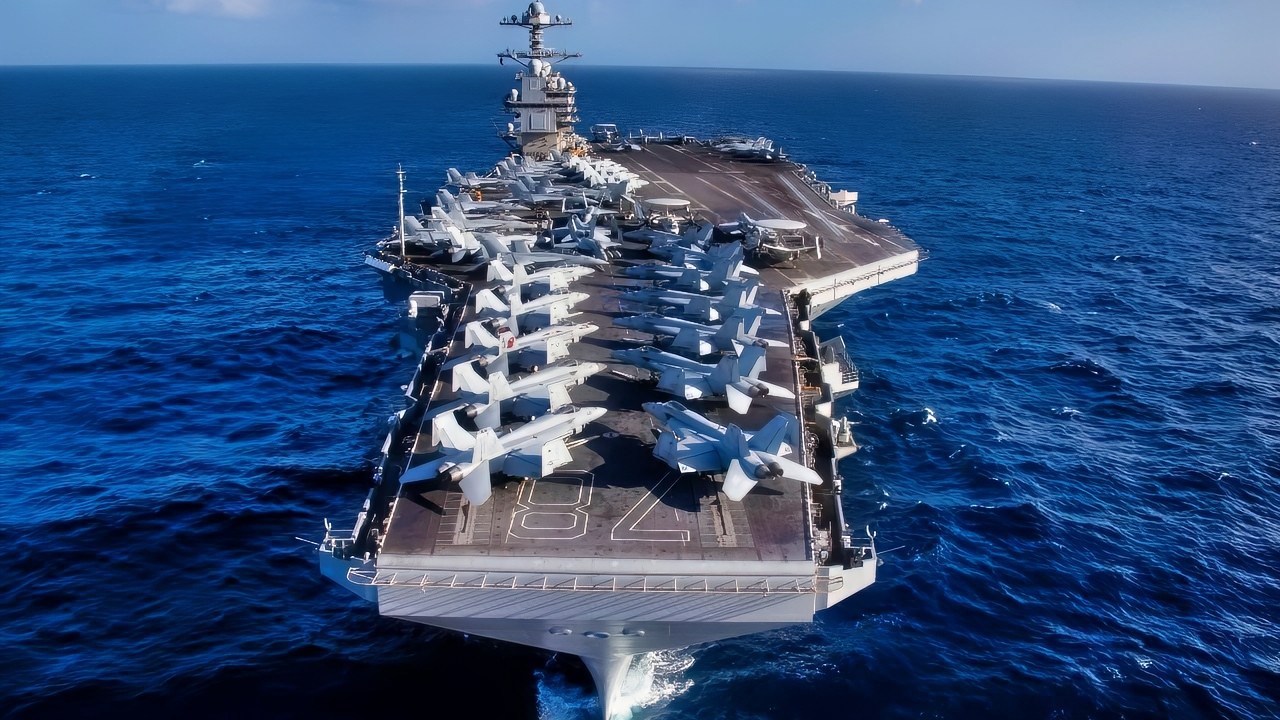
USS Gerald R. Ford Aircraft Carrier At Sea. Image Credit: U.S. Navy.
It added, “The consequences arising from passage through unauthorized routes shall be the responsibility of the owner, operator, and vessel commander.”
While the US has urged ship captains to sail along the route along Oman’s coast, Iran is insisting that ships sail along the northern route, close to Iran’s shore, which likely still has mines laid in it, or risk being fired upon.
Rubio Says US Will Judge Iran By “Actions, Not Its Rhetoric”
Secretary of State Marco Rubio told reporters on Thursday the Trump administration expects the strait to stay open, and is planning to judge Iran based on its actions rather than its “maximalist rhetoric.”
“If ships are moving as they should be moving, then that’s what we’re going to judge, and that’s what we’re going to react to,” he said while visiting Bahrain.
“If, on the other hand, this rhetoric is backed up by actual ships being threatened and ships are not moving, that’s a violation of the agreement, and we’re going to have a problem with it.”
Firing on and hitting a ship in the Strait, when it is supposed to be open, isn’t maximalist rhetoric. It is another example of why this regime, and any agreement with it, should be taken with extreme skepticism.

The Ford-class aircraft carrier USS Gerald R. Ford (CVN 78) and the Italian aircraft carrier ITS Cavour (CVH 550) transit the Atlantic Ocean March 20, 2021, marking the first time a Ford-class and Italian carrier have operated together underway. As part of the Italian Navy’s Ready for Operations (RFO) campaign for its flagship, Cavour is conducting sea trials in coordination with the F-35 Lightning II Joint Program Office’s Patuxent River Integrated Test Force to obtain official certification to safely operate the F-35B. Gerald R. Ford is conducting integrated carrier strike group operations during independent steaming event 17 as part of her post-delivery test and trials phase of operations.
Rubio also warned that if the regime’s rhetoric translates into physical threats that disrupt shipping traffic, it would be a violation of agreements and a major problem for the U.S.
Iranian And Omani Leaders Discuss “Freedom Of Navigation” Issues
Omani Foreign Minister Badr bin Hamad Al Busaidi and Iranian Foreign Minister Seyed Abbas Araghchi “reached an understanding on a mechanism for joint cooperation aimed at achieving the objectives of the U.S.-Iran memorandum of understanding regarding freedom of navigation in the Strait of Hormuz.”
Oman had said earlier that it did not plan to impose any fees, though Iran has been insistent on charging tolls, thinly disguised as fees, after the 60-day negotiating window, for passing through the Strait of Hormuz.
Stranded Sailors Evacuation Halted
The International Maritime Organization, a United Nations agency, announced on Tuesday that it will implement an evacuation plan for the more than 11,000 sailors still stuck in the Persian Gulf.
The plan was agreed upon by the IMO Council and in close coordination with Member States and industry.
However, following Thursday’s IRGC attack, that operation has been halted.
The head of the International Maritime Organization said the plan to move stranded ships through the strait will be on hold until the agency can confirm safety guarantees for the ships on the evacuation list and in the region.
“I have been informed of an attack today in the Gulf of Oman,” IMO Secretary General Arsenio Dominguez said on X, formerly Twitter. “Seafarer safety remains paramount. To ensure coordinated approach & navigational safety, the IMO evacuation plan will be paused until further clarity.”
Oil tanker traffic passing through the Strait of Hormuz had picked up amid negotiations between the U.S. and Iran aimed at ending the conflict, which has caused oil prices to decline as more supply hits the market.
Since the deal was announced at the G7 summit in France, tanker traffic, some of which had been stranded for months, has finally started moving toward their destinations, most of which are in Asian markets.
Traffic Through The Strait Surged Last Weekend
Between Saturday and Monday, 109 tankers have transited the Strait, according to Kpler, a firm that tracks global shipping traffic.
Most of the traffic is using the Omani route, but traffic is still not where it would normally be, as Iran has yet to remove the mines on their side of the Strait.
Kpler did say that while tankers are finally moving, container ships are still not moving, with an estimated 79 percent of container ships still waiting to move.
Kpler confirmed that oil shipments through the Strait of Hormuz have risen to around 4.8 million barrels per day since the U.S.-Iran deal was announced.
However, exports remain well below preconflict levels when 15 million barrels per day traveled through the strait.
On Wednesday, 73 ships passed through the Strait, according to CNN.
Secretary Rubio met with Gulf Arab leaders in Bahrain on Thursday to address their concerns over certain terms of the MOU, including the management of the Strait of Hormuz.
“The reality of it is that no country on Earth has a right to charge for the use of international waterways, and that will never be an acceptable condition of any deal,” Rubio said.
About the Author: Steve Balestrieri
Steve Balestrieri is a National Security Columnist. He served as a US Army Special Forces NCO and Warrant Officer. In addition to writing on defense, he covers the NFL for PatsFans.com and is a member of the Pro Football Writers of America (PFWA). His work was regularly featured in many military publications.


