


Starlink has been an invaluable asset to the Ukrainian Armed Forces. It has provided a safe and jam-resistant internet infrastructure for Ukraine, which has given the UAF stable communications and empowered its drone campaign against Moscow. Recently, however, the Russians have found a way to jam Ukraine’s Starlink connection. According to recent news reports, the Russian Army has found a way to jam Starlink connections in certain regions, thereby disrupting Ukrainian communications and drone guidance systems. This is one of the more recent examples of the tug-of-war nature of the Russo-Ukrainian war. As new offensive capabilities emerge, defensive capabilities evolve to counter new threats.
Starlink: Enabling Ukraine’s Drone Campaign
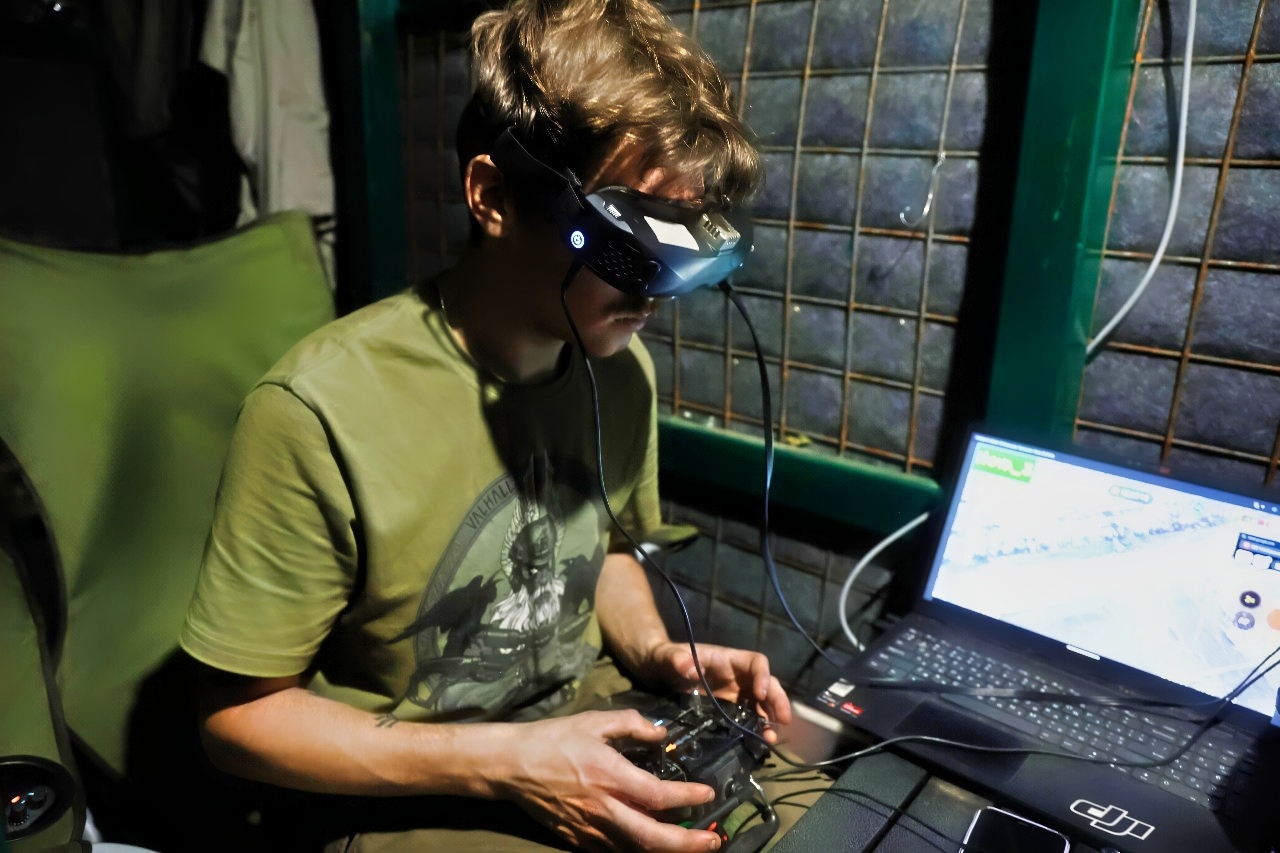
Bohdan, a drone pilot from the Unmanned Systems Battalion of Ukraine’s 110th Separate Mechanized Brigade, pilots an FPV drone in Donetsk Oblast during active battle operations. Photo: David Kirichenko
The new jamming system is a response to Ukraine’s increasing mid-range strike capabilities.
Starting in 2025, Ukraine has increased its strikes against sensitive targets in Russia’s backline, such as logistics vehicles, fuel infrastructure, and air defense installations.
The vast majority of these efforts have been focused on targeting the narrow land bridge connecting Russian-occupied Crimea to other occupied regions in Ukraine. Recently, however, this campaign, thanks to information and intelligence supplied by Western intelligence agencies, began to spread to the Russian mainland, including the capital, Moscow.
As a result, most regions across Russia have experienced fuel shortages because major fuel refineries have been forced to suspend operations.
Most of Ukraine’s long-range drones are powered by Starlink. This system allows the drone operator to communicate remotely with the drone and has been immune to jamming until recently.
The internet system was initially handed over to Ukraine in 2023, with funding from the U.S. Department of Defense. The service has been used on both aerial and naval unmanned systems to attack Russian military positions and infrastructure.
The Russians also managed to get their hands on several Starlink terminals, which they used for their own attack drones, but after negotiations with Elon Musk, the service was suspended for Russian use.
Jamming Elon Musk’s Starlink Connection
In response to constant drone attacks, the Russians have been developing countermeasures against drones powered by Starlink. This was first noted by Ukraine’s 422nd Unmanned Systems Regiment.
The system, called the Volna Kupol Garant, emits a signal powerful enough to disrupt Starlink connections within a 20-square-km (7.7-square-mile) radius. This new system, servicemen from the 422nd reported, has thrown a wrench into Ukraine’s drone operations and initially caused disruptions in certain regions, notably Kharkiv and Zaporizhzhia. The system is usually positioned near sensitive sites, like logistics hubs and military facilities, where Ukrainian drones are most likely to strike.
According to the UAF, ten of these new systems have been spotted so far, but it noted that the jammers are currently ineffective against non-Starlink-powered drones.
The 422nd has reportedly struck two of these installations, noting that operations using Starlink drones became noticeably easier after the systems were destroyed. “As soon as we struck that installation, our Starlink-equipped [drones] flew without problems,” said a crew commander who uses the call sign ‘Dyryhent’. The implementation of the Garant systems is significant, but has not yet been able to stop the recent uptick in Ukrainian drone attacks.
War Breeds Innovation
While the current iteration of Russia’s Starlink jammer may not seem impressive, future innovations will only expand the range and capabilities of this system. War has often been described as the great innovator, and that has certainly been true of the war in Ukraine.
Both Ukraine and Russia have demonstrated extraordinary creativity and ingenuity in their attempts to gain an advantage over the other side. Just as in nature, adaptation by one system typically prompts other evolutionary responses.
Case in point, Starlink was once thought to be unjammable, or at least jam-resistant. Now that the Russians have a system that can reliably disrupt it, albeit in relatively confined spaces.
The introduction of drones has fundamentally changed the battlefield in Ukraine. Currently, neither side has a perfect answer to the drone issue, but defenses against unmanned systems will eventually be developed as hard-kill and soft-kill systems are improved.
Where one side innovates, the other is usually not far behind. Ukraine’s current drone campaign is a response to Russia’s previous campaigns against Kyiv’s oil and energy infrastructure. With Ukraine’s innovations in drone technology, Russian methods for disrupting them are starting to catch up, and in time, launching drone attacks against the Russian heartland will be much more difficult than it already is.
Russia has also increased its own medium- to long-range attacks against Ukraine to disrupt the country’s military-industrial complex.
Recent missile/drone attacks against Kyiv have targeted logistics hubs and drone assembly areas to make Ukraine’s campaign more difficult to sustain.
The two countries have been trading blows recently as both seek to exploit the currently existing defensive gaps.
Ukraine lacks munitions to defend against Moscow’s ballistic missiles; meanwhile, Russia’s defense network currently has too many gaps to defend its vast airspace against Kyiv’s drones. The goal is to force the other side to capitulate under mounting economic pressure.
Will this strategy work out for Ukraine? It is too early to say. Russia possesses vastly more resources than Ukraine does.
If Kyiv wants Moscow to end the war on Ukraine’s terms, it will need bigger drones and a lot more of them.
About the Author: Isaac Seitz
Isaac Seitz, a Defense Columnist, graduated from Patrick Henry College’s Strategic Intelligence and National Security program. He has also studied Russian at Middlebury Language Schools and has worked as an intelligence Analyst in the private sector.


