
Ukraine Has Now Struck Russia’s 11 Largest Refineries: Ukraine has struck all 11 of Russia’s largest oil refineries, forcing Russia to take drastic measures to secure fuel supplies at home. The achievement was made when, overnight into Sunday, July 6, Ukrainian drones reached the Omsk Oil Refinery in Siberia – the largest refinery in Russia and the final facility among the country’s biggest processing plants that had previously avoided being attacked.
Now armed with its own domestically made drones and missiles, Ukraine has proven it is capable of offensive action – and in steadily expanding its long-range strike capabilities, it has begun to exert extreme pressure on the Russian economy. Moscow is now facing refinery shutdowns and fuel shortages; gasoline prices are rising nationwide, and a diesel export ban was announced on July 8.
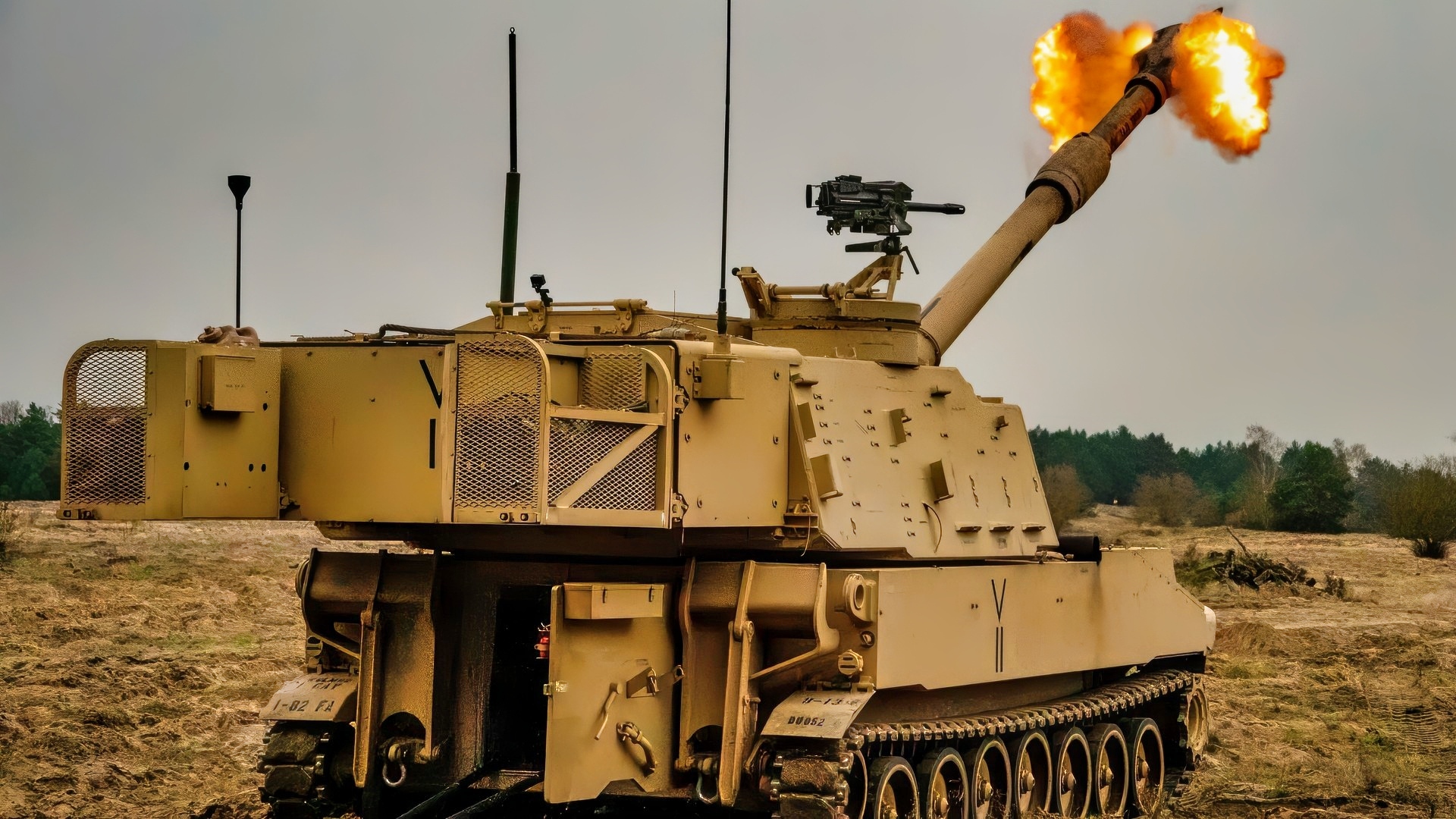
An M109 Paladin, assigned to 1st Battalion, 82nd Field Artillery Regiment, fires a round of high-explosive artillery during Dynamic Front on Forward Operating Site Torun, Poland, Nov. 19, 2024. Dynamic Front takes place from Nov. 4-24 in Finland, Estonia, Germany, Poland, and Romania, and demonstrates NATO’s ability to share fire missions, target information, and operational graphics from the Arctic to the Black Sea. It increases the lethality of the Alliance through long-range fires, builds unit readiness in a complex joint, multi-national environment, and leverages host nation capabilities to increase USAREUR-AF’s operational reach. Dynamic Front includes more than 1,800 U.S. and 3,700 multi-national service members from 28 Allied and partner nations. (U.S. Army photo by Spc. Julian Winston)
Ukraine Reaches Siberia with an Attack
The latest strike on the Omsk Oil Refinery proves just how far Ukraine has come since the beginning of this war. Omsk is Russia’s largest refining complex, with an annual processing capacity of approximately 22 million metric tons
. The facility is located over 2,500 kilometers, or 1,550 miles, from Ukraine. Its distance meant that the facility was untouched throughout the war – but the latest strike saw Ukrainian FP-1 “Flamingo” long-range drones cause significant damage on July 6. The attack set a new distance record for a one-way Ukrainian drone.
Reports described how the strike forced the shutdown of major crude distillation units, forcing the refinery to shut down.
Further west, Ukraine also struck the Perm Oil Refinery – one of Lukoil’s largest facilities, with an annual capacity of 13.1 million tons. The strike has contributed to Russia’s diesel shortage, with the Ukrainian General Staff noting that the refinery specializes in producing “high-quality petroleum products, including gasoline, diesel fuel and aviation fuel, which are used to meet the needs of the Russian occupation forces.”

The 1-148th Field Artillery Regiment is the latest unit in the Idaho Army National Guard to upgrade its combat capability as modernization efforts across the U.S. Army and Army National Guard take shape.
“Operators from the 1st Separate Centre struck the Lukoil-Permnefteorgsintez oil refinery… The plant’s design capacity is 13.1 million tonnes of oil per year. The facility produces over 60 types of products, including petrol, diesel fuel, lubricants and sulphur,” Ukraine’s Unmanned Systems Forces confirmed in a statement.
While less information is available about the strike, it once again proves that Ukraine no longer sees distance as a problem – its new missiles and drones can reach deep inside Russia and strike some of the country’s most valuable sites.
Pressure In Central Russia
Ukraine has also repeatedly targeted refineries supplying Russia’s economic heartland, with perhaps the most famous example being the strike on the Moscow Oil Refinery, which processes roughly 12 million metric tons of crude oil annually and supplies around 60% of Moscow’s regional fuel demand. The facility was struck twice during June, with large fires erupting at the facility and viral video footage showing the moment a fuel tank’s lid flew into the air as the tank seemingly exploded.
The Ryazan Oil Refinery, one of Rosneft’s most critical processing plants that handles 17.1 million tons of crude oil per year, was also hit in a series of strikes. Processing was suspended at the facility as of mid-May following Ukrainian drone strikes.
Yaroslavl Oil Refinery is another major supplier to central Russia, with an annual processing capacity of around 15 million tons. Although officials have released few details about the strikes, repeated attacks have been reported, and the disruption has continued throughout the spring and into the summer.
Volga Takes Heavy Damage
Some of the most damaging attacks so far have occurred in refineries situated along the Volga River – one of Russia’s most important industrial corridors. The Kstovo Oil Refinery near Nizhny Novgorod is one such example. Processing around 17 million metric tons of crude every year, the facility is now operating far less efficiently after losing more than half of its production capacity following Ukrainian strikes.
And at Novokuibyshevsk, a Rosneft refinery that was capable of processing 8.8 million tons annually, Ukrainian drone strikes forced operations to stop entirely. The nearby Syzran Oil Refinery, with an annual capacity of 8.5 million tons, was also forced to halt operations.
Northwest Russia and Beyond
The strikes have also heavily impacted operations in Northwestern Russia and beyond – specifically the region’s export-focused refineries.
The Kirishi Oil Refinery, for example, is Russia’s second-largest refinery. It has an annual capacity of around 21 million metric tons, and it has faced repeated Ukrainian assaults throughout the year so far. The attacks threaten one of Russia’s most important sources of refined fuel exports through the Baltic region, and successful strikes here would place immense additional pressure on an already struggling Moscow.
And in Bashkortostan, Ukrainian drones have already struck the Bashneft-Novoil facility in Ufa, which processes more than 7 million metric tons per year.
Ukraine’s campaign has evolved a lot in just the last year – and now, with the prospect of Ukraine being able to manufacture its own Patriot missiles for self-defense purposes, the ongoing long-range strike campaign just became even more sustainable.
About the Author: Jack Buckby
Jack Buckby is a British researcher and analyst specializing in defense and national security, based in New York. His work focuses on military capability, procurement, and strategic competition, producing and editing analysis for policy and defense audiences. He brings extensive editorial experience, with a career output spanning over 1,000 articles at 19FortyFive and National Security Journal, and has previously authored books and papers on extremism and deradicalization.


JOSEY WALES
July 8, 2026 at 9:20 pm
THEY STRUCK INSIDE OF RUSSIA BECAUSE THEY HAVE SMUGGLED IN DRONE WEAPONS AND INFILTRATORS. MANY UKRAINIANS NATIVE LANGUAGE IS RUSSIAN SO THEY CAN GO JUST ABOUT EVERY WHERE ACTUAL RUSSIANS GO. THEIR INTEL SERVICE IS GOOD AT FORGED DOCUMENTS TOO SINCE UNKRAINE HAS PLENTY OF PRACTICE AS THE MONEY LAUNDERING CAPITOL OF THE PLANET FOR MANY EARTHS.