
Europe Considers Hormuz Navigation Fees: Oman has presented Iran with a proposal, drafted with the assistance of the United Kingdom, that would allow shipping companies to make voluntary payments for navigation and emergency services in the Strait of Hormuz. Under the proposal, compulsory tolls would be prohibited – a measure that suits demands from Washington and recent comments from Oman.
The framework, developed by British maritime lawyers and Omani officials and modeled on systems used in the Straits of Malacca and Singapore, is now reportedly being considered by Britain, France, and other European governments. The proposal is designed to settle a dispute between the United States and Iran over whether Tehran can charge vessels for maritime services without maintaining full control over passage through the Strait of Hormuz. If accepted, once the war winds down and a deal is reached, it would ensure that one of the world’s most important international shipping routes remains open, without further risk of Iran seeking to assume control of the waterway.

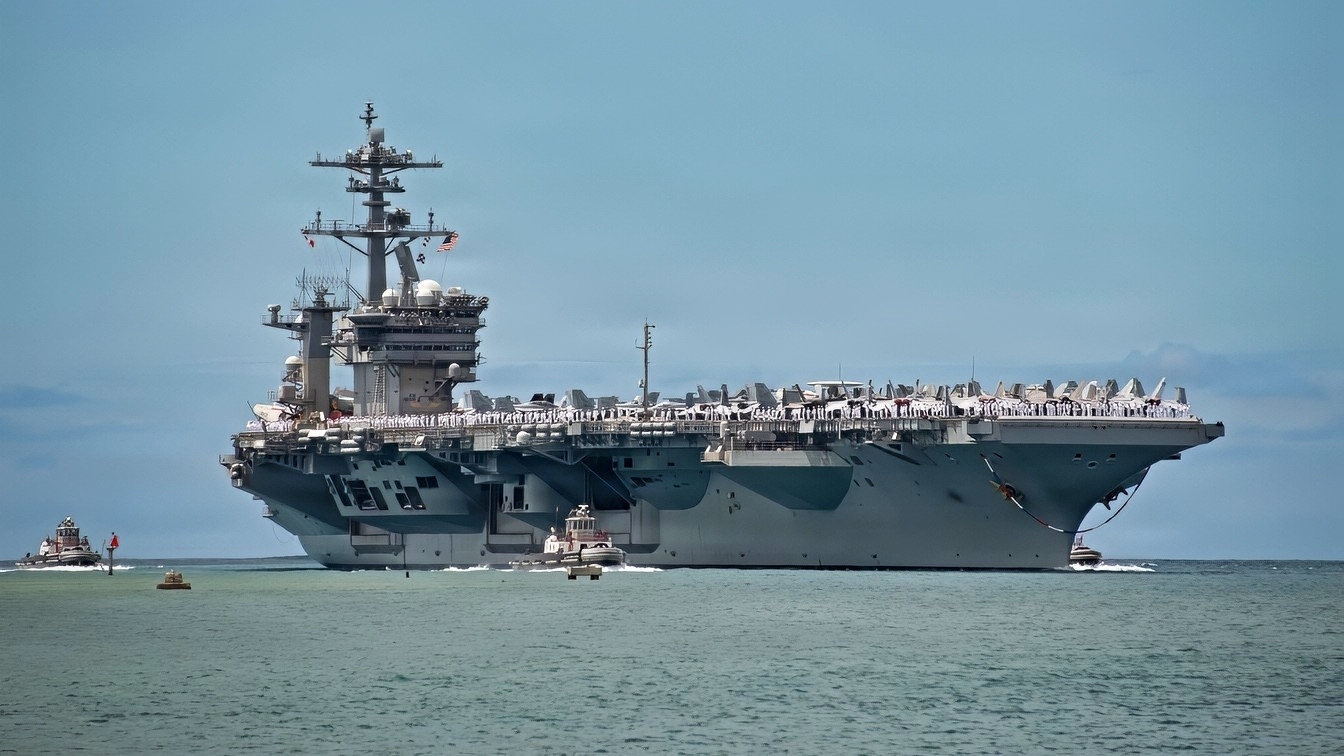
The world’s largest aircraft carrier, USS Gerald R. Ford (CVN 78) (front) and the Arleigh Burke-class guided-missile destroyer USS Bainbridge (DDG 96) participate in an integrated phase training event, March 23, 2025. The Gerald R. Ford Carrier Strike Group is underway in the Atlantic Ocean completing integrated naval warfighting training. Composite Training Unit Exercise (COMPTUEX) is the Joint Force’s most complex integrated training event and prepares naval task forces for sustained high-end Joint and combined combat. Integrated naval training provides America’s civilian leaders and commanders highly-capable forces that deter adversaries, underpin American security and economic prosperity, and reassure Allies and partners.(U.S. Navy photo by Mass Communication Specialist 2nd Class Maxwell Orlosky)

The aircraft carrier USS Nimitz (CVN 68) steams in the Pacific Ocean, Oct. 5, 2024. Nimitz is underway in 3rd Fleet conducting routine training operations. (U.S. Navy photo by Mass Communication Specialist Second Class Carson Croom)
The news comes as Iranian Foreign Minister Abbas Aragchi arrives in Muscat to begin talks with Omani officials on matters relating to the management of the Strait of Hormuz and shipping safety.
The negotiations come as the U.S.-Iran memorandum of understanding (MOU) unravels.
Oman Offers Malacca-Style Compromise
Under Oman’s proposal, payments would be permitted for clearly defined purposes, not merely for passage through the strait
. Those services would include navigational assistance, maritime rescue and emergency services, collision preparedness, emergency towing, responses to fires aboard tankers, and pollution response. However, ships that do not purchase those services would still retain the same right to pass through the Strait.
Neither Iran nor Oman would be permitted to impose any mandatory charges simply because the vessel entered the waterway.
It is an attempt to bridge the gap between Tehran and the West. Iran continues to argue that it bears high costs for security and navigation through the Strait of Hormuz and that it should be compensated for allowing ships to pass through the strait – but the United States and Gulf Arab states worry that Iran would establish a service fee-style system that would require prior authorization for ships to pass through the routes.
If Iran were to impose fees on ships seeking access to certain emergency services, but not on those that do not, it could bridge the gap and help Tehran raise the funds it needs to keep the strait safe and accessible.
However, the success of the proposal depends on whether Tehran genuinely believes it is fair to be reimbursed for costs of managing the Strait, or whether this is simply a deliberately hard line being drawn as part of its brutal negotiations with Washington.
Oman has reportedly offered to send legal experts to Tehran to explain the proposed system. And while the complete draft has not been made publicly available, reports this week describe how the Europeans are only willing to consider the framework as a possible solution is if the payments are voluntary. European governments are also reportedly willing to engage with the idea if it is supported by the International Maritime Organization.
Iran and Oman Begin New Talks…and the Strait of Hormuz Is Now Close
Iranian Foreign Minister Abbas Araghchi traveled to Muscat on Saturday to begin negotiations with Omani Foreign Minister Badr bin Hamad Al Busaidi over the future management of the Strait of Hormuz. Araghchi later wrote on Telegram that the two sides had exchanged their views on the “appropriate mechanisms” for protecting shipping.
The talks were complicated later that day, however, when Iran’s Islamic Revolutionary Guard Corps Navy again declared that the Strait of Hormuz was closed to commercial traffic. The announcement came as Washington and Tehran continue to clash over violations of June’s memorandum of understanding (MOU) and Iran’s repeated strikes on commercial ships transiting the strait.
Araghchi’s visit was first announced on Friday, July 10, by Foreign Ministry spokesman Esmaeil Baghaei in comments published by Iranian news agency IRNA. Baghaei said that the discussions represented a “continuation of the consultations that we started with Oman over the past one or two months.”
Before the meeting, Washington had demanded that Iran publicly apologize for its most recent strikes on ships transiting the strait, and confirm that commercial ships would not be attacked again.
The U.S. also insisted that the regime in Tehran announce its recognition of all shipping lanes in the strait. While no new attacks were recorded on Friday or early Saturday, Iran has so far failed to comply with the United States’ demands – and the announcement that the Strait of Hormuz is once again closed means the regime is not planning to issue an apology.
Washington now faces the prospect of following through on many of President Donald Trump’s most extreme threats against Iran, with even the last round of strikes – said to be ten times more destructive than the retaliatory strikes following Iran’s first MOU violation – having failed to bring the regime into line.
About the Author: Jack Buckby
Jack Buckby is a British researcher and analyst specializing in defense and national security, based in New York. His work focuses on military capability, procurement, and strategic competition, producing and editing analysis for policy and defense audiences. He brings extensive editorial experience, with a career output spanning over 1,000 articles at 19FortyFive and National Security Journal, and has previously authored books and papers on extremism and deradicalization.


