

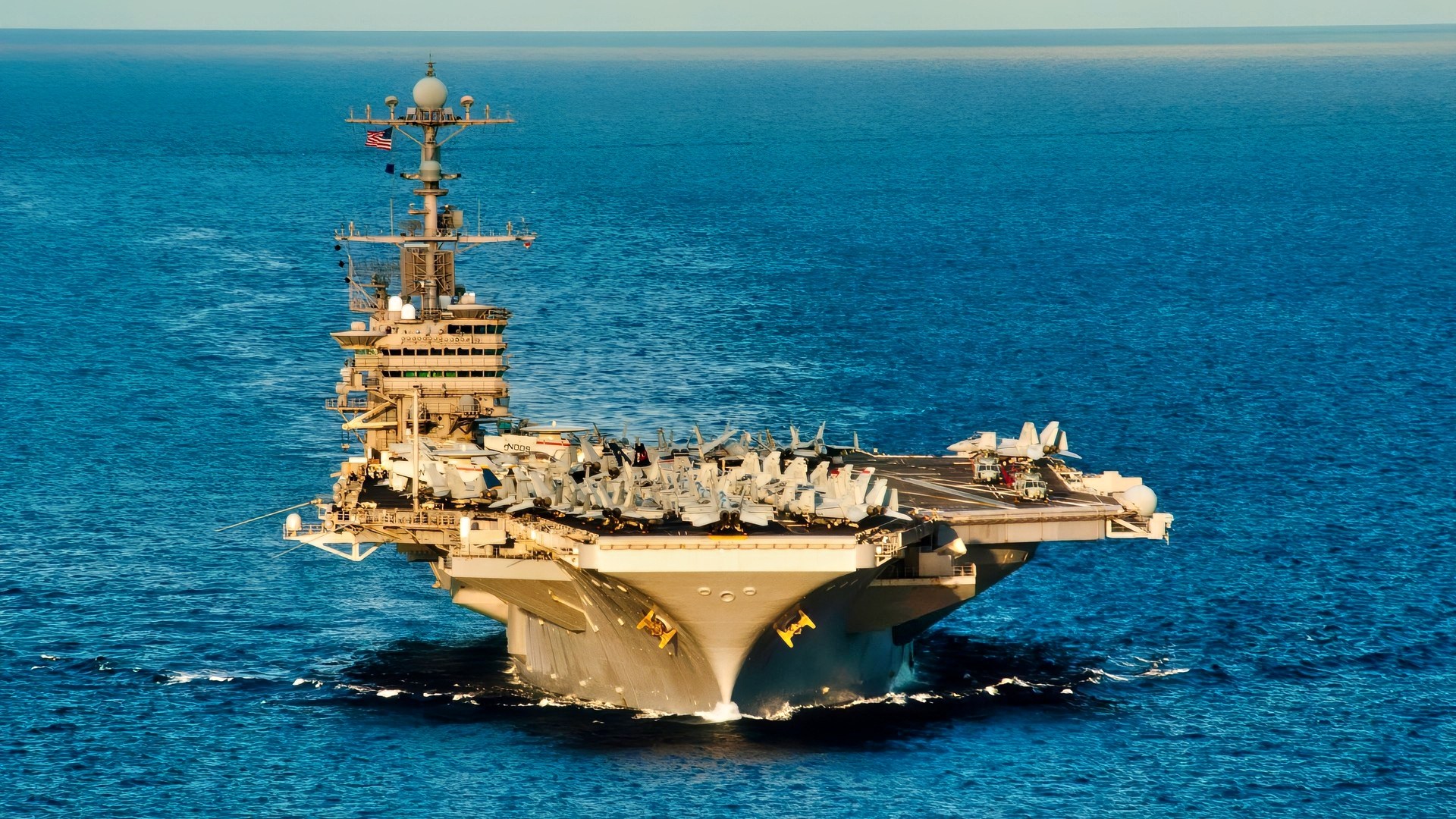
The United States Central Command (CENTCOM) says it carried out strikes on Iran for 90 minutes early Wednesday afternoon between 1330 and 1500 hours, as the US tries to exert control over the critical Strait of Hormuz.
The strikes followed attacks overnight, which Tehran said killed at least seven military personnel in the southeast of Iran.
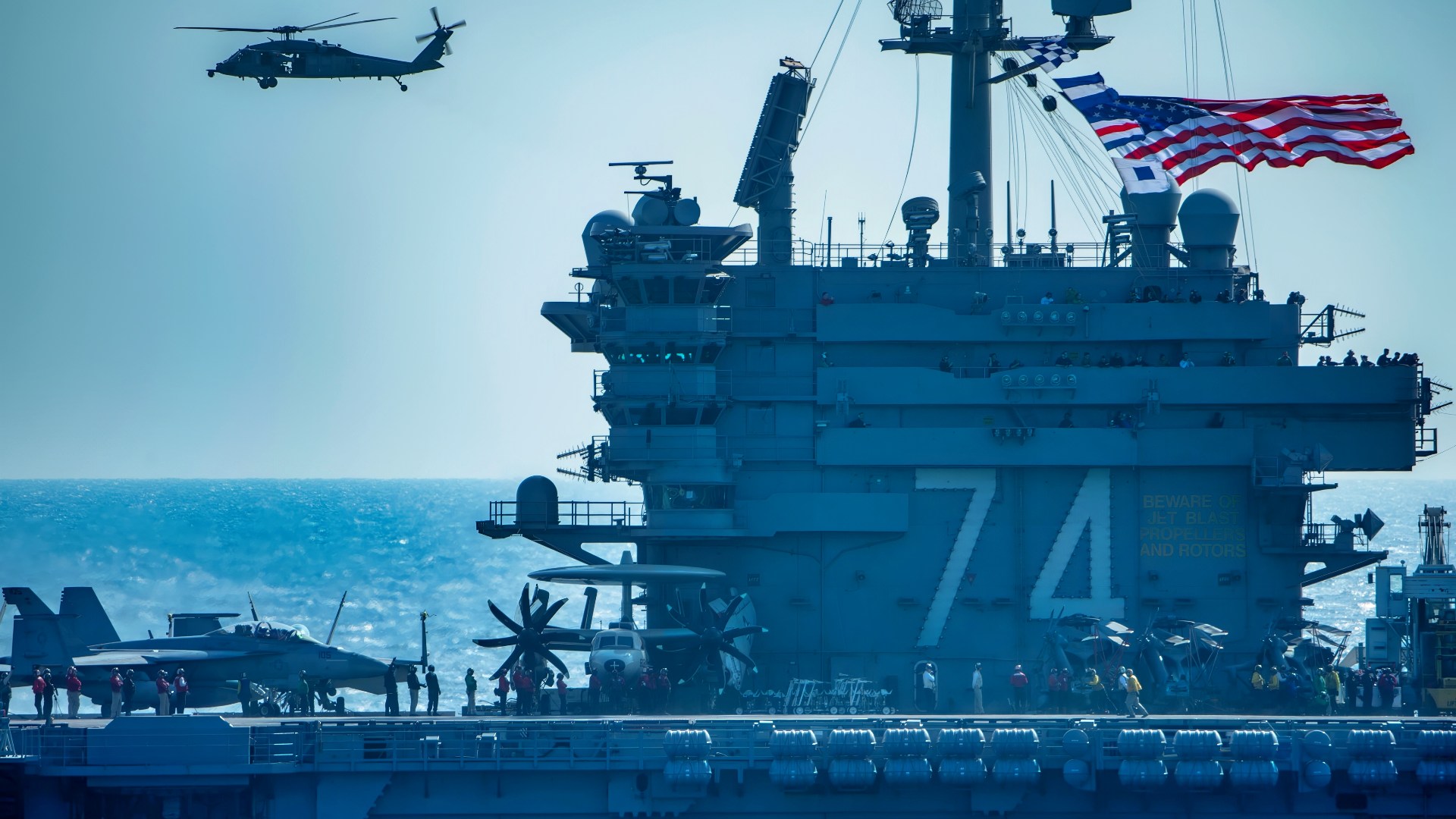
ARABIAN SEA (Dec. 14, 2018) The Nimitz-class aircraft carrier USS John C. Stennis transits the Arabian sea with the Essex Amphibious Ready Group (ARG) and 13th Marine Expeditionary Unit (MEU). The John C. Stennis Carrier Strike Group, Essex ARG, and 13th MEU are conducting integrated operations in the Arabian Sea to ensure stability in the Central Region, connecting the Mediterranean and the Pacific through the western Indian Ocean and three strategic choke points. (U.S. Navy photo by Mass Communication Specialist 3rd Class Tyler Diffie)
The US Navy has also reinstated the naval blockade over Iran’s ports and facilities.
President Trump threatened Tehran that the United States would strike bridges and power plants in Iran “next week” unless the Iranians return to the negotiating table.
“You better make a deal, or you’re not going to have anything left,” Trump warned.
“We’re going to hit them very hard tomorrow night. We’re going to hit them very hard the night after, and then next week it gets really bad for them because the power plants come next week.
“Next week comes the bridges. We’re going to knock out all their power plants. We’re going to knock out all their bridges unless they get to the table and negotiate,” Trump said to Fox News in an interview Tuesday.
Bridges Supporting Military Forces Are Legitimate Targets
Bridges in Iran are viewed as legitimate targets under specific conditions by US and Israeli leadership, a stance that has significantly escalated regional conflict. The legality and targeting criteria are based on specific doctrines and international disputes.
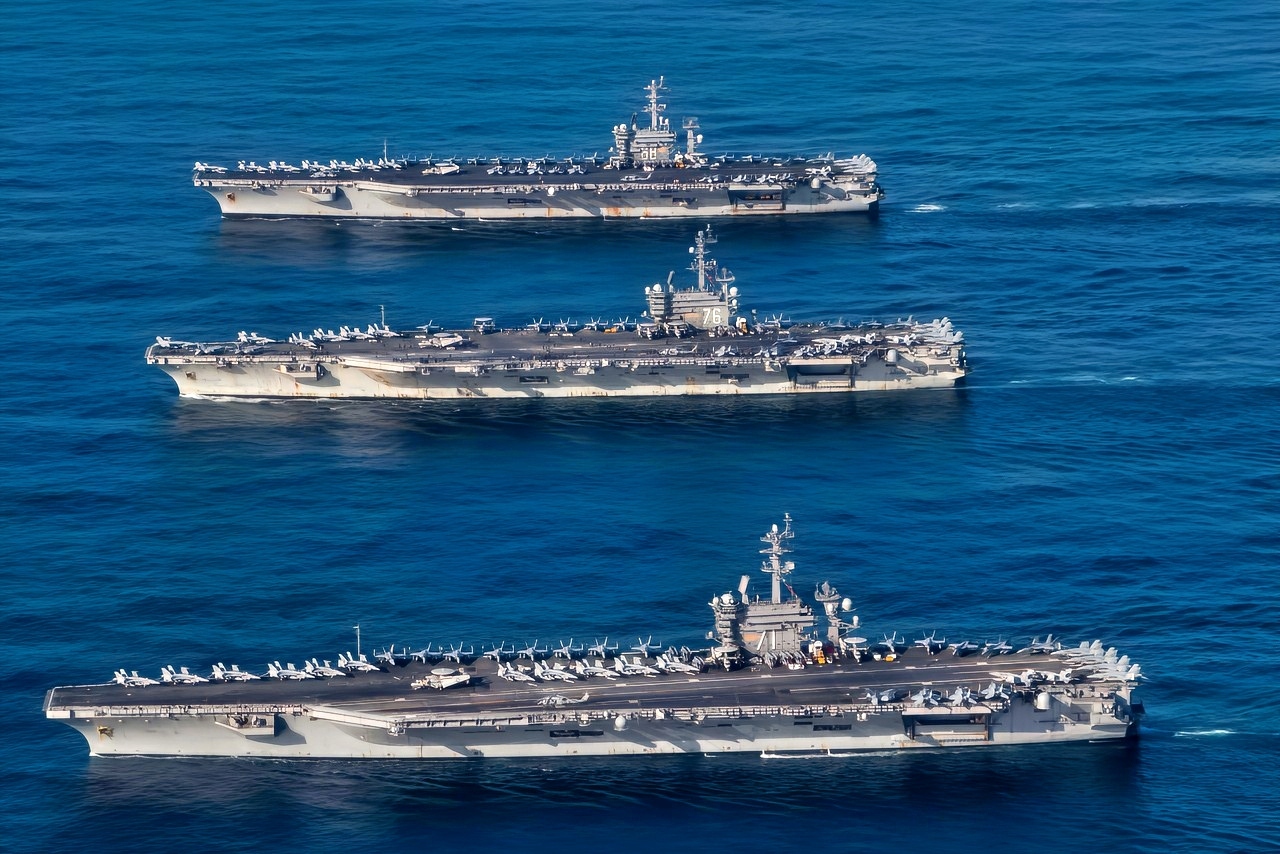
The U.S. Navy aircraft carriers USS Nimitz (CVN-68), USS Theodore Roosevelt (CVN-71) and USS Ronald Reagan (CVN-76) underway in the Western Pacific on 12 November 2017. The strike groups were underway and conducting operations in international waters as part of a three-carrier strike force exercise. This was the first time since August 2007 that three U.S. Navy carriers operated together. In 2007, USS Kitty Hawk (CV-63), USS Nimitz (CVN-68) and USS John C. Stennis (CVN-74) participated in exercise “Valiant Shield”.
US officials and military experts argue that bridges become legitimate targets if they are used to transport military equipment, drones, or missiles.
One example of this was the strikes on the B1 bridge near Tehran/Karaj, which the US justified on the grounds of disrupting supply routes, and recent strikes on the Aq Tekeh Khan railway in northern Iran aim to hinder logistics.
Iran also claimed that bridges in Israel and elsewhere in the Middle East are legitimate targets.
Brigadier General (ret.) Mark Kimmitt said to CNN’s Erin Burnett that “bridges and infrastructure that are primarily being used to support military forces are legitimate military targets.”
“I didn’t hear anything about civilian infrastructure. I didn’t hear anything about civilian bridges, so let’s hope we’re going to stay focused on the military targets,” Kimmit added.
Trump Says The US Will Hit Iran, “Until I Say Enough”
President Trump said strikes on Iran, which have continued for the fourth consecutive day since the collapse of the Memorandum of Understanding (MoU), will “continue until I say it’s enough.”
CENTCOM repeated that the strikes “further degraded Iran’s ability to attack commercial shipping in the Strait of Hormuz.”
“CENTCOM launched precision munitions against coastal defense systems and cruise missile storage and launch sites on Greater Tunb Island during the 90-minute wave,” it said.
The latest strikes were conducted during daylight hours, an unusual move. This signals the escalation was intended to inflict precise damage on military infrastructure, taking advantage of daylight to ensure targeting accuracy following earlier nighttime attacks.
Greater Tunb Island was seized by Iran in 1971 from what would become the United Arab Emirates (UAE) and is viewed as a strategic point in the strait.
Greater Tunb Island, Abu Musa, Lesser Tunb, Hengam, Qeshm, Larak and Hormuz form Iran’s “arch defense” regarding the Strait.
Iranian officials have referred to them and other Gulf islands as Tehran’s “stationary and unsinkable aircraft carriers.”
Iranian officials said that the American airstrikes hit an Iranian army barracks, killed at least seven troops, and injured more than 260 people across the country.
The president also declined to rule out calling in ground troops to Iran, but said, “I don’t want to do that.”
“Sometimes you need a ground campaign, but we have other people who will do the ground campaign for us,” he said. He didn’t specify other countries that had offered to send troops.
The Fight For Control Over The Strait of Hormuz
During his interview with Fox News on Monday, President Trump said, “We’re taking over the Strait.” Trump said Tehran had reached an agreement but then backed away from it.
He added that “everything was agreed to” during an 11-hour meeting on Sunday, but Iranian negotiators later called back and suggested changes.
Iran responded to the American airstrikes with attacks on Bahrain, Kuwait, Qatar, Jordan, and Oman.
The Sultanate of Oman announced“its condemnation and denunciation of this attack”, which came just hours after the country hosted Iran’s foreign minister to address security issues in the Strait of Hormuz.
Iran has accused the Gulf Cooperation Council (GCC) countries of actively supporting US military operations by hosting its bases and allowing it to use their airspace.
The IRGC claimed a “heavy and surprise” attack on logistics support centers and refueling platforms used by US aircraft carriers at the port of Duqm in Oman, according to Iran’s state broadcaster IRIB.
Iran insists that all shipping in the Strait coordinate with its recently created Persian Gulf Strait Authority (PGSA) and then use a second northern route that passes along the Iranian coast and is closely monitored and controlled by Iran.
In the past 24 hours, 34 ships have passed through the Strait, according to the Strait of Hormuz live tracker.
About the Author: Steve Balestrieri
Steve Balestrieri is a National Security Columnist. He served as a US Army Special Forces NCO and Warrant Officer. In addition to writing on defense, he covers the NFL for PatsFans.com and is a member of the Pro Football Writers of America (PFWA). His work was regularly featured in many military publications


D3F1ANT
July 15, 2026 at 1:15 pm
When Iran needs a break they’ll come back to the table to “negotiate”, under a ceasefire, to buy time. Then they’ll violate the ceasefire and their word until Trump starts the bombing them again. Wash. Rinse. Reapeat. If Trump wants an end to this, he’ll need to destroy the Iranian regime.
Ron
July 15, 2026 at 8:18 pm
Iran is trying to run out the clock hoping the dems take back the the house and senate and impeach DJT. Better get to the voting booth in Nov. cons/gop. Never trust an islamist anything.
Oliver Clozoff
July 16, 2026 at 10:51 am
Just tell the Iranians that if they attack a ship in the strait, we will destroy a bridge or a power plant (our choice). This arrangement will be in force forever.