


As the Iran War intensifies in another round of escalation, it is imperative to understand how global energy flows are being affected in the United States and worldwide. As the Wall Street Journal effectively reported in a recent piece, the crude oil and refined fuels markets no longer tell the same story.
What that means is that, while there was a brief interlude of hope that things would correct after the Trump administration and the Islamic Republic of Iran signed the Memorandum of Understanding (MoU), the global energy system never recovered from the months of disruption caused by the closure of the Strait of Hormuz.
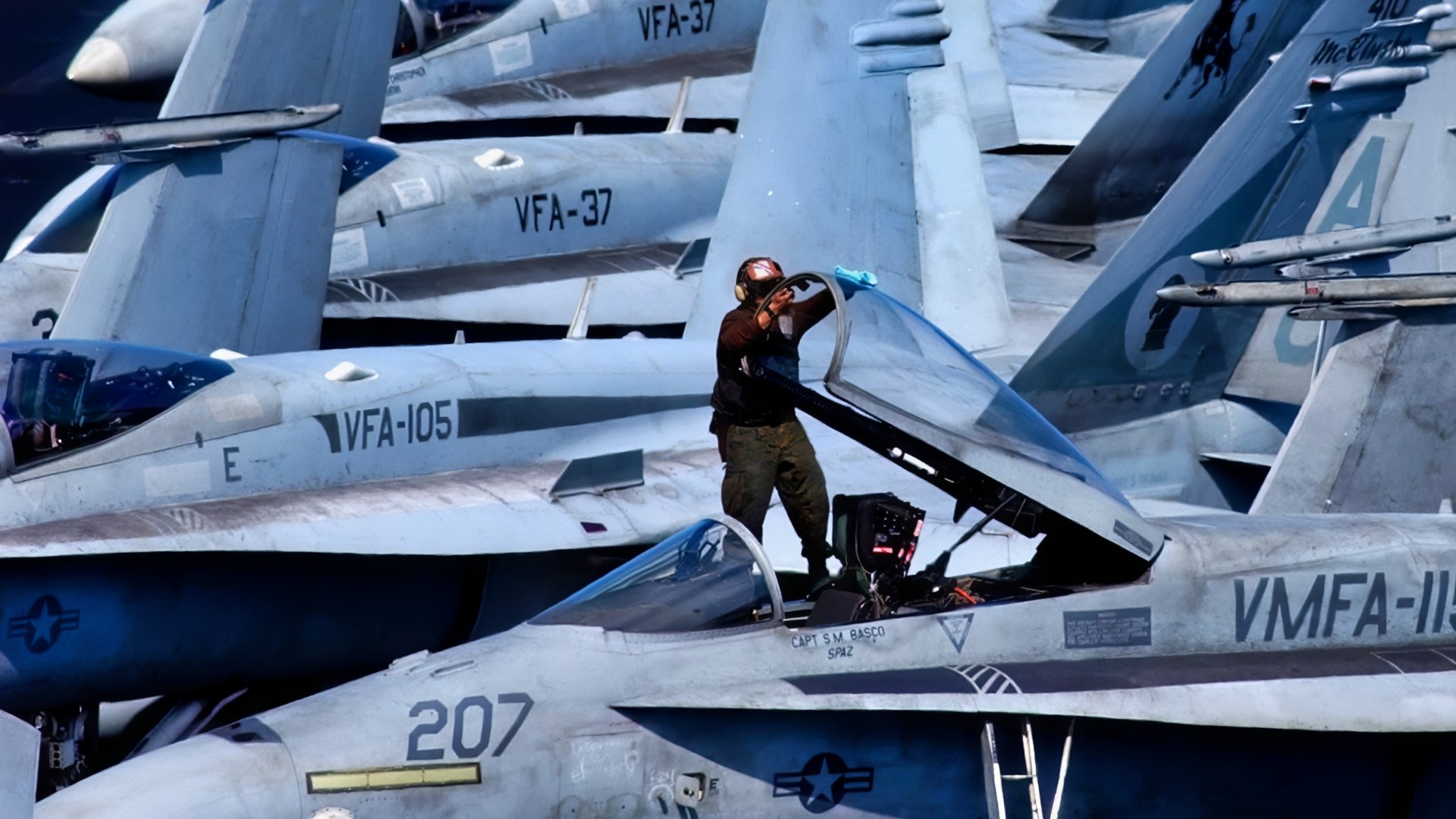
Marine Cpl. Rodger Lagrange cleans the canopy of a Marine F/A-18A+ Hornet onboard the USS Harry S. Truman (CVN 75) while the aircraft carrier operates at sea on Feb. 14, 2005. The Truman Strike Group and Carrier Air Wing 3 are conducting close air support, intelligence, surveillance, and reconnaissance missions over Iraq. Lagrange is attached to Marine Fighter Attack Squadron 115 deployed from Marine Corps Air Station Beaufort, S.C.
(DoD photo by Airman Philip V. Morrill, U.S. Navy. (Released))
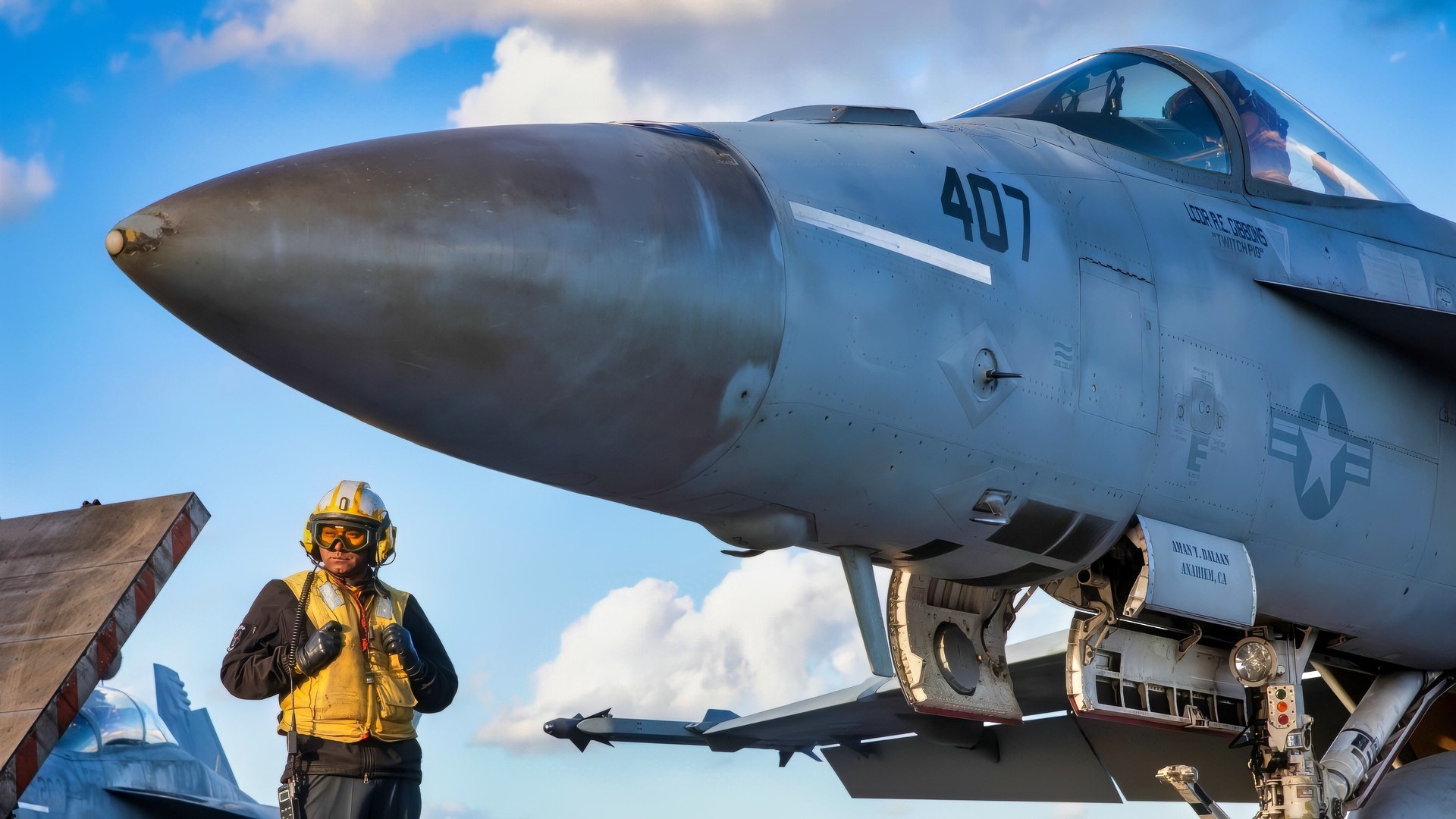
Aviation Boatswain’s Mate (Aircraft Handling) 1st Class Jose Mejiacastro, assigned to Air Department aboard the world’s largest aircraft carrier, USS Gerald R. Ford (CVN 78), prepares to signal to a Carrier Air Wing 8 F/A-18E Super Hornet attached to Strike Fighter Squadron 87 on the flight deck, Sept. 26, 2025. Gerald R. Ford, a first-in-class aircraft carrier and deployed flagship of Carrier Strike Group Twelve, is on a scheduled deployment in the U.S. 6th Fleet area of operations to support the warfighting effectiveness, lethality and readiness of U.S. Naval Forces Europe-Africa, and defend U.S., Allied and partner interests in the region. (U.S. Navy photo by Mass Communication Specialist 2nd Class Mariano Lopez)
And just when there looked to be a glimmer of hope that we might avoid the worst-case scenario, the war restarted.
America’s Shrinking Energy Buffer
Unlike at the start of the war, when the United States had around 400 million barrels of oil in its Strategic Petroleum Reserve (SPR), it has burned through at least 100 million barrels.
While one might think it shouldn’t matter, one must understand the science behind the method we use to store the oil in the SPR. The oil is in salt caverns. Engineers must maintain the oil stored there by injecting various chemicals to preserve its viability.
Yet, over time, the viability of the oil stored in the salt caverns declines.
The longer the oil stays in those caverns, the less useful it becomes. So, on paper, it looks like we’ve got 300 million barrels before zero. But the science is far more complex–and the margins, therefore, are much smaller–than it looks like on paper.
Frankly, we’ve already started hitting what’s known as “bottom barrel.” What Trump is doing with all these pauses, it seems, is trying to prevent the buffers from draining too fast.
Whether slow or fast, the buffers are dwindling.
Once they’re unusable–and they will be soon–the price of oil gets high very quickly. We’ve already seen, after the recent round of violence initiated over the Strait of Hormuz last week, how the energy markets, unlike in previous iterations of violence, were impacted. Gasoline prices spiked (as though reality were returning with a vengeance after months of the market being disentangled from economic and geopolitical reality).
That’s because the energy buffers are racing to zero.
America’s Commercial Inventories Are Running Thin
Returning to the WSJ piece, commercial inventories remain extremely low.
The Energy Department reported a 3-million-barrel increase after 10 consecutive weekly declines. One weekly increase barely dents months of inventory depletion. That’s the story throughout America’s stockpiles.
There’s a little place called Cushing, Oklahoma. You might not be familiar with it. But it is arguably one of the most important places for America’s energy sector. That’s the delivery point for WTI crude futures. If inventories fall below roughly 20 million barrels of oil, operators begin to suffer. Pumps lose efficiency. Sediment enters pipelines. Emptying the caverns totally is easier said than done. Oh, and pressure–a key element of maintaining an effective oil pipeline and storage nexus–becomes difficult to maintain (because there’s less volume).
Here again is a reinforcement of my earlier point that not every barrel in storage is actually usable.
And once Cushing approaches minimum operating inventory, the market effectively loses its emergency reserve.
On the demand side, crude demand has declined as refineries cut production. That’s masking the shortage, too. People are scratching their heads, wondering how we managed to lose 10 million barrels a day, yet we still see the global price of oil at around $70. That’s considered a reasonable price; it’s a perfect balance for consumers and producers. But that balance is being maintained by factors other than the almighty law of supply and demand.
Diesel Is the Real Warning Sign
Anyway, America today has low gasoline inventories and historically low diesel inventories. Diesel is probably the most important fuel from an economic standpoint. It’s the fuel that powers trucking and railroads, moving everything we need to sustain our economy. Meanwhile, it’s the fuel of agriculture and construction–as well as mining, shipping, and even military logistics.
Diesel shortages have an uncanny ability to ripple through nearly every part of the economy quickly.
Historically, diesel shortages often precede broader inflationary pressures because transportation costs rise across the board. That’s where we are starting to move toward now.
Some breathed a sigh of relief when they saw that jet fuel is finally stabilizing. But the longer the Strait of Hormuz remains closed, the more it will impact those numbers, too. Refined products, not crude, are becoming scarce, though.
So, when analyzing the numbers, the confused among us start to regain clarity. Gasoline futures rose over six percent while diesel jumped more than ten percent. Gasoline climbed to nearly $4.
Thus, refining capacity, not access to crude, is really becoming the bottleneck.
The Global Refining Crunch
As for the refinery capacity problem, China reduced refinery throughput significantly in response to the crisis in the Middle East. That lowered refined fuel production globally. Meanwhile, China withdrew from the global market during the crisis, relying on its impressive 1.4-billion-barrel SPR. Because of that reduction in refining, though, there’s plenty of crude available but far less gasoline and diesel.
To compound matters, Ukraine’s drone campaign against Russian refineries reduced Russian refining capacity, too. As a result, much of the diesel that global markets depend on gets disrupted. And now President Donald Trump has announced that, in honor of the deceased Sen. Lindsey Graham (R-SC), he’ll be signing Graham’s bill allowing the president to sanction any nation that purchases Russian oil and natural gas.
So, that’s further restricting key energy sources on the global market at a time when the world is already experiencing an epic level of tightening.
At present, America is simultaneously exporting its crude to help cover the losses from the SoH. The United States is also exporting its finite refined products. Meanwhile, America is rapidly drawing down energy reserves and operating with historically low inventories. That leaves little margin for error. A second major supply disruption would force difficult policy choices in Washington that, until recently, have not been part of the Trump administration’s overall calculations (they should have been).
The Calm Before the Next Shock
For all the Pollyanna-ish analysts and politicians out there, the headline crude oil prices are giving you a false sense of economic and energy security. Because of the war with Iran, the US emergency oil reserves remain dangerously depleted. Commercial inventories are approaching operational minimums in key locations.
Gasoline and diesel markets are much tighter than crude markets. Global refining capacity has precipitously declined, thanks to one shock after another. And this renewed disruption in the SoH–followed by any disruptions elsewhere, such as in the Strait of Bab el-Mandeb or the Red Sea–will trigger a far greater energy crisis than we’ve experienced thus far.
So, yes, the world may have thus far avoided an immediate oil shock during the ceasefire. Still, it has not rebuilt the strategic reserves or refining capacity needed to withstand another prolonged disruption. Right now, that’s a terrible position to be in because the war is clearly not ending anytime soon–and each day the war drags on, the energy crunch gets tighter.
About the Author: Brandon J. Weichert
Brandon J. Weichert is Senior National Security Editor. He also manages The Weichert Brief on Substack. Weichert also hosts “National Security Talk” on Rumble. He is the author of four bestselling national security books, the most recent of which is A Disaster of Our Own Making: How the West Lost Ukraine (Encounter Books). Follow him via Twitter/X @WeTheBrandon.


