


The Kuomintang Party (KMT), the principal opposition to the ruling Democratic Progressive Party (DPP), is increasingly vocal in calling for a less risky approach to cross-strait relations. Not surprisingly, Beijing is enthusiastically encouraging that trend. PRC officials repeatedly remind the Taiwanese people that tensions were far milder during the administration of Ma Ying Jeou, Taiwan’s last KMT president, who governed the island from 2008 to 2016. During his administration, cross-strait trade and tourism soared, and the two capitals signed numerous agreements on those and other issues.
Lyle Goldstein, a prominent U.S. scholar on PRC and Taiwan issues, asserts flatly that the KMT offers the United States an excellent off-ramp from Washington’s dangerous confrontation with Beijing over Taiwan.
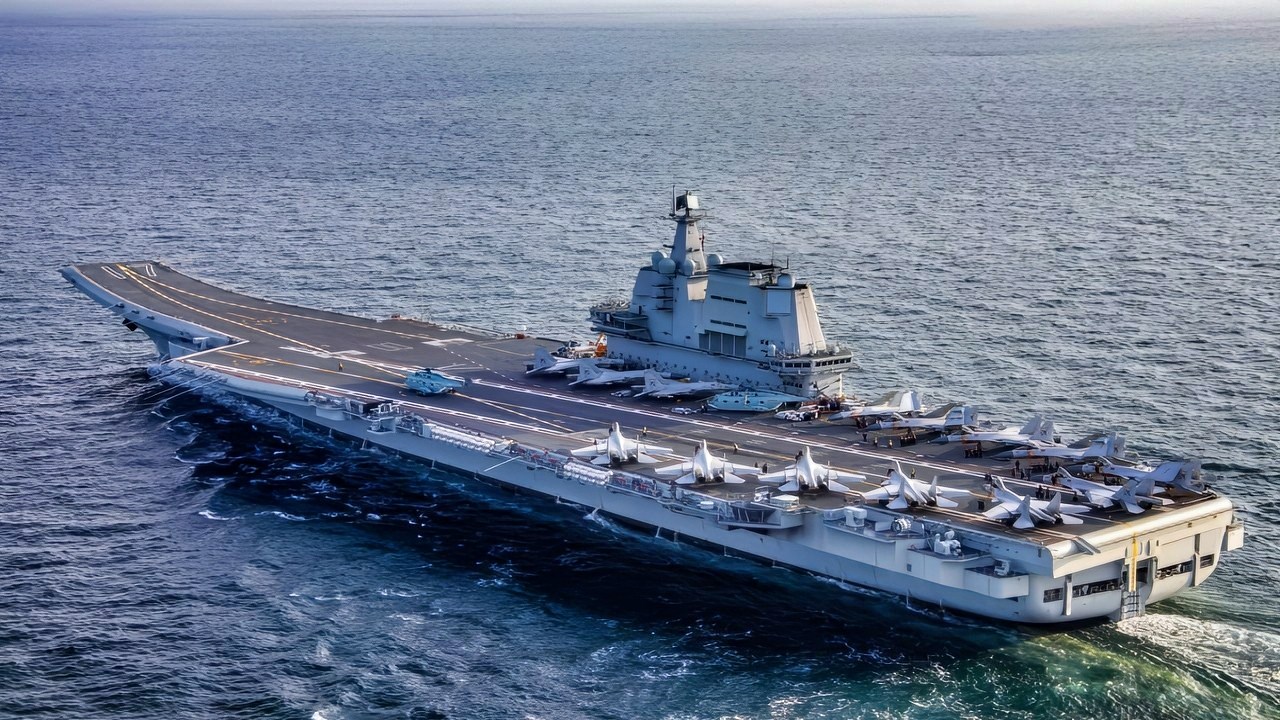
New China Aircraft Carrier. Image Credit: Weibo.

China SSN Submarine. Image Credit: Creative Commons.
Beijing’s attempt to revive that cooperative atmosphere was evident when Xi and other prominent PRC figures accorded KMT chair Cheng Li-wun an extremely cordial reception during her April 2026 visit to the mainland. Cheng reciprocated with a highly conciliatory tone during her interview with the South China Morning Post the following month. She explicitly contrasted the calm years experienced during Ma’s presidency with the acute tensions characterizing Lai Ching-te’s administration. During the former period, Cheng stated, “cross-strait relations were characterized by very friendly exchanges and were entirely free of major issues. At that time, we enjoyed significant space for international participation.” In contrast, “the nearly 10 years that followed have seen cross-strait relations rapidly deteriorate to the point of a perilous and dreadful prospect of war. This has created a sense of extreme danger, with the situation appearing to be on the verge of a breakout.”
Her strong implication was that a new KMT presidency would resume the cooperative policies that Ma had pursued. Indeed, the KMT has already seized multiple opportunities to thwart Lai’s policy agenda. As part of a broader opposition coalition that controls the national legislature, the party has scored some significant successes.
Taiwan is deeply divided politically. Lai and the pro-independence DPP have a strong, vocal cadre of supporters. But other Taiwanese have become very uneasy about the surge of military tensions in the Taiwan Strait that has typified the years of DPP rule. Restless Taiwanese voters may seek a return to the less confrontational style of the KMT.
However, the KMT has apparent internal divisions of its own that may continue to limit both its electoral appeal and its tactical effectiveness. Some KMT leaders want to make better relations with Beijing the party’s top priority. Others believe that for the foreseeable future, Taiwan will remain heavily dependent on the United States as the ultimate guarantor of the island’s security. Therefore, while members of that faction are alarmed by the DPP’s provocations, they do not want Taiwan to submit tamely to PRC domination either. Instead, they want to focus on reducing the animosity in relations between Taipei and Washington that has surfaced recently under Lai and Trump.
In other words, the primary goal of the KMT’s pro-U.S. faction is to demonstrate to Congress and the foreign policy establishment in the United States that the KMT would be a more cautious and responsible security partner than the DPP for Washington but would not become the PRC’s patsy.
Signs of a division between so-called “pro-Beijing” and “pro-Washington” elements within the KMT have become more visible since Taiwan’s 2024 elections. Cheng’s victory in becoming party chair has been widely interpreted in both Taiwan and the United States as a gain for the pro-Beijing faction, although she has tried to minimize the evidence of factionalism within her party.
Unsurprisingly, DPP partisans have enthusiastically promoted allegations that Cheng herself is overly solicitous toward Beijing. Some DPP figures especially suggested that Cheng’s preference for a smaller weapons budget risked aligning her party with Beijing’s opposition to US arms sales, especially a large-scale sale, to Taiwan.
Cheng has tried to sell the proposition that Taiwan does not have to make a stark choice between greater cooperation with Beijing and maintaining close economic and security ties with the United States. She made her case in considerable detail in her March 3, 2026, Foreign Affairs article.
The roots of the DPP-KMT policy disagreements appear to go far deeper than political and military issues. Instead, they involve fundamentally different perspectives on Taiwan’s very identity. Lai and the DPP consider Taiwan to be a separate society that strongly identifies with democratic capitalist values, not merely a subset of a larger Chinese nation—much less a Chinese nation controlled by the Communist Party.
Yet Goldstein notes that during her visit to the mainland, Cheng “did not mince words about Taiwan’s identity. She explained that the “overwhelming majority of people in Taiwan are descended from ancestors who crossed from the Mainland to Taiwan. They bear Chinese surnames, speak Chinese languages, celebrate Chinese festivals, and worship Chinese deities.” She added that “Chinese culture has always been part of the DNA of Taiwanese society….”
Cheng and members of the KMT’s more pro-Beijing faction run a grave risk by adopting such rhetoric. For more than 2 decades, public opinion surveys in Taiwan have shown that the percentage of respondents who regard their identity as “primarily Taiwanese” has grown steadily. The hedging answer of “both Taiwanese and Chinese” has shrunk gradually, remaining on a modestly downward trajectory. The “primarily Chinese” self-identity category has plunged. In a 2024 Pew Research survey, only 3 percent of respondents chose that answer.
The DPP’s authoritarian tendencies domestically, combined with Lai’s highly confrontational stance toward Beijing, have alarmed a growing percentage of Taiwanese voters. That development gives the KMT a very solid chance to regain the presidency in 2028 and continue to control parliament–perhaps even no longer needing a coalition partner.
However, it is worth recalling that Ma’s administration was undermined not only by popular revulsion at the KMT’s notorious corruption, but also by the popular Sunflower Movement’s successful portrayal of the party as being too accommodating toward Beijing and failing to defend Taiwan’s crucial interests. Cheng and the KMT’s current pro-Beijing faction risk falling into the same trap. Just as the Democratic Party in the United States is well-positioned to score major gains in America’s 2026 midterm elections, but only if voters conclude that the party is not a captive of the loony left, the KMT has a great electoral opportunity, but only if voters conclude that it is a responsible alternative to the DPP, not Beijing’s tool.
About the Author: Ted Galen Carpenter
Ted Galen Carpenter is a senior fellow at the Randolph Bourne Institute and a contributing editor at The National Security Journal and The American Conservative. He is the author of 13 books and more than 1,500 articles on national security, international affairs, and civil liberties. His latest book is Unreliable Watchdog: The News Media and U.S. Foreign Policy (2022).


high-end faight
July 20, 2026 at 2:31 am
(high-end faight = war using nukes.)
After Washington the great global hegemon and invader is done with Iran, it’s expected to embark or begin ‘operations’ against china.
For that coming development or scenario, the KMT would amount to represent absolutely nothing, but a mere dumb bystander, and thus must be discounted.
So, what actually figures greatly in the coming life-changing scenario, once openly described by Rubio as ‘an event of apocalyptic proportions.’
It’s pacom, the highly more power-powerful pacific version of centcom. Now active in the gulf. Embarking on genocides.
Also, the American CIA agents in china today, are in the equation.
Thus, china, if it wants to survive the coming momentous encounter, must now, today, immediately, get rid of them all. Including xi jinping.
If war, or a serious crisis erupts in the region, china’s current arsenal of rocket firepower will mean the difference between life and death, or survival and complete destruction.
Thus china must be prepared today, must need to know that killing the enemy, or the traitor outright, immediately is of utmost importance.
Hujjathullah M.H.B Sahib
July 20, 2026 at 2:39 am
This is a revealing piece that not only portrays the evolving nuances of Taiwanese politics but more broadly it also hints at the underlying tensions within the legacy of inter- or rather now the intra-Chinese civil war. To outside observers the Taiwanese appear to be basically caught between the Devil and the devil beyond the deep blue sea !