

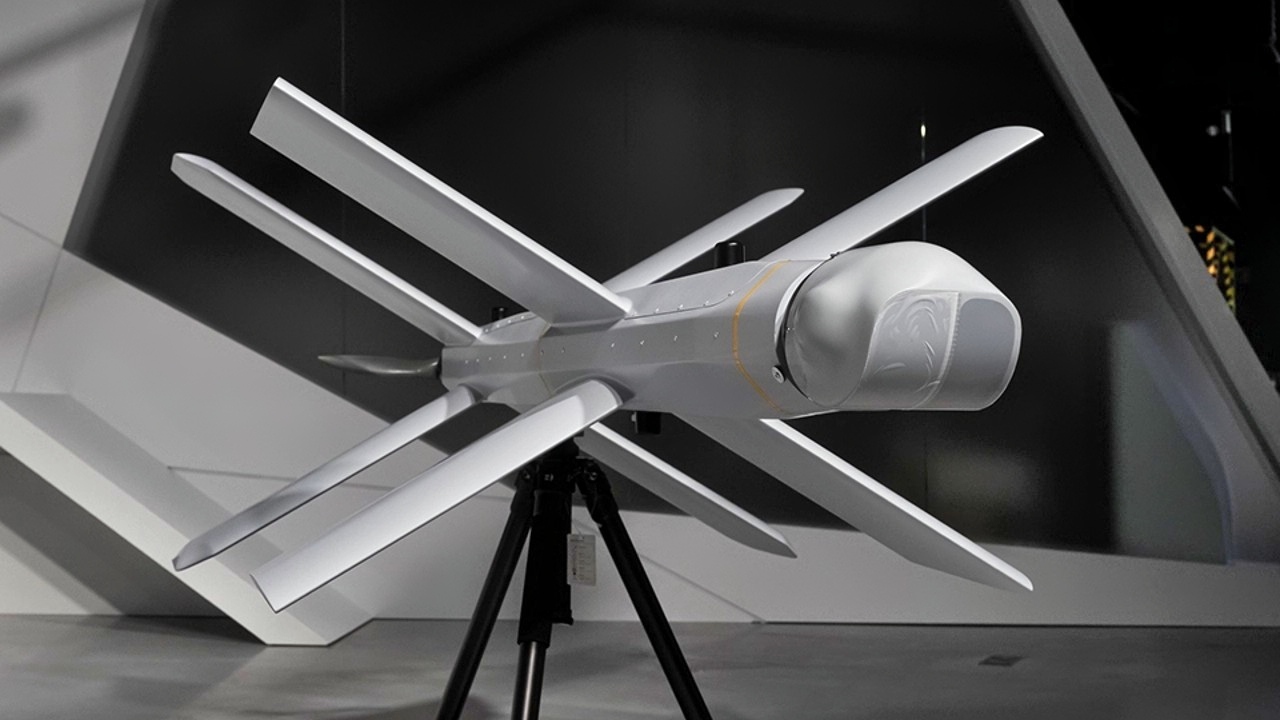
Both sides in the Ukraine War have experienced rapid, radical technological developments of the kind that would have been impossible without the conflict erupting in 2022. Today, that war has entered a new phase entirely.
After years of relying heavily on relatively slow, propeller-driven Shahed attack drones (courtesy of Iran), Moscow is now deploying large numbers of jet-powered variants.

U.S. Army Pvt. 1st Class Ian Wojick, assigned to 552nd Military Police Company, 25th Infantry, aims a DroneBuster, an anti-drone weapon, toward the sky during the Joint Pacific Multinational Readiness Center Exportable (JPMRC-X) exercise at Fort Magsaysay, Philippines, June 1, 2025.
This iteration of the JPMRC-X marks the second Combat Training Center (CTC) rotation conducted in the Philippines. As part of the Army’s premier regional CTC, JPMRC-X enables the U.S. Army, joint force, allies, and partners to develop skills in realistic environments and conditions. Through exportable capabilities, JPMRC-X strengthens war-fighting readiness, enhances multilateral relationships, and contributes to regional security and stability in the Indo-Pacific. (U.S. Army photo by Staff Sgt. Keith Thornburgh)
These drones are significantly faster and, of course, harder to intercept, fundamentally altering the battlefield dynamics and strategic calculations.
A Key Shift
That shift is making Kyiv and other Western defense companies redesign one of the most successful battlefield innovations of the war–the inexpensive interceptor drones–and if they aren’t careful, those cheap, expendable, easily mass-produced systems will lose all their advantages as they are made more complex to counter this serious threat.
According to Ukrainian military officials, nearly 20 percent of the Shahed drones employed by Russia now use jet engines rather than the traditional piston-driven propellers.
Those jet-powered variants can reportedly reach speeds approaching 310 miles per hour (500 kilometers), dramatically reducing the amount of time available for defenders to detect, track, and destroy them before impact.
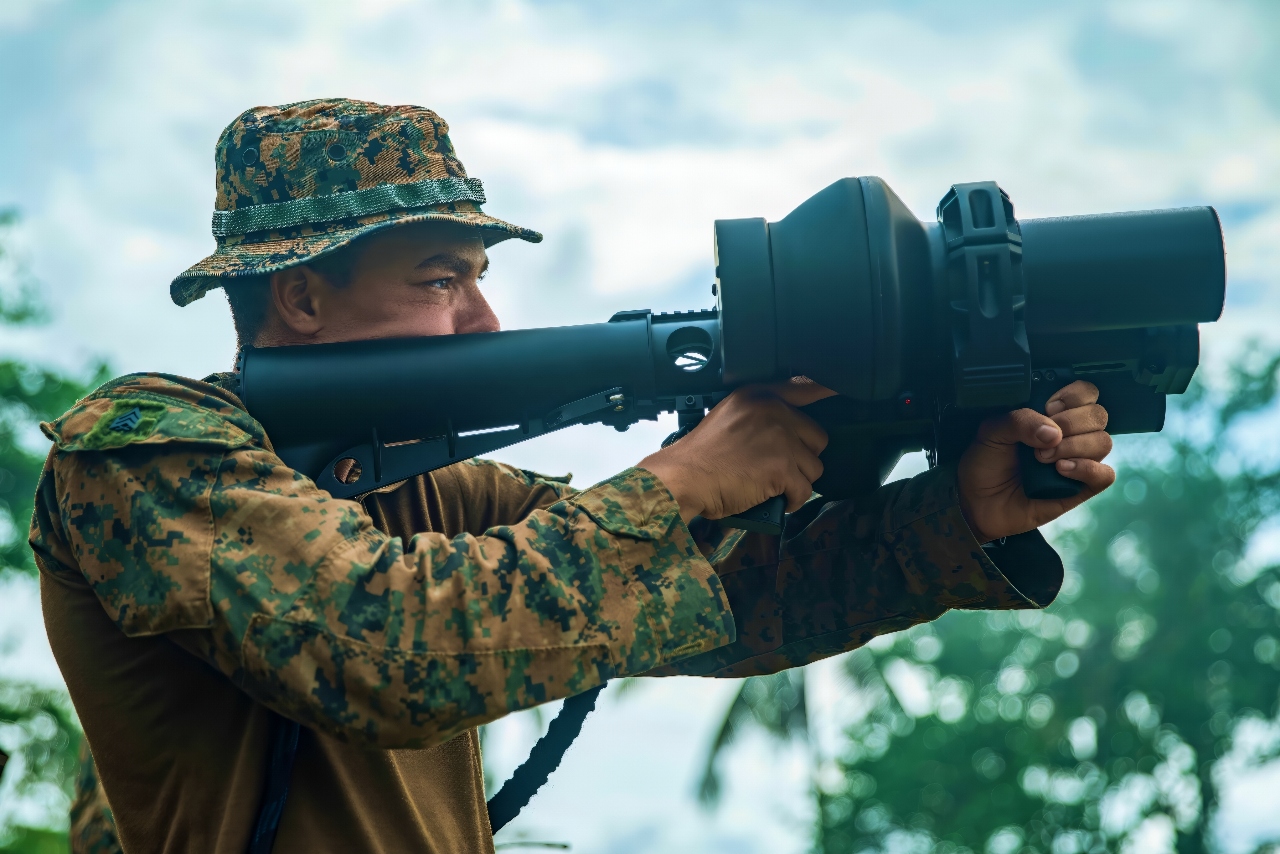
U.S. Marine Corps Sgt. Colin Clark, a mortarman assigned to Bravo Company, Battalion Landing Team 1/5, 15th Marine Expeditionary Unit, and a native of Texas, engages a target with a NightFighter S counter-unmanned aerial vehicle system during a demonstration for Philippine Marines assigned to Intelligence Company, 3rd Marine Brigade, as part of exercise KAMANDAG 8 at Tarumpitao Point, Palawan Province, Philippines, Oct. 17, 2024. KAMANDAG is an annual Philippine Marine Corps and U.S. Marine Corps-led exercise aimed at enhancing the Armed Forces of the Philippines’ defense and humanitarian capabilities by providing valuable training in combined operations with foreign militaries in the advancement of a Free and Open Indo-Pacific. This year marks the eighth iteration of this exercise and includes participants from the French Armed Forces, Royal Thai Marine Corps, and Indonesian Marine Corps; including continued participation from the Australian Defense Force, British Armed Forces, Japan Ground Self-Defense Force, and Republic of Korea Marine Corps. (U.S. Marine Corps photo by Sgt. Amelia Kang)
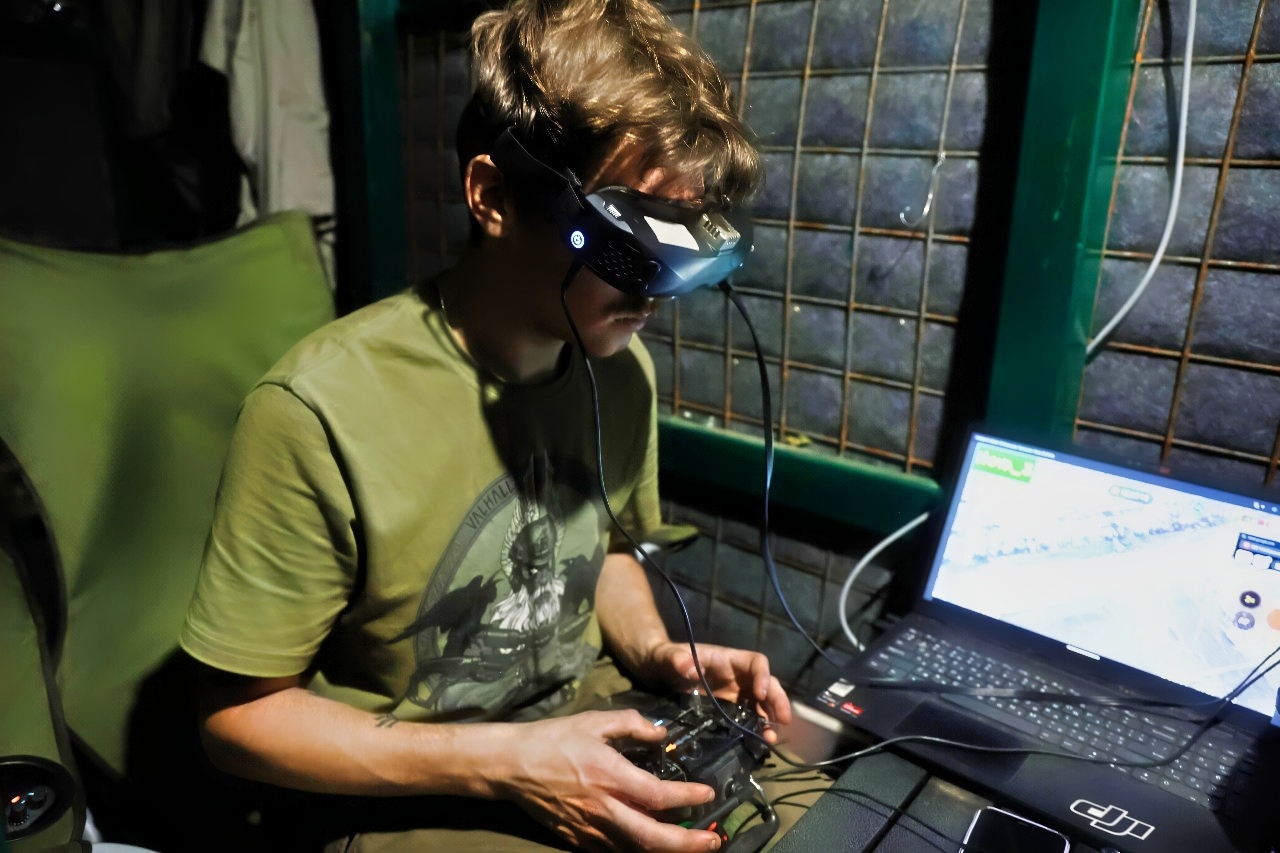
Bohdan, a drone pilot from the Unmanned Systems Battalion of Ukraine’s 110th Separate Mechanized Brigade, pilots an FPV drone in Donetsk Oblast during active battle operations. Photo: David Kirichenko
That increase in speed forces defenders to adapt their interception strategies. That, in turn, increases the difficulty of neutralizing incoming threats effectively.
Faster drones compress defenders’ reaction times, complicate radar tracking, and outrun many existing drone interceptors that were originally meant to defend against the slower, propeller-driven Shahed-136 drones (or their Russian derivatives, the Geran-series drone).
Ukraine’s answer is not necessarily more expensive missiles. Rather, Kyiv is developing faster drones itself.
Adaptations Galore
Reuters reports that SkyFall, a Ukrainian drone manufacturer, unveiled its newest P1-SUN “Jetkiller” interceptor drone at the Farnborough International Airshow in Britain.
That system is capable of reaching around 370 kilometers per hour and has already demonstrated effectiveness against jet-powered Shaheds during operational testing in Ukraine.
SkyFall plans to initiate large-scale production beginning in August of this year, underscoring the urgency and rapid pace of technological adaptation in response to evolving drone threats.
But wait, there’s more! As Billy Mays might have said into the camera.
General Cherry is another Ukrainian manufacturer, and that firm is developing an upgraded version of its Bullet interceptor specifically meant for countering Russia’s faster drones.
Depending on the propulsion system the company goes with, the interceptor will achieve speeds of up to 500 kilometers per hour while maintaining a relatively cheap production cost of $2,000 per unit.
British-Ukrainian defense firm Firebolt Engineering is taking a different tack.
That firm’s Griffen interceptor uses a jet engine rather than electric propulsion. The current version reportedly reaches around 350 kilometers per hour.
Engineers hope further development with propulsion specialist Dynamic Propulsion will push that figure to 400 kilometers per hour.
The main challenge, as always, is affordability. That’s because Firebolt assesses that each jet-powered drone interceptor they produce will cost less than $10,000 per unit. At the same time, though, that’s more than the electric alternatives (but still cheaper than conventional air defenses, so it’s all relative).
The Costs Are the Problem
Traditional surface-to-air missiles (SAMs) cost hundreds of thousands–or even millions–of dollars per shot. Russia can launch massive numbers of relatively inexpensive one-way attack drones meant to exhaust those expensive missiles (which they regularly do).
That economic imbalance has encouraged both sides in the war to seek inexpensive interception methods.
Interceptor drones truly reverse the cost equation by using relatively cheap unmanned aircraft to destroy incoming drones rather than wasting expensive air defense interceptors on every incoming target.
Those jet-powered drones are driving technological innovation, inspiring confidence that ongoing advancements can shape the war’s future and influence its outcome.
With both sides adapting, the contest increasingly becomes a manufacturing and engineering competition as much as a battlefield competition.
Success may ultimately depend less on who builds the fastest drone than on who can produce effective systems quickly, affordably, and in sufficient numbers to keep pace with an adversary that is constantly evolving.
These innovations at this point, and which side gets there first, could easily determine the victor in this war.
About the Author: Brandon J. Weichert
Brandon J. Weichert is Senior National Security Editor. He also manages The Weichert Brief on Substack. Weichert also hosts “National Security Talk” on Rumble. He is the author of four bestselling national security books, the most recent of which is A Disaster of Our Own Making: How the West Lost Ukraine (Encounter Books). Follow him via Twitter/X @WeTheBrandon.


