
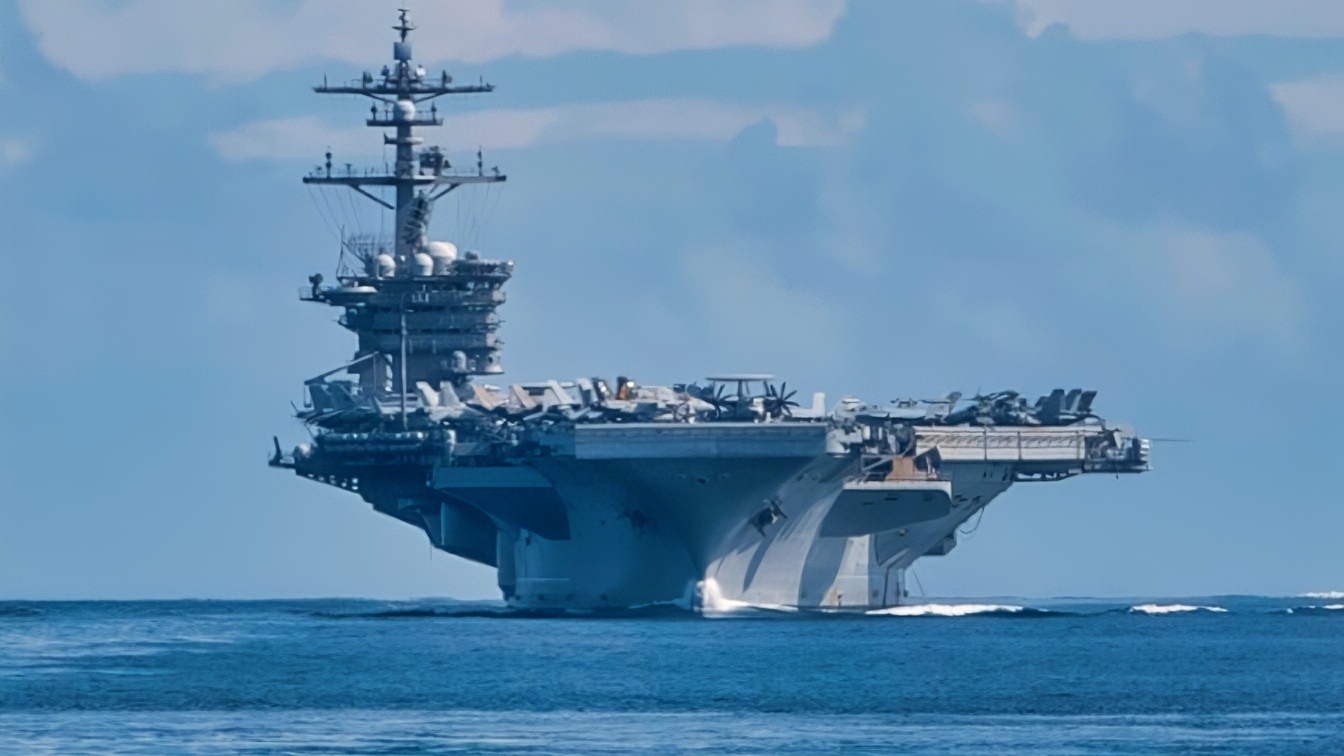
A cargo vessel was struck in the Strait of Hormuz on Wednesday, 23rd September, leaving two people injured.
The strike by an unknown projectile comes amid renewed optimism of a deal to end the Iran war and subsequently reopen the vital international waterway.
Nimitz-class aircraft carrier USS George Washington (CVN 73). Creative Commons Image.

The guided-missile destroyer USS Donald Cook (DDG 75) steams behind the aircraft carrier USS Theodore Roosevelt (CVN 71) in the Persian Gulf on Jan. 31, 2006. The Roosevelt Carrier Strike Group is conducting maritime security operations in the Persian Gulf.
(DoD photo by Airman Apprentice Nathan Laird, U.S. Navy. (Released))
U.S. and Iranian officials met through mediators for more than three hours on Tuesday on the sidelines of the United Nations General Assembly in New York.
Cargo Struck
On Wednesday, the United Kingdom Maritime Trade Operations (UKMTO) said it received a report that the cargo vessel had been struck in the Strait of Hormuz.
“The Company Security Officer of a cargo vessel reports being struck by an unknown projectile. The vessel is on fire and adrift,” UKMTO said. “All crew have been evacuated with 2 casualties reported.”
UKMTO added that an investigation was underway, although initial findings said the strike caused no environmental damage as a result of the strike. The identity of the ship was not revealed, nor was the source of the strike.
Hormuz Remains Closed
Ever since the conflict began at the end of February, the Strait of Hormuz has been a key talking point of the war.
The waterway is vital for Middle East oil exports, with Gulf states such as Qatar, Kuwait and the United Arab Emirates reliant on its opening.
Since U.S. and Israeli bombs rained down on Iran, Tehran has used its chokehold on the strait – which is only 24 miles wide at its narrowest point – to limit the flow of commercial shipping traffic through the body of water.
Traffic remains well below pre-war levels, with a ten-day moving average of just 15 vessels passing through the strait – more than 100 below the daily average at the start of the year.
Oman, a key mediator throughout the conflict, has led efforts to find a temporary solution.
Last month, a proposal to permit traffic into the Persian Gulf solely via Iranian waters, with outbound vessels traveling partly through Omani territory, was reportedly close to fruition.
However, a planned follow-up meeting was postponed last week after Saudi Arabia raised concerns about rising tensions in Yemen.
Potential Reopening
Earlier this week, an Iranian official told Reuters that the strait could be reopened within a week, provided the U.S. lifts its naval blockade of Iranian ports and eases military pressure.
“The U.S. needs to announce that it wants to resolve the issue diplomatically, make that official, and then agree on a timeline for how the process will move forward,” the senior official told Reuters.
Separately, Japan’s Kyodo news agency also cited a senior Iranian official, who said: “There is a possibility of moving toward an agreement,” adding that Washington must show “seriousness and commitment” towards diplomatic efforts.
Tehran has issued seven conditions before direct face-to-face talks with Washington can resume to reopen the strait.
Speaking to Al Jazeera, Supreme National Security Council Secretary Mohsen Rezaei said: “Our conditions are an end to the war on all fronts, the release of our frozen funds, and an end to the naval blockade.
Washington has an interest in accepting these conditions.
Trump’s threats will not achieve any results. We are prepared for a decisive war,” adding that Iranian military assessments believed a new U.S. strike was “very much on the cards.”
At the U.N. General Assembly on Tuesday, U.S. envoys Jared Kushner and Steve Witkoff met with an Iranian delegation through mediators just hours after President Donald Trump threatened to “annihilate” Iran to force a conclusion to the conflict.
Speaking to reporters later that day, Trump said the meeting had gone “very well” while conceding that the Iranian officials were “not the highest level.”
Witkoff also praised the talks, adding on social media: “[The mediators] successfully completed a round of discussions that we hope will prove constructive and promising. The mediators will continue their work.”
Oil Prices Remain High
A major ramification of the strait’s ongoing closure has been a rise in oil prices.
Brent crude, the benchmark for oil prices, once again rose above $100 per barrel earlier this month but has since fallen amid hopes that a deal to reopen the Strait of Hormuz could be reached soon.
Diesel prices, meanwhile, continue to reach record highs.
On Tuesday, diesel averaged a record $6.53 a gallon – a 77% increase on this time last year.
Given its importance to producers, transporters, and consumers, persistently high diesel prices remain an uncomfortable reality ahead of November’s midterm elections.
About the Author: Shay Bottomley
Shay Bottomley is a British journalist. He has written for the Western Standard, Business Insider, Maidenhead Advertiser, Slough Express, Windsor Express, Berkshire Live and Southend Echo.