


The U.S. is planning a shuffle of its aircraft carriers in the Middle East. The Wall Street Journal reported Thursday that the USS George Washington is headed to the region, where it will replace the USS Abraham Lincoln.
While there have been reports in recent days about horrible conditions on the latter carrier, including multiple reports about sailors trying to jump overboard, the Journal reported that the switch is “part of a previously scheduled rotation plan.” The Journal did not specify when the USS Abraham Lincoln would return home.
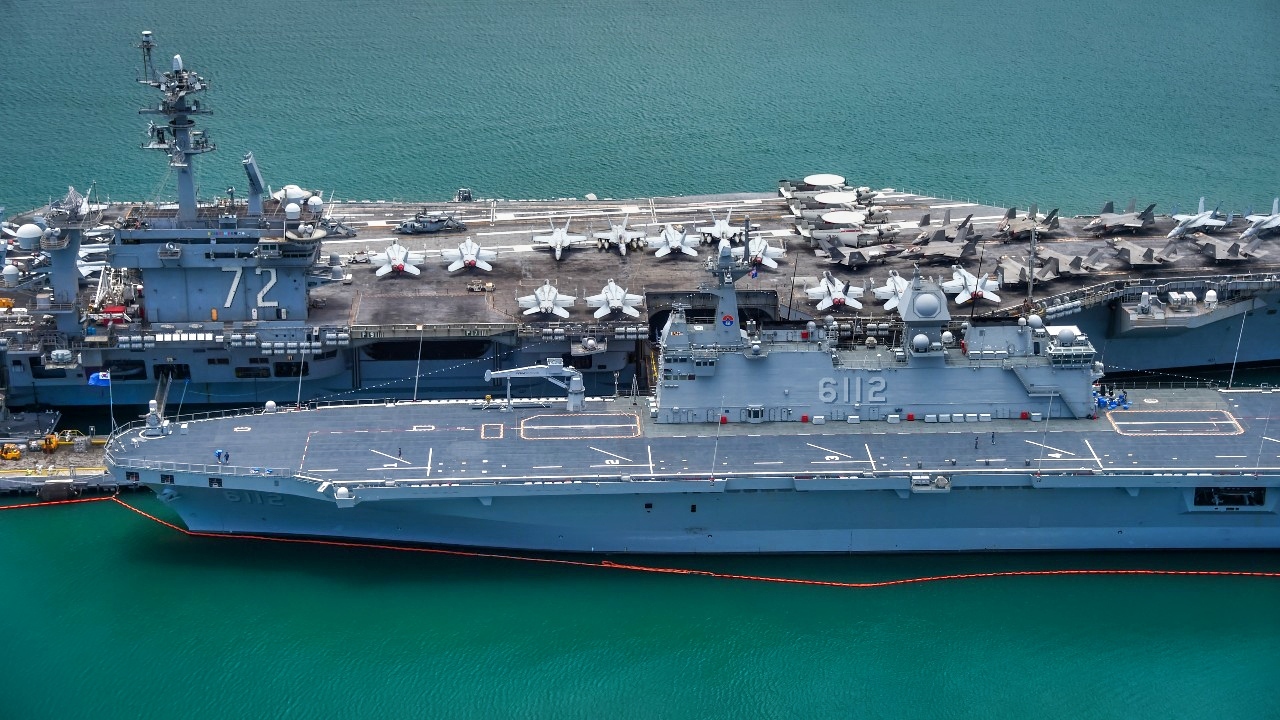
(July 7, 2022) – U.S. Navy nuclear-powered aircraft carrier USS Abraham Lincoln (CVN72) and Republic of Korea Navy amphibious assault ship ROKS Marado (LPH 6112) moored at Joint Base Pearl Harbor-Hickham, Hawaii, during Rim of the Pacific (RIMPAC) 2022. Twenty-six nations, 38 ships, four submarines, more than 170 aircraft and 25,000 personnel are participating in RIMPAC from June 29 to Aug 4 in and around Hawaiian Islands and Southern California. The world’s largest international maritime exercise, RIMPAC provides a unique training opportunity while fostering and sustaining cooperative relationships among participants critical to ensuring the safety of sea lanes and security on the world’s oceans. RIMPAC 2022 is the 28th exercise in the series that began in 1971. (U.S. Navy photo by Mass Communication Specialist Seaman Leon Vonguyen)
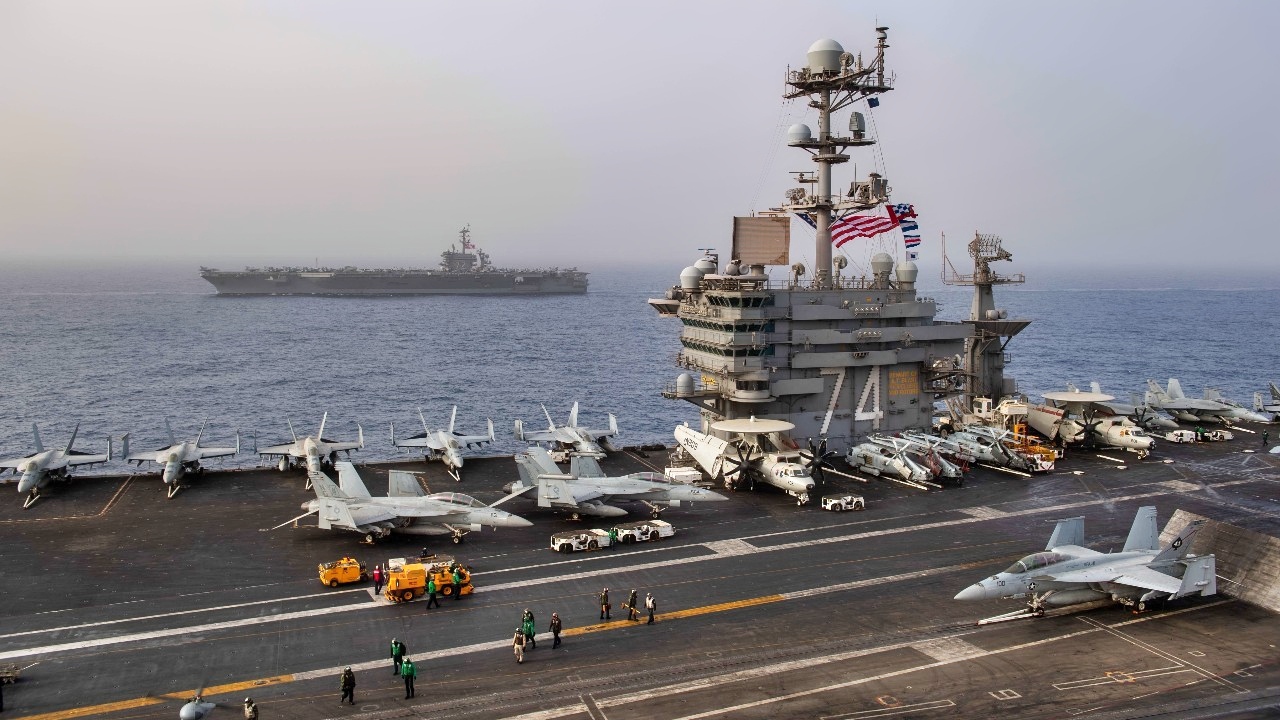
The aircraft carrier USS Abraham Lincoln (CVN 72), back, steams alongside the aircraft carrier USS John C. Stennis (CVN 74) in the Mediterranean Sea, April 24, 2019. The John C. Stennis Carrier Strike Group (CSG) 3 and Abraham Lincoln Carrier Strike Group (CSG) 12 are conducting dual carrier operations, providing opportunity for two strike groups to work together alongside key allies and partners in the U.S. 6th Fleet area of operations. John C. Stennis is underway in the Mediterranean Sea as part of the John C. Stennis Carrier Strike Group (JCSCSG) deployment in support of maritime security cooperation efforts in the U.S. 6th Fleet area of responsibility. (U.S. Navy photo by Mass Communication Specialist 3rd Class Grant G. Grady)
The George Washington Carrier Strike Group was in the Strait of Malacca as of Thursday, per USNI News.
The USS Abraham Lincoln has been deployed since December of last year and has been in the Middle East since January, a deployment that has included the entirety of Operation Epic Fury.
More recently, the carrier has been used as part of the U.S. blockade of the Strait of Hormuz. It’s been more than 200 days, the Journal report said, since Abraham Lincoln’s last port call.
One U.S. Senator wrote a letter this week expressing concerns about that long deployment and the conditions aboard the carrier, which currently hosts about 5,000 sailors and Marines.
“Serious Concerns”
On August 12, Sen. Richard Blumenthal (D-CT) wrote a letter to Defense Secretary Pete Hegseth and Acting Secretary of the Navy Hung Cao, expressing “serious concerns about the increasing length of Carrier Strike Group deployments,” and also specifically about the USS Abraham Lincoln.
This lengthy deployment, the senator wrote, “raises broader questions about the Navy’s ability to sustainably generate carrier forces while preserving servicemember well-being, maintenance schedules, fleet readiness, and the capacity to respond to future contingencies.”
Blumenthal raised several concerns in the letter, including water contamination, safety issues, plumbing problems, and even mail system issues that delayed packages from reaching sailors. All of this, the senator wrote, has had the effect of “deteriorating mental health” among those in the carrier group.
The senator also sought to raise another question, about the war more broadly: “Whether the Navy can sustain the operational tempo now being demanded of its carrier force, particularly as this Administration repeatedly commits U.S. forces to conflicts of its own choosing and increasingly relies on aircraft carriers to sustain those operations.”
Another lawmaker, Rep. Marlin Stutzman (R-IN), said on CNN this week that he “plans to seek an update” from the Pentagon on the conditions.
“At the end of the day, we know that those who are serving have to have comfort knowing that they’re getting properly taken care of,” Stutzman said.
One Sailor’s Story
In a widely shared account earlier this week, the Military Times reported on conditions aboard the USS Abraham Lincoln. A woman, Annabelle Loma, told the story of her husband, who “attempted to jump overboard” during his current deployment. She also said the Navy has been slow to communicate with her, and she has spoken with her husband only a few times since it happened.
The wife of another sailor told the Military Times that “a sailor on watch saw a shipmate preparing to go overboard, and he intervened.”
Also this week, Stars and Stripes reported on continuing worries about the mental health of sailors aboard the USS Abraham Lincoln, and revealed that family members of sailors recently spoke to Cao, the acting secretary of the Navy, and other senior officials, about their concerns, at a town hall meeting in San Diego that was attended by more than 200 people. More concerns were raised in a virtual meeting later that day.
One spouse, that report said, said her husband had said he “hopes he doesn’t wake up tomorrow.”
MS NOW reported that Cao, at the time, was “unable to specify” when relief was coming.
The Navy Responds
Per the Star and Stripes story, the Navy has pointed to the presence of counselors, chaplains, and others aboard the aircraft carrier and issued a statement that “leadership is continually conducting assessments to monitor and sustain the psychological readiness of every sailor.”
Vice Adm. Joseph Cahill, a top Naval commander, said at the meeting that “We hear you loud and clear the impact this has on families, on service members, and the long-term ability of us to stand, sustain our forces’ health,” MS NOW reported.
About the Author: Stephen Silver
Stephen Silver is an award-winning journalist, essayist, and film critic, and contributor to the Philadelphia Inquirer, the Jewish Telegraphic Agency, Broad Street Review, and Splice Today. The co-founder of the Philadelphia Film Critics Circle, Stephen lives in suburban Philadelphia with his wife and two sons. For over a decade, Stephen has authored thousands of articles that focus on politics, national security, technology, and the economy. Follow him on X (formerly Twitter) at @StephenSilver, and subscribe to his Substack newsletter.


