


Gulf oil exports may be picking up pace, but they still aren’t driving oil prices down.
But why, even with crude exports from the region hitting 80 percent of the pre-war levels, are prices still proving troublesome?
Is This Really a ‘Win’?
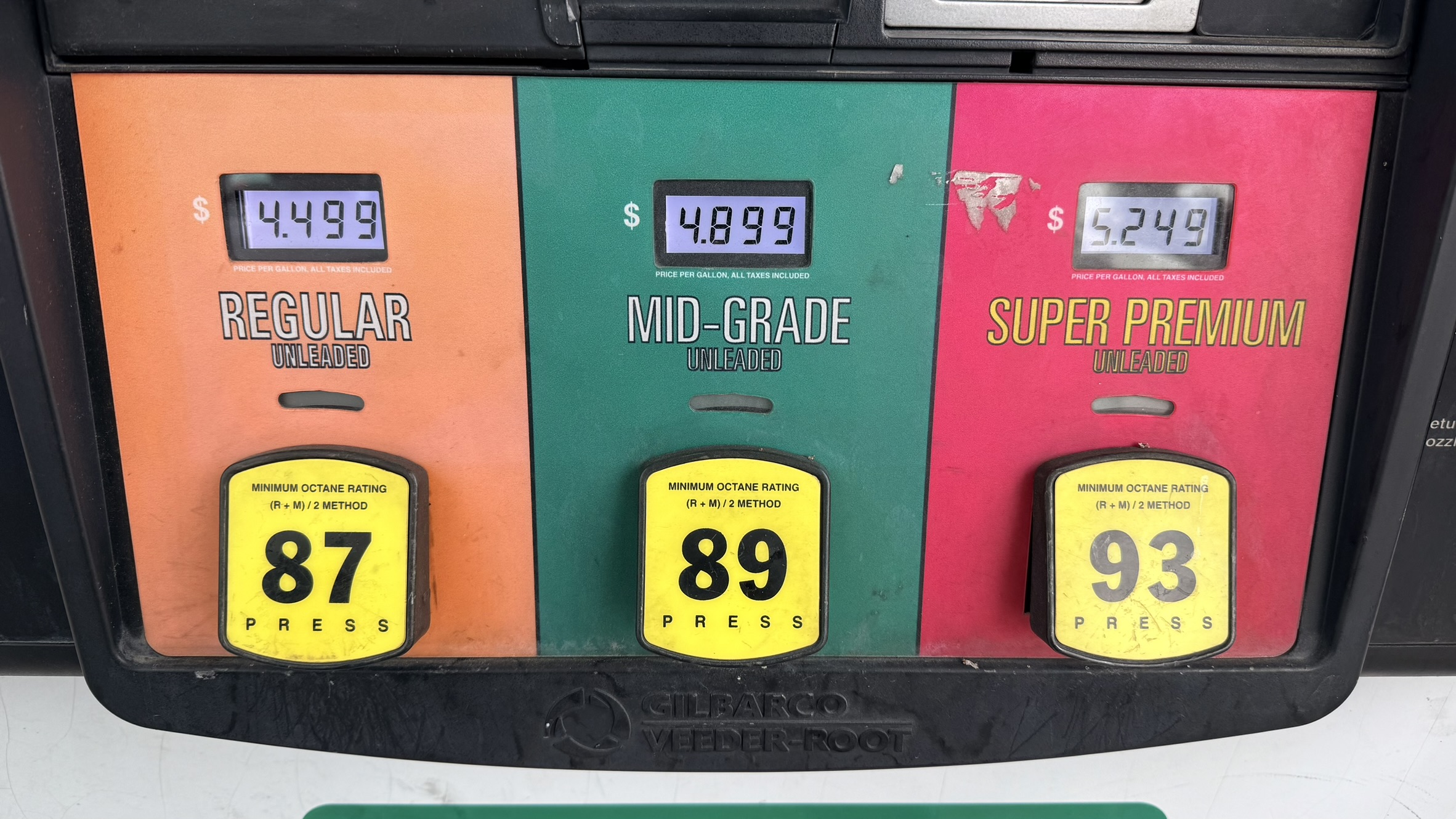
Gas Prices on May 9 outside of Orlando, Florida. Image Credit: Harry J. Kazianis for National Security Journal.
On Wednesday, Brent crude remained over $100 a barrel. “If this is winning, what would losing look like?” Bloomberg columnist Javier Blas quipped.
The latest figures support Blas’ point.
According to the Financial Times, Saudi Arabia, the UAE, Qatar, Bahrain, Kuwait, and Iraq exported an average of 15.5 million barrels of oil across September.
Vital infrastructure, including Riyadh’s East-West Pipeline, has been partially restored, as have tanker departures from its Red Sea port of Yanbu.
U.S. Helping Ships Through Strait
The U.S. is also helping increase traffic. U.S. Central Command commander Adm. Brad Cooper has announced that American forces offered security for 2,000-plus commercial transits, allowing more than one billion barrels of crude oil to pass through the strait.
Shipping has indeed recovered dramatically, partly due to Washington’s aid. According to Reuters, the expiring November Brent contract was at $103.19 a barrel at 1251 GMT Wednesday.

An F-16 Fighting Falcon assigned to the 54th Fighter Group sits on the flightline at Holloman Air Force Base, May 1, 2025. The F-16 was the first production aircraft with a fly-by-wire flight control system, meaning it’s controlled electronically instead of with direct mechanical linkages, allowing for more precise and safer maneuvers. (U.S. Air Force photo by Staff Sgt. Gaspar A. Cortez)
The more actively traded December contract was at $97.78, with Brent set to rise by about 14 percent this month.
Restored oil flows from the Gulf are not solving all the problems in the energy market.
According to the MUFG analysts cited by Reuters, “Recovering crude flows should temper supply-driven price pressures, although persistent product shortages and elevated freight costs are likely to keep the broader energy market tight.”
While oil production capacity is being restored following the recent disruption, a refining bottleneck persists in the energy market.
With reserves of diesel fuel, gasoline, and other refined products depleted, demand for products continues to exceed supply.
Bob McNally, founder of Rapidan Energy Group, argues that the market is still mired in problems. “The market realizes that. We have dug ourselves into a deep deficit over the last several months, and this only reduces it,” he explained, adding: “It does not get us back to where we were.”
The Diesel ‘Squeeze’
The squeeze is most evident in diesel.
Reuters reported Tuesday that the White House was pushing European governments to draw down emergency diesel stocks, with American officials reportedly most frustrated by France and Germany.
Washington and 31 other International Energy Agency members agreed in March to draw down 400 million barrels from emergency reserves, including 172 million barrels from the United States.
Energy Secretary Chris Wright complained that “several European member countries have released only a fraction of the crude oil and petroleum products they pledged.”
Nor does it tell the whole story, as crude shipments in the waterway are rising again. Ship-tracking companies can’t even agree on how large these movements are.
Kpler estimated flows averaged nearly 12.5 million barrels per day in the week ending Sept. 27 – roughly a million barrels short of its prewar level – while Windward placed the number closer to 10 million barrels per day. “This is not trivial,” said Ami Daniel, chief executive of Windward, in an interview with the Washington Post.
But the newspaper noted that these flows still require expensive naval escorts and shipping routines that could be jeopardized if Iran again opens fire on commercial vessels.
Refined Products Remain Under Strain
Getting crude through the strait is not the same as getting diesel, gasoline and jet fuel to waiting customers.
Middle Eastern refining capacity has been severely damaged, and shipments of finished products through the narrow stretch of water are a tiny fraction of what they were before the war, the Washington Post noted. “We’ve dug ourselves into a big hole,” said Rice University oil market expert Mark Finley.
A Reuters survey of 30 economists and analysts, published Wednesday, slightly raised its forecast for average Brent crude prices in 2026 to $89.05 a barrel, up from $85.08 in the previous month’s poll.
DBS Bank energy researcher Suvro Sarkar said the bank was “not betting on a resolution” within the next three to six months.
Indeed, it would be sensible for ordinary consumers to avoid getting their hopes up also.
About the Author: Georgia Gilholy
Georgia Gilholy is a journalist based in the United Kingdom who has been published in Newsweek, The Times of Israel, and the Spectator. Gilholy writes about international politics, culture, and education. You can follow her on X: @llggeorgia.


