

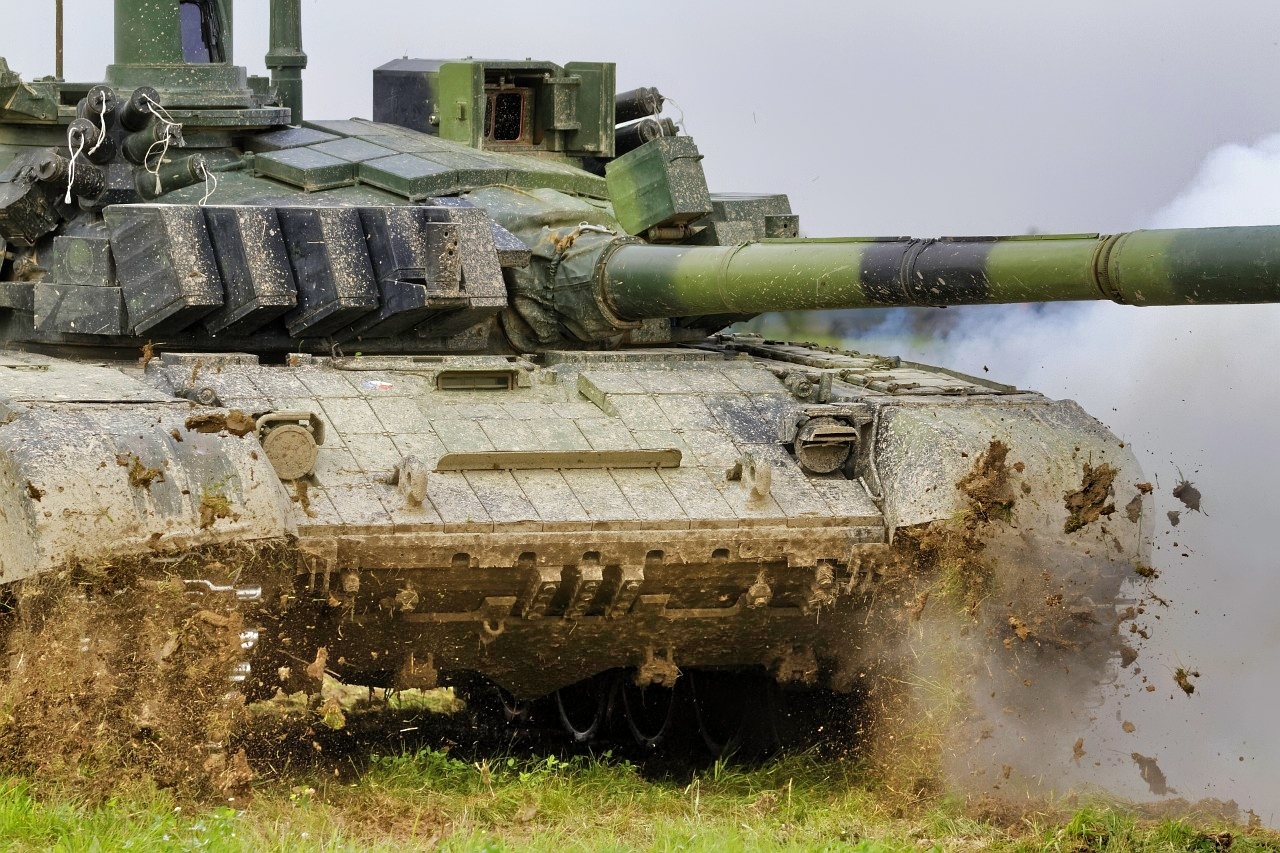
The T-72 was the Soviet Union’s armored champion. Although the Gulf War somewhat tarnished its reputation, the tank remained the USSR’s MBT of choice and, later, the Russian Federation’s. Despite its faults, the T-72 is a rugged, reliable tank that is easy to produce and maintain at a much lower cost than other modern tanks.
Unfortunately, the war in Ukraine has not been kind to the old Soviet-era icon.

Russian T-72 Tank Ukraine War. Image Credit: Creative Commons.
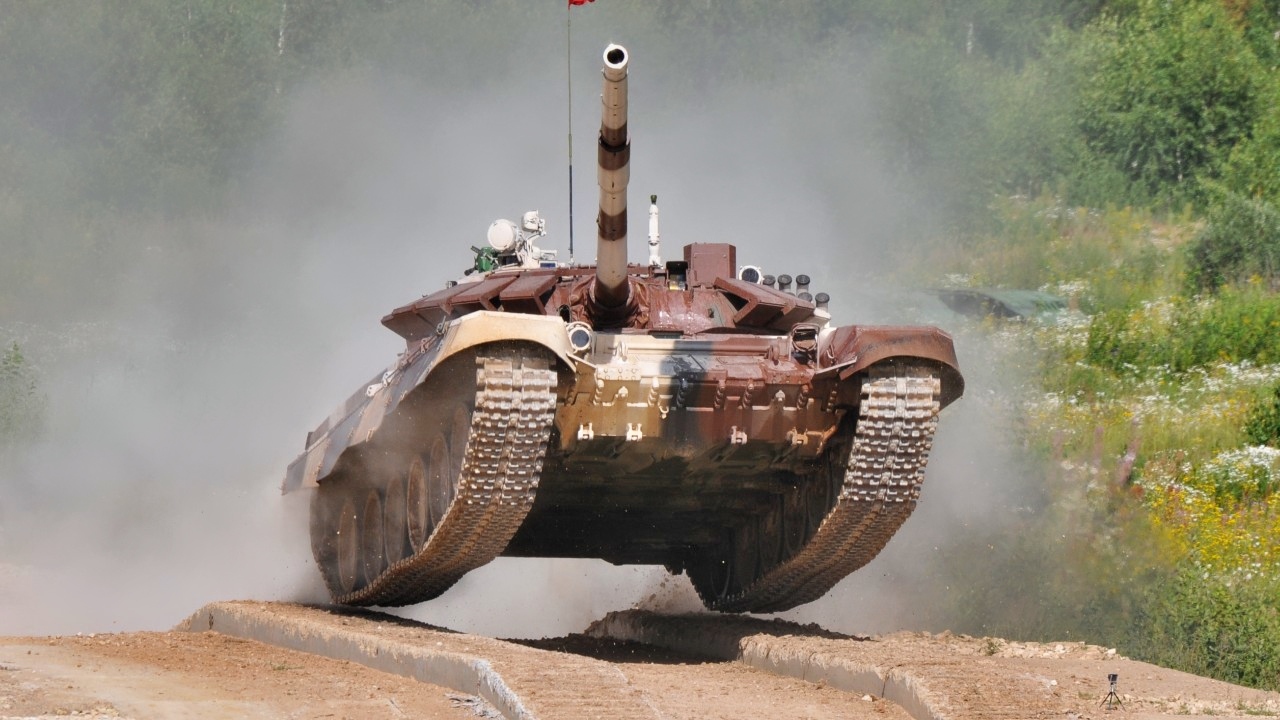
T-72 Tank from Russia. Image Credit: Creative Commons.
Although the tank is still perfectly capable in the right hands, the T-72, and virtually every other tank model, was completely unprepared for Ukraine’s challenges and the new era of drone-centric warfare.
The T-72 in Ukraine
When Russia launched its invasion in 2022, the T-72 made up the bulk of Russia’s tank forcen.
Some estimates suggest the Russian Army had around 1,200 active T-72B3s, while its T-80BVM inventory totaled around 100 and its T-90M inventory sat at a measly 50.
Combined with older models, the Russians had around 2,840 T-72s in active service, not counting the 7,000 to 10,000 in reserve stockpiles.
The most modern variant of the T-72, the T-72B3M (or T-72B3 obr. 2016), is equipped with Sosna-U thermal imagers for the gunner and modern fire-control systems (FCS).
Combined with Kontakt-5 explosive reactive armor, the tank is well equipped for modern warfare. Or so everyone thought.
The T-72 has fared poorly during the war in Ukraine.
According to Oryx, of the 4,441 Russian tanks damaged or destroyed, about 1,784 were T-72s. The T-72’s carousel autoloader is often blamed for its low survivability (the same is said for every Soviet tank after the T-64, for that matter).
While that is certainly true, Russian studies of prior combat experience found that the main cause of devastating ammo explosions was actually extra ammo in the fighting compartment, not necessarily the autoloader.
The Soviet autoloader can hold up to 22 rounds inside the carousel.
However, with extra ammo racks, the T-72 can carry up to 44 rounds, with the extra ammo stored in the fuel cells and special racks around the crew compartment.
When this ammunition detonates, the ammo in the autoloader also goes off, and the tank explodes violently.
The Russians tried to solve this problem in the T-90M by adding a bustle ammo storage compartment.
The Harsh Reality of the Ukraine War
The autoloader is but one piece of the puzzle. Even with a better autoloader, the T-72’s performance in Ukraine likely wouldn’t have changed significantly.
Poor tactics have been a major factor contributing to the overall underwhelming performance of Russia’s tank forces.
At the start of the war, tanks moved in large, easy-to-spot columns, as if rehearsing for a parade. This made them easy pickings for Ukrainian artillery and anti-tank crews.
Russian tanks were also sent on combat missions without support from infantry or artillery units, making them an easy target for the Ukrainians. On the modern battlefield, a lone tank is a dead tank.
It doesn’t matter what type.
Drones have emerged as a major threat to tanks on both sides of the conflict.
A small, cheap drone with a shaped-charge warhead can damage or destroy a multi-million-dollar tank, even more advanced Western designs.
These drones can be deployed in large numbers and can easily swarm enemy armor.
If one drone isn’t enough, multiple other FPVs will usually finish the job. Experienced pilots know a tank’s weak spots and can maneuver their drones to target them specifically.
For the T-72, its weak spots are on the sides and rear, where the armor is thinnest.
As a result, the Russians have experimented with various types of external armor for their tanks.
When implemented correctly, anti-drone cages, colloquially called “cope cages,” can improve a tank’s survivability against drones.
The T-72’s Days Are Numbered
As the war has progressed, Russia has been forced to change its tactics to account for new battlefield realities. As a result, tanks are no longer as prevalent as they were in 2022.
Now, Russia uses its tanks primarily in fire-support roles, operating farther from the front lines and providing indirect fire against enemy positions.
Occasionally, Russia still deploys tanks for direct fire support, but these instances have become increasingly rare and are riskier thanks to the proliferation of drones.
Once the backbone of Russia’s tank fleet, the T-72 is slowly becoming less of a priority for the Russian Ministry of Defense.
As the old Soviet stocks dry up, the Russians have shifted their focus to the T-90M.
According to Janes, Russia’s T-90M fleet has increased from barely 50 in 2022 to around 500 in 2025; that number has doubtless increased in 2026.
The T-90M is simply a better tank than the T-72B3. It has better armor and is currently the only tank in Russia in full-scale production (Russian media reported in 2023 that production on the T-80 will restart, though the current status of these efforts is unclear).
Make no mistake: Russia will run the T-72 to its last mile, but since production has been closed for some time, the Soviet stocks will run out in time.
About the Author: Isaac Seitz
Isaac Seitz, a Defense Columnist, graduated from Patrick Henry College’s Strategic Intelligence and National Security program. He has also studied Russian at Middlebury Language Schools and has worked as an intelligence Analyst in the private sector.


