

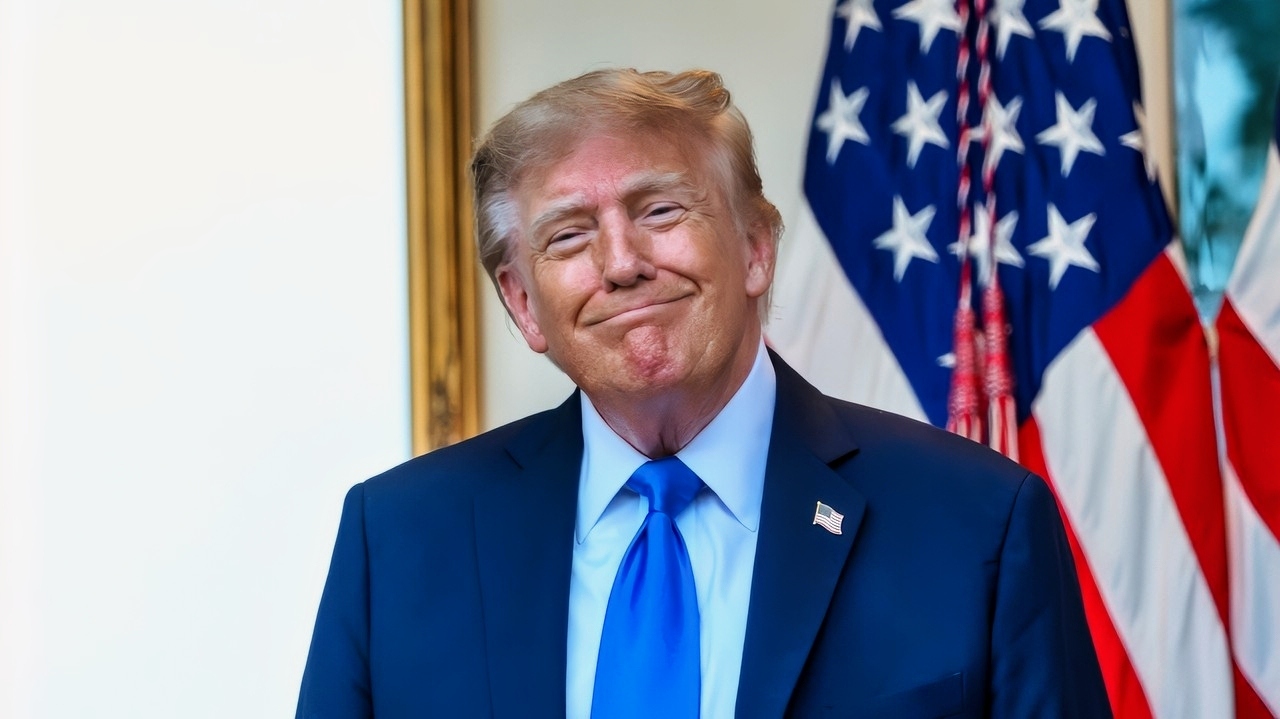
U.S. President Donald Trump said he is considering whether to strike a peace deal with Iran.
“Do I make a deal or do I finish them off?” Trump mused during an interview with Fox News host Larry Kudlow on Sunday.
Iran’s Nuclear Sites Under Close Surveillance

VIRGINIA BEACH, Va. (Sept. 20, 2025) The United States Air Force F-22 Demo Team performs at the 2025 Naval Air Station (NAS) Oceana Air Show aboard NAS Oceana, Sept. 20, 2025. The show’s theme celebrated 250 years of America’s navy and featured performances highlighting the precision, power, and innovation of naval aviation. (U.S. Navy photo by Mass Communication Specialist Seaman Apprentice Oliver McCain Vieira)

F-22 Raptor. Image Credit: Creative Commons.
He also said Iran’s nuclear sites are under close surveillance, stressing: “We know every single thing that is happening at Pickaxe Mountain.” He also noted that three Iranian nuclear sites that the U.S. has previously targeted have been destroyed.
CNN separately reported that U.S. forces are ready to carry out a large-scale operation within 96 hours of a presidential order.
Targets could include military sites, nuclear sites, and energy installations.
However, a senior Pentagon official said: “The Department is a planning organization, and its job is to develop and execute military options ordered by the President.”
No one confirmed that any attacks would be carried out.
No U.S. Attacks Ahead Of Midterms
For now, the White House has ruled out any attacks before the midterm elections next Tuesday, November 3.
“The United States will not be attacking Iran at any time before the midterm elections,” spokesperson Anna Kelly told ABC News.
An Israeli source close to the preparations told ABC that only the “timing” was undecided, but that Trump would have to greenlight any future joint strikes.
Meanwhile, Iran’s Foreign Ministry Spokesman Esmaeil Baghaei accused Washington of attempting to force Iran into a deal.
“The American side is not serious about negotiations,” he told Anadolu Agency on Monday.
Earlier this month, Vice President JD Vance told Reuters that Iran needs to make a “meaningful” reduction in uranium enrichment if it wants a deal.
“If you don’t want a nuclear weapon, then why do you need 60% enriched fuel?” he noted.
However, a senior Iranian official said that the U.S. demands were “contrary” to Iran’s.
Tehran wants the U.S. blockade on Iranian ports lifted and for sanctions on its oil exports to be eased before nuclear talks can take place.
Could U.S. Downscale Gulf Presence
Despite speculation that the war could flare up again, some Gulf officials worry the U.S. could reduce its presence in the region.
Typically, around 40,000 troops are stationed across almost 20 locations in the region.
Bahrain, where the Fifth Fleet is based, suffered extensive damage to the main U.S. naval base to the tune of $400 million or more, according to a report by the Congressional Research Service.
Officials are considering pulling out of damaged facilities or moving people further away from Iran. However, the Washington Post reported in August that there are no current plans for a permanent troop reduction.
Saudi Officials Meet with Tehran
Saudi defense minister Prince Khalid bin Salman, Pakistani army chief Field Marshal Asim Munir and Turkish intelligence chief Ibrahim Kalin met with Iranian officials on Monday.
Saudi Arabia said its goal was to keep lines open to avoid any re-escalation of hostilities, Reuters reported.
“The participants agreed to continue the dialogue to strengthen cooperation amongst the four regional countries,” the joint statement said.
Pakistan has reportedly put forward a middle ground and may have assurances from the three visiting countries, along with Qatar.
However, neither Washington nor Tehran has publicly accepted this.
Iran’s ambassador to Pakistan, Reza Amiri Moghadam, said on Saturday that Tehran was willing to reopen Hormuz if the American naval blockade were lifted.
“We will study the Mecca Agreement, and if it is good, we will support it,” he said, referring to the mutual defense pact among all visiting countries, of which Tehran is not a signatory.
Oil Market Shows Cost of Stalemate
Trump claimed on Sunday that the U.S. had control of Hormuz, but ANZ research quoted by Reuters on Tuesday suggested that only around 60% of pre-war traffic was passing through.
Brent crude was trading at $116.26 a barrel Tuesday morning, compared with $102.16 for U.S. West Texas Intermediate.
“Prices remain elevated amid persistent geopolitical uncertainties,” analyst Sugandha Sachdeva told Reuters.
Israel Would Welcome Iranian Regime Change
Israeli Prime Minister Benjamin Netanyahu has openly welcomed regime change in Tehran. He said in a Channel 14 interview on Sunday, “I instructed the IDF and the Mossad to topple the [Iranian] regime.”
However, reports of disagreements between Netanyahu and Israeli military chief Eyal Zamir have emerged ahead of Israel’s general election on Tuesday.
Israel Katz, Israel’s defense minister, denied claims Israel was planning to launch an attack before the vote, saying reports of disagreements were “completely baseless and false.”
About the Author: Georgia Gilholy
Georgia Gilholy is a journalist based in the United Kingdom who has been published in Newsweek, The Times of Israel, and the Spectator. Gilholy writes about international politics, culture, and education.


