

Iran said it attacked navigation systems on an Omani island that it claims was supporting passage for commercial shipping through the Strait of Hormuz.
Three sources told Reuters that navigation systems on Didamar had been attacked, while Tehran claimed responsibility on Tuesday, November 10.

Littoral Combat Ship Deck National Security Journal Image by Stephen Silver.
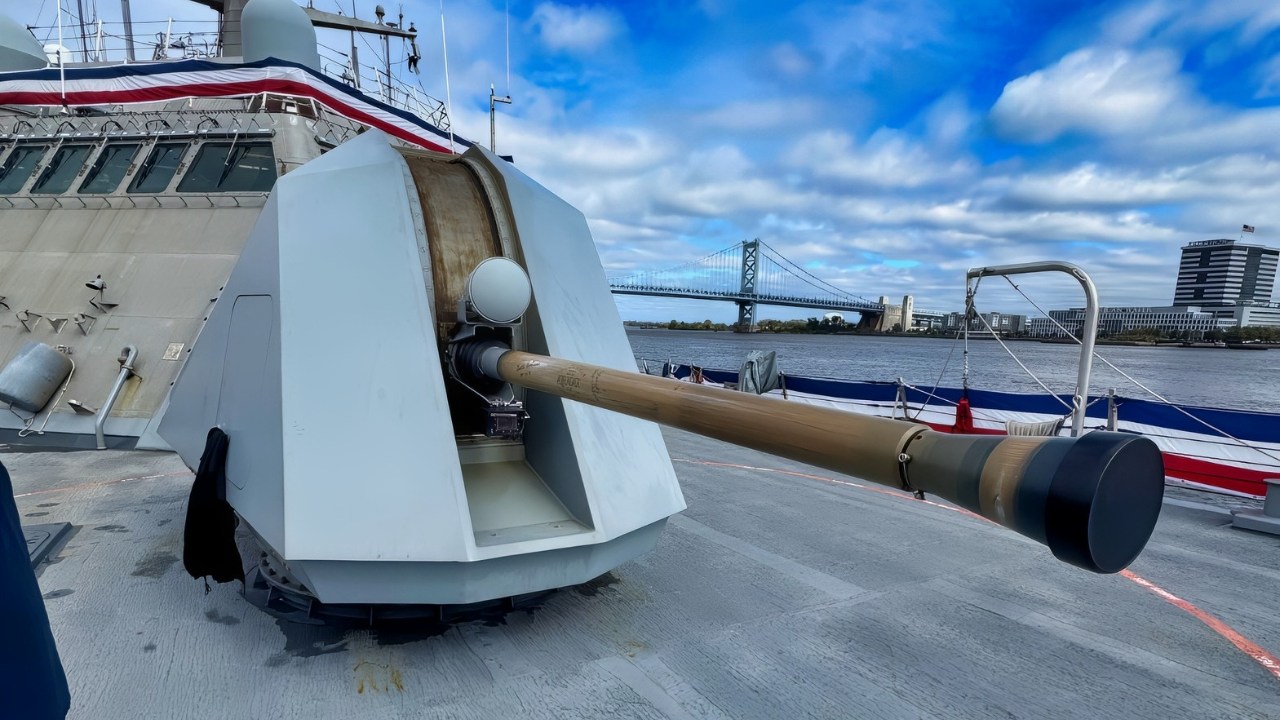
Littoral Combat Ship Deck Gun U.S. Navy. Image Taken by National Security Journal on October 14, 2025.
However, a senior Omani official denied that the systems had been struck, while satellite imagery taken on Tuesday does not suggest any substantial damage.
Iran Targets Equipment It Says Supports Unauthorized Transit
According to Iranian state media, the Islamic Revolutionary Guard Corps Navy (IRGC) said Didamar Island’s equipment was being used to support shipping through the Strait of Hormuz.
The Institute for the Study of War dated the apparent attack to Sunday, November 8, two days before Iranian media claimed responsibility.
Reuters verified a video showing smoke rising from the island, while satellite imagery from the European Union’s Copernicus program showed thermal activity.
It is unlikely to have a substantial impact on shipping through the strait, according to sources speaking to Reuters. Other navigational systems reportedly remain in place elsewhere.
However, a senior Omani official, according to The Maritime Executive, disputed the Iranian claims.
The publication suggested there was no obvious damage to the island’s lighthouse or its radio and radar masts. However, it added that this may be difficult to see through satellite imagery.
An Important Guide for Strait of Hormuz Shipping
Didamar, also known as Little Quoin Island, belongs to Oman and lies roughly 10 nautical miles off the Musandam Peninsula.
Its importance predates the Iran war. According to navigation service provider AMNAS (Arabian Maritime and Navigation Aids Services), Didamar was the site of Oman’s first lighthouse that began operating in 1914.
It was built because the island’s flat summit provided the elevation needed for a light visible to vessels approaching the Gulf.
AMNAS refurbished the lighthouse in 2006, upgrading it to a modern rotating beacon with a range of 23 nautical miles.
Didamar is also home to radar and radio communications equipment as well as the Royal Navy of Oman’s Hormuz Control Center. Any attack would likely be considered a breach of Omani sovereignty.
Strait of Hormuz Strikes Continue After Damaging Month
When the Iran war began at the end of February, Iran immediately closed the Strait of Hormuz to commercial shipping, threatening to strike any vessel that passed through what it claims to be a waterway under its jurisdiction.
The strait remains a key sticking point in negotiations between Washington and Tehran, with the latter refusing to reopen the waterway until its demands are met.
Increasingly, Gulf nations such as Qatar, which lack an alternative route for their exports, have relied on covert transit through the Strait of Hormuz via ship-to-ship cargo transfers.
These have often been conducted under cover of darkness, with trackers turned off, and transiting vessels staying close to the Omani coast, protected by U.S. forces in the area.
With crude oil exports returning to pre-war levels at the end of September, Iran has intensified attacks on shipping since the start of last month, leading to 37 ships being attacked in October — the most in a single calendar month since the war began in February. The previous record was 22, set in March.
Status Quo Means Sporadic Strikes
The U.S. strategy appears to be one of preserving the current state of conflict, where neither major combat operations are ongoing, nor is Washington pursuing a permanent end to the war.
At the G7 foreign ministers meeting in Paris on Tuesday, Secretary of State Marco Rubio reportedly told counterparts that President Donald Trump did not have to choose between restarting a major offensive and accepting an unfavorable agreement.
“The president doesn’t just have two options,” Rubio reportedly explained. “It’s not just return to war or sign a ridiculous peace deal. We won’t do a stupid deal. The third option we have is to continue to do what we do now.”
The status quo means sporadic strikes could continue, including from U.S. forces in the region. The day before the midterm elections, U.S. forces struck targets on Qeshm Island, with officials describing the operation as “defensive.”
Pressed by a reporter about the strikes several days later, President Trump said: “I don’t want to talk about it. We do minor strikes. They built a little bit of an anti-aircraft device, and we knocked it out in about 15 minutes, maybe five.”
About the Author: Shay Bottomley
Shay Bottomley is a British journalist. He has written for the Western Standard, Business Insider, Maidenhead Advertiser, Slough Express, Windsor Express, Berkshire Live and Southend Echo.