

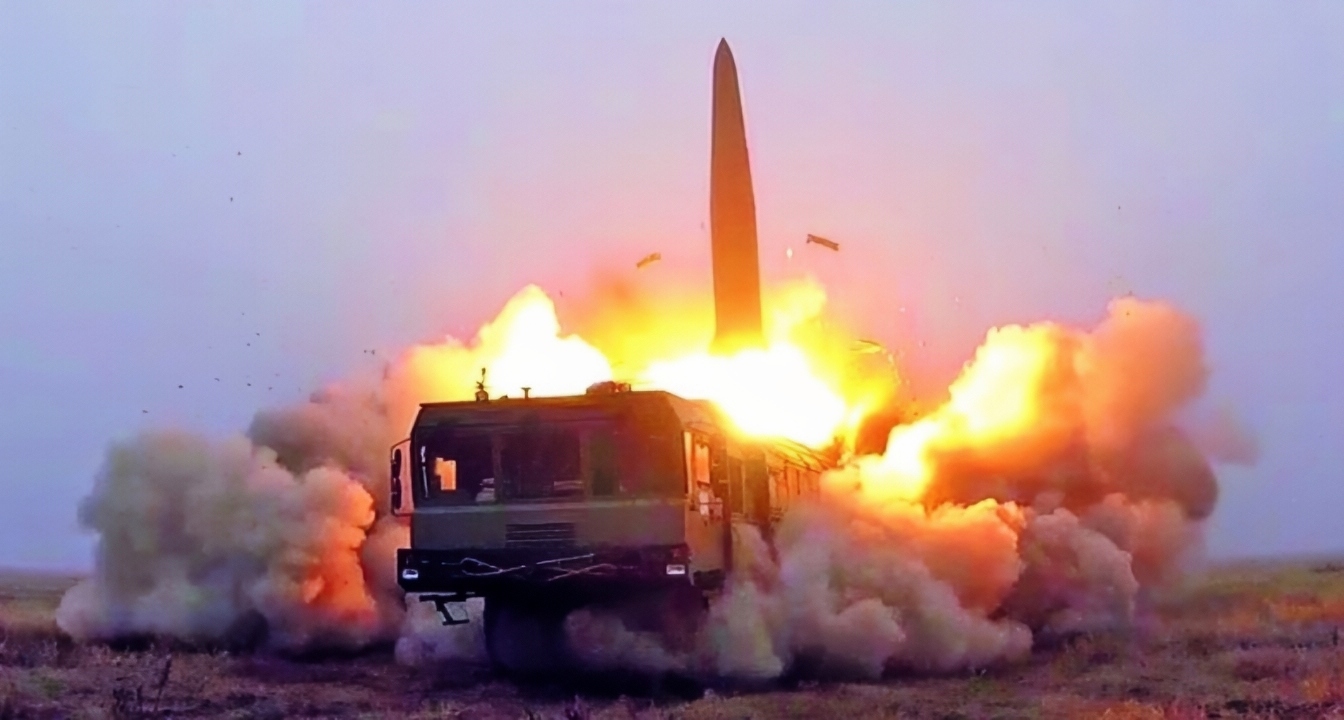
Moscow can build one ballistic missile every five hours, according to Ukrainian Defense Minister Yevhenii Khmara, and that pace of production is accelerating.
Speaking during a NATO Parliamentary Assembly meeting, Khmara explained that in October alone, Russia fired a whopping 153 ballistic missiles at targets throughout Ukraine.

Sukhoi Su-34 Fullback. Image Credit: Creative Commons.

Russian Su-34 fighter-bomber. Image Credit: Creative Commons.
In tandem, Russia is increasing its use of jet-powered, explosive-laden attack drones too.
“At the beginning of the year, Russia was launching fewer than 300 jet-powered drones per month. In October, that figure had already exceeded 4,000.
The intensity of ballistic and cruise missile strikes is also increasing.
In October, the terrorist state launched 153 ballistic missiles at Ukraine,” Khmara explained.
Civilian Targets
Earlier this summer, Ukraine enjoyed a great degree of success in targeting the single largest source of funding for the Kremlin’s coffers: the taxation of fossil fuels shipped abroad.
Oil refineries throughout Russia — some thousands of kilometers from the war’s front lines — have quite literally gone up in smoke, the targets of repeated drone and missile attacks.
This has knocked a significant amount of Russian oil refining capacity offline and forced Russia to defend targets within its heartland.
Stymied from advancing on the battlefield, Russia has pivoted from targeting Ukrainian forces on the battlefield’s front lines to targets on the home front.
Water treatment facilities, power substations, and energy infrastructure have found themselves within the Kremlin’s crosshairs.
It is part of Russia’s campaign to plunge Ukraine’s civilian population into the cold and dark during the winter months when temperatures plunge below freezing, and seemingly an attempt to exact a political toll on the Ukrainian population.
Staggering Death Toll
That Russian losses in Ukraine are high is no secret; Ukraine widely showcases the success its forces have enjoyed in pushing back hard against the Russian invasion.
What has been more difficult to parse, however, is just how steep Russia’s losses in Ukraine have been.
Thanks to a recent data breach, a substantial amount of light has been shed on Russia’s losses.
A pair of hacking groups, Silent Crow and Cyber Partisans, Ukrainian and Belarusian outfits respectively, recently breached Rosstat, the Russian federal statistical service.
Among the terabytes of data the two groups were able to secure was information related to Russian deaths, including place and date of death.
Using that data, the groups were able to determine which of those deaths were caused by the war in Ukraine.
Using that data, several independent media groups were able to determine that by the end of September, Russian deaths in Ukraine amounted to about 490,000.
But that figure does not account for soldiers listed as missing in action, a categorization that almost certainly will eventually be counted as killed.
When factoring in those missing, as well as a delay in tallying deaths, the estimated number of Russian soldiers killed in action jumps precipitously to more than 720,000.
It is a shocking statistic, and one that represents more soldiers killed in all the wars fought by the Kremlin since the end of the Second World War combined.
Speaking to The New York Times, Michael Kofman, a senior fellow at the Carnegie Endowment for International Peace, explained that even though Russia is losing more soldiers on the battlefield than it can recruit, an estimated nearly 410,000 soldiers will join the ranks this year.
Though perhaps not enough to decisively turn the tide in Russia’s favor, it is certainly enough for the Kremlin to continue the fight, even if it is indecisive.
The scope of Kyiv’s battlefield losses is more difficult to ascertain with certainty.
While it is generally accepted that Ukrainian losses in the war are substantially less than those of Russia, their losses are not insubstantial.
Information about Ukrainian battlefield deaths is naturally not public, but estimates of Kyiv’s losses generally range from 150,000 to 200,000.
Inching Forward
Despite the relative lack of progress by Russian forces on the battlefield, they continue to press forward in the east slowly.
Kramatorsk, one of Ukraine’s fortress cities in the eastern Donbas region, is now under evacuation orders, with families and children instructed to head west out of Russian range.
About the Author: Caleb Larson
Caleb Larson is an American multiformat journalist based in Berlin, Germany. His work covers the intersection of conflict and society, focusing on American foreign policy and European security. He has reported from Germany, Russia, and the United States. Most recently, he covered the war in Ukraine, reporting extensively on shifting battle lines in Donbas and writing about the war’s civilian and humanitarian toll. Previously, he worked as a Defense Reporter for POLITICO Europe. You can follow his latest work on X.


