


According to recent reports, the U.S. is repositioning air assets closer to the Middle East as the conflict continues to escalate.
The U.S. has been moving heavy strike aircraft like the B-1B Lancer and aerial refuelers like the KC-130 Stratotanker in preparation for a new and more intense period of the conflict.

U.S. Air Force Capt. Samuel “RaZZ” Larson, F-22 Raptor Demonstration Team commander, performs an aerial maneuver in preparation for the ongoing airshow season at Joint Base Langley-Eustis, Virginia, July 9, 2024. Airshows play a crucial role in highlighting the importance of air power in modern warfare and help reinforce the deterrence capabilities of advanced fighter aircraft like the F-22 Raptor. (U.S. Air Force photo by Senior Airman Mikaela Smith)
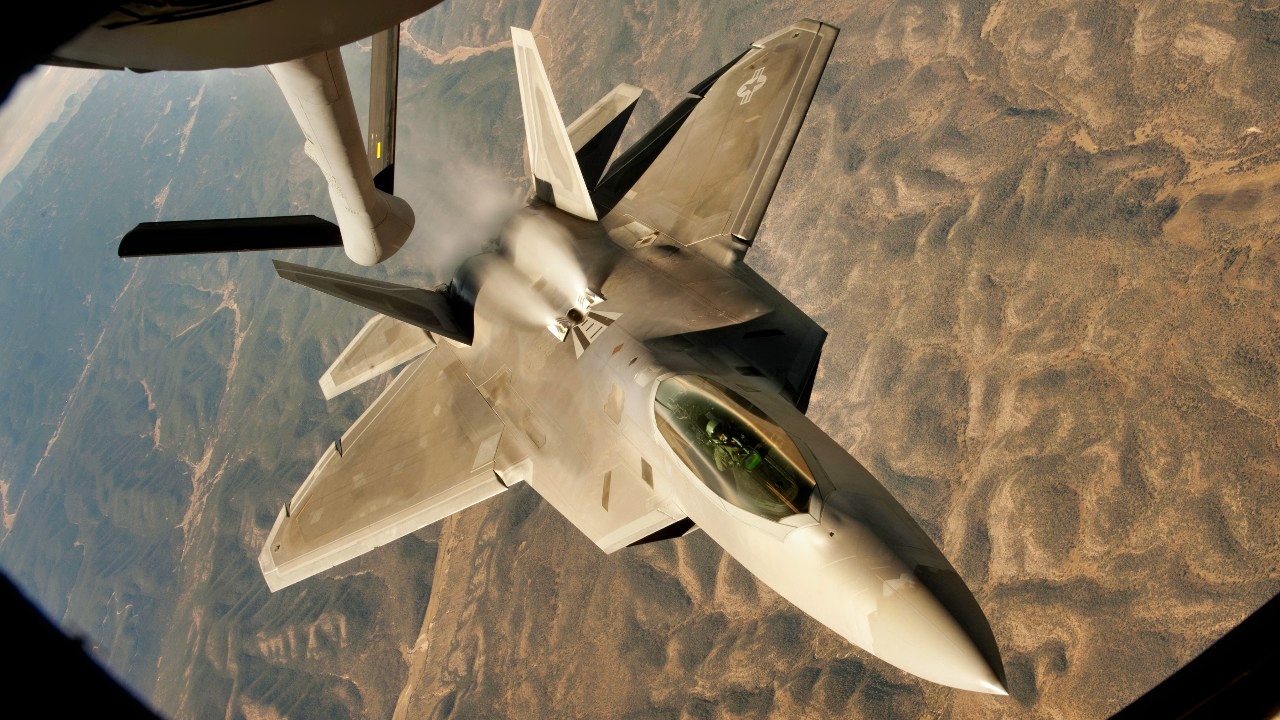
A U.S. Air Force F-22 Raptor backs away from a KC-135 Stratotanker after conducting an in-flight refueling during a training mission over central New Mexico on Oct. 23, 2013. The Raptor is assigned to the 49th Fighter Wing at Holloman Air Force Base, N.M. The Stratotanker is assigned to McConnell Air Force Base, Kan. DoD photo by Airman 1st Class John Linzmeier, U.S. Air Force. (Released)
While the Pentagon has not confirmed that the U.S. intends to escalate, the military is repositioning its assets closer to the region to give President Trump more options for the conflict against Iran should escalation be his preferred plan of action.
Military experts and analysts, on the other hand, worry that the U.S. may be stretched too thin to wage an all-out war against Iran.
B-1Bs Attacking Iran Again
On Tuesday, it was reported that B-1B bombers engaged in combat operations against Iran for the first time since the end of the ceasefire.
The bombers were spotted flying out from their base in the UK and were tracked along their flight path. CENTCOM made no mention of the bombers in its typical statements about overnight attacks against Iran.
The B-1’s likely utilized JASSM stand-off cruise missiles during their attacks.
While Tehran’s air defenses have been significantly degraded over the past six months, it is likely still too risky to drop glide bombs or unguided munitions over Iranian airspace.
The U.S. has also been moving more KC-130 aerial refuelers near the region, likely in preparation for an expanded air campaign. Refueling aircraft, while not as interesting to talk about as the B-1B, are critical to U.S. operations.
This point was raised by national security analyst Aaron MacLean in an interview with CBS. “When you’re running these sustained campaigns over Iranian airspace, you need this architecture of aerial refueling in place,” he said. “And the news that we’re seeing more refuelers in the region is an indication that you can scale up the scope of the campaign night to night and day to day.”
Escalating the War in Iran
President Trump has said recently that he has considered escalating the war in Iran as the war approaches its fifth consecutive month. “I am considering a massive attack.
Bigger than ever before. I am close to making a decision.” The U.S. has been pounding Iran for two weeks in a row now, with Tehran refusing to budge.
Both sides continue to battle over control of the Strait of Hormuz, with both sides claiming control over the valuable waterway.
The situation continues to escalate, as one crisis leads to another, preventing any chance of diplomacy. “The situation is getting out of control,” said UN Secretary-General António Guterres. “The region is being pulled into an ever-widening circle of confrontation. One crisis feeds another.
One escalation triggers the next.”
To make matters worse, the Iranian-allied Houthis in Yemen are opening up a second front in the Red Sea.
Earlier this week, the militant group announced a blockade in the Bab al-Mandeb Strait, threatening to exacerbate the current energy crisis caused by the closure of Hormuz.
The Houthis also announced that they carried out attacks against two fuel tankers in the Red Sea as they made their way towards the Strait.
President Trump threatened to respond militarily to Iran and the Houthis if they continued to harass commercial shipping in the Red Sea. “The U.S. will hold Iran responsible, in that the Houthis are a Surrogate and/or Proxy of Iran, and major military punishment will be inflicted upon Iran and, of course, the Houthis themselves,” the President wrote on Social media.
Can the U.S. Afford a Wider War?
As the U.S. totters on the verge of all-out war with Iran, some officials are concerned that the U.S. may be in over its head as the military experiences a shortage of long-range weaponry.
Prior to the termination of the ceasefire, the U.S. had used a considerable amount of resources against Iran.
According to some estimates, the U.S. launched 1,000+ Tomahawk missiles, 1,000+ JASSM missiles, 1,000+ Patriot interceptors, and more than 200 THAAD interceptors.
In all cases, deliveries in 2026 have accounted for no more than 20% of the munitions used so far, if not less. “We do not have enough to safely sustain operations, and I don’t think the White House is aware of that,” an anonymous official told The Washington Post.
Unfortunately, the U.S. is running out of options to avoid escalating.
The diplomatic front has stalled, and talks with Iran appear to be going around in circles without addressing the underlying causes of the conflict.
Meanwhile, with the second front opening in the Red Sea, the U.S. lacks the forces in the region necessary to handle the blockades in Hormuz and the Red Sea simultaneously.
A ‘Mini’ Vietnam War in the Making?
What was supposed to be a relatively quick combat operation is now turning into a protracted war, precisely what Trump had hoped to avoid in the first place. One can only hope that the war is resolved by the end of the year before it escalates even further.
About the Author: Isaac Seitz
Isaac Seitz, a Defense Columnist, graduated from Patrick Henry College’s Strategic Intelligence and National Security program. He has also studied Russian at Middlebury Language Schools and has worked as an intelligence Analyst in the private sector.


