

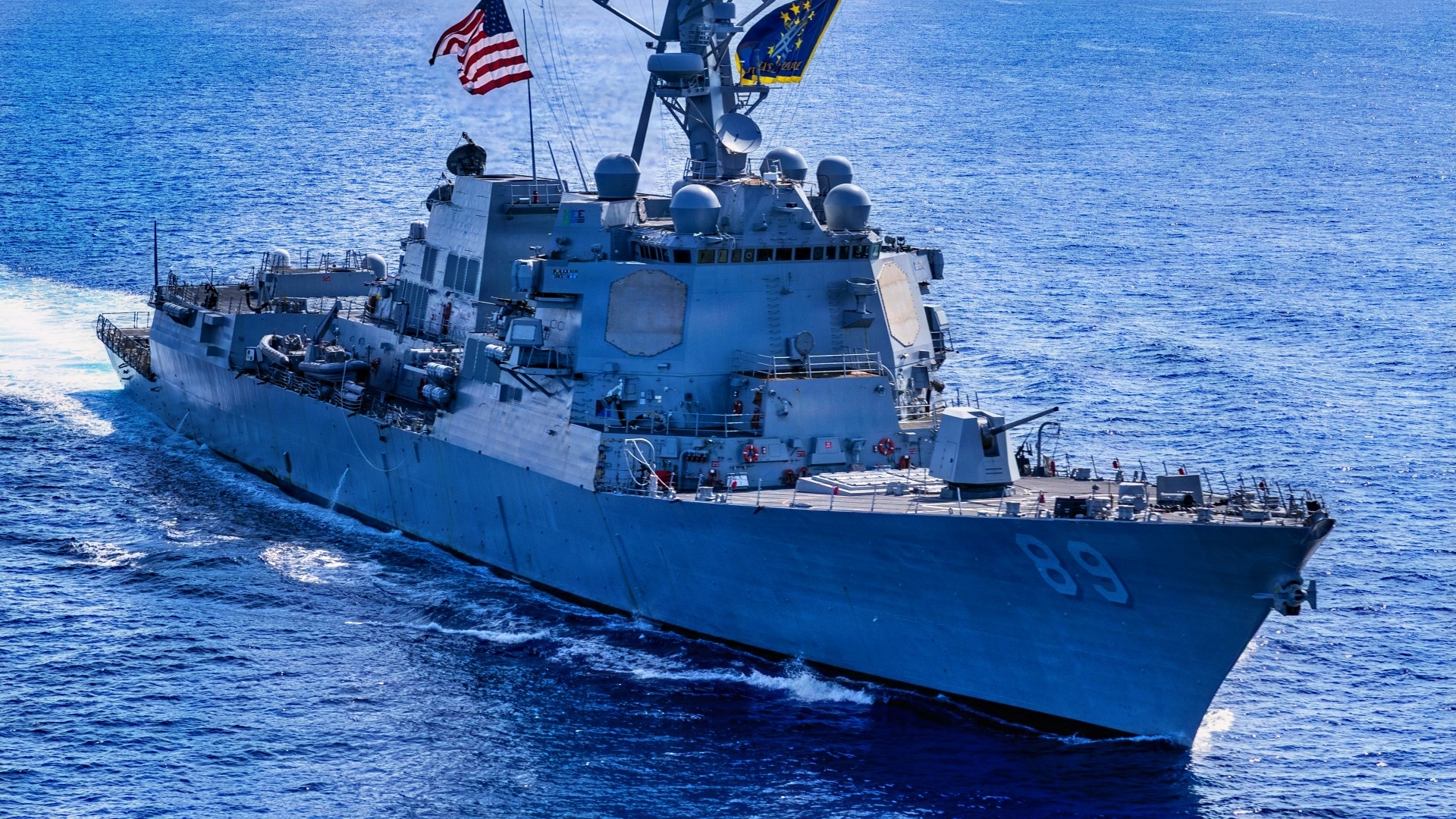
The naval blockade of Iranian ports currently in force is the second one.
The first ran from mid-April to 18 June, was suspended as part of the memorandum of understanding signed days earlier, and was reinstated on 14 July after Iranian attacks on shipping collapsed the agreement’s confidence-building measures. CENTCOM disabled a tanker with Hellfire missiles a day into the new blockade.
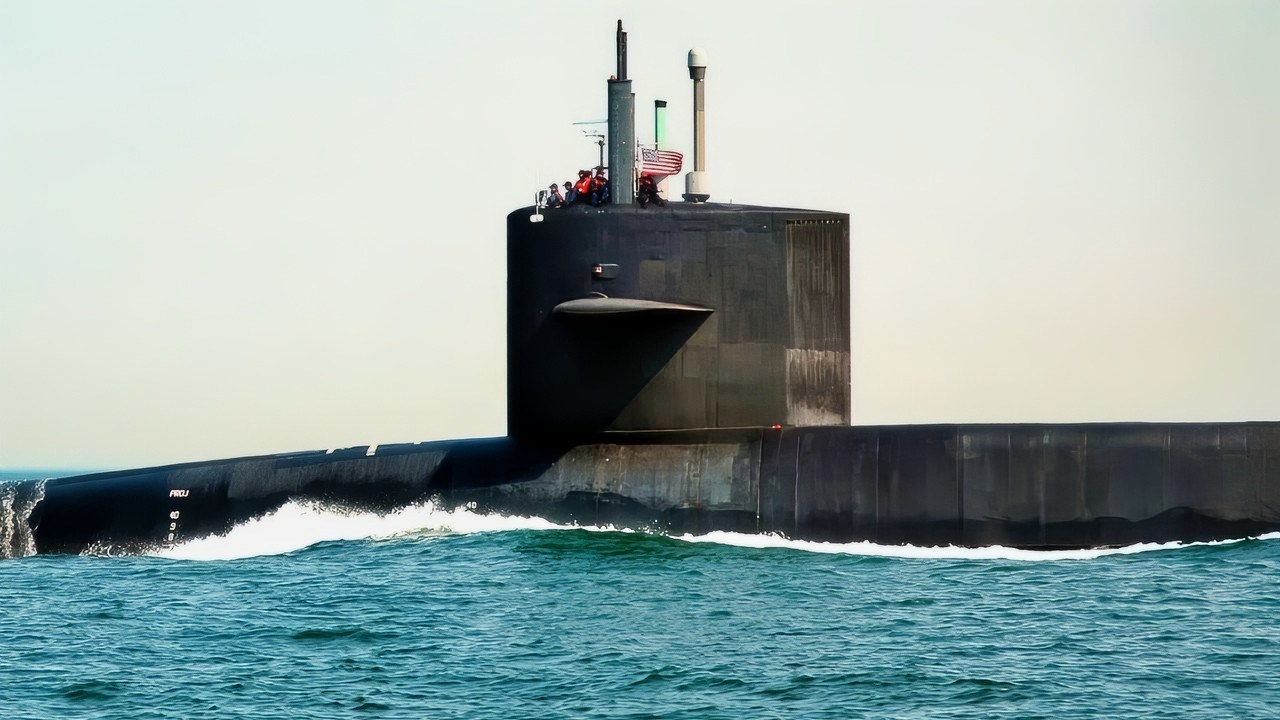
(March 31, 2006) – The guided missile submarine USS Florida (SSGN 728) conducts sea trials off the coast of Virginia. Florida will be delivered to the Fleet in April, and a Return To Service ceremony is scheduled for May 25 in Mayport, Fla. As the second of four SSBN submarines to be converted to SSGN, this nuclear-powered submarine will have the capability to: launch up to 154 Tomahawk cruise missiles; conduct sustained special warfare operations with up to 102 Special Operations Forces (SOF) personnel for short durations or 66 SOF personnel for sustained operations; and provide approximately 70 percent operational availability forward deployed in support of combatant mission requirements. U.S. Navy photo by Chief Journalist (SW/AW) Dave Fliesen.
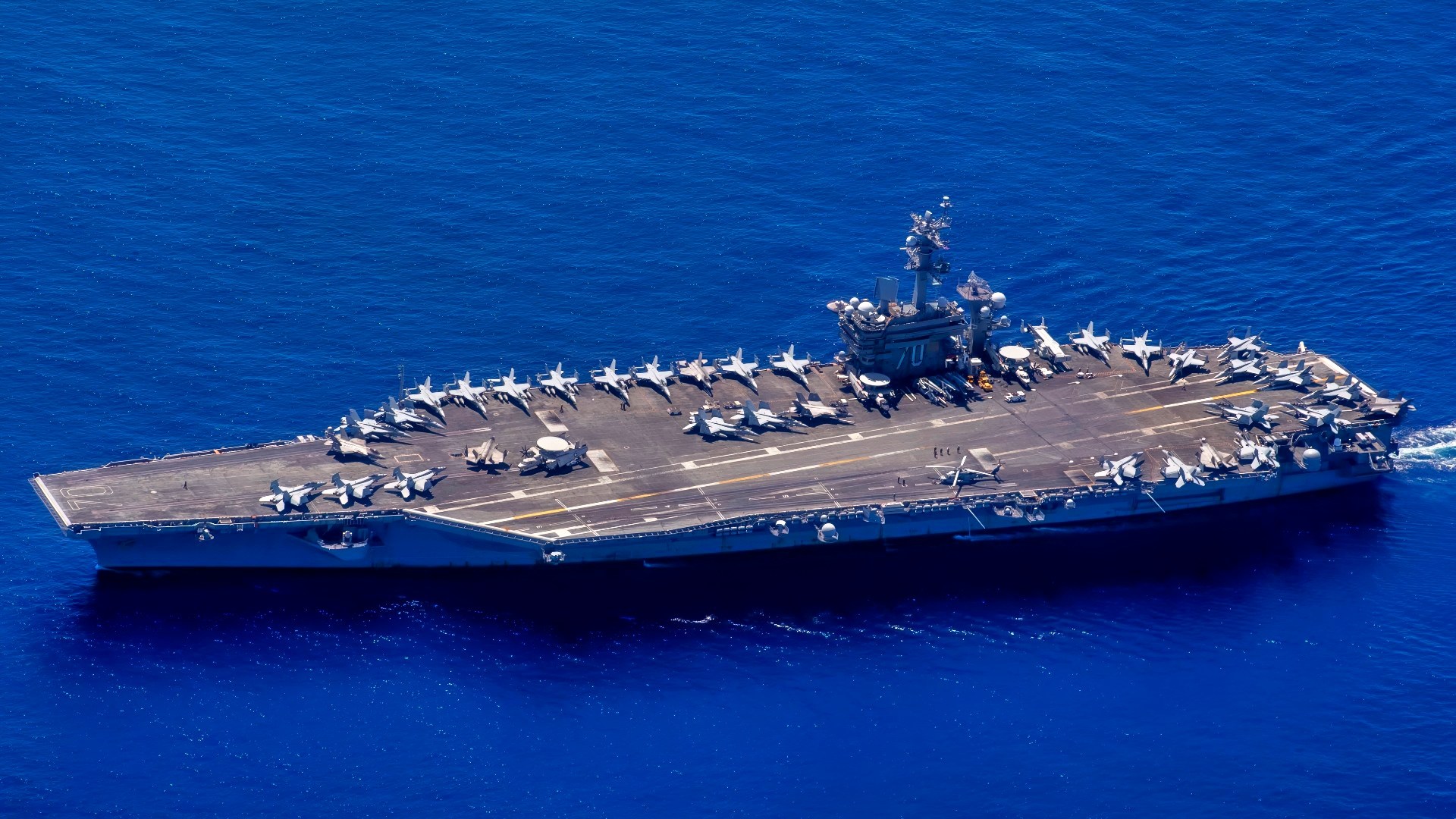
(Dec. 17, 2021) Nimitz-class aircraft carrier USS Carl Vinson (CVN 70) transits the Indian Ocean during a bilateral training exercise with the Royal Australian Air Force, Dec. 17, 2021. Carl Vinson Carrier Strike Group and elements of the Royal Australian Navy and Air Force are conducting a bilateral training exercise to test and refine warfighting capabilities in support of a free and open Indo-Pacific. (U.S. Navy photo by Mass Communication Specialist 1st Class Tyler R. Fraser)
Ten days later, the President told Axios he is close to ordering a strike bigger than anything in this war, including Operation Epic Fury in February.
The Iranians, he said, want to negotiate but “haven’t received enough pain yet.” Two officials told Axios no order has been given.
The interesting question is not whether these positions contradict each other.
They don’t, quite. Economic strangulation and air campaigns work together often enough, and a strike can be designed to reinforce a blockade rather than replace it.
What nobody in this administration has explained is how the two are supposed to combine: which instrument generates the leverage, what concession would satisfy it, and what political result would cause the escalation to stop.
That gap is the actual problem this week, and firepower does not fill it.
What the Traffic Data Show
The blockade is doing measurable work. Lloyd’s List Intelligence recorded transits by ships with no Iranian connection falling to 25 in the week of 13 to 19 July, down from 108 the week before.
Inbound traffic dropped to eight vessels from forty-three. Total movement through the strait is running roughly ninety percent below last year.
Iran-linked tanker traffic tells a different story.
Those transits came in at 21 for the same week against 31 the week prior — a decline, but nothing like the collapse among everyone else.
The vessels Washington most wants to stop are proving the most persistent, partly because Tehran built its own permission regime at Hormuz over the spring, with coordination requirements and IRGC-approved routing that the Persian Gulf Strait Authority now administers.
A shadow fleet operating inside a system Iran controls does not need the American-promoted Omani corridor, and a high volume of dark transits means we cannot fully see what is moving anyway.
So the blockade is imposing costs.
It is imposing them most heavily on the traffic that was already inclined to stay away.
Whether it is producing leverage over Iranian decisions is a separate question, and the numbers do not answer it. Economic pressure converts into political outcomes only through a mechanism somebody specified in advance.
Germany absorbed extraordinary costs from the Combined Bomber Offensive without negotiating; the Reich was defeated by armies.
What the Escalation Actually Tells Us
Resist the temptation to read Trump’s language as a slip. Presidents talk this way, and this one has been threatening Iran with unprecedented force since January.
Treating “enough pain” as an accidental confession makes for a satisfying column and a weak argument.
The behavior carries more weight.
An administration confident in its original timetable does not normally need to replace patience with public urgency ten days into a campaign.
It lets costs compound and waits. What is visible instead is preparation: refueling aircraft moving to Israel, B-1 bombers leaving British bases, medical personnel flowing into Germany.
The blockade may well be imposing everything CENTCOM says it is; what the threatened strike suggests is that Washington no longer believes those costs will deliver the required political result on the schedule available.
A larger strike would intensify pressure.
It would also change the mechanism through which that pressure is supposed to work.
Once economic strangulation becomes inseparable from the threat of escalating air attack, it stops being clear which instrument is generating leverage or what would satisfy it.
Iran Changed the Battlefield
The blockade concentrated American pressure at Hormuz. Iran answered by widening the contest through the Houthis at Bab al-Mandeb, forcing Washington and its partners to defend a second route on different terms.
Two Saudi tankers have been struck, and the Houthis have declared a blockade against Saudi shipping, with Brent climbing above $100 for the first time since May.
The cost exchange runs against us. A proxy drone attack on a tanker is cheap for Tehran.
The American answer — thirteen consecutive nights of strikes, carrier presence, bombers repositioning across two theaters — is not.
Coercive wars do often end when one side’s willingness to continue gives out. The question is whose tolerance and whose political calendar break first, and on that the arithmetic here is not obviously in our favor.
The Question Tehran Is Actually Asking
Iranian planners are not wondering whether America will strike. That was settled twelve nights ago, and the thirteenth answered it again.
What they are working out is which concession would arrest the escalation. Tehran has been clear enough about its own price: it rejected an Iraqi-brokered ceasefire proposal this week on the grounds that it would leave control of Hormuz unresolved.
What Iran cannot determine is whether any limited concession would be accepted in return, or whether the American objective has moved from behavioral change to strategic capitulation to something closer to regime defeat.
That uncertainty is more dangerous than confusion about American resolve, because an adversary who cannot identify the price of stopping has little reason to pay any part of it.
Tehran walked away from Islamabad, signed in June, and abandoned the memorandum within a month. Each cycle has left both sides less certain what a deal is worth.
Two Clocks
The House voted 214 to 208 on Thursday to direct the President to halt operations against Iran, four Republicans crossing over.
The Senate rejected a parallel measure, and the resolution goes nowhere in its present form. It still marks something: the domestic clock is running faster than the coercive one.
The administration may be escalating not because the blockade has imposed too little cost, but because it has imposed cost too slowly for Washington’s political calendar.
A third clock started this week. Pakistan is exploring a resumption of talks after a push from Beijing, and a Pakistani official says a halt to attacks on Saudi Arabia and the Gulf states is now a precondition for anything to restart.
The diplomatic track, in other words, runs through the Red Sea front the blockade was never built to reach.
That is the misreading I expect over the coming week. A larger strike will be reported as escalation dominance, proof that Washington still sets the terms.
Read it instead alongside the sequence that produced it: blockade, suspension, collapse, blockade again, and now the largest strike of the war.
After the bombs fall, the question will not be how much damage Iran absorbed. Tehran has absorbed a great deal and shows no sign of surrender.
It will be how that damage brings a settlement closer.
If Washington still cannot answer, this was never a theory of victory.
It was a sequence of instruments, each reached for when the last failed to deliver.
About the Author: Dr. Andrew Latham
Andrew Latham is a professor of international relations and political theory at Macalester College in Saint Paul, MN. You can follow him on X: @aakatham.


