


Summary and Key Points: In April 2024, the U.S. Air Force executed its most powerful “elephant walk” in history at Whiteman Air Force Base, Missouri, launching 12 B-2 Spirit stealth bombers simultaneously.
-Representing over 50% of the active fleet, this mass fly-off was a high-stakes signal of deterrence to Russia and China.
-As the world’s most advanced flying wing, the B-2 combines intercontinental range with a 40,000-pound payload of conventional or nuclear munitions.
-This display of “Spirit Vigilance” confirms that even as the B-21 Raider emerges, the B-2 remains America’s ultimate tool for penetrating the most sophisticated global air defenses.
-Bonus: Back in July of last year, National Security Journal did a walkaround tour of a B-2 stealth bomber at the National Museum of the Air Force. We present a video of the tour above and a collection of photos of the bomber at the end of the article.
Why the U.S. Air Force Just Launched Half Its B-2 Spirit Fleet at Once in Missouri
The elephant walk is often used to display national power and prestige. While the practice had its actual uses during the Cold War, today it is primarily a posturing gesture to showcase American strength.
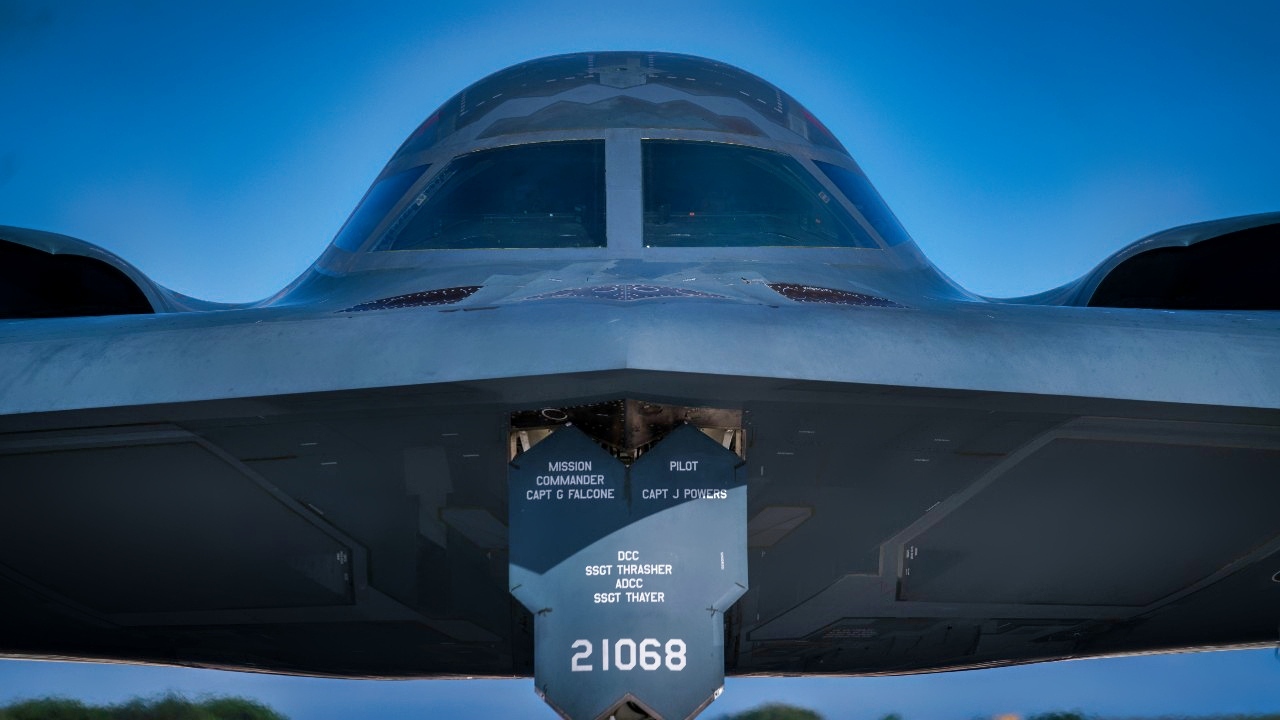
In April 2024, the most powerful elephant walk took place, involving 12 B-2 Spirit bombers that took off from Whiteman Air Force Base in Missouri.
The gesture was meant as a display of strength, signaling the U.S. Air Force’s power to its adversaries.
This display occurred at a time when both Russia and China were (and still are) posing a direct threat to the U.S. and its allies.
A B-2 Spirit, assigned to the 509th Bomb Wing, Whiteman Air Force Base, taxis on the flightline Jan. 8, 2018, at Andersen Air Force Base, Guam. Approximately 200 Airmen and three B-2 Spirits from Whiteman Air Force Base (AFB), Missouri, deployed to Andersen AFB in support of U.S. Pacific Command’s (PACOM) Bomber Assurance and Deterrence mission. U.S. Strategic Command bombers regularly rotate through the Indo-Pacific region to conduct U.S. PACOM-led air operations, providing leaders with deterrent options to maintain regional stability. During this short-term deployment, the B-2s will conduct local and regional training sorties and will integrate capabilities with key regional partners, ensuring bomber crews maintain a high state of readiness and crew proficiency (Air Force photo by Staff Sgt. Joshua Smoot) .

A B-2 Spirit bomber deployed from Whiteman Air Force Base, Missouri, is parked on the flightline at Joint Base Pearl Harbor-Hickam, Hawaii, Jan. 10, 2019. Three B-2 bombers and more than 200 Airmen deployed here in support of U.S. Strategic Command’s (USSTRATCOM) bomber task force mission. Bomber aircraft regularly rotate through the Indo-Pacific region to integrate capabilities with key regional partners and maintain a high state of aircrew proficiency. (U.S. Air Force photo by 2nd Lt. Allen Palmer)
The Largest Elephant Walk in U.S. History
The minimum interval takeoff (MITO) exercise began during the Cold War (although the practice dates back to WWII), when bombers had to maintain 24-hour readiness.
In the event of a crisis, the U.S. Strategic Air Command had to get as many bombers in the air as possible.
The exercise tested the readiness of the Air Force’s bomber crews and provided training for sudden crises.
Today, bombers no longer wait on 24-hour alert. MITO exercises, or elephant walks as they are often referred to, are now primarily demonstrations of strength and readiness.
The elephant walk at Whiteman in 2024 consisted of 12 B-2 bombers, which is more than 50 percent of the U.S. inventory of active B-2s. “Visual displays of power can serve as a reminder to potential adversaries of the overwhelming air power that the B-2 can bring to bear,” a spokesman for the 509th Bomb Wing, which operates the Air Force’s combat B-2 fleet, told Air & Space Forces Magazine. The gathering of bombers was part of a larger exercise—the annual Spirit Vigilance readiness exercise—which lasted from April 8 to April 12. A similar display took place in 2022, during which eight B-2s took to the runway as part of the exercise.
Sending a Strong Message
The B-2 Spirit is an especially poignant aircraft to use for such a display of power.
The B-2 is currently the most advanced aircraft in the USAF’s inventory and is easily the deadliest, discounting the B-21. “Exercises are both critical to our readiness and a powerful tool to demonstrate to the world that the B-2 is a credible and reliable strategic deterrent,” Col. Keith Butler, 509th Bomb Wing commander, said in an official press release.
It is no mistake that President Trump ordered a flyover by a B-2 when hosting Russian President Putin for diplomatic talks in Alaska (although, based on how those talks ended, the message apparently was not received).
The B-2 Spirit is one of the most recognizable bombers ever built. It has a distinctive flying wing configuration, which eliminates the traditional fuselage and tail. This shape, combined with radar-absorbent materials and coatings, drastically reduces its radar cross-section, making it extremely difficult to detect by enemy radar systems. Beyond radar stealth, the aircraft also incorporates infrared signature reduction, acoustic dampening, and visual camouflage techniques, ensuring low observability across multiple detection spectrums.
The Most Advanced Bomber in the U.S. Air Force
In terms of physical dimensions, the B-2 Spirit has a wingspan of approximately 172 feet and a length of about 69 feet, standing 17 feet tall. It has a maximum takeoff weight of roughly 336,500 pounds.
The bomber is powered by four General Electric F118-GE-100 turbofan engines, each producing around 17,300 pounds of thrust. These engines are buried deep within the wing structure to minimize heat emissions and radar reflections. The aircraft operates at subsonic speeds, with a maximum speed close to Mach 0.95, and can reach altitudes of up to 50,000 feet.
One of the requirements when designing the B-2 was intercontinental capability. The aircraft had to be able to strike any target around the world from its home base in the continental U.S. It has an unrefueled range of about 6,000 nautical miles, which can be extended to over 10,000 nautical miles through aerial refueling.
This capability allows the bomber to strike targets anywhere in the world from bases in the continental United States, making it a critical asset for long-range strategic missions.
Why America’s Enemies Don’t Want to Mess With the B-2
The B-2 Spirit can carry up to 40,000 pounds of ordnance within its internal bomb bays. Its payload options include conventional bombs such as JDAMs and Mk 82/84 series, precision-guided munitions like the GBU-28 bunker buster, and nuclear weapons, including the B61 and B83 gravity bombs.
This versatility enables the aircraft to perform a wide range of missions, from precision strikes against hardened targets to strategic nuclear deterrence.
Inside the cockpit, the B-2 features advanced fly-by-wire controls, a sophisticated navigation system, and low-probability-of-intercept radar.
Secure communication systems and mission-planning tools enable it to operate effectively in contested environments.
Despite its size and complexity, the aircraft is crewed by only two pilots, thanks to extensive automation and integrated avionics.
B-2 Bomber Exterior Tour by National Security Journal

Really Up Close B-2A Spirit Bomber. Image Credit: Harry J. Kazianis/National Security Journal.

B-2 Bomber at USAF Museum National Security Journal Image. All Rights Reserved.

B-2 Bomber from U.S. Air Force Display. Image Credit: Harry J. Kazianis/National Security Journal.

B-2 Stealth Bomber at USAF Museum July 19 2025. Image Credit: Harry J. Kazianis/National Security Journal.
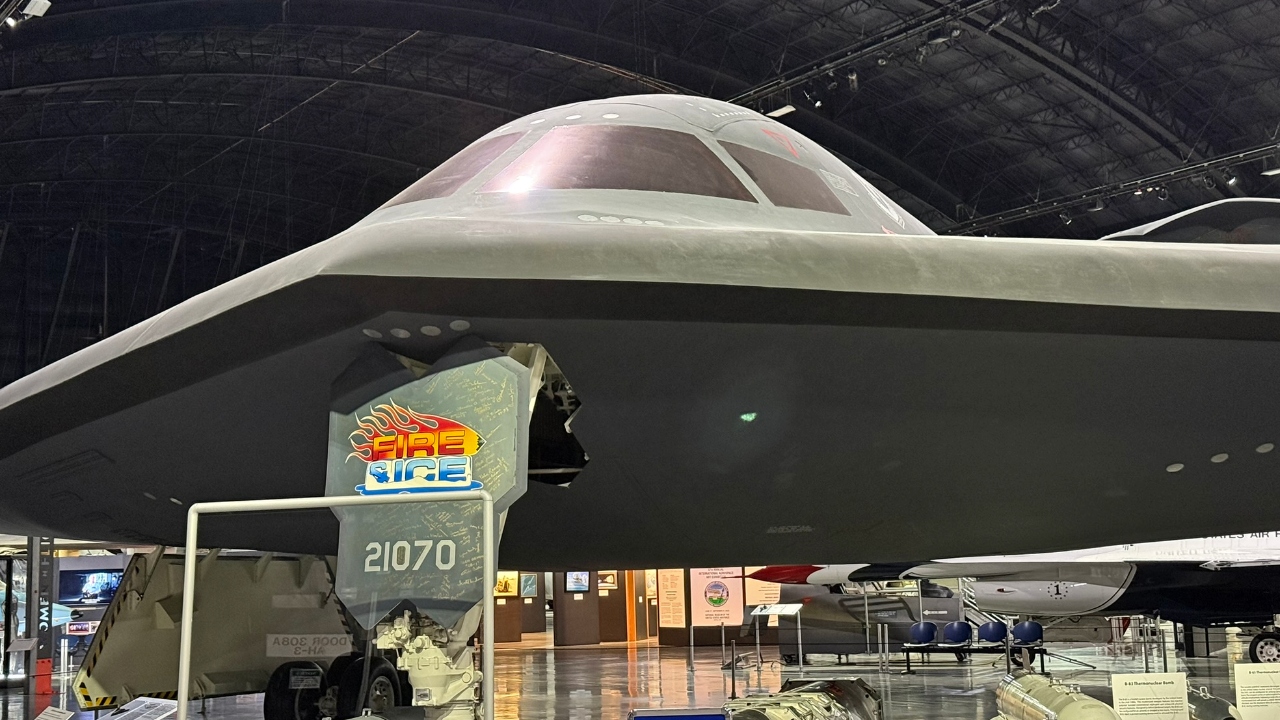
B-2 Bomber @ U.S. Air Force Museum. Image Credit: National Security Journal.
About the Author: Isaac Seitz
Isaac Seitz, a Defense Columnist, graduated from Patrick Henry College’s Strategic Intelligence and National Security program. He has also studied Russian at Middlebury Language Schools and has worked as an intelligence Analyst in the private sector.


