

PUBLISHED on August 14, 2025, 9:34 PM EDT – Key Points: The legendary F-14 Tomcat was a purpose-built fleet defense interceptor, but its early service life was plagued by its notoriously unreliable Pratt & Whitney TF30 engines.
-Originally designed for a bomber, the TF30s were ill-suited for the rigors of dogfighting, leading to frequent compressor stalls, engine failures, and the loss of at least 40 Tomcats.
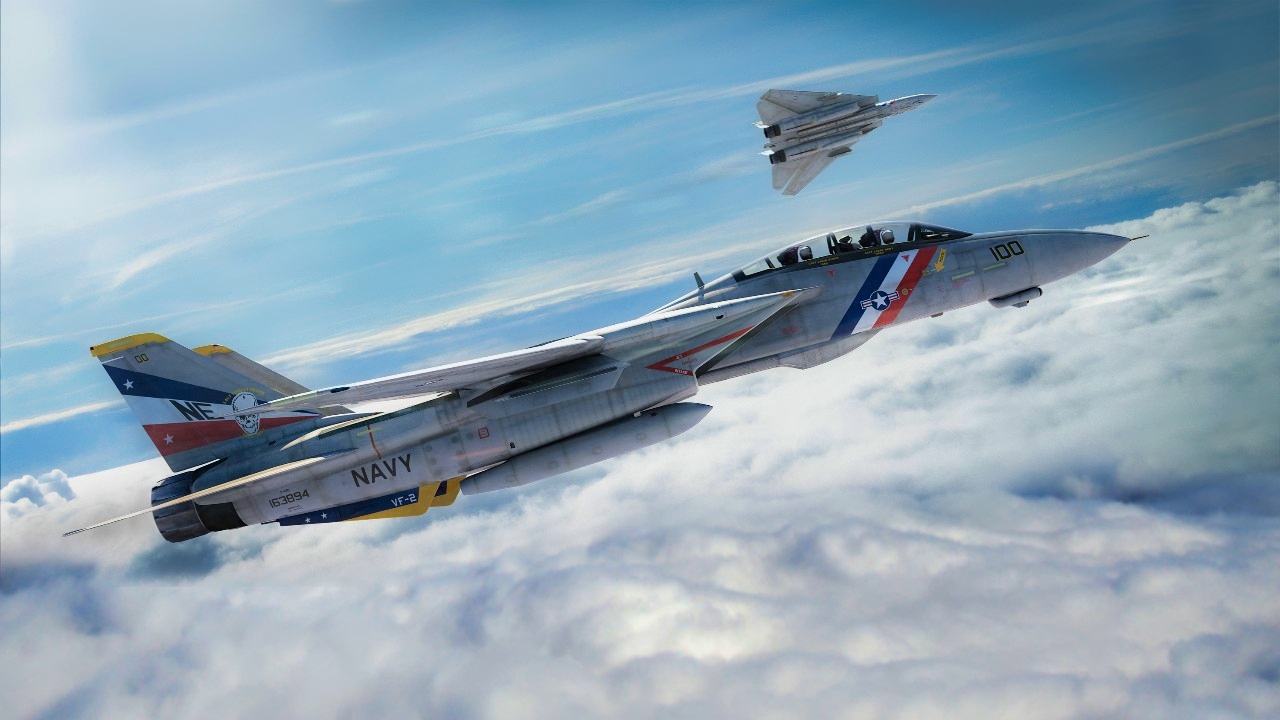
F-14 Tomcat US Navy. Image Credit: Creative Commons.
-Then-Navy Secretary John Lehman called it the “worst engine-airplane mismatch” in years. While the eventual introduction of the General Electric F110 engine solved these issues, a yoyoing budget meant that many F-14As flew with the problematic TF30s well into the 2000s.
The F-14 Tomcat Engine Crisis?
When the F-14 Tomcat first entered service, it was powered by a pair of Pratt & Whitney TF30 engines that had been designed for the F-111B, which was more multi-role bomber than a fighter.
These engines were powerful, but incredibly problematic, ultimately leading to the loss of as many as 40 Tomcats over the years. Eventually, the TF30 engines were replaced by General Electric F110-GE-400s that effectively solved all of the TF30’s problems, but many F-14s continued running the old engines well into the 2000s.
Today, plenty of airplane nerds (like this author) still count the F-14 Tomcat among their favorite aircraft of all time… so why was it retired so long before its peers like the F-15 and F-16?
The truth is, the F-14 Tomcat was a highly advanced fighter that was really purpose-built for a world-ending nuclear conflict. When you look back on the program, its challenges, and subsequent solutions, the image becomes a bit clearer.
The F-14 made sense when we were on the verge of World War III… but without a Soviet boogeyman to keep Uncle Sam’s pocketbook upturned and shaking, it became an incredibly expensive and sometimes problematic solution to a problem nobody had anymore. And to make matters worse, only a portion of the F-14 fleet was ever as capable as most of the world believed.
But to be completely clear, it was still one hell of a jet.
‘A Nice Aircraft Powered by Two Pieces of Junk’
For all its capability, the Tomcat could also be troublesome. The TF30 engines were indeed powerful, but they were also arguably too sensitive for the job. They’d been designed for an even heavier application in the 80,000 pound F-111B, but that platform was more bomber than fighter.

F-14 Tomcat Museum Photo. Image Credit: Creative Commons.
Bombers need powerful engines to carry their payloads at combat speeds, but they also have very different flight envelopes than fighters.When operated at high angles of attack, or when the pilot adjusted the throttle position quickly (both common facets of the air combat the jet was built for but uncommon in bomber missions), the engines were prone to compressor stalls. This issue led some to call the Tomcat, “a nice aircraft powered by two pieces of junk.”
“From the very start you essentially teach the pilots to fly the engine as a priority over flying the airplane,” Capt. Lee Tillotson, the Navy’s F-14 program coordinator, told the Washington Post in 1984.
“The pilot has to be very aware of what he does with the throttle at all times.”
More troubling still, with the engines mounted a vast nine feet apart to allow for greater lift and more weapons carriage space, a stall in one engine could throw the aircraft into an often unrecoverable flat spin. These issues led to the loss of a whopping 40 F-14s in all.
But it wasn’t just the stall issue plaguing the engine’s in Maverick’s ride. The turbine blades inside the engine were also prone to failure long before their anticipated service life expired, causing catastrophic damage to the engine and putting pilots’ lives at risk.
Navy Secretary John F. Lehman Jr. went on to say the TF30 engine “in the F-14 is probably the worst engine-airplane mismatch we have had in many years. The TF30 engine is just a terrible engine and has accounted for 28.2 percent of all F14 crashes.”
Today, we may look back on the F-14 with wistful awe, remembering how it was the only fighter that could stand toe-to-toe with the (fictional) MiG-28. But when it was in service, not everybody loved the Tomcat.
“The sooner we are out of it, the happier I will be,” Lehman told Congress in 1984. “I guess the good news is that all the Iranian F-14s have the TF30, too.”
In 1987, F-14s began receiving new engines in the General Electric F110, which offered more thrust and eliminated many of the reliability problems associated with the TF30. These improved F-14Bs and the subsequent F-14Ds were very much the Tomcat of Top Gun fame, and as a result, you’ll often find Tomcat fans dismissing the TF30’s woes as a problem specific to the F-14A in the early days of operation.
The truth is, a yoyoing budget made the transition from the TF30 to the F110 slow going. By 1996, nine years after the F110 entered service in the F-14, the Navy F-14 fleet included just 126 Tomcats with the new GE engines, while the other 212 were still flying on the troublesome TF30. In fact, F-14A’s running the TF30 were still flying for the Navy until as late as 2004.
About the Author: Alex Hollings
Alex Hollings is a writer, dad, and Marine veteran who specializes in foreign policy and defense technology analysis. He holds a master’s degree in Communications from Southern New Hampshire University, as well as a bachelor’s degree in Corporate and Organizational Communications from Framingham State University. This first appeared in Sandboxx News.


A-7 Metal Hammer
August 15, 2025 at 7:04 pm
The TF30 was also a pile of junk in the A-7 series of aircraft.
That’s why they went to the Allison TF41.
Denis R.
August 22, 2025 at 6:12 am
Part of the shortsightedness of the Navy and Congress, they thought it was ok as we didn’t have to worry about the USSR anymore, but a stronger possible enemy which has over the years been very vocal about wanting to expand on its territory for the sake “Of Its Citizens” read, power or something even more nefarious. That country is China and is now basically funded in its endeavor by the Western nations wanting to save a buck in manufacturing but disclosing information and trade secrets that China exploits for its own gain without observing patents and would undoubtedly apply to its military if they chose to do so. Why do those in Charge keep making the same mistake over and over. They never learn.