

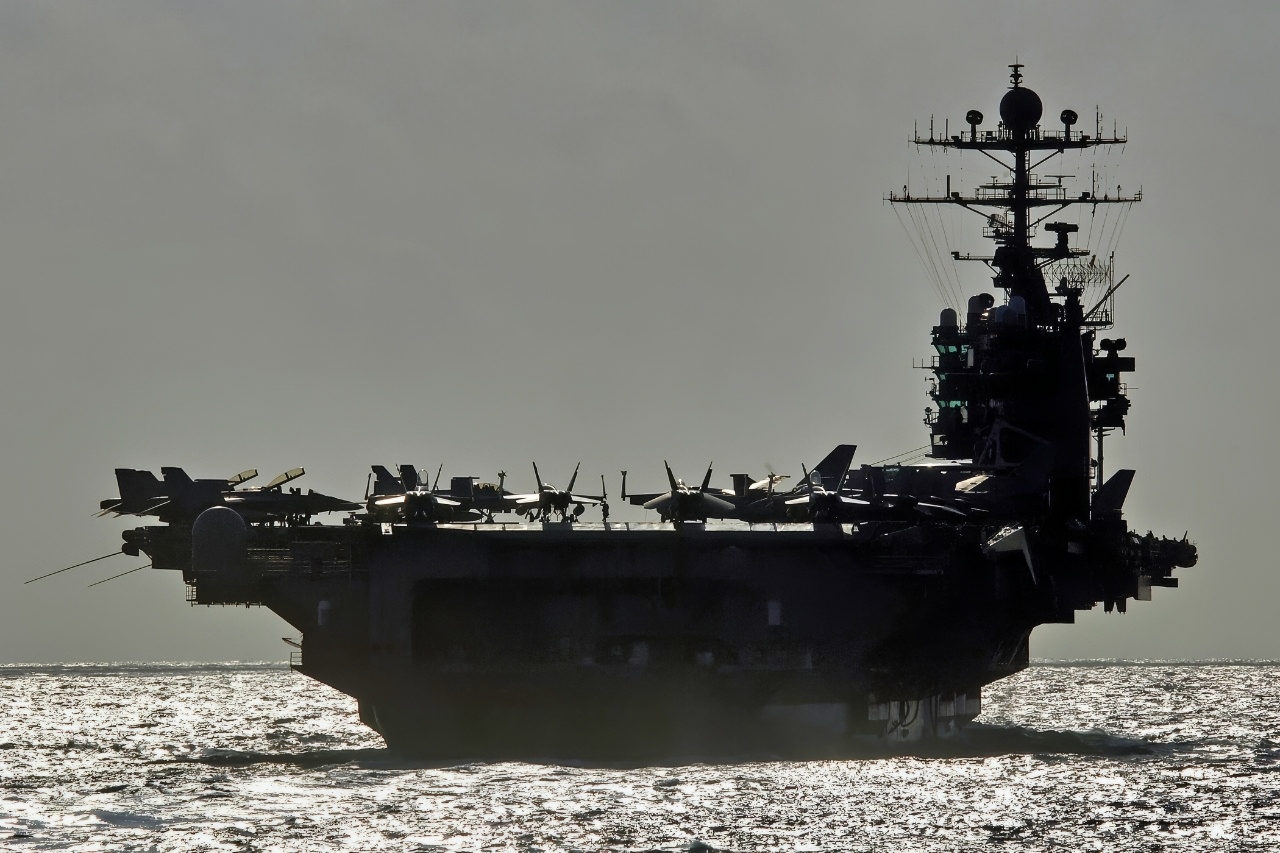
Key Points and Summary – USS George Washington and its aircraft carrier strike group have been operating west of the Philippines’ Palawan coast, officially to support salvage of a lost F/A-18F and MH-60R that sank in contested South China Sea waters.
-But the deployment does much more than protect sensitive wreckage.
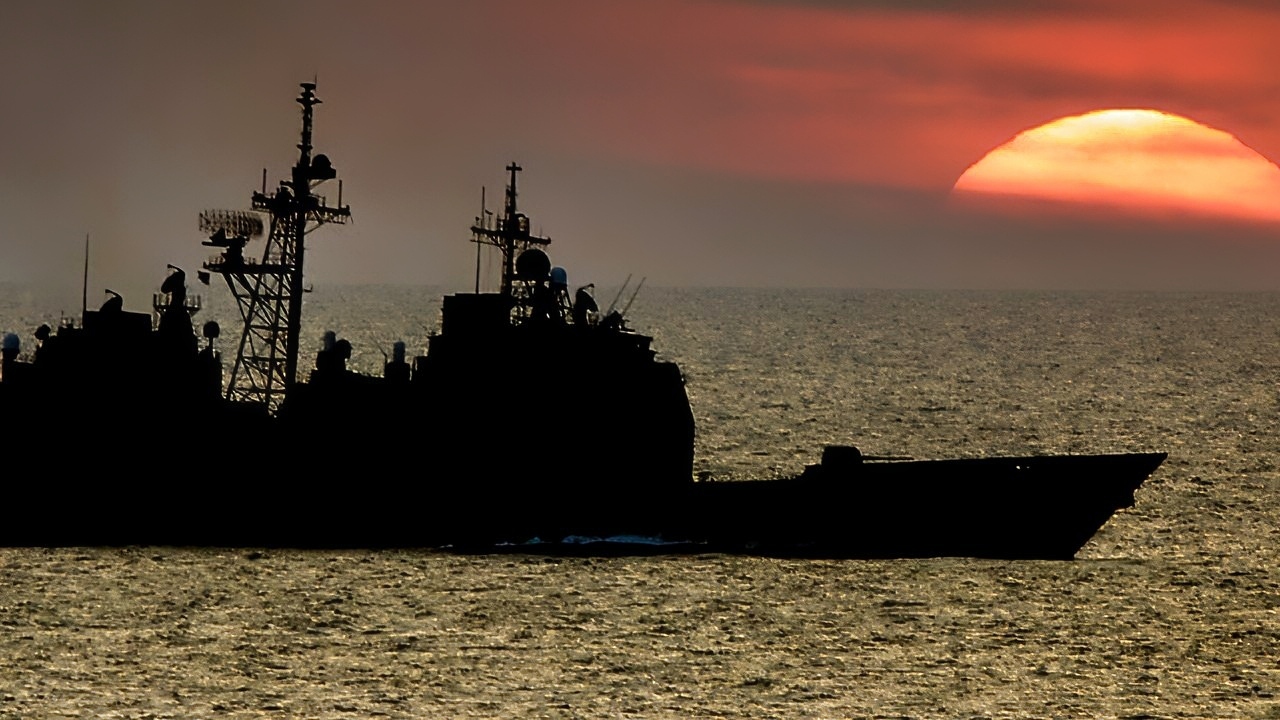
The Ticonderoga Class Cruiser USS Normandy (CG 60) steams at sunset in the Atlantic Ocean while operating with the USS George Washington battle group on May 18, 2000. The Normandy, homeported in Norfolk, Va., is participating in a Joint Task Force Exercise with the battle group.
(DoD photo by Petty Officer 2nd Class Shane McCoy, U.S. Navy. (Released))
-It visibly challenges Beijing’s sweeping maritime claims, reinforces freedom of navigation, and reassures allies such as the Philippines, Japan, and Australia.
-Operating with AIS switched off for over 50 days, the carrier underscores how U.S. forces now train to fight in contested seas, even as China’s expanding carrier fleet and aggression around Scarborough Shoal raise the stakes.
USS George Washington’s South China Sea Mission Sends China a Clear Message
The USS George Washington was spotted operating in the South China Sea along with its carrier strike group (CSG) in the area.
According to satellite imagery, the carrier was spotted in waters west of the Philippines’ westernmost province, Palawan.
The warship’s presence provoked outrage from both North Korea and China, which deployed its own warships in opposition to the CSG.
Why a Naval Carrier is Operating in the South China Sea
The official reason, according to the Department of War, for the USS George Washington’s presence is to support salvage operations for two U.S. Navy aircraft.
In October, an F/A-18F Super Hornet and an MH-60R Seahawk helicopter crashed in the South China Sea while operating from the USS Nimitz (CVN-68) during its final deployment.
Both incidents occurred within thirty minutes of each other, and while all crew members survived, the aircraft sank in contested waters claimed almost entirely by China.
Recovering these aircraft is currently a high priority for the Pentagon.
An E/A-18G Growler, attached to Electronic Attack Squadron (VAQ) 141, taxis on the flight deck of Nimitz-class aircraft carrier USS George Washington (CVN 73), while underway in the Indian Ocean, July 24, 2025. The USS George Washington Carrier Strike Group (GWA CSG) is conducting routine operations in the U.S. 7th Fleet area of operations. George Washington is the U.S. Navy’s premier forward-deployed aircraft carrier, a long-standing symbol of the United States’ commitment to maintaining a free and open Indo-Pacific region, while operating alongside allies and partners across the U.S. Navy’s largest numbered fleet. (U.S. Navy photo by Mass Communication Specialist Seaman Nicolas Quezada)
Although the Super Hornet and Seahawk are not cutting-edge platforms in 2025, they still contain sensitive avionics and materials that could provide adversaries, particularly China, with insights into U.S. carrier aviation capabilities.
Analysts note that even incremental knowledge could help China refine its J-15T carrier-based fighters or identify vulnerabilities in U.S. systems.
Consequently, the U.S. dispatched the USNS Salvor (T-ARS-52), a Safeguard-class salvage ship, to lead recovery efforts, with the George Washington providing air cover, logistical support, and deterrence against interference.
Sending a Message to China
Beneath the veneer of salvage operations, the presence of the USS George Washington serves to send a strong signal to the U.S.’ adversaries.
For China, the presence of a U.S. carrier strike group in these waters directly challenges Beijing’s of sovereignty and reinforces the principle of freedom of navigation under international law.
This is particularly salient given recent Chinese actions, including the deployment of its newest aircraft carrier, Fujian, near Hainan Island, and aggressive maneuvers by the People’s Liberation Army Navy and China Coast Guard around Scarborough Shoal.
For regional allies such as the Philippines and security partners like Japan and Australia, the George Washington’s presence is a reassurance that Washington remains committed to their defense and to maintaining a rules-based order.
This comes after a series of joint exercises, including the trilateral patrol near Scarborough Shoal involving U.S., Japanese, and Philippine forces earlier in November, which drew sharp protests from Beijing and even prompted Chinese bomber overflights.
For the global audience, at a time when U.S. attention is divided among crises in the Middle East and Europe, sustaining a robust posture in the Indo-Pacific signals that America’s pivot to Asia is enduring, not episodic.

USS George Washington. Image Credit: Creative Commons.
George Washington’s forward deployment from Yokosuka is emblematic of this commitment.
Background and Operation in Japan
The carrier’s activities in the South China Sea are not occurring in isolation. They are part of a continuum of multinational exercises and cooperative security initiatives aimed at enhancing interoperability among allies and partners.
Earlier in 2025, the George Washington participated in Talisman Sabre, a major U.S.-Australian-led exercise, and conducted joint operations with the Royal Navy’s HMS Prince of Wales and Japan’s JS Kaga.
George Washington’s current mission, though focused on salvage, provides an opportunity to sustain readiness and demonstrates that carrier strike groups can pivot rapidly from peacetime exercises to real-world contingencies.
A recurring theme in U.S. operations in the South China Sea is the assertion of freedom of navigation and overflight.
By operating in waters west of the Philippines and near contested features like Scarborough Shoal, the George Washington reinforces the U.S. position that these are international waters, not China’s sovereign territory. Carrier deployments are among the most visible and potent expressions of this principle, given their scale and capability.
Critics argue that such actions risk escalation, but proponents contend that failing to challenge excessive maritime claims would effectively concede them.
In this sense, George Washington’s presence is as much about law as it is about power; it embodies the U.S. commitment to a rules-based maritime order.
Posturing Between China and the U.S.
Interestingly, the George Washington has been operating with its Automatic Identification System switched off for over fifty days, making it invisible to civilian tracking platforms. This deliberate opacity reflects the sensitivity of its mission and the desire to minimize targeting opportunities for adversaries.
It also illustrates the evolving nature of carrier operations in contested environments, where information dominance and unpredictability are as crucial as firepower.
The timing of George Washington’s deployment coincides with several developments that heighten its strategic significance. China’s naval expansion continues, with the PLAN now fielding three aircraft carriers and the new Type 003 Fujian.

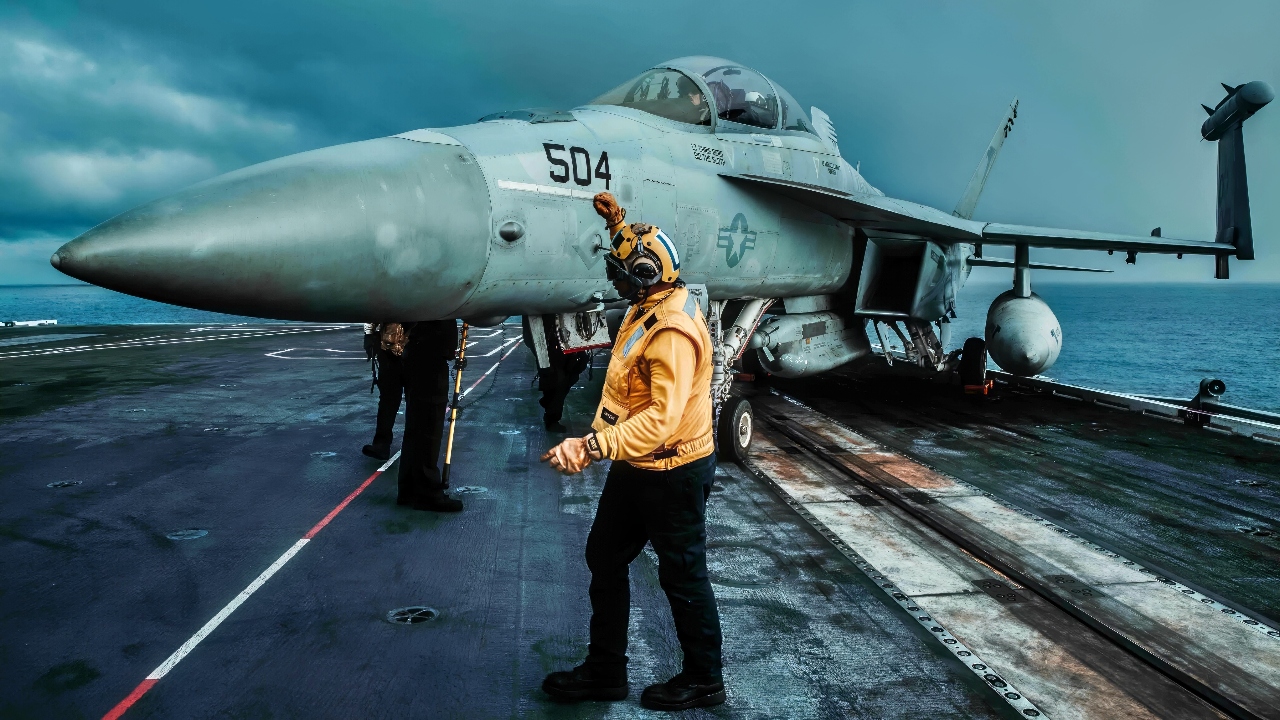
U.S. Navy Aviation Boatswain’s Mate Aircraft Handling 2nd Class Kyle Darmanin, from Mooresville, North Carolina, assigned to air department’s flight deck crash and salvage division, signals an F/A-18E Super Hornet, attached to Strike Fighter Squadron (VFA) 27, on the flight deck of Nimitz-class aircraft carrier USS George Washington (CVN 73) while underway in the Timor Sea in support of Talisman Sabre 2025, July 14, 2025. Talisman Sabre is the largest bilateral military exercise between Australia and the United States advancing a free and open Indo-Pacific by strengthening relationships and interoperability among key allies and partners, while enhancing our collective capabilities to respond to a wide array of potential security concerns. (U.S. Navy photo by Mass Communication Specialist 2nd Class Tyler Crowley)
Its appearance near Hainan during George Washington’s transit underscores the competitive dynamic at play. Philippine-China tensions have also escalated, with recent incidents including Chinese water cannon attacks on Philippine vessels near Scarborough Shoal inflaming regional anxieties.
U.S. carrier presence serves as a deterrent and a political signal of solidarity with Manila. President Donald Trump’s visit to the George Washington in Japan just a week before its South China Sea entry further adds fuel to the fire.
About the Author: Isaac Seitz
Isaac Seitz, a Defense Columnist, graduated from Patrick Henry College’s Strategic Intelligence and National Security program. He has also studied Russian at Middlebury Language Schools and has worked as an intelligence Analyst in the private sector.
More Military
The Army’s AH-64E Apache Helicopter Can Destroy Drones with Missiles
U.S. Navy Iowa-Class Battleship USS New Jersey’s ‘Comeback’ Is Now Complete
Blaze of Glory: The SR-71 Blackbird Retired Hitting Mach 3.21


