
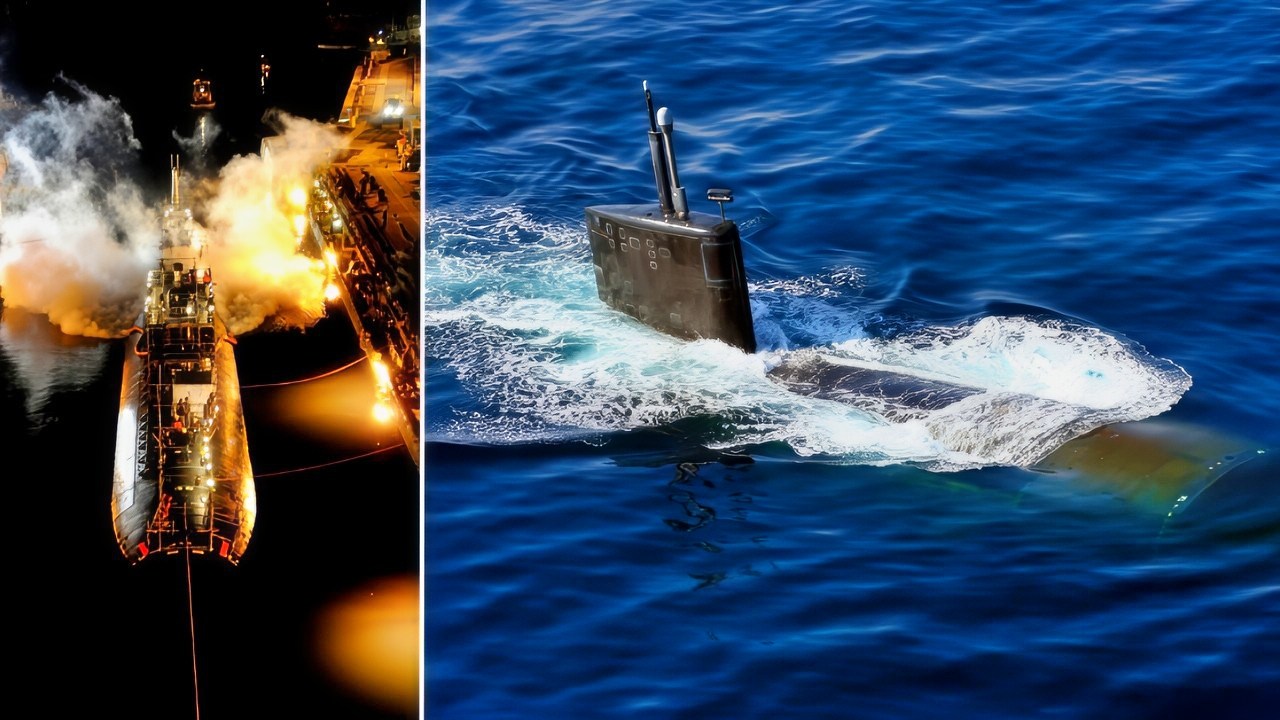
Key Points and Summary – The U.S. nuclear submarine USS Miami was destroyed by a catastrophic fire in 2012 while undergoing an overhaul.
-The cause was not a technical failure but a bizarre act of arson: a civilian shipyard worker set the blaze simply because he wanted to leave work early.

241204-N-VW723-2064 PACIFIC OCEAN (Dec. 4, 2024) The Los Angeles-class fast-attack submarine USS Greeneville (SSN 772) transits the Pacific Ocean while supporting a distinguished visitor embark, Dec. 4, 2024. Greeneville is one of four Los Angeles-class fast-attack submarines assigned to Commander, Submarine Squadron 11. These submarines are capable of supporting various missions, including: anti-submarine warfare; anti-ship warfare; strike warfare; and intelligence, surveillance, and reconnaissance. (U.S. Navy photo by Mass Communication Specialist 1st Class Keenan Daniels)
-The fire caused hundreds of millions in damages, forcing the Navy to scrap the vessel.
-A subsequent investigation found the disaster was worsened by poor fire readiness, and a 2023 GAO report later concluded the Navy still lacked a unified system to apply fire-safety lessons fleet-wide.
How the Nuclear Submarine USS Miami Was Destroyed
On May 23, 2012, the USS Miami (SSN-755), a Los Angeles-class attack submarine, was undergoing a scheduled overhaul at Portsmouth Naval Shipyard in Kittery, Maine, when a fire broke out and rapidly escalated.
The blaze quickly destroyed the forward compartments, including control areas and torpedo rooms. The fires left the vessel completely irreparable. While the reactor and propulsion systems thankfully remained intact, and no fatalities occurred, the scale of the destruction forced the Navy to retire the submarine.

(June 11, 2025) – The Los Angeles-class fast-attack submarine USS Annapolis (SSN 760) transits Apra Harbor, Naval Base Guam, June 11, 2025. Assigned to Commander, Submarine Squadron 15, based at Polaris Point, Naval Base Guam, Annapolis is one of five forward-deployed fast-attack submarines. Renowned for their unparalleled speed, endurance, stealth, and mobility, fast-attack submarines are the backbone of the Navy’s submarine force. Regarded as apex predators of the sea, fast-attack submarines serve at the tip of the spear, helping to reaffirm the submarine force’s forward-deployed presence in support of a free and open Indo-Pacific. (U.S. Navy photo by Lt. James Caliva)
This fire wasn’t caused by a maintenance error or a technical problem: it was arson.
The Arson, the Fire, and the Response
At approximately 5:41 p.m. that day, fire crews were alerted to the presence of smoke onboard the Miami. Over the next 12 hours, firefighters from the shipyard and nearby areas worked to stop the blaze.
The fire was enormous; seven responders sustained injuries and one crew member reportedly broke ribs while falling through a removed deck plate.
The fire was eventually brought under control, but only after it had destroyed the ship.
Initial statements from the Navy suggested that the fire could have originated from an industrial vacuum cleaner that inadvertently ignited debris by drawing in heat from a nearby source. But an investigation after some months confirmed that it was, in fact, caused by arson.
A civilian shipyard worker, Casey James Fury, was later indicted after he confessed to intentionally setting rags on fire while aboard the forward section of the vessel. Remarkably, Fury said that he caused the fire so that he could leave work early.

PHILIPPINE SEA (Dec. 10, 2010) The Los Angeles-class attack submarine USS Houston (SSN 713) takes part in a photo exercise as part of Keen Sword 2011. Keen Sword is a joint, bilateral exercise designed to strengthen Japan-U.S. military operations. (U.S. Navy photo by Mass Communication Specialist 3rd Class Casey H. Kyhl)
Fury later admitted to causing a smaller second fire on the dry dock cradle.
In March 2013, Fury was sentenced to more than 17 years in prison and ordered to pay $400 million in restitution.
The final investigation by the Navy determined that the severity of the fire was rooted specifically in the act of arson, but that it was exacerbated by response delays, poor fire detection, and insufficient readiness for a catastrophic fire. The report also suggested a cultural blindspot whereby, over time, focus on routine safety practices meant there was an underemphasis on worst-case fire contingency planning.
The Costs and Fallout
In the weeks following the disaster, Navy and congressional officials discussed the possibility of repairing the Miami and returning her to the seas. The initial cost estimates ranged from $400 million to $450 million.
Some proposals included cannibalizing parts from recently decommissioned submarines. But as engineers uncovered additional structural issues, the projected costs ballooned to around $700 million. In August, the Navy decided against repairing the Miami and instead moved to decommission the vessel. The Miami was formally decommissioned in 2014 and in 2015 was towed to Puget Sound for scrapping.
The loss was substantial. The Miami was a nuclear attack submarine, and its loss was more than just a financial hit—it was a huge operational blow at a time of tightening defense budgets. The Miami was once known as “Big Gun” because of her cruise missile strike capability, and the fact that she had conducted clandestine deployments in the past. With the vessel’s retirement, the Navy lost a major asset.
The situation was bad, and it was worsened by the public nature of the disaster, especially the fact that a subordinate worker had caused hundreds of millions of dollars in damage by simply setting a rag on fire. It was a reputational issue as much as it was a financial and operational one, exposing vulnerabilities in security, oversight, and the Navy’s ability to defend itself from its own workers.
The Miami fire revealed that fire readiness is essential; the potential for a fire aboard a warship should not be approached as a low-probability risk.
Yet Government Accountability Office (GAO) auditors later revealed that, even after the Miami fire, the Navy lacked a unified system to address fire-related lessons and apply them fleet-wide.
“Establishing a process for the consistent collection, analysis, and sharing of fire-related lessons learned would assist the Navy to improve behavior and reduce the risk of ships repeating costly mistakes,” a GAO report published in April 2023 explains.
The report added that, while the Navy had “begun improving the collection of data related to fires aboard ships during maintenance,” there were no subsequent analyses of the broad effects that fires have on the Navy’s operations and strategic resources.
“Without conducting such analyses, the Navy will not have a complete picture of the magnitude of risks associated with ship fires,” it continued.
The Miami fire was a rare and absurd act of sabotage, but it showed how easily a single point of failure can cripple an asset worth hundreds of millions of dollars—and how lapses in readiness or oversight can multiply that risk. In an era of tight budgets and rising threats, the Navy can’t afford another lesson that expensive.
About the Author:
Jack Buckby is a British author, counter-extremism researcher, and journalist based in New York. Reporting on the U.K., Europe, and the U.S., he works to analyze and understand left-wing and right-wing radicalization, and reports on Western governments’ approaches to the pressing issues of today. His books and research papers explore these themes and propose pragmatic solutions to our increasingly polarized society. His latest book is The Truth Teller: RFK Jr. and the Case for a Post-Partisan Presidency.
More Military
The F-35 Has a Range Problem That Can’t Be Fixed
The F-14D Tomcat Still Haunts the U.S. Navy
The B-1B Lancer Bomber Almost Never Flew
Battleship USS Nevada Has a Message for the U.S. Navy
Forget Aircraft Carriers: ‘Light Aircraft Carriers’ Armed with Drones Might Be the Future


