


Key Points and Summary – The F-14D Tomcat earned its legend by doing the carrier’s hardest jobs well.
-Its digital APG-71 radar paired with long-range missiles gave the fleet a “long arm.”
-Under the nose, TV and infrared sensors added quiet, jam-proof awareness.
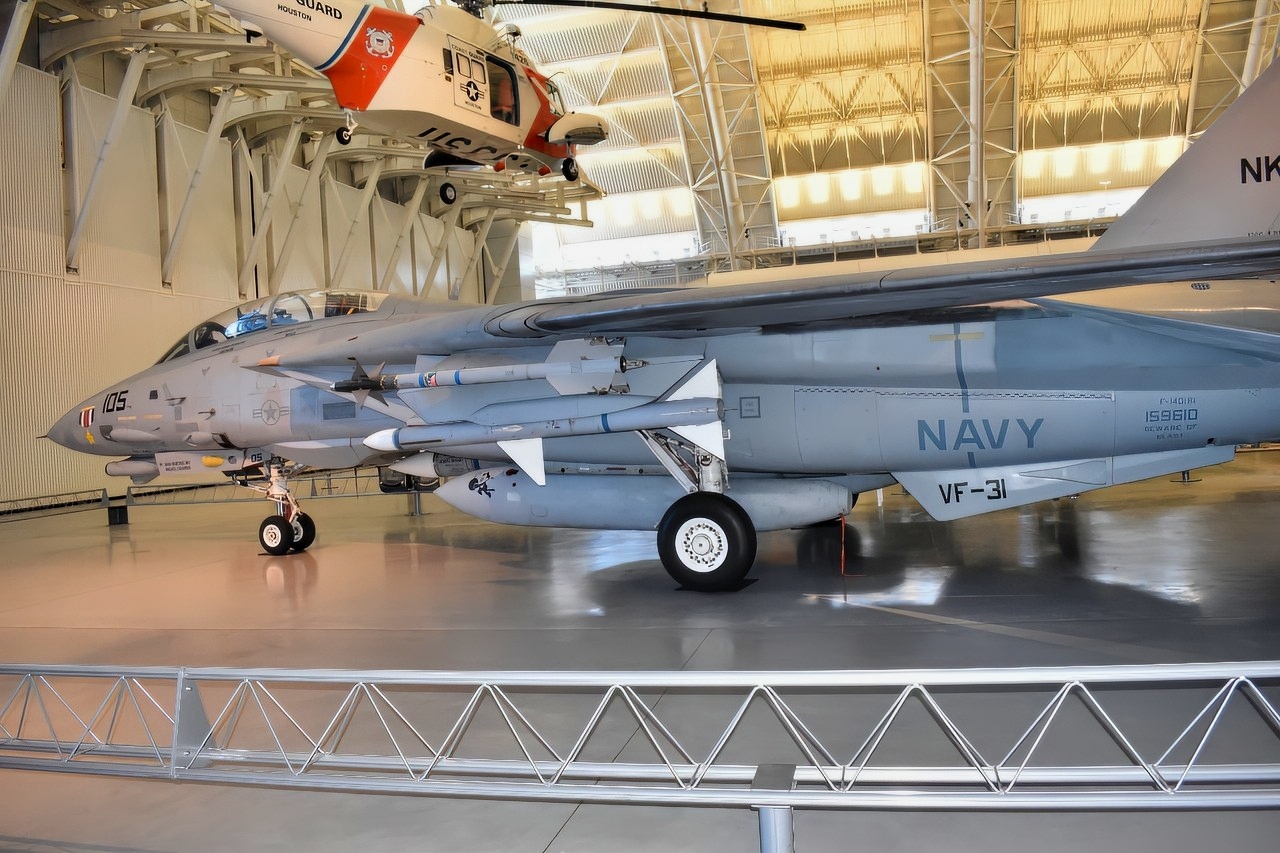
F-14 Tomcat at Steven F. Udvar-Hazy Center. Image by Brent M. Eastwood for National Security Journal.
-Swing-wings and new GE F110 engines let the jet launch heavy, go far, and still land safely.
-With a LANTIRN pod and later JDAM weapons, the last Tomcats became precise “Bombcats,” filling a strike gap as other platforms retired.
-Proposals to modernize—often called Tomcat 21—showed real headroom, even if budgets said no. Costly and complex? Yes. Effective when it counted? Absolutely.
-We have included many original pictures from our time visiting with various F-14 Tomcat fighters to give you a better sense of the plane.
The F-14D Tomcat: 5 Reasons This Plane Deserves a Place in U.S. Naval Aviation History
Here’s a fact you already know if you read this publication a lot: My team and I spend a lot of time staring at F-14 Tomcat fighter jets.
And of course, that means F-14D Tomcat variants for sure.
We travel to museums all over the United States to take photos and bring you what we see in some of the most remote places where these planes are stored and admired.
That means we also collect the stories of fighter pilots who tell amazing stories of what the F-14 achieved in the skies.
The reasons for us are obvious: Ask a room full of Navy aviators which retired jet they miss most, and you’ll hear the same name over and over: Tomcat.
Not just any Tomcat—the F-14D, the last and best of the breed.
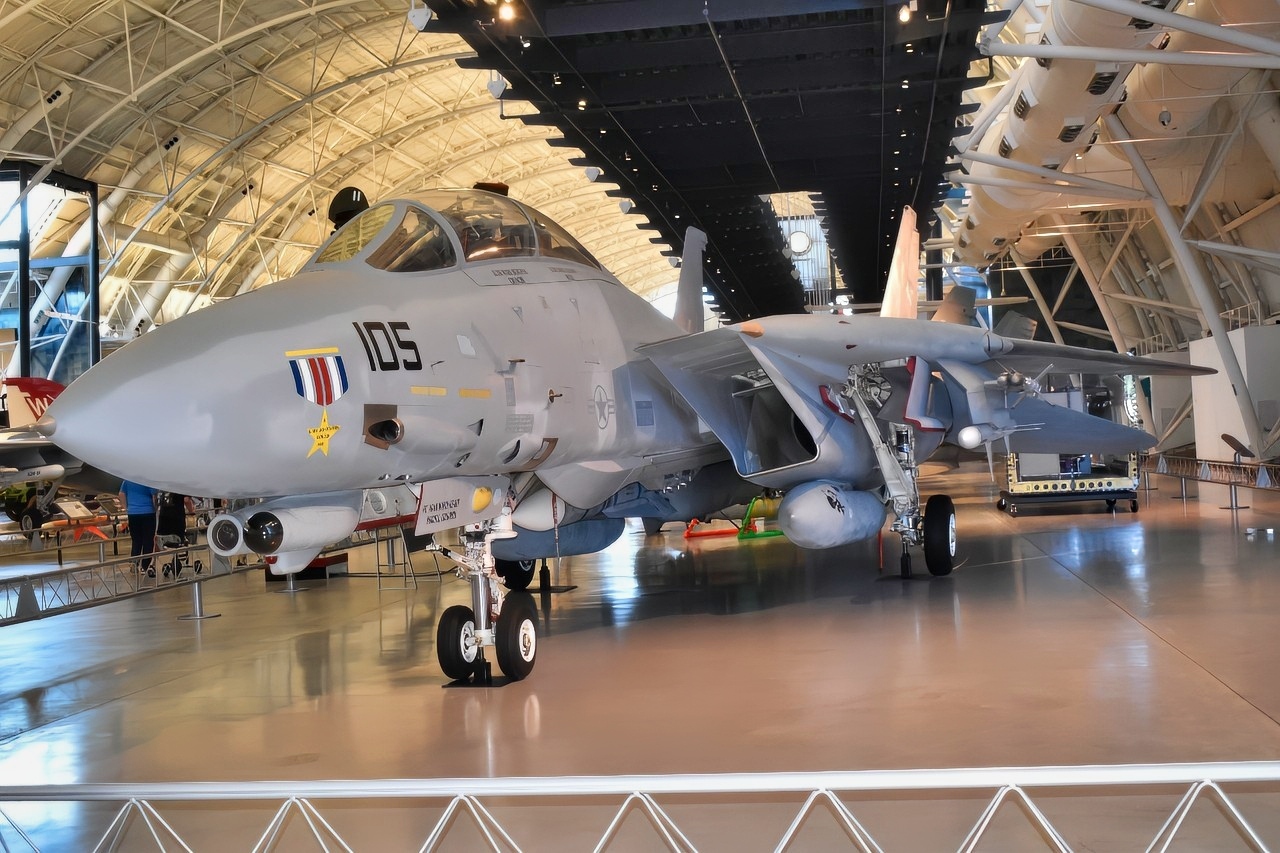
F-14 Tomcat Image from National Security Journal. Photo taken by Brent M. Eastwood on September 5, 2025.
It was fast, big, and famously photogenic, sure. But the nostalgia you hear from carrier decks and ready rooms isn’t about movie posters.
It’s about reach, awareness, flexibility, and trust—things the F-14D delivered in spades at a time when the fleet needed a long-arm defender and, later, a precision striker.
Costs were high, and maintenance could be a challenge, but the Navy ultimately chose a more straightforward, cheaper path with the Super Hornet.
But before the curtain fell in 2006, the F-14D earned a reputation that still echoes on the waterfront. Here are the five features that explain why.
1) The Long Arm: Radar Plus Phoenix
The F-14 story starts with a simple naval problem: stop threats before they get anywhere near the carrier.
The F-14D’s answer was a pairing that defined “long arm”: a powerful radar that could see and track faraway targets, and a big, long-range missile designed to kill them at distance.
In the D-model, the original analog radar of earlier Tomcats gave way to a faster, more capable AN/APG-71 set—think of it as a digitally turbocharged upgrade that could sift fast-moving blips from background clutter, look down into the mess near the sea surface, and still keep multiple contacts in view.
That radar cued the AIM-54 Phoenix, a hefty beyond-visual-range missile the Tomcat could carry in numbers.
On a practical level, this meant a Tomcat crew—pilot up front, Radar Intercept Officer (RIO) in back—could patrol a huge bubble around the carrier, see first, and shoot first, often while still miles from any threat to the ships behind them. In an era of high-fast bombers and cruise missiles, the F-14D’s “long arm” wasn’t a talking point. It was a tactic.
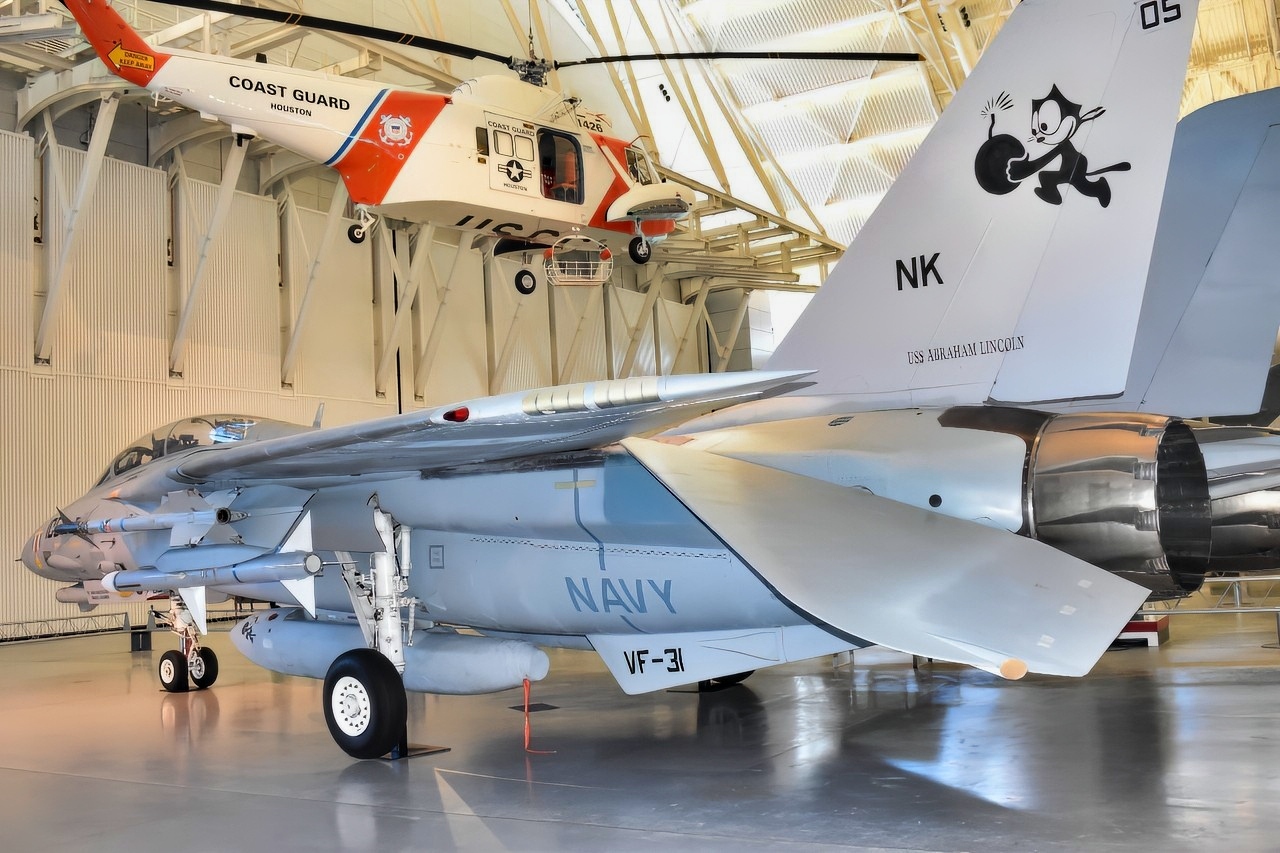
F-14 Tomcat Image by Dr. Brent M. Eastwood/National Security Journal.
Even after the Phoenix left U.S. service in 2004, the radar remained a difference-maker: better processors, smarter modes, and cleaner displays gave crews more confidence at the moment that matters—when you have seconds to decide if a contact is friend, foe, or unknown.
2) Eyes Beyond Radar: IRST, TV, and Human Teamwork
If the radar was the Tomcat’s brain, its eyes were a multi-sensor stack that aged unusually well. Under the nose lived two special tools. One was a Television Camera System, essentially a stabilized long-zoom TV that could lock onto a tiny dot and show the crew exactly what they were looking at. The other was IRST—Infrared Search and Track—which passively looks for heat, not radar reflections. IRST doesn’t shout; it listens. That’s priceless when you want to find something without announcing yourself on the airwaves.
These sensors let the F-14D do something subtle but powerful: build confidence. Radar says “there’s something out there at this distance, going this fast.” The TV camera says “and this is what it looks like.” IRST adds “and I can still see it even if someone is jamming.”
Blend those with the D-model’s cleaned-up cockpit displays, and the pilot-RIO team could correlate, cross-check, and make better calls—whether to push, hold, warn, or shoot.
This is where the two-crew cockpit really paid off. In the Tomcat, the pilot flew the jet and kept the energy right. The RIO tended the sensors, sorted the picture, and talked the formation through it. No machine can fully replace that rhythm of human teamwork under pressure. The F-14D made that teamwork sing.
3) Swing-Wing Magic, Modernized
The Tomcat’s variable-sweep wings—those dramatic, pivoting panels—were never a gimmick. They were how a single airplane could be both a long-range sprinter and a slow-speed, heavy-load deck lander. Wings forward for more lift when you’re slow, heavy, or turning hard; wings back to slice drag and go fast. On the boat, laden with fuel and weapons, that mattered. At altitude, hunting along the carrier’s distant fence line, it mattered even more.

F-14D Tomcat Fighter NSJ Original Image. Taken by Dr. Brent M. Eastwood.
By the 1990s, the F-14D added smarter flight controls and much better engines. The old TF30s (the ones early Tomcat pilots dreaded) were replaced by GE F110 powerplants with real thrust and far better throttle response. The combination—swing-wing aerodynamics plus honest power—meant the D-model could launch heavy, climb hard, go far, and still come back aboard with useful “bring-back” (fuel and unused weapons). And when the mission shifted from long-range interception to precision strike, those same wings gave the Tomcat a steady, forgiving platform for dropping guided bombs in bumpy air.
Pilots will argue tactics forever, but nobody argues what the F-14D could do for the ship: launch big, go long, and come home with margin.
4) From “Big Fighter” to “Bombcat”
The F-14D’s most surprising trick was becoming a precision striker without changing its fundamental DNA. The pivot hinged on one pod and a lot of hustle: LANTIRN—Low Altitude Navigation and Targeting Infrared for Night.
Hanging under the fuselage, LANTIRN let Tomcat crews find, track, and laser-guide bombs onto targets at night and through weather. The airplane that was built to swat threats over the horizon became the airplane that could pick the right window in a city block.
Fleet squadrons proved it quickly, first in training and then in combat over the Balkans, Afghanistan, and Iraq. Later, when JDAM—Joint Direct Attack Munition—arrived (turning regular bombs into all-weather precision weapons with a GPS-guided tailkit), the F-14D could do even more. In the space of a few years, the Tomcat went from “fleet defender” to the carrier’s most precise hammer, with a back seat that excelled at managing the sensor picture while the pilot flew a rock-steady weapons run.

F-14D Tomcat in NYC on USS Intrepid. Image Credit: National Security Journal Taken on 9/19/2025.
This wasn’t just a cool rebrand. It filled a real gap. As the dedicated A-6 Intruder left service, the Navy needed a platform to carry precision strike into the 2000s while newer jets matured. The F-14D, with its speed, legs, sensors, and two-crew cockpit, stepped up. “Bombcat” wasn’t a nickname. It was a job description.
5) Growth Headroom—and the “What If” That Won’t Die
Some airplanes are born maxed out. The F-14D wasn’t. Even as the Navy weighed retirement, designers and test pilots kept sketching upgrades that would have pushed the jet far into the 21st century: better engines with more thrust and efficiency; conformal fuel tanks to stretch range without hogging pylons; lighter, stronger composite panels; new wings and flaps; digital flight controls to tame the edges of the envelope; a modern data-link that would knit Tomcats into the wider fight; and a sensor and cockpit refresh to make all that capability usable.
You’ll hear names like Tomcat 21 or Super Tomcat 21 attached to those packages. The short, honest version is that most of the pieces existed. None of it required sci-fi leaps. The result would have kept the Tomcat’s signature strengths—reach, speed, payload, and two-crew sensing—while trimming the maintenance and reliability headaches that haunted earlier blocks.
So why didn’t it happen? Two reasons the Navy will give you straight: money and simplicity. The Tomcat was expensive to fly and fix, even in its improved D-model. The Super Hornet promised a cleaner logistics train, easier upkeep, and enough capability across most missions. In a world of finite budgets and long wars to support, “good enough, affordable, and available” beat “spectacular, expensive, and complicated.”’

F-14 Tomcat. Image Credit: Creative Commons.
And yet, the what-if lingers for a reason. The proposals showed the F-14D still had headroom. In another budget, in another decade, that headroom might have been filled.
So Why Do Sailors Still Miss It?
Because the F-14D solved carrier problems in a way crews could feel. On a dark deck, you trusted its legs to get you out and back. On a bad day in the stack, you trusted its wing to hold you up. In the intercept, you trusted its picture—radar, TV, IR—to tell you what you were really looking at. And when the mission changed from “go fence-sitting” to “go put steel on a window,” the jet changed with it.
No airplane is perfect. The F-14D cost real money, soaked up sailor-hours, and asked a lot from maintainers. But the payoff was a machine that let a carrier shape the air fight far from the wake, then turn around and shape the land fight when that’s what the day demanded.
That’s why the last trap in 2006 felt like more than a farewell fly-past. It felt like closing the log on a kind of thinking—kill threats early, see better than the other guy, keep the ship safe at all costs—that will never go out of style, even as we pursue it with different airframes and newer code.
About the Author: Harry J. Kazianis
Harry J. Kazianis (@Grecianformula) is Editor-In-Chief and President of National Security Journal. He was the former Senior Director of National Security Affairs at the Center for the National Interest (CFTNI), a foreign policy think tank founded by Richard Nixon based in Washington, DC. Harry has over a decade of experience in think tanks and national security publishing. His ideas have been published in the NY Times, The Washington Post, The Wall Street Journal, CNN, and many other outlets worldwide. He has held positions at CSIS, the Heritage Foundation, the University of Nottingham, and several other institutions related to national security research and studies. He is the former Executive Editor of the National Interest and the Diplomat. He holds a Master’s degree focusing on international affairs from Harvard University.
More Military
The B-1B Lancer Bomber Almost Never Flew
Battleship USS Nevada Has a Message for the U.S. Navy
Forget Aircraft Carriers: ‘Light Aircraft Carriers’ Armed with Drones Might Be the Future
The Marine Corps San Antonio-Class Amphibious Ships are ‘Sitting Ducks’‘
It Can Outrun Everything’: The SR-71 Blackbird Mach 3 Spy Plane Had 1 Job


