


France’s next-generation aircraft carrier — formerly designated PANG, now renamed France Libre — will displace 80,000 tons, making it nearly twice the displacement of the Charles de Gaulle and the largest warship in Europe. Two TechnicAtome K-22 nuclear reactors will power the carrier to a maximum speed of 27 knots.
Libre Aircraft Carrier: This Will be the Biggest Ship in Europe
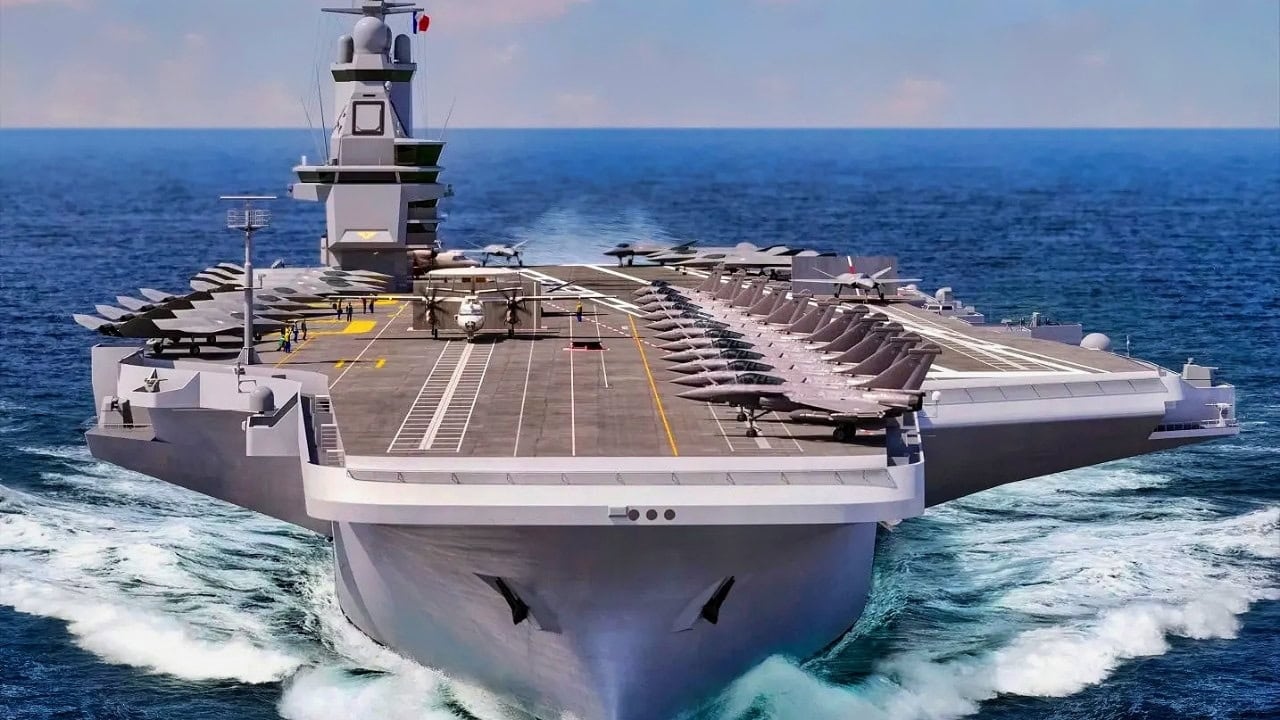
PANG France Aircraft Carrier. Image Credit: Creative Commons.
If the subject is “liberty and freedom,” you know the French are interested. That is why they named their new aircraft carrier the “France Libre,” to relabel it from the more official-sounding PANG moniker. PANG is a French acronym for “New Generation Aircraft Carrier.” The France Libre will certainly be a force to be reckoned with, allowing the navy to carry the flag around the world and enabling French political leaders to project power and conduct freedom-of-navigation missions anywhere at any time.
The France Libre displaces 80,000 tons, so it is not a small carrier. That is nearly two times the displacement of France’s other carrier, the Charles de Gaulle. Libre is propelled by two TechnicAtome K-22 nuclear reactors. Like the U.S. Navy’s Gerald R. Ford, it will utilize the EMALS catapult and Advanced Arresting Gear.
Slam Dunk for NATO
This will be good for NATO interoperability with the United States and other alliance navies. The data sharing network is a premium feature. The France Libre should be able to use its own strike group to identify enemy threats and share intelligence with the Americans and other allies.
Ready to Lead the Alliance In Style
The French must wait a long time for the Libre. It may not be delivered until 2038, but that is not dampening the pride that the French have in this carrier.
“The project of our armed forces, but also of our research, of our national industries. This will to remain free is the will for independence at all costs; for total, unconstrained autonomy of action; for the projection of our forces wherever the defense of France’s interests demands it, anywhere in the world,” French President Emmanuel Macron said, as noted by Naval News.
Nuclear-powered Floating Air Base
The Libre can hit a maximum speed of 27 knots with the two reactors. This is close to the 30-knot speed on U.S. carriers. The French should be able to keep up with their allies. There will be 2,000 sailors on board, so the Libre will be a floating city with many features to enhance the quality of life for shipmates.
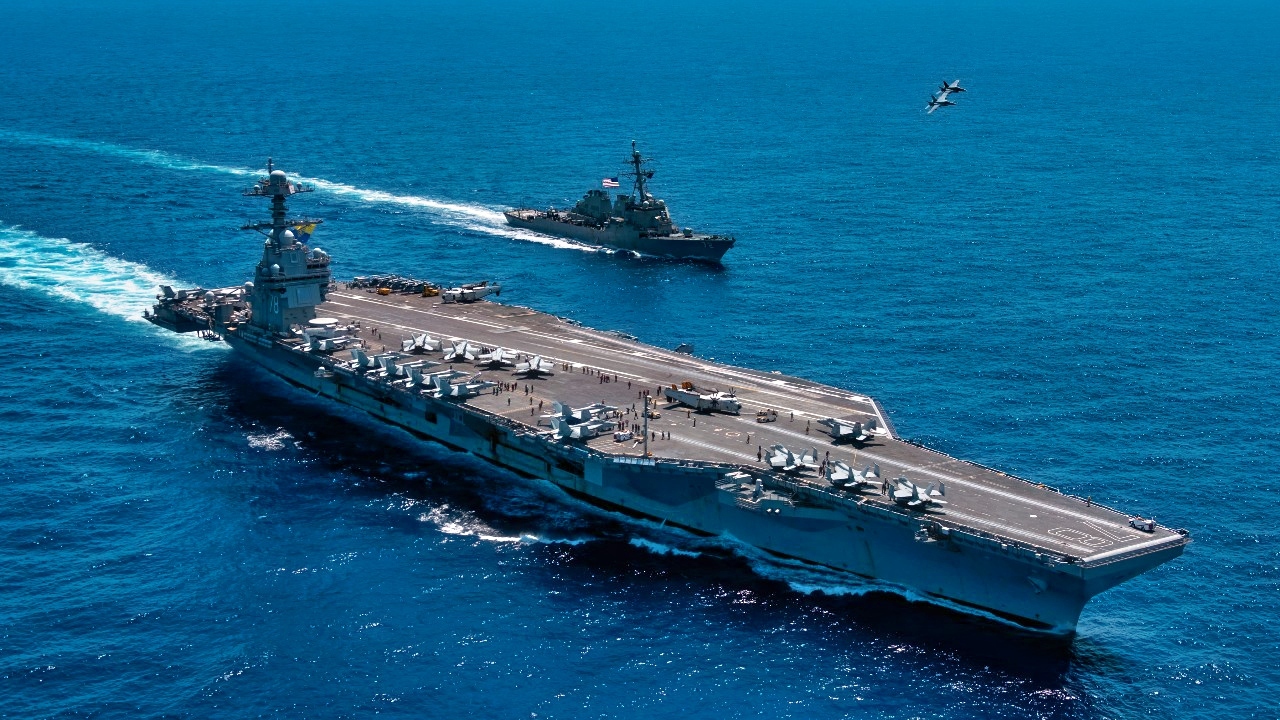
An F/A-18F Super Hornet, attached to the “Blacklions” of Strike Fighter Squadron (VFA) 213 and a F/A-18E Super Hornet, attached to the “Golden Warriors” of Strike Fighter Squadron (VFA) 87 fly over the world’s largest aircraft carrier, USS Gerald R. Ford (CVN 78), the Arleigh Burke-class guided-missile destroyer USS Mahan (DDG 72), April 11, 2025. The Gerald R. Ford Carrier Strike Group is underway in the Atlantic Ocean completing integrated naval warfighting training. Composite Training Unit Exercise (COMPTUEX) is the Joint Force’s most complex integrated training event and prepares naval task forces for sustained high-end Joint and combined combat. Integrated naval training provides America’s civilian leaders and commanders highly-capable forces that deter adversaries, underpin American security and economic prosperity, and reassure Allies and partners. (U.S. Navy photo by Mass Communication Specialist 2nd Class Maxwell Orlosky

The world’s largest aircraft carrier USS Gerald R. Ford (CVN) 78 and the USNS Laramie (T-AO-203) conduct a refueling-at-sea in the Eastern Mediterranean Sea, Oct. 11, 2023. USS Gerald R. Ford is the Navy’s newest and most advanced aircraft carrier, representing a generational leap in the U.S. Navy’s capacity to project power on a global scale. The Gerald R. Ford Carrier Strike Group is currently operating in the Eastern Mediterranean Sea, at direction of the Secretary of Defense. The U.S. maintains forward deployed ready and postured forces to deter aggression and support security and stability around the world.(U.S. Navy photo by Mass Communication Specialist 2nd Class Jackson Adkins)

The Ford-class aircraft carrier USS Gerald R. Ford (CVN 78) and the Italian aircraft carrier ITS Cavour (CVH 550) transit the Atlantic Ocean March 20, 2021, marking the first time a Ford-class and Italian carrier have operated together underway. As part of the Italian Navy’s Ready for Operations (RFO) campaign for its flagship, Cavour is conducting sea trials in coordination with the F-35 Lightning II Joint Program Office’s Patuxent River Integrated Test Force to obtain official certification to safely operate the F-35B. Gerald R. Ford is conducting integrated carrier strike group operations during independent steaming event 17 as part of her post-delivery test and trials phase of operations.
Borrowing Technology from the USS Gerald R. Ford
The French should learn lessons from the development of the Gerald R. Ford. This carrier experienced schedule slips and cost overruns. The EMALS and Advanced Arresting Gear were problematic, as were weapons elevators. That should be mitigated when the French add these features to the Libre. There will be manufacturing efficiencies and economies of scale for French shipyard workers to emulate, and the delays and cost problems should be minimized.
The EMALS will enable a higher sortie rate and reduce wear and tear on the aircraft launched. There should be smoother takeoffs, giving aviators confidence that the carrier is one of the most technologically advanced in the world.
The French Fighter Wing Is Top-notch
The Libre air wing will feature Dassault Rafale M F5 fighters. These will be interconnected with American F/A-18 E/F Super Hornets and later with F-35Cs. This is great for the French as they work with dual-carrier training operations in the Atlantic and Pacific with the U.S. Navy. As the French air wing flies its missions, the Libre can share intelligence and reconnaissance data with the Americans. These tactics are needed for patrolling large ocean areas and will serve as a force multiplier.
Let’s say the French and the Americans are deployed to the Middle East for multi-national missions to keep the Strait of Hormuz open. They will be better able to conduct a joint operation to patrol the strait and prevent Iran from blocking the strategic waterway.
The Libre Has a High Price Tag
The downside of the Libre is cost. It could set the French back over $11 billion. This may not be palatable to the French public, who are not accustomed to France pursuing a muscular foreign policy. It is one thing for France to deploy troops to Africa for counter-terrorism and counter-insurgency missions. But it is quite another to send a carrier strike group around the world to help lead NATO efforts against China. Macron will have to explain to his voters that France Libre will play an important role in counter-acting modern threats to the alliance and that the carrier formerly known as the PANG must be built to ensure France’s commitment to strategic operations around the world.
The Upside to Having a Nuclear-powered Carrier
However, this is an exciting time for the French Navy. Having a nuclear-powered aircraft carrier lets the military join an exclusive club. The navy is ready to take on this huge responsibility, allowing the French to patrol the world and respond to flare-ups. The Americans are ready to share carrier technology and allow the new carrier to have the most up-to-date innovations. So, hail to the Libre and let’s see if the French can execute a defense acquisition strategy to produce the carrier in all its glory.
About the Author: Brent M. Eastwood, PhD
Author of now over 3,500 articles on defense issues, Brent M. Eastwood, PhD, is the author of Don’t Turn Your Back On the World: A Conservative Foreign Policy and Humans, Machines, and Data: Future Trends in Warfare, plus two other books. Brent was the founder and CEO of a tech firm that predicted world events using artificial intelligence. He served as a legislative fellow for US Senator Tim Scott and advised the senator on defense and foreign policy issues. He has taught at American University, George Washington University, and George Mason University. Brent is a former US Army Infantry officer. He can be followed on X @BMEastwood.


